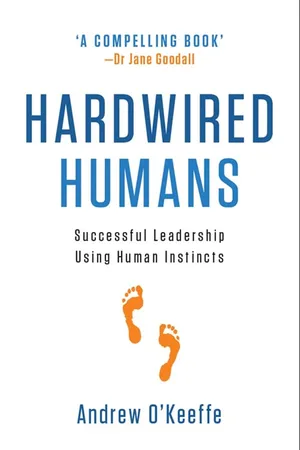
Offices are not our natural habitat. Leadership is easier when we understand the nine instincts that still drive human behaviour. With the Industrial Revolution only 250 years ago, we left our hunting, gathering and village societies to work in offices and factories. The behaviour that ensured our ancestors' survival on the savannah plains of Africa over the millennia is alive and well in today's workplaces. The nine instincts explain the reasons, and the solutions, to the challenges that leaders commonly face. Based on the author's wide experience in large organisations combined with witty true stories of chimps from Gombe, Tanzania and Taronga Zoo, Sydney, Hardwired Humans explains the psychology behind the human instincts of social behaviour. As you read this entertaining book, you will learn how the instincts of clan connections, hierarchy, gossip, politics, snap judgments, status displays and sexual competition continue to drive modern office interactions just as they have driven human interaction for millennia. The book shares a practical framework that helps makes sense of human behaviour and allows leaders to manage more effectively. In a note introducing the book, Dr Jane Goodall calls it a ' compelling book'. The Australian Financial Review Boss magazine highly recommends the book as one ' that will captivate anyone who finds the "people stuff" confounding.'
- 244 pages
- English
- ePUB (mobile friendly)
- Available on iOS & Android
eBook - ePub
About this book
Information
Instinct 1. Social Belonging
This instinct helps explain why:
- people talk about a great team being just like a family
- teams have a natural size
- 80% of people who resign do so because of their manager
- conflict in our team drives us crazy
- silo behaviour emerges as organisations grow beyond a moderate size.
JANE GOODALL WATCHED FLINT die. Dr Goodall first began studying the chimpanzees at Gombe Stream National Park in Tanzania in 1960. One of her early observations was that chimps, like us, have strong bonds between family members and those bonds endure for life. Flint’s reaction to his mother’s death shows how strong this bond can be. His mother Flo died when Flint was eight and a half years old. So traumatised was the youngster with the loss of his mother he died within three weeks.
Some 35 years after Flint’s death Dr Goodall was telling me about Flo and Flint’s deaths. In October 2008 Dr Goodall and I had just concluded a three week tour speaking to business audiences about the implications of instincts for leaders. In vividly recalling Flint’s death, Dr Goodall said that she could describe it as nothing other than grief. upon Flo’s death Flint stopped eating and with his immunisation system so weakened he quickly deteriorated. Back closer to the time she wrote, ‘The last short journey he made, pausing to rest every few feet, was to the very place where Flo’s body had lain. There he stayed for several hours … he struggled on a little further, then curled up—and never moved again.’
The first of our nine instincts is social belonging. We are a social animal; we are not loners. As a social animal, we gain our sense of identify from our membership of two groups: our family group that naturally numbers about seven people, and our extended clan which can number up to around 150.
Let’s make concrete the connection between instincts and organisational life. The building block of human communities is family groups. Given that we have just recently emerged into offices and factories, it follows that the building blocks of organisations are, or should be, small family-sized teams. With our need to connect intimately with a small group of others numbering around seven, it also means that nothing drives us to distraction faster than if our immediate work team is dysfunctional. It means that as organisations grow towards 150, people will begin to say, ‘It’s not as friendly as it used to be.’ And when numbers go significantly beyond 150 we will have stronger bonds to our department or subsidiary than to the whole organisation to the extent that silos and internal competition will tend to occur as departments compete for resources and recognition.
Family
Our strong sense of community and lifetime family bonds comes from our reproductive strategy as a species. There are not many animals on the planet that have this lifetime family bond as their survival strategy.
Our strategy is to invest everything in the raising of a few offspring—we focus our reproductive energy on just a few children. Some animals adopt a strategy at the other extreme. A mother turtle, for example, swims up to the beach during the night, digs a shallow hole and lays her eggs. She covers her eggs with sand, and that’s her mothering duty done! The hatchlings have all the information they need to survive and the species plays the numbers game where enough hatchlings—around one in a thousand—hopefully survive through to adulthood to reproduce.
We humans don’t play the numbers game. Human parents, particularly mothers, invest heavily in raising an infant to reproductive age. After birth, a human baby’s brain takes another year to complete its physical growth and quite a few years before the youngster could hope to survive on their own. The human mother has the capacity to give birth to only a handful of children over her lifespan. With this incredible investment in an offspring, it’s not surprising that the bond between parents and offspring, and between direct family members, are for life.
There is something special about families and our primary sense of identify that comes with being part of a family. In April 1846, the Donner party consisting of 87 men, women and children set off from Illinois en route inland to California on the west coast of the uSA. unfortunately for the group they reached the Sierra Nevada mountains later than expected and became trapped by an October snow storm and camped to face the winter. Come spring, 40 of the party had died due to the atrocious conditions. But curiously, a high proportion of people who survived were members of family units and a high proportion who died were young men travelling alone. Only three of the 15 single men survived and the only woman who died was travelling in a small group of four.
We’re just not loners and family holds a special place. James Bain spent 35 years in a Florida gaol wrongly sentenced for a crime he didn’t commit. When he was freed in December 2009 he was asked on the steps of the court house how he got through so many years in prison. He answered with his engaging smile, ‘By maintaining myself and to get home to my mum.’ When asked what he planned to do now he was out, he said, ‘I’m going home with my family. I’m going to see my mum. That’s the most important thing in my life right now.’
We are not surprised by this human response. It is a key part of what it means to be human and an instinct we share with chimpanzees.
Taronga chimpanzees
Through my work using zoos as a base, I have become friendly with a number of wonderful primate keepers. Louise Grossfeldt is head of primates at Sydney’s Taronga Zoo and her colleague, Allan Schmidt, is a senior member of her team. They generously share their stories of their chimp community to assist leaders gain insight into the natural condition for social animals.
The chimpanzee community at Taronga is one of the best zoo-based communities in the world, mainly due to the size and complexity of the group that reflects the wild condition of chimps. There are 19 individuals in the chimp community at Taronga. The 19 chimps represent six families. There are three adult males, and the multi-male, multi-family nature of chimpanzee communities is a key part of the social complexity, coalitions and politics in the life of a chimp.
In November 2009 the chimps at Taronga were temporarily relocated while their exhibit underwent a major refurbishment. The relocation was as sensitive as an office move, planned with as much thought as we would expect our office move to be managed. Louise and her team planned the move around family groups. The politics amongst the male chimps also featured prominently in the keepers’ planning. Adult males are almost always rivals for the top job, and the relationships between males is observably more intense and more dynamic than between the females.
The first group moved the 200 metres to the temporary exhibit was the alpha male, Lubutu, and his family along with the two oldest females. Lubutu was comfortably established in his new territory when on the third day the second of the adult males arrived.
Chimbuka, this second male, was still unconscious and in the care of the vets when Lubutu spotted him. All hell broke loose. Lubutu went into a wild display, hair hackled so he looked twice his size, screaming and banging on walls and screens. A fully-grown adult chimp with around five times the strength of a human male creates an awesome display. Arrivals of females over the previous two days had not created such a response from Lubutu.
After his health check Chimbuka was left to wake up in the den. When he did wake Chimbuka freaked out. In the wild, male chimps never leave their territory so being moved to a strange location would indeed be instinctively frightening. The keepers opened an access raceway so the females might greet and comfort him.
But the females were reluctant to go to him, presumably frightened by Chimbuka’s frenzied display and presumably torn by the decision confronting them—on the one hand, if they left him alone his mood might deteriorate and he might become more dangerous, yet if they went to him they might be attacked. The group of seven females plus juveniles and infants wavered at the edge of the raceway some ten metres away. They oscillated, teetering on going forward and then shrinking back. Individual chimps, not moving themselves, encourage others to go forward. No one moved. The group was frozen.
From the back of the pack comes Bessie, Chimbuka’s 60-year-old grandmother. She wants to get to her grandson. Bessie is frail, stooped and moves awkwardly. She is blocked by the band of petrified observers. Like Moses, she parts a path and makes her way through the group. Finally, she gets to the front of the pack. She crosses the precipice and reaches her grandson. She pauses just before him as if saying, ‘Come here, Sweetie’ and gives him a big hug. The reassuring effect is instant—Chimbuka quickly calms down. The other females now gather round and reassure him. There are some things only a mother or grandmother can provide.
Family as the organisation building block
Given that we humans moved from villages into offices and factories only 250 years ago (and for many countries outside the Western world, many years fewer than that) we bring the basic construct with us to work—our need to bond intimately with a few people. These people become our ‘as if ‘ family and we want that group to be close-knit and functional. Many of us even describe our teams as being ‘just like family’.
Given the critical role of family for the human condition, it is not surprising that our organisations are, or at least should be, built upon family-sized work groups of around seven people. This was the natural size of family in primitive days—mum and dad, perhaps a grandparent and a few children. The range in this group is five to nine, or seven plus or minus the standard deviation of two.
‘Seven’ is significant for the human brain. The working memory of the brain has, on average, the capacity to handle seven items. After seven, plus or minus two, we tend to make mistakes. Seven digits of a telephone number are quite easy to remember, while eight is challenging for the average human. up to seven is the number of people that work in a syndicate team at a conference—eight is quite dysfunctional due to the increased mathematical combinations. In a study by physicist Peter Kline of Medical university of Vienna analysing the size of a committee that is the most dysfunctional, the number that stood out as the worst was the committee size of eight.
Seven or so people as a group is the size that can best create a sense of intimacy. The Economist magazine asked Facebook to test whether the technology of social networking revealed any trend of people’s intimate contacts. In the research conducted by Dr Cameron Marlow, the ‘in-house sociologist’ at Facebook, The Economist reported:
… What also struck Dr Marlow … was that the number of people on an individual’s friend list with whom he or she frequently interacts is remarkably small and stable. The more ‘active’ or intimate the interaction, the smaller and more stable the group.Thus an average man—one with 120 friends—generally responds to the postings of only seven of those friends by leaving comments on the posting individual’s photos, status messages or ‘wall’. An average woman is slightly more sociable, responding to ten. When it comes to two-way communication such as e-mails or chats, the average man interacts with only four people and the average woman with six …
The analysis concluded that despite the capacity of online social networking sites, humans ‘still have the same small circles of intimates as ever’.
The family paradox
There’s a paradox in this instinct for leaders and team members. On the one hand we have this instinctive need to bond closest with around seven people.
We want our work team to be as if it is family. We know that nothing drives us to distraction faster than if our team is dysfunctional. And in turn, if it is dysfunctional we hold our leader most responsible. This is our natural model.
Yet on the other hand, and here’s the paradox, our work team cannot be our family. Our true family is our immediate family with whom we have our closest genetic bond. Nothing replaces kin, and it is our real family alone that, in the normal condition, endures a lifetime. Our work team cannot fill that role. So when people refer to their team as ‘family’, it’s important not to take that literally. A team leader needs to manage this paradox. People want to work in a functional team where they are secure in their relationships with each other and confident in the support the leader gives them. But there is a line the team leader can’t cross. For example, the team leader shouldn’t talk to people at work with the same candour that they would use with their immediate family. If the leader did, there is a good chance the staff would be aggrieved and resentful—and the leader might be counselled.
Here is an example of the family paradox. Say you are a team leader and you have someone in your team with powerful body odour. Other team members constantly complain to you about the obnoxious smell of their colleague.
If the situation involved direct family members the matter wouldn’t be a problem and would be solved without great thought or sensitivity. A parent or sibling says to the smelly individual, ‘Johnny, you stink. Go take a shower.’ Johnny is unlikely to be seriously offended and the parent/offspring/sibling relationship is at no risk of being damaged. While we want to experience a strong connection with our work team as if we are family, our social boundaries forbid us to talk as directly as this at work, at least without risking offence. The manager in this particular situation must find a more careful and sensitive approach. The stakes are high in the conversation when it occurs.
When I mentioned this scenario to a group of leaders, one of them confessed that this exact situation confronted him some years before and that the way be managed it was not one of his better moments. unable to find a way to pluck up the courage to raise it with the employee, he left a note on the person’s car windscreen that would be seen after work. The individual never appeared back in the office, no doubt embarrassed by the complaint and probably angry with the manager. Few managers would handle this challenge well. That’s how delicate it can be when we are managing non-family.
Awareness of the implications of this paradox assists leaders to be grounded in the reality of what’s possible and what’s not, and as a consequence, to overcome one of the inhibitors to effective leadership.
Dynamics of a newcomer
Managers and zoo keepers have a lot in common. A newcomer to a small group affects the team’s dynamics. We’ve all noticed team members sizing up a newcomer and the new person working out where they fit in. After all, it’s as if someone has joined our family. Even the power of the boss can be affected, for better or worse, by a new arrival. With social animals, like chimps, gorillas and humans, things can get pretty tricky when introducing a new member into the group.
In April 2010 the keepers at Melbourne Zoo began managing the introduction of a gorilla to the zoo’s gorilla community. Damian Lewis is a primate keeper at the zoo and one of the generous keepers who share their experiences with our clients. Several months after the introduction he was sharing the story with a group of leaders—who could readily identify with the dynamics in the family group associated with a new ‘team’ member.
At the time of the introduction the group comprised a silverback male and four females. A fifth female, Mbeli, was transferred from Taronga Zoo. One of the reasons for the transfer was the ‘team’ dynamics of the group. The silverback, Rigo, was not a very dominant leader—not as dominant as you would expect in the normal course of things for gorillas. As a consequence of this lack of power by the silverback, the most dominant female, Yuska, pretty much ran the show. She henpecks Rigo and dominates the females—who support her against Rigo. His lack of ...
Table of contents
- Contents
- A note From Dr Jane Goodall
- Why We Behave the Way We Do
- Instinct 1. Social Belonging
- Instinct 2. Hierarchy and Status
- Instinct 3. Emotions Before reason
- Instinct 4. First Impressions to Classify
- Instinct 5. Loss Aversion
- Instinct 6. Gossip
- Instinct 7. Empathy and Mind Reading
- Instinct 8. Confidence Before Realism
- Instinct 9. Contest and Display
- Organisational Behaviours that Now Make More Sense
- Appendix The 9 Human Instincts Defined
- Acknowledgments
- Notes
- References
Trusted by 375,005 students
Access to over 1.5 million titles for a fair monthly price.
Study more efficiently using our study tools.
Frequently asked questions
Yes, you can cancel anytime from the Subscription tab in your account settings on the Perlego website. Your subscription will stay active until the end of your current billing period. Learn how to cancel your subscription
No, books cannot be downloaded as external files, such as PDFs, for use outside of Perlego. However, you can download books within the Perlego app for offline reading on mobile or tablet. Learn how to download books offline
Perlego offers two plans: Essential and Complete
- Essential is ideal for learners and professionals who enjoy exploring a wide range of subjects. Access the Essential Library with 800,000+ trusted titles and best-sellers across business, personal growth, and the humanities. Includes unlimited reading time and Standard Read Aloud voice.
- Complete: Perfect for advanced learners and researchers needing full, unrestricted access. Unlock 1.5M+ books across hundreds of subjects, including academic and specialized titles. The Complete Plan also includes advanced features like Premium Read Aloud and Research Assistant.
We are an online textbook subscription service, where you can get access to an entire online library for less than the price of a single book per month. With over 1.5 million books across 990+ topics, we’ve got you covered! Learn about our mission
Look out for the read-aloud symbol on your next book to see if you can listen to it. The read-aloud tool reads text aloud for you, highlighting the text as it is being read. You can pause it, speed it up and slow it down. Learn more about Read Aloud
Yes! You can use the Perlego app on both iOS and Android devices to read anytime, anywhere — even offline. Perfect for commutes or when you’re on the go.
Please note we cannot support devices running on iOS 13 and Android 7 or earlier. Learn more about using the app
Please note we cannot support devices running on iOS 13 and Android 7 or earlier. Learn more about using the app
Yes, you can access Hardwired Humans by Andrew O'Keeffe in PDF and/or ePUB format, as well as other popular books in Business & Management. We have over 1.5 million books available in our catalogue for you to explore.