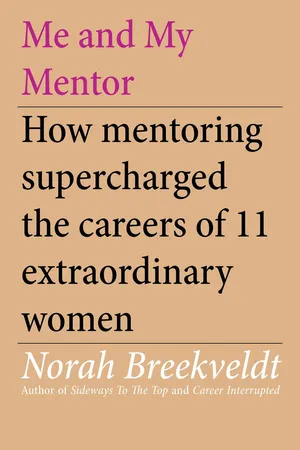
How important is mentoring in accelerating my career success and helping me realise my potential? Why are men more likely to have mentors than women? How do I proactively pursue a mentoring relationship? What is more effective - formal mentoring programs or informal mentoring relationships? Me and My Mentor explores these and other questions mentors and mentees face in their working life. Eleven mentor and mentee couples talk openly about their experiences, the professional and personal friendships that evolved, the challenges they worked through, the career and learning opportunities that opened up for them and the mutual benefits they received from the relationship. Each story provides practical tips and insightful lessons from which men and women can learn and apply to their own mentoring journeys. If you've ever been curious about how mentoring can advance your career, or how you can apply mentoring to achieve true diversity in your workplace, then Me and My Mentor is a must read!
eBook - ePub
Me and My Mentor
How Mentoring Supercharged the Careers of 11 Extraordinary Women
- 240 pages
- English
- ePUB (mobile friendly)
- Available on iOS & Android
eBook - ePub
About this book
Information
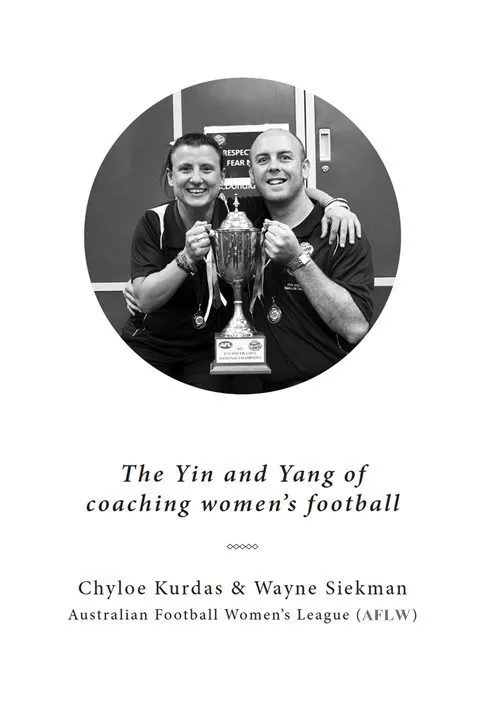
Chyloe Kurdas
Chyloe was the Australian Football League (AFL) Victoria’s female Football Development Manager from 2007 to 2016. She has been the driving force behind the cultural change for the inclusion of women and girls in football in Victoria. Chyloe’s strategic leadership helped to establish a record number of over 300 community-based female teams across Victoria. With the support of a number of hand-picked coaches she also established an under 18s (U18) high performance program for over 450 of Victoria’s most promising female footballers. Chyloe has worked hard to demonstrate that Australian women have sufficient talent to support a vibrant national women’s league. Her drive and commitment have been vital in convincing the AFL to commit to a national competition for women footballers and have revolutionised women’s participation in football. The AFLW has since captivated Australia with sell-out crowds, exceptional TV ratings and captivating games. Chyloe is now an AFLW radio and television commentator and writes for ESPN as their AFLW columnist.
Wayne Siekman
In 2013, Wayne Siekman made a decision that changed his life. With sixteen years of coaching experience, including coaching the Dandenong Stingrays in the TAC (Transport Accident Commission) Cup and coaching the Victorian Metro Youth Girls to national championships, he decided to accept a role on the coaching panel of Collingwood’s inaugural national women’s league. He has never looked back.
Chyloe’s story
Climbing that mountain
I see the emergence of the AFLW as a great example of a community-led, bottom up movement. Women’s football has been influenced and developed over decades by parents who have daughters who played—and by the girls themselves—as well as club coaches and progressive community football clubs.
The AFL came on board with women’s football around ten years ago, appointing people like me in each state who were charged with driving that community growth. I was playing in the Victorian Women’s Football League (VWFL) at the time and took on this role after one too many knee injuries meant I had to shift from being a player to becoming a coach. Three years later, in 2010, the AFL committed to a national championship for women and this decision led me to re-evaluate my role. While I was a reasonable coach, I knew I wasn’t a high-performance coach at that point, and felt I couldn’t give the girls what they needed into the future. So I put myself back in the shoes of the athletes, and asked myself, ‘If I was a player, what sort of coach would I want?’ I set out to identify emerging male coaches who were looking for an opportunity to challenge themselves. I identified a succession of really good men who were coaching in the U18 TAC Cup developing our most promising male players.
I initially worked with people like Andrew Jago, who went on to coach Melbourne University’s women’s team in the VFL, to build the talent development program. We brought in assistants, psychologists and fitness coaches, then Paul Groves (current Western Bulldogs AFLW Head Coach) joined us. Wayne came along in 2013, when Paul was our head coach. Andrew and I created version 2.0 of the talent development program, then Wayne and I modified and improved on it, creating version 3.0.
I was appointed to set up grass roots programs so girls could play football at a local level. But that was as high as they could go in competitive football. I wasn’t satisfied with that. I was more aspirational, and had a vision of creating a high-performance football pathway that would culminate in a national women’s competition—providing girls with the same pathway to pursue their aspirations as boys. The journey felt a bit like climbing one mountain—state football—and then another mountain—the national competition.
We recognised very early on that we had to build talent that would warrant the AFL supporting a women’s league. This is where the coaches came in. We couldn’t have done it without guys like Andrew, Paul and Wayne. They had coached boys in the TAC Cup for many years, and provided the girls with the same level of quality coaching and leadership as the boys. Once the girls started playing well, the AFL stood up and took notice. They recognised that this was something they could package up and sell, and upon which they could build a national competition.
A new coaching model for girls
With my background in psychology and health promotion, I was conscious of providing a program that understands the needs of our female athletes. For instance, if a kid is underperforming or she’s training poorly the first question we ask is: ‘Is she okay?’ as opposed to ‘Gee, she’s been annoying or training poorly tonight’. We know that teenage girls at different points in adolescence can be really self-focused, so they might have to be coached and managed differently as they get older. In twelve months’ time, if we stick with them, they could be completely different.
Developing a relationship with girls is largely around building their confidence, their self-belief, and their self worth. Girls often have a growth mindset, they are open for growth because they are like sponges, always wanting to learn.
Players that have been playing for four or five years know they are good, but the new ones really struggle with building self-belief. Last night, for instance, I was coaching a new team and I said to them ‘Put your hand up if you don’t really think you’re good enough to be here’. Every kid puts her hand up. ‘Why did you get invited?’ I asked. They said, ‘We work hard’. I go ‘Yep.’ ‘Someone sees something in us.’ ‘Yes.’ Then someone eventually said, ‘People think we’ve got a bit of a talent?’ They always externalise their capability, it never comes from within themselves. We teach them self-belief because we believe that internal motivation and self-confidence is the platform from which you should operate. Almost every single AFLW player that has come from our U18 program didn’t think she was good enough to be there when she first joined it.
Boys are different. They would say, ‘I should be here’. They wouldn’t feel comfortable putting their hand up and showing that they weren’t confident.
So it’s really important to appoint the right coach, who understands the differences between coaching boys and girls. They must have a nice balance of masculinity and femininity in how they coach and apply themselves. They’ve got to be process focussed, caring, tender, nurturing, loving and empathic. They’ve got to balance this with knowing when to be outcome and instruction-focused, knowing when it’s right to raise their voice, or be very firm and concrete. They’ve got to know how to bring those two things into the coaching relationship, because female athletes often lack confidence.
Trust and love: the vital ingredients to success in the AFL Women’s League
Having been a female athlete, I know the relationship with the coach is really special. When our coach sees something in us, we hang on to every word they say. We tend to expect women to be nurturing, caring and want to please others. That seeps into the way girls think and act, and the value that they place on relationships. We care about how our coach is feeling, so we don’t want to let them down. It’s in our wiring.
Wayne is a very caring guy, really loving. He feels his emotions, and he’s a lover of people. That’s really apparent in how he coaches the girls, whether they’re U18s or adult women. Love and care are important factors in how we lead female athletes. Wayne’s gifts are really well suited to the needs of the female football community.
Men’s football is quite different. You need to motivate them differently, almost turn around and whack them and go ‘That was a shit effort mate.’ If you said that to a woman, she’d never come back. Although I have observed a shift towards a more loving and caring approach among some of the male coaches, so maybe a more balanced, nurturing way of coaching footballers will eventually seep into the coaching method in men’s football too.
The ideal partnership—kindred spirits
Wayne and I have a great partnership. Although I was his boss, there was no real sense of a hierarchy, quite the opposite. Our relationship was very collaborative, and there was a real teamwork element to it.
I wanted the program to have a philosophy of growth—to be process oriented, packaging things up, ticking all the boxes and recruiting people, not just players, and Wayne had a similar approach. So we were like kindred spirits.
We really complemented each other in terms of technical expertise too. Wayne would speak to the people in the football world that might not have been willing to listen to a female voice. Then, if we needed a female lead, I would speak to those people. I was also able to help Wayne understand the specific needs and motivations of women and girls, as well as teaching him how to manage same-sex attracted athletes. Last year we had to cut a girl from the grand final whose same-sex partner was in the leadership group. These are fifteen and sixteen-year-old girls. As a woman and as a same-sex attracted woman I’ve been able to mentor Wayne and the team about these dynamics,
It was also terrific for Wayne to bring in his knowledge of coaching in the TAC Cup for the last sixteen years. He would challenge my thinking with new ideas and push us to take the program one step further. I loved hearing him say ‘I’ve got this great new idea. Could we do this? Could we find some money for that?’ He taught me to be really open to new ideas.
A united purpose guides everything
We were on a journey together and it was about committing to developing the breadth and capability of our athletes over the long term, rather than focusing on winning the next game. That journey was tested at times, and led to what may have been some disappointing outcomes for Wayne, particularly in the first year. We lost a game where we had a deliberate strategy to play one of our best players across the centre half back role rather than through the middle. If we’d played her in the middle we would have won, but we were committed to developing this girl’s footballing versatility. Now we’ve showcased her in the middle, we’ve showcased her up forward and we’ve showcased her down back. It’s worked because now the league has got this amazing athlete as a result.
It was really important that Wayne didn’t internalise that outcome as a personal failing on his part and that we didn’t put him or the team in that position again. So, in 2015 we dedicated ourselves to implementing strategies to boost the performance of the players. Over the long term, it’s paid off. The grand final this year was the most perfect game of football I’ve ever been involved with. It’s the culmination of three years of working together, refining our relationship and the program we built together.
Having a mentee mentality
When you’re the first in something, it’s more challenging to find a me...
Table of contents
- Preface
- Norah Breekveldt
- Introduction
- Pat McCabe & Michelle Britbart
- Ruby Anandajayasekeram & Keerthi Ravi
- Lynn Corcoran & Delphine Merino
- Adam Fennessy & Kate Houghton
- Jodi Fullarton-Healey & Sophie Wilson
- Chyloe Kurdas & Wayne Siekman
- Cindy Briscoe & Tina Chawner
- Professor Carol Pollock, Associate Professor Usha Panchapakesan & Dr. Sarah Glastras
- Jerril Rechter & Bec Reid
- Anita Curnow & Sophie Atkinson
- Kim Rubenstein & Larissa Halonkin
- Standing on the shoulders of giants
- Conclusions
- Acknowledgements
Trusted by 375,005 students
Access to over 1.5 million titles for a fair monthly price.
Study more efficiently using our study tools.
Frequently asked questions
Yes, you can cancel anytime from the Subscription tab in your account settings on the Perlego website. Your subscription will stay active until the end of your current billing period. Learn how to cancel your subscription
No, books cannot be downloaded as external files, such as PDFs, for use outside of Perlego. However, you can download books within the Perlego app for offline reading on mobile or tablet. Learn how to download books offline
Perlego offers two plans: Essential and Complete
- Essential is ideal for learners and professionals who enjoy exploring a wide range of subjects. Access the Essential Library with 800,000+ trusted titles and best-sellers across business, personal growth, and the humanities. Includes unlimited reading time and Standard Read Aloud voice.
- Complete: Perfect for advanced learners and researchers needing full, unrestricted access. Unlock 1.5M+ books across hundreds of subjects, including academic and specialized titles. The Complete Plan also includes advanced features like Premium Read Aloud and Research Assistant.
We are an online textbook subscription service, where you can get access to an entire online library for less than the price of a single book per month. With over 1.5 million books across 990+ topics, we’ve got you covered! Learn about our mission
Look out for the read-aloud symbol on your next book to see if you can listen to it. The read-aloud tool reads text aloud for you, highlighting the text as it is being read. You can pause it, speed it up and slow it down. Learn more about Read Aloud
Yes! You can use the Perlego app on both iOS and Android devices to read anytime, anywhere — even offline. Perfect for commutes or when you’re on the go.
Please note we cannot support devices running on iOS 13 and Android 7 or earlier. Learn more about using the app
Please note we cannot support devices running on iOS 13 and Android 7 or earlier. Learn more about using the app
Yes, you can access Me and My Mentor by Norah Breekveldt in PDF and/or ePUB format, as well as other popular books in Business & Mentoring & Coaching. We have over 1.5 million books available in our catalogue for you to explore.