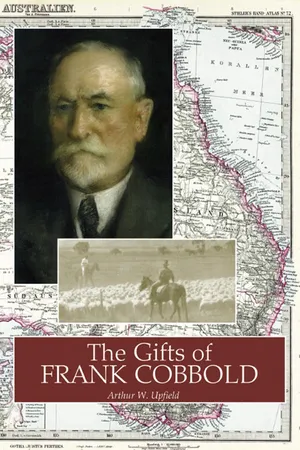
This biography of Frank Cobbold opens when Frank goes to sea on a Clipper aged 14. It follows him through inexperience as a Fijian trader who escaped the cannibals' cook pot and survived one of the worst hurricanes in living memory. In Australia he learned the skills of a surveyor and quickly became a sought-after and trusted station manager. Despite problems that would have defeated a less resolute man he took droughts, cheats and unyielding land tenure regulations in his stride to become one of Australia's great pioneering pastoralists. Admired by fellow bushmen, trusted by his partners and wooed by bankers, his gritty determination earned him a small fortune which he gave away. It's a remarkable story.
- 278 pages
- English
- ePUB (mobile friendly)
- Available on iOS & Android
eBook - ePub
The Gifts of Frank Cobbold
About this book
Trusted by 375,005 students
Access to over 1.5 million titles for a fair monthly price.
Study more efficiently using our study tools.
Information
CHAPTER ONE
1853 to 1867
Early Years
1.
Francis Edward was born in Ipswich, Suffolk to Arthur and Sarah Cobbold. At the same time, the settlers of north-eastern Australia were agitating for separation from the huge southern state of New South Wales. Not only was he the seventh son of his parents, but he was the seventh son of a seventh son. This traditionally accepted sign of good fortune was to be substantiated through a long life of adventure and endeavour on the sea, among the islands of the New Hebrides, and in that part of Australia which Queen Victoria named 'Queensland' in 1859, when Francis Edward Cobbold was six years old.
Australia was to claim the boy from an early age and during this period it was rapidly emerging from being the depository for England's overcrowded jails. The great influx of free settlers was beginning to have its effect on the quasi-military form of government, and the public concern for democratic and responsible government resulted in colonies destined to be among the brightest jewels in the Queen's empire.
This new Eldorado beneath the Southern Cross called for men of grit and stamina, and did not fail to get them. British factories were demanding ever-increasing supplies of wool for their younger colony of Victoria when McArthur established the fact that sheep were ideally suited to be reared in Australia. The eyes of all adventurers in the world had begun to turn towards the south and the people of the British Isles were starting to realise that Australia was not, after all, a mere conglomeration of convict settlements but a land of great promise for those possessing initiative and determination.
It was only natural that one of the Cobbolds of Suffolk should be caught up by the enterprising stream flooding from England across the world to Australia.
2.
The earliest surviving records of the Cobbolds go back to Robert Cobbold of Tostock, a Yeoman farmer who died in 1603. He was followed by a succession of Cobbolds in direct line to Thomas Cobbold, who started a brewing business at Harwich in 1723. At this period, the water supply at Harwich was very unsatisfactory; Thomas Cobbold soon recognised the fact that successful brewing depended upon a pure water supply and arranged for water to be conveyed to Harwich down the river Orwell from Holy Wells Springs, Ipswich in especially constructed barges.
That condition of affairs did not satisfy him for long, however. It was not good business economics to bring the mountain to Mohammed, so he decided to go to the mountain, and the brewery was moved to the same water supply at Ipswich where the first Cliff Brewery was established in 1746. There, Thomas Cobbold extended his enterprises, becoming a farmer, a merchant, and a ship owner, determined to command the transport of merchandise and raw materials necessary to his business.

1. John Cobbold (1771-1860)
His son, young Francis Edward's great-Grandfather John Cobbold, extended his father's activities by a wharf and then building his own ships to be sent out to engage in foreign trade. At least eighteen units of this fleet carried the Cobbold house flag to the distant harbours of India and China. In size, they ranged from the 50 tons spritsail, Cliff, to the 366 tons barque, Dorsetshire, and an old picture shows the John Cobbold, 200 tons, helping a vessel in distress in a great storm in the Atlantic.
Determined to secure water rights for his brewery at Ipswich (named the Cliff Brewery) John Cobbold purchased the Holy Wells Estate in 1780, built a mansion on it and afterwards extended the boundaries of the property. The house was to witness the succession of five John Cobbolds in direct line, the last to live there being John Dupius Cobbold who died in June 1929. The sixth John Cobbold and his son, the seventh John Cobbold, now reside at Glemham Hall, ten miles distant from the old home of the family.

Holy Wells, Ipswich
John Murray Cobbold (1897-1944) was killed when a flying bomb hit the Guards Chapel during Sunday morning service on 18th June 1944 and his son (the seventh) John Cavendish Cobbold (born 1927) died in 1983. Glemham Hall passed to younger brother Patrick Mark Cobbold (1934- 1994) and thence to the present owner Philip Hope-Cobbold.
From the Tostock yeoman farmer sprang a dynasty as proud of its history and of its family as any that ruled an empire. The traditional line of descent was rigidly maintained, the eldest son automatically inheriting the major portion of his father's estate. The records of the family prove that its strength has never diminished, and that the attributes of business flair, foresight, and rigid rectitude have been passed down from one generation to the next.
In course of time, the original brewery was replaced with one fitted out with all the most approved appliances and constructed by the Cobbold staff from the Cliff building yard. The resources of the river were developed and the Cobbold docks, warehouses and maltings spread out over ground which had originally contained riverside gardens and merchants' houses. The Cobbolds grew with the growth of Ipswich, which they assisted to grow. As Punch pertinently put it:
Why is Ipswich like an old shoe?
Because it is Cobbold all over.
3.
On 17th October 1831, Mrs Bowditch Lee wrote to a young lady about to take her place as a governess in John Cobbold's family. She gave vivid little character sketches of every member of the family, and of the master of the house she wrote:
'Mr Cobbold is a fine, handsome man, between 50 and 60, full of native talent and shrewdness, abounding in kindness, liberality and generosity, indulgent to his children, full of honourable and manly feelings, and replete with that excellent quality, common sense'.
Of Mrs Cobbold, Mrs Lee wrote:
'Mrs Cobbold, who must have been beautiful, is a stout little woman, with a countenance beaming benignity … her whole life is spent in doing kind actions to others, or trying to do so … there is not a creature that she ever heard of that she does not wish to make happy. Having reared fourteen children, all of whom are living, you will readily suppose that her energy of character and her bodily activity have been constantly called into action'.
At this time the eldest son, John, was 'High Bailiff and a lawyer in great practice'; the second son, Henry, 'is a complete contrast to Mr John. He tries to hide a great deal of good and fine feeling under a blunt and rough manner …'; a married daughter is 'a charming person, full of talent, taste and kindness'; and Frank is a 'perfect hero in person, and is highly gifted with ability and taste, and he is a good conscientious clergyman ….'
Mrs Bowditch Lee goes on to list and describe in detail other members of the family, thus: 'Mrs David Hanbury, another married daughter, is an elegant-looking, handsome woman ….'; 'Kate is one of the sweetest, the mildest and best human beings ….'; 'Agnes is beautiful and extraordinarily gifted in every respect ….'; 'Emily is not so handsome, but quite enough to turn a person's head ….'; 'Harriet is a dear pale, black-eyed, silk-ringletted girl, bounding about like an antelope ….'; and 'Kate is engaged, but obstacles exist at present on the side of the gentleman's family'.
The youngest of the family was Arthur, then aged 15 and at school at Boulogne. He was the seventh son and was to become the father of Francis Edward Cobbold, whose career is to follow.

3. Arthur Thomas Cobbold (1815-1898)
4.
A picture of Francis Cobbold's father Arthur, made during the closing years of his life, shows a strong family likeness to his ancestors - the same strength of mind and the same physical strength, the same determined jaw, and the same facial sternness when in repose - a sternness somewhat belied by the straight nose and the widely placed eyes. Born in 1815, he lived to reach his eighty-third year - longevity being another feature of his forebears.
In due time he married Sarah Elliston who, like her husband, lived to a ripe age and reached her eight-sixth year. They had ten children, the subject of this biography being the eighth child and, as mentioned earlier, the seventh son.

4. Sarah Cobbold, nee Elliston (1814-1899)
The Ellistons were a yeoman family of Suffolk - the earliest recalled being Robert Elliston of Monks Eleigh - and more than one member of this family distinguished himself. One of Sarah Elliston's uncles was a naval lieutenant under Admiral Boscawen when he defeated the French fleet off Gibraltar in 1759; he had reached the rank of Commander when he retired. Another uncle - William Elliston - was a member of St. John's College, Cambridge, receiving his degree in 1754 with the distinction of fourth wrangler and in 1760 he was elected Master of Sidney Sussex College, a post he held until 1807.
Yet another uncle, Robert William Elliston, was a comedian-actor, manager who was at one time the proprietor of Drury Lane Theatre. Of him it was said: 'He had never been excelled and seldom equalled'.
Issue 18 of Phaeon, the Sidney Sussex Newsletter, described William Elliston as 'the Master from 1760 to 1807 who transformed the College into a place of high standing in the University after a hundred years in the shade'

5. The children of Arthur Thomas Cobbold and Sarah Elliston
5.
It can never be fully established that the seventh son of a seventh son is definitely lucky. After all, luck is much less a matter of chance than the result of long planning, and the sense to take a firm hold on an opportunity before it passes by. It is also preferable to be born lucky than to be born rich - this truth may be illustrated by the incident of Francis Edward Cobbold's visit to the engine house of the Old Colchester Brewery at the early age of seven.
The main reason for the visit was the coldness of the east wind and the warmth of the air coming out through the open door. Once they arrived, however, the great attraction was the gleaming engine flywheel turning at high speed. For several moments Francis stood still and silent and partly hypnotised by the revolving metal. Then a strong draught of air blew through a second door, and whisked the ends of the scarf wound about his neck against the lynch pin of the wheel. To the child, time ceased to be. He watched the woollen strands revolving with the wheel shaft, saw how they were twisted round and round like the strands of a rope, and he saw how the rope of his scarf tautened, grew rapidly shorter and then began to drag him towards the wheel. There would have been no subsequent career to record if the engineer in charge had not come in at that moment, sprang to the boy's side and, with superhuman strength, torn the scarf away from the ponderous revolving mass of metal.
In 1860, when Mr Arthur Cobbold and his family were living near the little village of Waldringfield, ten miles from Ipswich, Francis attended a dame's school. From there he went on to an Academy kept by Mr Frost and his sister at Colchester and, at the age of eleven, he joined his brother Fred at Colchester Grammar School, which at that time was run by Doctor Wright, DCD assisted by Doctor Bates (the Classics Master), Mr Harrison (the English Master), Herr Gunst (the German Master), Sergeant Atkins, who instructed the pupils in drill, and Mr Callaghan, the gymnastic instructor.
If the two learned Doctors despaired of Francis Cobbold, their state of mind was not shared by either Callaghan or Atkins. These men were concerned only with young Cobbold's physique, not his mental development. They saw, with the vision of experts, the physical man the child was destined to become, and they delighted - when the Doctors frowned - in moulding the boy's muscles, hardening his body with constant exercises, training it to accept hardship without complaint - precisely as though they knew in advance the demands that life was to make of him.
Though mentally alert, the boy was not quick to learn from books. Like many other boys, learning did not appeal to him because he could not understand - and no-one took the trouble to explain - how application to study can exercise the mind and make it easier to grapple with life's inevitable problems. Loving most branches of field sports - he won the quarter mile race and the gymnastic trophy for boys under fifteen - nonetheless he still managed to assimilate a sound education which was to be of use to him in understanding, appreciating and adapting himself to the tremendous changes he was to witness, and in which he was to play a large part.
Though familiarity with Latin, Ovid and Virgil may not teach a man to bake a loaf of baking powder bread successfully in the hot ashes of a camp fire, it will still assist in building up a comfortable philosophy cheerfully to accept a blackened loaf, in the centre of which the flour and the water still remain a glutinous mass!
The smell of tar, of canvas and of salt water had an inevitable effect on the growing boy. The sea called softly and insistently, and it was to the sea that Francis Cobbold turned in holiday freedom. The holidays were spent among the fishermen on Mersea Island, when golden days were lived on the smacks at sea; or on the river Deben, near Waldringfield, where the family possessed a sailing boat in which cruises were undertaken to Felixstowe and up river to Woodbridge; or on yachting cruises in Mr Cobbold's cutter-rigged boats, the Stag and the Dewdrop which were kept at Harwich.
The house at Waldringfield was situated on the riverbank, and in winter it was often used as a shooting box for wildfowl. Mr Cobbold was a keen sportsman, who inculcated in his sons the intelligent use of firearms, and created in them an intense interest in the wildlife found on and in the vicinity of the river.

Waldringfield on the River Deben from 'The Maybush', October 1995 (a favourite haunt of Giles, the famous British cartoonist)
A powerful telescope set up in a top room was used to mark the arrival and landing on the marshes of flighting wild- fowl, and expeditions were taken in the flat-bottom duck punts in which the boys were trained in the craft of stalking ducks - pushing the punts gently and soundlessly through the narrow water-passages among the tall reeds, or hugging the low bank of a mud flat to gain position within gun range.
Sometimes their father took the boys over the surrounding fields and...
Table of contents
- INTRODUCTION
- CHAPTER ONE
- CHAPTER TWO
- CHAPTER THREE
- CHAPTER FOUR
- CHAPTER FIVE
- CHAPTER SIX
- CHAPTER SEVEN
- CHAPTER EIGHT
- CHAPTER NINE
- CHAPTER TEN
- CHAPTER ELEVEN
- CHAPTER TWELVE
- CHAPTER THIRTEEN
- CHAPTER FOURTEEN
- CHAPTER FIFTEEN
- CHAPTER SIXTEEN
- CHAPTER SEVENTEEN
- CHAPTER EIGHTEEN
- CHAPTER NINETEEN
- CHAPTER TWENTY
- CHAPTER TWENTY-ONE
- CHAPTER TWENTY-TWO
- EPILOGUE
- THE GIFT OF INDEPENDENCE
- ACKNOWLEDGEMENTS and EDITOR’S NOTES
Frequently asked questions
Yes, you can cancel anytime from the Subscription tab in your account settings on the Perlego website. Your subscription will stay active until the end of your current billing period. Learn how to cancel your subscription
No, books cannot be downloaded as external files, such as PDFs, for use outside of Perlego. However, you can download books within the Perlego app for offline reading on mobile or tablet. Learn how to download books offline
Perlego offers two plans: Essential and Complete
- Essential is ideal for learners and professionals who enjoy exploring a wide range of subjects. Access the Essential Library with 800,000+ trusted titles and best-sellers across business, personal growth, and the humanities. Includes unlimited reading time and Standard Read Aloud voice.
- Complete: Perfect for advanced learners and researchers needing full, unrestricted access. Unlock 1.5M+ books across hundreds of subjects, including academic and specialized titles. The Complete Plan also includes advanced features like Premium Read Aloud and Research Assistant.
We are an online textbook subscription service, where you can get access to an entire online library for less than the price of a single book per month. With over 1.5 million books across 990+ topics, we’ve got you covered! Learn about our mission
Look out for the read-aloud symbol on your next book to see if you can listen to it. The read-aloud tool reads text aloud for you, highlighting the text as it is being read. You can pause it, speed it up and slow it down. Learn more about Read Aloud
Yes! You can use the Perlego app on both iOS and Android devices to read anytime, anywhere — even offline. Perfect for commutes or when you’re on the go.
Please note we cannot support devices running on iOS 13 and Android 7 or earlier. Learn more about using the app
Please note we cannot support devices running on iOS 13 and Android 7 or earlier. Learn more about using the app
Yes, you can access The Gifts of Frank Cobbold by Arthur W. Upfield in PDF and/or ePUB format, as well as other popular books in History & Historical Biographies. We have over 1.5 million books available in our catalogue for you to explore.