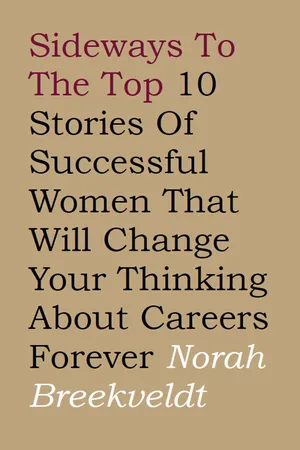
Sideways to the Top is a thought provoking book that explores how 11 women challenged the status quo and took alternative career pathways to the top. The 10 case studies challenge many of the generalisations and stereotypes about how women achieve success, told through the stories of a diverse range of women leaders, including some seen as Australian icons and others with lower profiles who nonetheless have achieved a great deal. The book also features:
- Chapters about the realities and current issues facing women building their careers, linking useful ideas and tools with the realities of those whose stories are told.
- An example of how one multinational corporate is changing the culture and mindset in the business towards accepting diversity as a business imperative.
- A practical checklist and action plan to help women navigate their career.
eBook - ePub
Sideways to the Top
10 Stories of Successful Women That Will Change Your Thinking About Careers Forever
- 292 pages
- English
- ePUB (mobile friendly)
- Available on iOS & Android
eBook - ePub
Sideways to the Top
10 Stories of Successful Women That Will Change Your Thinking About Careers Forever
About this book
Trusted by 375,005 students
Access to over 1.5 million titles for a fair monthly price.
Study more efficiently using our study tools.
Information
Catherine Nance
The Future of Work: A Woman’s Perspective
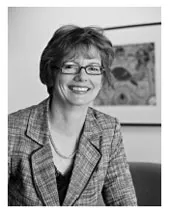
Catherine Nance is a partner and actuary at PricewaterhouseCoopers (PwC), where she heads the National Retirement Incomes and Asset actuarial consulting group. Catherine has over 20 years’ professional experience advising governments, companies and superannuation funds in superannuation, employee benefits, investment consulting, aged care, and finance and investment-related work.
She is currently a Director, and a Chair of the Audit Committee, of the Western Australian Treasury Corporation and a Director of the Government Employees Superannuation Board of WA. She was previously a Director of Community CPS Australia Limited.
Catherine’s charming and approachable manner is what first strikes you when you meet her. Yet, as soon as she speaks, Catherine commands immediate respect and you can understand how she became one of the rare group of senior partners in professional services firms based in Melbourne.
Since 2004, when she was appointed as one of the first generation of women partners at PwC in Perth, Catherine Nance has had considerable experience in assessing the performance of businesses and in developing ways to improve the way they work and to create value.
Our conversation started with her view, from an actuarial perspective, of the future of work for women. It was a rich conversation, interspersed with stories and anecdotes from her own personal journey. This chapter is somewhat more a discussion of her perspectives, supported with some excellent data, than a discussion of her career at an individual level.
Some figures: 21st-century women at work
A comparison of research from the United States and from Australia reveals some interesting facts.
Hanna Rosin, in her book The End of Men,1 claims that the US is, or soon will be, living under a matriarchy. She concludes that ‘the US economy is in some ways becoming a kind of travelling sisterhood’:
- In 2009, American women outnumbered men in the workforce for the first time.
- They now outnumber men on degree courses by a ratio of three-to-two, and are even beginning to ‘crowd out men’ in science and engineering courses.
- More and more families depend on the woman as the main breadwinner (almost 64 percent in Washington, DC).
- Of the 15 most expanding job categories in the US, 12 are now dominated by women.
The Australian economy, by contrast, has not reached these startling statistics. Yet perhaps we are not so far off. For instance:
- As at October 2012, women comprise 35 percent of the workforce.2
- In August 2011, 59 percent of women were in the labour force, and their participation rate is steadily increasing each year. By contrast, 82 percent of men were in the labour force and their participation rate has been declining.3
- Women graduates have outnumbered men on degree courses since the 1980s (a steady 51 percent of women were graduates from 1988 to 1992).4 By 2011, 57 percent of higher education students were women.5
- In 2011, women outnumbered men two-to-one in management and commerce degrees.6
- Eighty percent of purchases or purchasing decisions are made by women.7
- Women live longer than men. A boy born in 2009 to 2011 can expect to live to almost 80 years, while a girl can expect to live just over 84 years.8
Enabling women to succeed in the workplace, however, seems to be a continual challenge. Despite the fact that more women undergraduates are entering the workforce than men:
- Only six percent of line management positions in the ASX 200 are held by women (the pipeline to many CEO roles).
- There are only seven female CEOs in the ASX 200 (up from six in 2010).
- Women still hold only 12 percent of ASX 200 directorships and only 9.7 percent of executive roles.
- Fifty-six percent of ASX 500 companies still do not have a woman on their boards.9
- Australia is ranked 50th in the world for women’s workforce participation relative to men’s.10
These figures have shifted in the last couple of decades, but at a glacial pace. In 1994, women represented only three percent of all board members, one percent of executive directors and four percent of non-executive directors. There has been no increase in the number of women on boards in the previous three years.11
The public sector seems to have fared somewhat better:
- In Australia, at the time of writing, we currently have a woman prime minister, governor-general and speaker in Parliament.
- For over 20 years, we have had women premiers in every state and territory in Australia except South Australia.
- In 2012, women made up 24.7 percent of elected positions in the House of Representatives and 38.2 percent of the senate.12
- At June 2011, women comprised 57.5 percent of all Australian Public Service employees13 and held 35.3 percent of government board appointments, with four government portfolios meeting the gender-balance target.14
Yet despite these figures, Australia remains ranked 41st in the world for women in ministerial positions.15
What’s more, the Global Gender Gap Index shows Australia dropped eight rankings between 2006 and 2011 from 15th to 23rd,16 indicating that Australia is regressing compared to other nations in closing the gender gap.
‘How is our workforce developing, and what will it look like in the foreseeable future?’
The weight of numbers
‘I think ageism will have to vanish through sheer weight of numbers. I think that discrimination towards women will also vanish.’
First, the workforce will continue to age. The 55+ age group is a significant and essential component of the labour market, representing 15 percent of the total workforce in Australia.17 There is also a cohort of workers aged 45–54 that are moving through and will provide the fastest-growing labour market segment in the next decade.18 By the year 2016, it is estimated that in New South Wales alone there will be more people over 65 years of age than people 15 years and under.19
Secondly, the participation of women in the Australian labour force is expected to grow. IBISWorld, an independent market research company, expects the participation of women to grow by 2.7 percent over 2013–14, to reach 5.79 million females, outpacing growth in the male workforce and closing the gender gap.20
A report by Deloitte, prepared on behalf of the Australian Human Rights Commission, uncovered three factors that would impact on workforce participation in Australia in the foreseeable future:
- Higher participation rates among women.
- Increases in the age pension requirement, with the age for women increasing to 65.5 by mid-2017, followed by the age for both women and men rising to 67 by mid-2023. increasing the participation of older workers in the labour market.
- Shifts in traditional attitudes to retirement, as Australians adjust to significant increases in longevity.21
The natural outcome in having an ageing population with women outliving men is that workforce participation rates will continue to increase in the over-55s, with an increasing proportion of the workforce comprising women.
This raises two interesting questions. First, does this trend mean equality in the workforce will be driven purely by the force of numbers? Secondly, what difference will these changes make to the profile of executives holding leadership positions?
While the force of numbers is a factor in promoting equality, our ability to achieve it will be too slow without positive intervention, argues Catherine. Intervention is essential to circumvent a number of stereotypes and biases that, firstly, confound our ability to achieve equality and, secondly, restrict access to powerful leadership positions. ‘Before you get change, usually you have to have a very active period of hustling for change,’ she has observed. In Australia, the issue of imposing quotas on companies is again being debated, as are other strategies such as voluntary targets. This is because relying on the greater participation of women in the workforce (i.e. on demographic pressures alone) hasn’t had much impact in the effort to build equality of opportunity.
Laura Liswood, author of The Loudest Duck, agrees that the numbers game alone does not lead to greater diversity. She argues that you need to shape attitudes at all organisational levels, and foster a fair and equal working environment, and that the way to do this is by eliminating subtle advantages and disadvantages to specific groups.22
Ageism
‘Once we’ve all slipped towards the 50 and over [age bracket], we’re sort of slipping off the radar.’
Catherine believes that business’s view of ageism — that older workers are somehow less productive, less energetic, less competent and have fewer ideas than younger generations — must change. Catherine recounts a story of a workplace that introduced a new program encouraging staff to think laterally, be innovative and develop out-of-the-box solutions. However, this program was only available to young graduates aged in their 20s because it did not occur to management that older employees might want or could contribute to this program. These types of programs perpetuate the myths about older workers lacking ideas or initiative. Yet there is a growing body of research that demolishes these stereotypical biases. For instance:
- Lockheed Martin, an American global aerospace, defence, security and advanced technology company, were able to demonstrate that the costs associated with retaining older workers, including retraining and the redesign of jobs, tools and practices, can be offset through improved performance, lower claims and reduced medical costs. Retaining older workers is also likely to assist in the transmission of highly desirable work traits, such as loyalty and a strong work ethic, from older to younger workers.23 Older employees are also often custodians of a large amount of corporate knowledge and have strong industry networks, both highly valuable to employers and difficult to replicate in younger employees.
- Research conducted in the US in 2010 found that the greatest productivity loss occurs in employees aged in their 30s, whereas productivity loss occurs least in employees aged 60 or older.24
- Other research into Nobel Prize winners and great inventors found that innovators are around six years older today than they were a century ago. This shift, the researchers concluded, is consistent with the life-cycle productivity of great minds (this increases as they get older) and is also consistent with an ageing workforce.25
- Finally, the average founder of a high-tech startup isn’t a whiz-kid graduate, but a mature 40-year-old. Older entrepreneurs have higher success rates when they start companies and the highest rate of entrepreneurship in America has shifted to the 55–64 age group, with people over 55 almost twice as likely to found successful companies than those between 20 and 34.26
These stereotypes are not just perpetuating inequity. There is an increasing body of research that demonstrates they also have real implications for business performance, productivity and the health of the economy. Research shows that:
- Australia, and indeed many countries worldwide, are facing talent shortages, which will only worsen. We will need older people to work because we won’t have enough workers otherwise.
- McKinsey reported that, by 2040, Europe will have a shortfall of 24 million workers aged 15 to 65. This gap can be reduced to three million if the p...
Table of contents
- Contents
- Introduction
- Acknowledgments
- Contemporary Research Findings
- Dr Hannah Piterman, Contemplations on a 30-year Journey
- Dr Kerry Baxter, Against the Odds
- 10 Inspirational Stories of Career Success
- Katie Lahey, Grab that Opportunity
- Ann Sherry, AO, Career Hopscotch
- Women in Partnership: Yin–Yang Balance
- Theresa Gattung, Cracking the Glass Ceiling
- Terri Janke, Driven by a Vision
- Naomi Simson, Rebel with a Cause
- Janine Allis, You’ve Come a Long Way, Baby
- Farah Farouque, You’ve Come a Long Way, Baby
- Jane Fenton, AM, You’ve Come a Long Way, Baby
- Annwyn Godwin, A Public–Private Partnership
- Reflections and Conclusions
- Catherine Nance, The Future of Work: A Woman’s Perspective
- Heather Carmody, The Gloves are Off in the Diversity War
- Paul Waterman, Engaging the Head and the Heart
- Katherine Teh-White, The Secret to Career Happiness
- Kathleen Townsend, What the Headhunters Don’t Tell You
- Hugh Davies, Drawing Some Conclusions about Career Management in the Current Decade
- A Checklist for Successful Career Navigation
- Action Plan
- Footnotes
- Additional Reading
Frequently asked questions
Yes, you can cancel anytime from the Subscription tab in your account settings on the Perlego website. Your subscription will stay active until the end of your current billing period. Learn how to cancel your subscription
No, books cannot be downloaded as external files, such as PDFs, for use outside of Perlego. However, you can download books within the Perlego app for offline reading on mobile or tablet. Learn how to download books offline
Perlego offers two plans: Essential and Complete
- Essential is ideal for learners and professionals who enjoy exploring a wide range of subjects. Access the Essential Library with 800,000+ trusted titles and best-sellers across business, personal growth, and the humanities. Includes unlimited reading time and Standard Read Aloud voice.
- Complete: Perfect for advanced learners and researchers needing full, unrestricted access. Unlock 1.5M+ books across hundreds of subjects, including academic and specialized titles. The Complete Plan also includes advanced features like Premium Read Aloud and Research Assistant.
We are an online textbook subscription service, where you can get access to an entire online library for less than the price of a single book per month. With over 1.5 million books across 990+ topics, we’ve got you covered! Learn about our mission
Look out for the read-aloud symbol on your next book to see if you can listen to it. The read-aloud tool reads text aloud for you, highlighting the text as it is being read. You can pause it, speed it up and slow it down. Learn more about Read Aloud
Yes! You can use the Perlego app on both iOS and Android devices to read anytime, anywhere — even offline. Perfect for commutes or when you’re on the go.
Please note we cannot support devices running on iOS 13 and Android 7 or earlier. Learn more about using the app
Please note we cannot support devices running on iOS 13 and Android 7 or earlier. Learn more about using the app
Yes, you can access Sideways to the Top by Norah Breekveldt in PDF and/or ePUB format, as well as other popular books in Business & Management. We have over 1.5 million books available in our catalogue for you to explore.