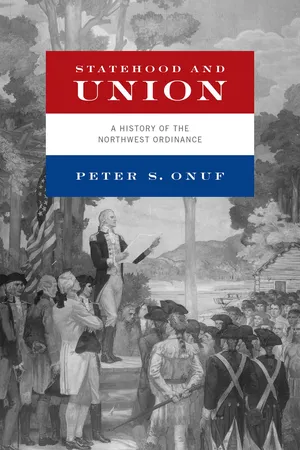
This new edition of Statehood and Union: A History of the Northwest Ordinance, originally published in 1987, is an authoritative account of the origins and early history of American policy for territorial government, land distribution, and the admission of new states in the Old Northwest. In a new preface, Peter S. Onuf reviews important new work on the progress of colonization and territorial expansion in the rising American empire.
- 198 pages
- English
- ePUB (mobile friendly)
- Available on iOS & Android
eBook - ePub
About this book
Information
Publisher
University of Notre Dame PressYear
2019Print ISBN
9780268105464
9780268105457
eBook ISBN
9780268105488
1.
Liberty, Development,
and Union
☆
VISIONS OF THE WEST IN THE 1780S
After the Revolution, American policy makers looked west with mingled expectation and anxiety. They entertained high hopes for the growth of national wealth and power through expansion of settlement and addition of states. At the same time, in darker moments, they feared that the opening of the West would release energies that might subvert social order and destroy the union. Images of anarchy and disorder in postwar America were drawn from, and projected onto, the frontier. Semisavage “banditti,” squatters, and land speculators were seen spreading over the western lands. European imperial powers—British to the north, Spanish to the south and west—supposedly stood ready to exploit frontier disorder and Indian discontent to reverse the outcome of the Revolution.1 The success of the American experiment in republican government thus seemed to depend on establishing law and order on the frontier.
As republican ideologues, Americans found the idea of territorial expansion profoundly unsettling. History demonstrated that republics were vulnerable to decline and decay as citizens turned toward private pursuits. Would vast new opportunities for individual improvement—or for escape from the restraints of the “civilized” East—subvert republican virtue?2 Would Americans be able to preserve the wide distribution of property, the “happy mediocrity” that students of James Harrington considered essential to the broad distribution of power?3 Expansion also raised the familiar issue of size. Montesquieu and other writers warned Americans that republicanism was best suited to small states and that a republic’s effective authority progressively diminished as it expanded.
During the mid-1780s the West presented a challenge both to policy makers and ideologists. Once the states began to relinquish their western claims to the United States, Congress had to organize, distribute, and defend the new national domain. Given the new nation’s straitened circumstances, congressmen were determined to finance the costs of western government through land sales; they also anticipated that land sales eventually would help discharge the burdensome national debt. But the realization of these goals hinged on the market for western lands. Were these lands valuable enough, now or in the forseeable future, to attract sober and industrious purchasers and settlers? The answer depended on Congress’s ability to protect new settlements and on the region’s prospects for economic development. Would farmers be able to get their crops to market? Would merchants and manufacturers be attracted west, thus creating local markets as well as links to the outside world?
This chapter will explore the ideological implications of policy imperatives faced by congressmen as they drafted ordinances organizing western land sales and government. Regardless of their prior political preferences, policy makers were compelled to embrace a vision of an economically developing, commercial frontier. But the endorsement of private enterprise implicit in this program for western development was apparently at odds with long-cherished republican premises. American republicans needed to invent a new vision of their future prospects that would transcend and invalidate the grim predictions of republican theory. Advocates of territorial expansion had to portray the private pursuit of profit—the impulse that would draw purchasers into the western land market—as the source of national wealth and welfare.
Prescriptions for commercial development of the frontier challenged the conventional opposition of self-interest and public interest. Opponents of expansion argued that the centrifugal force of private enterprise pushing outward the frontiers of settlement threatened to weaken the states and subvert republican liberty. In response, promoters of western development boldly asserted that private interest, properly channelled, was the true foundation for liberty and prosperity in an expanding “republican empire.” This assertion suggested a broad reconception of the relation between public and private realms. In effect, promoters of expanding economic opportunity in agriculture, commerce, and manufacturing in the West—and by extension throughout the union—redefined liberty. For them, “a Love of liberty” and “a spirit of enterprize” were complementary, perhaps even identical, impulses in the forming of American character.4
In May 1784 a student orator at the College of Philadelphia captured the sense of opportunity and adventure that helped transform republican premises: “A new country, partly uninhabited, and unexplored, presents the fairest opportunity to the industrious and enterprising, of making most useful and curious discoveries—of serving mankind, and enriching themselves” How, exactly, the “noble, patriotic desire of serving mankind and ourselves” would advance the cause of republicanism was not yet altogether clear.5 But the formulation of a coherent western policy in the years after the Peace of Paris suggested the shape of things to come.
I. Visions of the West
The far-receding hinterland provoked grandiose visions of future greatness. It also presented a set of problems that demanded immediate attention. Congressmen had to formulate effective policies for novel conditions, understanding that a few false steps could transform the dream of western development into a nightmare of lawlessness, frontier warfare, and disunion. The challenge was to regulate the westward thrust of settlement in ways that would strengthen the union, preserve peace with the Indians and neighboring imperial powers, and pay off the public debt while permitting enterprising settlers to pursue their own goals. Congress’s solution, embodied in the western land and government ordinances of 1784–1787, was to attempt to create a legal and political framework conducive to both regional and national economic development. Promoters of western expansion believed that the commercial development of the frontier would increase the population and wealth of the entire union; most important, it would produce a harmony of interlocking interests without which union itself was inconceivable.
Enthusiastic reports about the fertility of America’s inland empire made economic development on an unprecedented scale seem possible, even “natural”; the dangers of disorderly expansion made developmental planning seem imperative. The western lands problem thus forced Americans to think in new ways about their future. They began to make crucial new connections between private enterprise, economic growth, and the national destiny. Such thinking undoubtedly came easily to “commercial republicans” dedicated to the pursuit of profit and imbued with a spirit of free trade.6 But the necessity of wartime sacrifice and public spiritedness inhibited the open advocacy of enterprise. After the war, conflicts among farmers, merchants, and manufacturers over the direction of economic policy reinforced traditional misgivings about the place of private interests in public life. Ironically, it was in opening the way west—precisely where European philosophers saw homo Americanus escaping the baneful reach of commerce and preserving his republican virtue in rustic simplicity—that American expansionists saw an unprecedented opportunity for a higher synthesis of agriculture, commerce, and manufactures.7 For them, the development of the frontier would be a movement forward in the history of civilization, not a refuge from it. In the West, interests so often in conflict in long-settled parts of the country would be harmonious and interdependent: farmers needed merchants to find markets; by processing local products and supplying farmers’ basic needs, manufacturers would help the new settlements avoid unequal terms of trade with the outside world. Even Jefferson, with his well-known partiality for agrarian localism, promoted the development of commercial agriculture on the frontier.8 Only by rapidly developing the frontier economy and integrating it into the national economy could the West be preserved for the union, and the union itself be preserved.
In many ways, the debate over how to begin disposing of the national domain, culminating in the land ordinance of May 20, 1785, anticipated the reconception of the American union later embodied in the federal Constitution.9 American policy makers faced a “critical period” in the West: frontier lawlessness threatened Congress’s tenuous hold over the domain recently created by state land cessions. The federal lands were potentially an “amazing resource” for paying off Revolutionary War debts: on the day the land ordinance passed, Richard Henry Lee exulted, “these republics may soon be discharged from that state of oppression and distress” caused by indebtedness.10 But if settlers refused to pay Congress for their lands and looked beyond the United States for markets for their produce, disunion would inevitably follow. Westerners would then “become a distinct people from us,” George Washington predicted. “Instead of adding strength to the Union,” they would become “a formidable and dangerous neighbour,” especially if they turned to Britain or Spain for protection.11 In effect, by fracturing the continent, the loss of the West would recreate European conditions in America. The weakness of the new nation in conventional military terms would then be telling. This disintegration was precisely what Americans—“the hope of the world”—had to avoid, according to Turgot, the French economist and statesman. America must never become “an image of our Europe, a mass of divided powers contending for territory and commerce.”12
Not only did the United States stand to forfeit tremendous economic resources and a vast area for growth by failing to maintain federal authority in the West, but it would also become increasingly vulnerable to disunion and counterrevolution. Most commentators agreed that the alternative to expansion was disintegration; even the most superficial knowledge of western conditions confirmed that such fears were well grounded. This mix of hope and fear was characteristic: the West was thus a mirror for Americans in the critical years after the Revolution.
II. Economic Development
Western policy makers promoted the commercialization of the frontier in order to gain much-needed revenue from the sale of federal lands. A policy that maximized land values by controlling the available supply and clustering new locations near existing settlements and transportation routes would also make the frontier easier and less costly to defend. From both financial and strategic perspectives western development was an immediate, practical imperative. But for more enthusiastic commentators, economic development served loftier goals. For them the new nation’s future prosperity and power depended on the commercial conquest of western nature. In late 1785, a New Yorker blasted the “pusillanimity and irresolution” of state and national economic policies that caused Americans to “totter about like infants.” Yet “bountiful Nature” might still preserve Americans against their folly, yielding “spontaneously every natural resource we can ask of or even think of.”13 “Without doubt,” “Observator” explained, it “was the original design of nature and providence” that Americans should “have recourse to the luxuriancy of our soil, and the industry of our hands.”14 “The grand object of America,” the English writer “Candidus” advised, should be “to improve these immeasurable tracts of land” in the “bosom” of the continent.15 “Observator” agreed; economic development alone “would render us truly independent.”
The key issue for political economists who contemplated the productive potential of the West was whether or not Congress would implement policies that would guarantee development. As Enos Hitchcock posed the question to a convocation of the Society of the Cincinnati at Providence, Rhode Island, on July 4, 1786, would the United States
rise superior to all her enemies, and extend her hospitable arms for the reception of the oppressed every where? How would the inexhaustible sources of agriculture be continually pouring into her lap, wealth and opulence; opening every avenue to commerce, and extending it from pole to pole? How would the rapidity of her population cover the vast tracts of uncultivated lands, now the rendezvous of wild beasts, with virtuous and useful inhabitants?16
For Hitchcock and other proponents of constitutional reform, one obvious answer to these questions was the institution of a stronger federal union.17 Certainly the generally perceived weakness of Congress jeopardized its effectiveness in enforcing its land policy, as in all else. But wealth would not pour forth from the western cornucopia by simple fiat, even one issued by a powerful central government. Instead, the vast project of western development depended on the mobilization of private initiatives. The ultimate strength—and even survival—of the union would be based on the resulting growth of national population and wealth.
Congressional land policy, it appeared, would determine not only the pace of settlement but also the ultimate size of the western population. Proponents of western development suggested that overly rapid, unorganized settlement in advance of, and at the expense of, the development of markets and transportation facilities would retard long-term population growth. Just as disorganized settlement jeopardized revenues from land sales, it also endangered the region’s—and the nation’s—long-term prospects for economic growth: the promise of the West could easily be forfeited.
The vision of western abundance, as well as more practical policy considerations, led to a significant divergence over the character of continental expansion between Americans and sympathetic European commentators. Looking at the New World from afar, European writers hoped that Americans would sustain a pastoral balance between nature and civilization as they pushed out across the West, thus avoiding the excesses of commercial civilization. They had a “whole world to people,” wrote Mirabeau: “From the sea, quite beyond the mountains, stretches out an immense territory, which must be covered with cottages, with peasants, and with implements of husbandry.”18 This would be a world without commerce, a utopia for independent farmers. English radical Richard Price also predicted that Americans would “spread over a great continent and make a world within themselves.” Both writers were captivated by the image of America as an agrarian paradise peopled by an “independent and hardy yeomanry, all nearly on a level.”19 Neither made the connections between agriculture, trade, and manufactures that American policy makers believed essential to western development.
American policy makers were impressed—and frightened—by the volatility of the frontier. They were convinced that the federal government’s authority and property interests depended on effectively directing the course of western political and economic development. As a result, congressmen were less interested in creating the material conditions for Price’s “hardy yeomanry” than in sustaining links with—and control over—a rapidly dispersing frontier population. Under frontier conditions, the rustic simplicity and personal independence celebrated by foreign commentators posed a problem. In the new country, beyond the discipline both of established local institutions and of the marketplace, the lines between liberty and license and between private enterprise and rampant privatism inevitably blurred. Congressmen were skeptical about the possibility of republican self-government on the frontiers. They concluded that Congress would have to take an active role in regulating westward settlement and securing the union of East and West.
Students of early territorial history have generally held that this fear of anarchy prompted a reactionary insistence on social order by a new class of unelected, autocratic territorial officials.20 Certainly, the need for a more effective “c...
Table of contents
- Half Title
- Title
- Copyright
- Dedication
- CONTENTS
- MAPS
- ACKNOWLEDGMENTS
- PREFACE TO THE 2019 EDITION
- INTRODUCTION
- 1. Liberty, Development, and Union: Visions of the West in the 1780s
- 2. Squatters, Speculators, and Settlers: The Land Ordinance of 1785
- 3. New States in the Expanding Union: The Territorial Government Ordinances
- 4. From Territory to State
- 5. Boundary Controversies
- 6. Slavery and Freedom
- 7. From Constitution to Higher Law
- NOTES
- INDEX
Trusted by 375,005 students
Access to over 1.5 million titles for a fair monthly price.
Study more efficiently using our study tools.
Frequently asked questions
Yes, you can cancel anytime from the Subscription tab in your account settings on the Perlego website. Your subscription will stay active until the end of your current billing period. Learn how to cancel your subscription
No, books cannot be downloaded as external files, such as PDFs, for use outside of Perlego. However, you can download books within the Perlego app for offline reading on mobile or tablet. Learn how to download books offline
Perlego offers two plans: Essential and Complete
- Essential is ideal for learners and professionals who enjoy exploring a wide range of subjects. Access the Essential Library with 800,000+ trusted titles and best-sellers across business, personal growth, and the humanities. Includes unlimited reading time and Standard Read Aloud voice.
- Complete: Perfect for advanced learners and researchers needing full, unrestricted access. Unlock 1.5M+ books across hundreds of subjects, including academic and specialized titles. The Complete Plan also includes advanced features like Premium Read Aloud and Research Assistant.
We are an online textbook subscription service, where you can get access to an entire online library for less than the price of a single book per month. With over 1.5 million books across 990+ topics, we’ve got you covered! Learn about our mission
Look out for the read-aloud symbol on your next book to see if you can listen to it. The read-aloud tool reads text aloud for you, highlighting the text as it is being read. You can pause it, speed it up and slow it down. Learn more about Read Aloud
Yes! You can use the Perlego app on both iOS and Android devices to read anytime, anywhere — even offline. Perfect for commutes or when you’re on the go.
Please note we cannot support devices running on iOS 13 and Android 7 or earlier. Learn more about using the app
Please note we cannot support devices running on iOS 13 and Android 7 or earlier. Learn more about using the app
Yes, you can access Statehood and Union by Peter S. Onuf in PDF and/or ePUB format, as well as other popular books in History & Early American History. We have over 1.5 million books available in our catalogue for you to explore.