A radical reexamination of the textual and archaeological evidence about Augustus and the Palatine
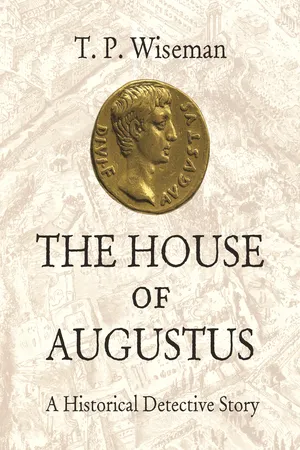
Caesar Augustus (63 BC–AD 14), who is usually thought of as the first Roman emperor, lived on the Palatine Hill, the place from which the word "palace" originates. A startling reassessment of textual and archaeological evidence, The House of Augustus demonstrates that Augustus was never an emperor in any meaningful sense of the word, that he never had a palace, and that the so-called "Casa di Augusto" excavated on the Palatine was a lavish aristocratic house destroyed by the young Caesar in order to build the temple of Apollo. Exploring the Palatine from its first occupation to the present, T. P. Wiseman proposes a reexamination of the "Augustan Age," including much of its literature.
Wiseman shows how the political and ideological background of Augustus' rise to power offers a radically different interpretation of the ancient evidence about the Augustan Palatine. Taking a long historical perspective in order to better understand the topography, Wiseman considers the legendary stories of Rome's origins—in particular Romulus' foundation and inauguration of the city on the summit of the Palatine. He examines the new temple of Apollo and the piazza it overlooked, as well as the portico around it with its library used as a hall for Senate meetings, and he illustrates how Commander Caesar, who became Caesar Augustus, was the champion of the Roman people against an oppressive oligarchy corrupting the Republic.
A decisive intervention in a critical debate among ancient historians and archaeologists, The House of Augustus recalibrates our views of a crucially important period and a revered public space.
- 264 pages
- English
- PDF
- Available on iOS & Android
eBook - PDF
About this book
Information
Table of contents
- Cover
- Title
- Copyright
- Dedication
- CONTENTS
- Abbreviations
- List of Illustrations
- Preface
- 1. Understanding Augustus
- 2. History and Archaeology
- 3. The Palace
- 4. Palatine Prehistory
- 5. Palatine Legends
- 6. The Romulus Paradigm
- 7. Commander Caesar and His Gods
- 8. The Temple and the Portico
- 9. Palatine Poets
- 10. A Miscarriage of Justice
- Notes
- Bibliography
- General Index
- Index of Passages
Trusted by 375,005 students
Access to over 1.5 million titles for a fair monthly price.
Study more efficiently using our study tools.
Frequently asked questions
Yes, you can cancel anytime from the Subscription tab in your account settings on the Perlego website. Your subscription will stay active until the end of your current billing period. Learn how to cancel your subscription
No, books cannot be downloaded as external files, such as PDFs, for use outside of Perlego. However, you can download books within the Perlego app for offline reading on mobile or tablet. Learn how to download books offline
Perlego offers two plans: Essential and Complete
- Essential is ideal for learners and professionals who enjoy exploring a wide range of subjects. Access the Essential Library with 800,000+ trusted titles and best-sellers across business, personal growth, and the humanities. Includes unlimited reading time and Standard Read Aloud voice.
- Complete: Perfect for advanced learners and researchers needing full, unrestricted access. Unlock 1.5M+ books across hundreds of subjects, including academic and specialized titles. The Complete Plan also includes advanced features like Premium Read Aloud and Research Assistant.
We are an online textbook subscription service, where you can get access to an entire online library for less than the price of a single book per month. With over 1.5 million books across 990+ topics, we’ve got you covered! Learn about our mission
Look out for the read-aloud symbol on your next book to see if you can listen to it. The read-aloud tool reads text aloud for you, highlighting the text as it is being read. You can pause it, speed it up and slow it down. Learn more about Read Aloud
Yes! You can use the Perlego app on both iOS and Android devices to read anytime, anywhere — even offline. Perfect for commutes or when you’re on the go.
Please note we cannot support devices running on iOS 13 and Android 7 or earlier. Learn more about using the app
Please note we cannot support devices running on iOS 13 and Android 7 or earlier. Learn more about using the app
Yes, you can access The House of Augustus by T. P. Wiseman,T.P. Wiseman in PDF and/or ePUB format, as well as other popular books in Literature & Roman Ancient History. We have over 1.5 million books available in our catalogue for you to explore.