The rise and successes, the travails, and the eventual demise of the German Democratic Republic told in personal detail by activist and writer Victor Grossman
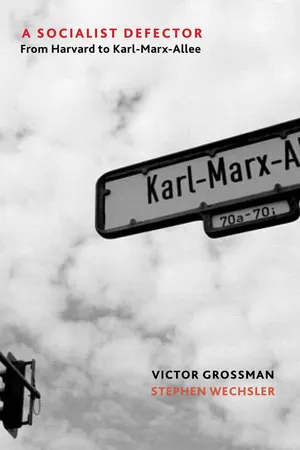
The circumstances that impelled Victor Grossman, a U.S. Army draftee stationed in Europe, to flee a military prison sentence were the icy pressures of the McCarthy Era. Grossman – a.k.a. Steve Wechsler, a committed leftist since his years at Harvard and, briefly, as a factory worker – left his barracks in Bavaria one August day in 1952, and, in a panic, swam across the Danube River from the Austrian U.S. Zone to the Soviet Zone. Fate – i.e., the Soviets – landed him in East Germany, officially the German Democratic Republic. There he remained, observer and participant, husband and father, as he watched the rise and successes, the travails, and the eventual demise of the GDR socialist experiment. A Socialist Defector is the story, told in rare, personal detail, of an activist and writer who grew up in the U.S. free-market economy; spent thirty-eight years in the GDR's nationally owned, centrally administered economy; and continues to survive, given whatever the market can bear in today's united Germany.
Having been a freelance journalist and traveling lecturer – and the only person in the world to hold diplomas from both Harvard and the Karl Marx University – Grossman is able to offer insightful, often ironic, reflections and reminiscences, comparing the good and bad sides of life in all three of the societies he has known. His account focuses especially on the socialism he saw and lived – the GDR's goals and achievements, its repressive measures and stupidities – which, he argues, offers lessons now in our search for solutions to the grave problems facing our world. This is a fascinating and unique historical narrative; political analysis told with jokes, personal anecdotes, and without bombast.
- 336 pages
- English
- ePUB (mobile friendly)
- Available on iOS & Android
eBook - ePub
About this book
Information
1—Wrong Way?
I was ten years old in the summer of 1938 when a jolly, somewhat nutty airplane mechanic named Corrigan, instead of flying back from New York to California in his air jalopy as officially authorized, flew it solo, secretly and illegally, across the Atlantic to Ireland. On his return he got a hilarious confetti welcome—and the term “wrong-way Corrigan” went into the language of the day.
Fourteen years later I did something maybe even nuttier. The water barrier I crossed was far narrower, about 400 or 500 yards across the Danube River. But I didn’t fly, I fled, and not in a plane but swimming. At that time the river divided the U.S. Zone from the USSR Zone in Austria, so I was piercing the Iron Curtain—but also in the wrong direction. I certainly did not expect any confetti welcome. Nor did I get any.
That cold water immersion obviously didn’t kill me. But didn’t it at least cure me? And didn’t it ruin my life, making me a traitor to everything decent in the world, starting with the United States? What in the name of God or the devil made me commit such an amazing blunder? How soon did I begin to regret it? This book will try to answer those questions, while raising many new ones, for me and possibly some readers as well.
My immediate motivation was clear. Drafted into the U.S. Army in 1951 in the icy days later known as the McCarthy era, and in great fear of the new McCarran Act with its threat of unlimited years in prison as a “foreign agent” (or in concentration camps authorized by the same law), I signed the paper required of all Korean War draftees that I had never been a member of the 120 listed organizations, many long gone, all “taboo” and nearly all leftist. I had indeed been in about a dozen, not only the Joint Anti-Fascist Refugee Appeal (for Spanish Civil War victims) and the Southern Negro Youth Congress (out of sympathy and support) but also, as a student opposed to atom bombs, anti-union laws, and racism—and believing in socialism—in the most ostracized of them all, the Communist Party. I was not a card-carrying member only because the Party no longer gave out membership cards.
My hope was that if I kept my nose clean and my mouth shut then the two years of army service might come and go without a check on my past delinquency. At first, I was very lucky, I was sent not to Korea but to Germany. Then luck turned sharply against me: they did check up—and discovered my perjury. Ordered to report to a military judge, I read the threatened punishment for my crime—up to $10,000 and five years in prison. Five years behind bars, in Leavenworth? With no one to consult or advise me I simply panicked. The threat of prison is what made me wade in and swim across the swift but not at all blue Danube.
What has that got to do with this book? Everything. Upon arrival, the Soviet authorities, without consulting my possible preferences, held me briefly in confinement and then released me into a town of East Germany, the still very young German Democratic Republic, or GDR.
Thus, after twenty-four years growing up in New York and New Jersey, after nine schools, public and private (two years each at posh Dalton and Fieldston Schools), a B.A. at Harvard, unskilled factory work in Buffalo, and a long hitchhike trip from one U.S. coast to the other and back, I now became an inside witness to the growth, development, and demise of the GDR and of what has happened since. As a worker again and once more as a student, when I became the one and only person in the world with a diploma from both Harvard and the Karl Marx University of Leipzig (and since the latter has dropped the name, I will undoubtedly retain this distinction) I became finally a freelance journalist and lecturer and got to visit nearly every town and city and many a village. I saw, heard, and took part in almost every phase of GDR life, while my base and main vantage point was my apartment near downtown East Berlin, less than a mile from its famous, or infamous, Wall.
I think I can hear two reactions: one sympathetic: “My God, you poor guy! How in blazes did you survive such a long ordeal in that hellhole?”
Or unsympathetic: “Thirty-eight years locked up in there? Serves you damned right for your treacherous act!”
To the second reaction I would mildly absolve myself by noting that the man who framed the law that frightened me from the start, Senator Pat McCarran of Nevada, turned out to be the rottenest, most vicious anti-Semite in Washington, DC. That paper, which my fear made me sign when I was drafted, thus totally altering my life, was later ruled unconstitutional by the Supreme Court. And I can add that in 1994 the U.S. Army mercifully decided to discharge me, with no punishment at all, after forty-two years. But to both reactions I would reply that life in general, politics in particular, and most specifically the GDR story, are just not that simple.
My first twenty-four years were spent in the world’s leading land of free enterprise. By strange circumstance, in 1952, I landed in a country with a “planned economy,” variously referred to as communist, “real socialist,” “command economy,” or some far saltier appellations. In 1990, after thirty-eight years, this time with no swimming involved, I was again back in a free market system.
Even at my ripe old age, I make no claim to be wiser or more correct than anyone else. But we live in a time when many good people are hunting for answers to severe problems facing our world, often fearlessly exploring a wide range of possible solutions. My life journey taught me lessons and led to conclusions that might be of interest, even value. I offer no ready-to-bake recipes but only some ideas, if only because, more than most Americans, I had an unusual opportunity to make comparisons.
“What? Opportunity? Comparisons?” some voices will retort. “Are you stupid? Or simply stubborn? Need anyone even consider contradictions between good and evil, justice and injustice, freedom and totalitarian dictatorship? Don’t you know the words of that great freedom-fighter Winston Churchill: ‘Democracy is the worst form of government, except for all the others’? Can there really be any doubts about that corpse of a misbegotten regime daring to call itself the German Democratic Republic?”
Was it my ancestral background, my schooling, or my checkered past that imbued me with a firm rule to look at things “on the one hand”—but then, too, “on the other hand”? Life and politics are hardly drawn in one or even two dimensions. This does not always apply, it is true, and not everywhere. But, rightly or wrongly, this habit forced its way into my thinking about the GDR and East Berlin both before and after the “fall of the Wall” in 1989–90. However, before I reflect about capitalism, socialism, communism, freedom, and democracy or any other isms or solutions for the world’s troubles, I want to describe some of what I experienced.
2—Future Dreams in an Ancient Town
After many hours, and finding no sign of the Red Army, I was finally picked up by the Austrian police, barefoot and bedraggled from my fateful Danubian swim, and escorted, as I demanded, to the Soviet Kommandantur (because, very wisely, I did not trust the cops). I was briefly questioned, then driven the next day to Soviet HQ in Baden near Vienna, and politely but unceremoniously locked up in a small, very primitive cell, under armed guard, for a period of two weeks. After some initial skepticism about the long day I had spent hunting for the Soviet armed forces I had expected to find patrolling this stretch of the Iron Curtain, the guards became friendly. I had fascinating discussions on literature and cinema with the armed soldier outside my cell; using my ten, at most twenty Russian words, mostly from names of books. I would say “Anna Karenina?” He would gradually understand me despite my false pronunciation and then say with a big smile: “Da, da, chital, khorosho!”—“Yes, yes. I’ve read it. Good!” Since I had also seen a number of Soviet films, like Gulliver and Lenin in October, these exchanges and evaluations lasted a while, to our mutual satisfaction, and I learned new vocabulary. Most essential was “ubornaya” for “toilet.”
After twice reading the three available books in English, one a history of Scotland, and getting a complete new outfit of clothes and accessories (“And for you a red tie!”), I was driven to an unknown destination, which turned out to be the GDR, and was placed in an isolated room in a building in Potsdam, near Berlin. I had a one-hour daily walk in the garden behind the guarded house and about once a week got a visit from a friendly fellow called “George,” with only a slight Russian accent, who asked me about myself, chatted about politics, showed me match tricks, and asked if I was interested in moving to Western Europe. I definitely wasn’t and that was dropped.
I suggested assuming a new name to protect my family from difficulties, so he told me to choose one. Try as I could, I could think of no new moniker. When a decision became necessary he asked if Victor Grossman was okay. I didn’t like it at all but, having failed in my own search, accepted it, also in the knowledge that unlike, say, Murphy or Johnson, it retained some of my Jewish identity (though it was seen by some as German, until I corrected them).
After two months, and another set of clothes from the Soviets plus one now from the GDR authorities, I landed in Bautzen, a town of 45,000 inhabitants in a corner of East Germany near the Czech and Polish borders. What I found was certainly not the communist-type Utopia I may have been dreaming of. The war, less than eight years earlier, had not spared the town, long a battle-point: a few remaining ruins, cleared lots, and a cemetery of Soviet soldiers attested to that. But I saw no signs of the hunger or rags that press reports might have led me to expect; life seemed to move along fairly normally. The few vehicles were old, sometimes unusual: delivery trucks with two wheels in back but one in front, or cars with wood ovens mounted in back as motors. In 1952 the shops offered basic groceries and textiles and were quite spartan; I recall long hunts for handkerchiefs and a new washrag. For a few weeks razor blades were short, which meant lining up to get old ones resharpened. Toilet paper was unavailable, so newspapers or pulpy magazines (but no Sears and Roebucks catalogues) were torn into neat squares.
It seems that the Soviet authorities had chosen Bautzen to settle deserters from Western armies because it was as far as possible from West Berlin and West German borders but not directly on a crossing point to Poland or Czechoslovakia. Also, it was large enough to provide jobs but not too large to lose track of us in a big city atmosphere. Our numbers changed, since there were new arrivals every month or so but a similar number would abscond westward again. About fifteen to twenty were Americans, about ten were British, and five to ten were French with a similar number from North African French colonies who deserted so as not to be sent to fight in Indochina. There were a few from the Netherlands, a Spaniard, an Irishman, a Mexican, and a Nigerian. Many were not there for political reasons; some had fled because of various conflicts, often connected with drinking, a few because their relationships with German women were prohibited; of these one such was too “Red East German,” a few were African Americans with white women friends. Some of the British had rejected service in Korea. It was a strange bunch. New arrivals were put up in a hotel, then rooms were found or apartments for families. In general, those who found female partners or wives tended to integrate quite well while single GIs, with no trade and almost no German, and no TV as yet, gathered at various dives or the all-night bar at the train station, thus often missing shifts at their usually low-level jobs, or getting into trouble. One interesting exception was a black American, a trained baker and a boxer, who became a favorite athlete until his age caught up with him. Since he worked regularly and neither smoked nor drank, he had a pleasant apartment on the central square of town, and because he was perhaps the first person of color ever seen in this out-of-the-way town, he often attracted and enjoyed a bunch of happy kids, like the Pied Piper. Though he traveled to matches, the rest of us had only one restriction—not to leave the county without permission. It was a very big county, and since we had as yet little reason to travel this hardly worried us.
After a week or so a job was found for me. I received about 250 marks a month in wages, always paid in cash. Rent for my furnished room was 25 marks a month. Like every working person in the GDR I received a hot lunch, which was the main meal of the day in Germany, for one mark or less, and since I had been given enough clothing, shopping problems bothered me less than those of a sanitary nature. Typically for prewar housing, there was no flush toilet but an indoor privy a half-flight down from my room; the pail of water to flush it had to be constantly refilled. So did the pitcher with basin in my room for washing and shaving. Baths were at a bathhouse. And almost every day power was cut off, always unexpectedly; matches and candles had to be kept handy. Like nearly all homes in those days, my room was heated by a big ceramic oven. That required making a fire every day, a technique with newspaper, kindling, and black coal briquettes, which had to be carried up from the cellar after bringing down the ashes from the day before. The coal had to burn thoroughly, for about an hour, before the oven could be safely screwed shut. I soon gave up and lived for one icy winter in a room heated only on Sundays by my merciful but slightly scornful landlady, who also invited me to join the family for Sunday dinners.
Of course, even for a New Yorker whose family seldom had it easy and almost never lived in a comfortable, roomy apartment, one free of roaches and bugs, life was rather primitive. But I rarely complained or even grumbled about it; I had chosen this path myself and could blame no one, except those distant politicians who passed the McCarran Act.
Then too, at twenty-four, I was very much a devoted young communist. I had not chosen the GDR but I was now here. The aim of the government and ruling party, declared four months before my arrival and proclaimed constantly ever since, was to “build socialism.” That was my aim, too, making me willing to endure growing pains, if that’s what they were, and generally take the bad with the good.
Was there really any good?
My start in this workers’ paradise was helping to tote heavy oak and beech planks at a large factory. This required a long, early walk to work—there were no buses yet—and an equally long, far more tired walk back after work. In those early years there was still a half-day’s work on Saturday. I soon learned to balance one end of a plank on one shoulder while the man in front of me carried his end on the other. It was hard work; I hope they eventually modernized it after I left. In our “brigade” of five men, Jakob, the “brigadier,” received the assignments—how many oak or beech planks were needed—and did the required paper work. Jakob, as a member of the German minority, had been forced to leave his Hungarian home at war’s end. Although I could speak German pretty fluently by then, his accent was at first hard for me to understand. He was an easygoing fellow, however, and we got along well from the start.
There were certainly differences from the two factories I had worked in in Buffalo. There we had to bring our own lunch or run to a diner we called the “Greasy Spoon.” In the factory in Bautzen there was both a breakfast room for the mid-morning break, called “second breakfast,” with as much free ersatz coffee as you wanted; the canteen, run by the union, served the not fancy but quite adequate hot lunch, which always included potatoes with meat or fish and vegetables.
Unlike at the Buffalo factory, in the Bautzen factory there was visible propagandizing, with slogans urging socialism and improved labor effectivity, always in white letters on red cloth, but few paid any attention to them (except me, at first). In general, there and in many factories I visited in later years, I found a rather relaxed atmosphere, perhaps in part because, with every hand needed, no one feared losing their job. In fact, whenever the workload permitted, it was possible to visit a doctor, a dentist, a hairdresser, and even a little cooperative grocery, where now and again some goods were on sale that were not easy to find, if at all, in shops outside the factory. That meant that if the factory grocery offered imported lemons or raisins or fresh, early tomatoes, strawberries, or cherries, a considerable line quickly formed. Work could wait! And that explained what had at first puzzled me: why people came to work not with a lunchbox but with a worn but capacious briefcase.
I think everyone was automatically in the union, but I can hardly recall the union meetings—perhaps my language handicap induced me to skip them. I think everyone, or almost everyone, also felt obliged to pay a few pfennigs in dues as a member of the German-Soviet Friendship Society—even me. I had been moved when the victory of Stalingrad over the Nazi Wehrmacht ten years earlier was marked by a special ceremony in the center of town—in Germany!—but now I think that many of my fellow workers saw the occasion largely as a chance to get home a little earlier than usual with no loss of pay.
A memory note: A workmate, pointing to a big furnace, said, “When Friedrich Flick owned this plant during the war that’s where they threw corpses of foreign workers or prisoners of war. Too many hours, too heavy work and too little to eat.”
A very different but also moving note for me: Seeing a train pull into the station, still using an old steam locomotive, and reading, painted on it in big white letters, “Free the Rosenbergs!”—the Jewish couple facing death in Sing-Sing prison.
My factory job lasted only five months. At that time, before my second winter, I had the greatest luck. I found and fell for my Renate. Coming from a village too far to commute daily, she also had a rented room, nicer than mine. And it was, like her, warm and cozy in the evening.
I SOON DISCOVERED customs that were neither good nor bad, just unusual, even comical. Like the constant handshaking at any and every occasion, such as with every single member of my work team each morning, then all over again at quitting time. Or little girls’ curtseys and boys’ forelock-tossing bows of the head when introduced. Also, the “Guten Tag” and “Auf Wiedersehen” greetings on entering and leaving every grocery or bakery, whether or not anyone was listening. Or the reluctance of young fathers to push a baby carriage and, if there were no escaping it, to do so with one sidewise outstretched hand while looking away, as if the child belonged to someone else. Completely taboo for males in those days was carrying a bouquet of flowers, even if concealed under paper. Later, these taboos disappeared.
Then there were the language problems: the (impossible) need to know whether a noun is masculine, feminine, or neuter and treat it accordingly, which Mark Twain happily satirized by noting that a red beet is a “she” but a pretty girl an “it.” One witty Turkis...
Table of contents
- Cover
- Title Page
- Copyright
- Contents
- A Socialist Defector
- Index
Trusted by 375,005 students
Access to over 1.5 million titles for a fair monthly price.
Study more efficiently using our study tools.
Frequently asked questions
Yes, you can cancel anytime from the Subscription tab in your account settings on the Perlego website. Your subscription will stay active until the end of your current billing period. Learn how to cancel your subscription
No, books cannot be downloaded as external files, such as PDFs, for use outside of Perlego. However, you can download books within the Perlego app for offline reading on mobile or tablet. Learn how to download books offline
Perlego offers two plans: Essential and Complete
- Essential is ideal for learners and professionals who enjoy exploring a wide range of subjects. Access the Essential Library with 800,000+ trusted titles and best-sellers across business, personal growth, and the humanities. Includes unlimited reading time and Standard Read Aloud voice.
- Complete: Perfect for advanced learners and researchers needing full, unrestricted access. Unlock 1.5M+ books across hundreds of subjects, including academic and specialized titles. The Complete Plan also includes advanced features like Premium Read Aloud and Research Assistant.
We are an online textbook subscription service, where you can get access to an entire online library for less than the price of a single book per month. With over 1.5 million books across 990+ topics, we’ve got you covered! Learn about our mission
Look out for the read-aloud symbol on your next book to see if you can listen to it. The read-aloud tool reads text aloud for you, highlighting the text as it is being read. You can pause it, speed it up and slow it down. Learn more about Read Aloud
Yes! You can use the Perlego app on both iOS and Android devices to read anytime, anywhere — even offline. Perfect for commutes or when you’re on the go.
Please note we cannot support devices running on iOS 13 and Android 7 or earlier. Learn more about using the app
Please note we cannot support devices running on iOS 13 and Android 7 or earlier. Learn more about using the app
Yes, you can access A Socialist Defector by Victor Grossman in PDF and/or ePUB format, as well as other popular books in Politik & Internationale Beziehungen & Politische Biographien. We have over 1.5 million books available in our catalogue for you to explore.