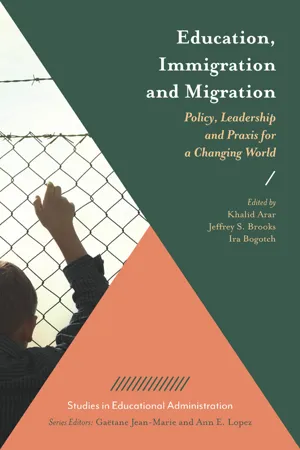
Education, Immigration and Migration identifies issues educational leaders face as they seek to lead schools and school systems experiencing immigration and better understand their current strategies for improvement. The chapters shed light on the poorly understood relationship between educational leadership and refugee populations by giving a deeper appreciation of the scope and nature of issues at local, national and transnational levels. Each chapter offers new ways in which practitioners, policy-makers and scholars can think about complex dilemmas such as the implementation of equitable and democratic values, and difficulties involved in adapting organization and culture. Given its cross-national interdisciplinary approach, this book will prove invaluable for educational leaders, scholars and policymakers alike.
eBook - ePub
Education, Immigration and Migration
Policy, Leadership and Praxis for a Changing World
- 280 pages
- English
- ePUB (mobile friendly)
- Available on iOS & Android
eBook - ePub
Education, Immigration and Migration
Policy, Leadership and Praxis for a Changing World
About this book
Global Migration has changed the practice of educational leaders, policy makers, students, teachers and community members. This book traces this worldwide shift through research-based chapters that touch on both local idiosyncrasies and dynamics common across many contexts.
Information
Topic
EducationSubtopic
Educational PolicyChapter 1
Migrants, Immigrants, Refugees and Other Boxes into Which We Put One Another
Abstract
We are in the midst of a refugee crisis, and the ways in which we approach the issue of unprecedented numbers of people crossing borders will shape our world for generations to come. In this chapter, we problematize immunology, capitalism and other lenses through which we construct, label and categorize others and how such constructions and categorizations manifest in educational spheres for migrants, immigrants, refugees and host country nationals. As with access to education, the resources one has also determine one’s ability to migrate and the conditions of one’s resettlement. Therefore, we discuss the ways in which globalization provides greater mobility for those with substantial wealth and how conditions with/in post-modernism serve to create borders between people, their wealth and the social contexts in which they and their wealth reside. We create boxes as labels into which we slot people all too easily. While we critique the discourses and systems that create the socio-political milieu of education for immigrants, migrants and refugees in the US, we also highlight issues abroad, including how language is weaponized in the framing of immigration and those who emigrate.
Keywords: Refugees, migrants; immigrants; corruption; immunology; education
Once, at the conference dinner at a University Council for Educational Administration (UCEA) meeting, the first author dined with Fenwick English, a scholar in educational administration and leadership. At some time during the dinner, Fenwick told the first author, ‘What I like about you, Duncan, is that you think outside the box.’ Without missing a beat, the first author replied, ‘What box?’
In this chapter, we discuss the many ways we name, construct and conceptualize boxes for one another and for ourselves, be they categories such as immigrant, refugee, migrant, exile, alien and the like. This is a more conceptual analysis of migration and immigration, situated solidly within a social justice framework and informed by, among other theoretical constructs, the concept of immunology. Conceptual frameworks are a part of such an analysis that and the many other ways we think. Not just the conceptual frameworks themselves, but the ways in which we construct them, the processes we use to do so and which we employ in the construction process and afterwards, the structures we produce in the process, all these combine to make these frameworks, these boxes, problematic. One example of such problematics can be found in how we come to think about race and how our beliefs manifest. One might ask, for instance, if race is socially constructed (Ladson-Billings, 1998), how does race matter (e.g. Milner, 2015, 2018)? The same can be asked about other socially constructed categories, such as immigrant, and this is precisely what we shall do here. Ironically, though we think with such frameworks, as we shall show, they are also part of the problem. Whether we speak of mental models (Senge, 1990), heuristics (Kahneman, 2011), metaphors (Lakoff & Johnson, 1980), frames (Goffman, 1959), theories of mind (Cheney & Seyfarth, 2007), levels of consciousness (Kegan, 1994), epistemological beliefs (Schommer, 1994) or some other meta-cognitive conceptual framework, each has its drawbacks, its limitations, its applications and misapplications. Or, as Karl Mannheim (1952/2012), one of the founders of sociology and sociological theory, wrote regarding cultural studies: ‘none can give a full and valid account of its object within the limits of its own conceptual framework’ (p. 36), or any framework, we might add. The labels or categories we use in thinking about and describing other people essentialize them.
Categorizing the Other
Some hold that we humans are wont to categorize, to label or name the phenomena we sense and slot them into categories, bins or boxes (Kahneman, 2011), neglectful of the fact that knowledge is socially constructed (Burke, 2000, 2012) and not ‘objective’ fact. Further, we usually perform mental operations on these phenomena, as, for example, in imputing causality when two phenomena occur together (Kahneman, 2011). These, and other, simple cognitive operations – prone to bias, fallacy and error (Ariely, 2010, 2013; Kahneman, 2011) – are the most harmful when they move from the purely individual level to the social, through discourse, and into policy and law. (Though, this is not to minimize the damage that can be done through prejudice and bias, even hate, at the individual level.)
Throughout history, in instances of inter-tribal or intercultural group contact, people applied a simple ‘us-them’ formula to those of whatever group they encountered (Bremmer, 2018). Politicians and demagogues magnified and weaponized peoples’ fears, offering ‘a compelling vision of division, of “us vs them”’ (p. 2). Some hold that this us–them distinction is human nature:
People everywhere are ‘identity crazed’, as the evolutionary psychologist John Tooby has put it. We can’t help it: We’re wired from birth to tell Us from Them. And we inevitably (and sometimes unconsciously) favor Us—especially when we feel threatened. (Berreby, 2018, p. 52)
And the categories or boxes into which people sort other people, and the divisions, categories and boxes into which they put themselves go beyond the binary us–them to judging what groups around them matter and their place in such groups:
We have a keen mental radar that seeks to learn what groups matter around us and which ones we are members of. And this radar is always on. […] ‘This is how person perception generally works’ [neuroscientist] Van Bavel […] [said]. ‘In the first split second, we judge people on the basis of their group memberships.’ […] Caring about your group memberships […] [is] something you do automatically, like breathing. (Berreby, 2018, p. 53)
Berreby referred to these as ‘tribal minds’ (p. 54). Gladwell (2005) contemplated such initial perceptions of others and noted that ‘it would be interesting to find out what goes on in that moment when someone looks at you and draws all sorts of conclusions’ (para 11).
Interest in the Other has deep historical roots – whether for trading, scholarly, or warring and conquest or defensive purposes. The Greeks were interested in Ethiopians and other (Northern) Africans. The Chinese traded with Italians and others via the Silk Road. Written accounts of these and other encounters were kept. For example, The India House (Lisbon, ca. the fifteenth century) and the House of Trade (Seville, ca. 1503) (Burke, 2000) included vast depositories of sailors’, traders’ and explorers’ logs and ledgers. It was only much later that such bodies of knowledge coalesced into, were formed or captured by, academic disciplines. Two disciplines especially concerned with the Other were anthropology and sociology.
The early eminent sociologist, Georg Simmel (1950), wrote a seminal essay on ‘the stranger’ – ‘the wanderer who comes today and stays tomorrow’ (p. 402). For Simmel, the stranger manifests ‘the unity of nearness and remoteness involved in every human relation’ (p. 402). ‘The stranger’, noted Simmel, ‘like the poor and like sundry “inner enemies”, is an element of the group itself’ (p. 402). The stranger ‘intrudes as a supernumerary […] into the group in which the economic positions are actually occupied’ (p. 403).
The stranger is by nature no “owner of soil” – soil not only in the physical, but also in the figurative sense of a life-substance which is fixed, if not in a point in space, at least in an ideal point of the social environment. (p. 403)
The stranger carries with him/her/them a certain type of objectivity, having no organic connection to the group: ‘it is a particular structure composed of distance and nearness, indifference and involvement’ (p. 403). Strangers are not generally viewed as individuals, ‘but as strangers of a particular type’ (p. 407). And ‘in spite of being inorganically appended to it, the stranger is yet an organic member of the group’, ‘composed of certain measures of nearness and distance’ (p. 408).
Simmel (1950) introduced an important point – one we ought to keep in mind in our discussion of migration and immigration, that of the spatial. Conventionally, the fixed citizen has been a foundation of the state and state sovereignty (Harrington, 2016), especially for purposes of taxation, which mobility undermines. Harrington (2016) commented on how the ‘increased international mobility of wealthy people’, particularly, undermined ‘a system of state authority based primarily on a fixed subject: that is, individuals who consistently inhabit a specific space within a well-defined jurisdiction’ (p. 236, emphasis in original).
The historically unprecedented movement of such large numbers of people has caused it to be framed as a crisis. For instance, the UN estimated that in 2015, there were close to 60,000,000 refugees throughout the world (Sengupta, 2015), fully half of them children. (Note: this 60,000,000 figure means that one in 100 of the entire human race is displaced!) In 2016, the UN estimated that there were as many as 40,300,000 internally displaced persons (or IDPs) (UNHCR, n.d.), only a relatively small number of whom might seek to or be able to immigrate.
There are dynamics at play today other than human mobility and movement that contribute to it being an ‘issue’ or ‘crisis’. This historically unprecedented movement of people today can be framed by some as a crisis or issue because of extant global social conditions, including globalization and what Giddens (1990) referred to as ‘a radicalized modernity’, or which others refer to as post-modernity or the post-modern. One characteristic of the post-modern is the separation of time and space and a further separation of space from place (Giddens, 1990). Another is insecurity, which is especially prevalent in more traditional societies or among more traditionally minded people, which makes relevant our use of immunology (Sloterdijk, 2013) as an analytical tool below. According to Giddens (1990), social systems are disembedded under post-modern conditions. The global and globalized predominance of space – which is, in effect, ‘empty’, absent of particular contextualized factors, especially as concerns social relations – fosters ‘relations between “absent” others, locationally distant from any given situation of face-to-face interaction’ (p. 18). ‘Place becomes increasingly phantasmagoric: which is to say, locales are thoroughly penetrated by and shaped in terms of social influences quite distant from them’ (p. 18, emphasis in original). And, ‘the “visible form” of the locale conceals the distanciated relations which determine its nature’ (p. 19). Like the Industrial Revolution before it, post-modernity has occasioned social upheaval and unrest, contributing to the uprooting and movement (i.e. mobilization) of large numbers of people. People feel a loss of stability and security, and this has been seized upon by right-leaning politicians and nationalists (tribalists) in framing immigrants as a threat.
But mobility itself is not the problem. Several factors affect one’s mobility – whether a refugee, immigrant, traveller or tourist. One’s wealth – capital or financial resources – is a factor. Mobility is experienced differently by those with different financial resources. Wealth itself is ‘hypermobile’ (Harrington, 2016), and moves, or is moved, more easily than people, especially those with fewer financial resources. Harrington (2016) discussed the mobility of wealth and the wealthy, those she referred to as high-wealth individuals (HWIs). She discussed how they secure their wealth, protect it from taxation, trade restrictions, divorce and inheritance, and avoid debt obligations. Using the services of a new class of professional, the wealth manager, together they have created ‘a form of capital that is, like its owners, “transnational” and “hypermobile”’ (p. 12). But HWIs present an analytical moment for us, a deconstructive moment. The procedures or ‘tricks’ they use, if not illegal, are in Harrington’s (2016) words, ‘formally legal but socially illegitimate’ (p. 12).
HWIs, assisted by their wealth managers, undermine the ‘authority of the modern tax state’ (Harrington, 2016, p. 17). However, these individuals, being hypermobile, are courted by numerous governments and states and offered citizenship in what Harrington referred to as ‘the sale of citizenship’ (p. 240). Unlike the migrants, immigrants and refugees we are concerned with here, states offer the HWIs ‘cash-for-passports programs’ (p. 240), allowing them to avoid ‘the lengthy and uncertain bureaucratic process to which the nonwealthy are subject’ (p. 240). Citing Giddens (1990), Harrington noted how the processes employed by HWIs benefited from, while at the same time contributed to, ‘one of the novelties of globalization: “the lifting out” of social relations from local contexts of interaction and their restructuring across indefinite spans of time-space’ (p. 236). ‘This contributed to the creation of an international elite, as hypermobile as their capital’ (p. 236).
The processes and structures employed by these individuals are opaque, not transparent, as they skirt governmental authority of any type in guarding their wealth against taxation and debt obligations, as revealed recently through the disclosure of the Panama Papers and, later, the Paradise Papers. In a sense, they are no less guilty than the less wealthy, but unlike the less wealthy who often must leave behind any and all of their possessions, the HWIs ensure that their wealth is hypermobile. For these and other reasons, they are highly courted by states, especially the poorer states (e.g. Greece), not shunned or turned away, arrested and deported.
Immunology, Literally and Metaphorically
Recently, during a regular doctor’s visit by the first author of this chapter, the nurse responded to a question in conversation as to whether she had immunized her two young children, ages two and six, against influenza. As with many Americans today, the nurse shared scepticism about vaccines generally. (Some believe there to be a link between childhood immunizations and autism, though this has not been proven.) This particular nurse practised more a homoeopathic type of medicine, personally, not professionally. She admitted that she usually does not get shots because that’s ‘like putting poison in your body’. This surprised the first author, coming as it did from a health care professional. So he probed:
Duncan: ‘You don’t vaccinate your ...
Table of contents
- Cover
- Title Page
- Education, Immigration and Migration: Policy, Leadership and Praxis for a Changing World
- Chapter 1 Migrants, Immigrants, Refugees and Other Boxes into Which We Put One Another
- Chapter 2 Leadership and Policy Dilemmas: Syrian Newcomers as Future Citizens of Ontario, Canada
- Chapter 3 Leading K–12 Refugee Integration: A GENTLE Approach from Ontario, Canada
- Chapter 4 Building Welcoming and Inclusive Schools for Immigrant and Refugee Students: Policy, Framework and Promising Praxis
- Chapter 5 Migrant Qualification Recognition as Control: Governmentality, Education and the Movement of People between Borders
- Chapter 6 Leading for Praxis and Refugee Education: Orchestrating Ecologies of Socially Just Practices
- Chapter 7 Syrian Refugee Students’ Lived Experiences at Temporary Education Centres in Turkey
- Chapter 8 Dramatic Experiences of Educators Coping with the Influx of Syrian Refugees in Syrian Schools in Turkey
- Chapter 9 Higher Education for Displaced Syrian Refugees: The Case of Lebanon
- Chapter 10 Refugees in Their Own Land: The Challenge of Managing a School in a Palestinian Refugee Camp in the Divided City of Jerusalem
- Chapter 11 Mediterranean Migration: From Treacherous Seas to Tortuous Roads?
- Chapter 12 Precarious Realities: Undocumented Youth in the Southwest (USA)☆
- Chapter 13 Attention to the Rights of Students Who Are Children of Immigrant Families: The Case of High Complexity Schools in Catalonia, Spain
- Chapter 14 Business as Usual or a State of Emergency? School Leadership During an Unprecedented Increase in Asylum-seekers
- Chapter 15 The Hybrid Status of Muslim Schools in Britain: Conditions of Self-expression
- Index
Trusted by 375,005 students
Access to over 1.5 million titles for a fair monthly price.
Study more efficiently using our study tools.
Frequently asked questions
Yes, you can cancel anytime from the Subscription tab in your account settings on the Perlego website. Your subscription will stay active until the end of your current billing period. Learn how to cancel your subscription
No, books cannot be downloaded as external files, such as PDFs, for use outside of Perlego. However, you can download books within the Perlego app for offline reading on mobile or tablet. Learn how to download books offline
Perlego offers two plans: Essential and Complete
- Essential is ideal for learners and professionals who enjoy exploring a wide range of subjects. Access the Essential Library with 800,000+ trusted titles and best-sellers across business, personal growth, and the humanities. Includes unlimited reading time and Standard Read Aloud voice.
- Complete: Perfect for advanced learners and researchers needing full, unrestricted access. Unlock 1.5M+ books across hundreds of subjects, including academic and specialized titles. The Complete Plan also includes advanced features like Premium Read Aloud and Research Assistant.
We are an online textbook subscription service, where you can get access to an entire online library for less than the price of a single book per month. With over 1.5 million books across 990+ topics, we’ve got you covered! Learn about our mission
Look out for the read-aloud symbol on your next book to see if you can listen to it. The read-aloud tool reads text aloud for you, highlighting the text as it is being read. You can pause it, speed it up and slow it down. Learn more about Read Aloud
Yes! You can use the Perlego app on both iOS and Android devices to read anytime, anywhere — even offline. Perfect for commutes or when you’re on the go.
Please note we cannot support devices running on iOS 13 and Android 7 or earlier. Learn more about using the app
Please note we cannot support devices running on iOS 13 and Android 7 or earlier. Learn more about using the app
Yes, you can access Education, Immigration and Migration by Khalid Arar, Jeffrey S. Brooks, Ira Bogotch, Khalid Arar,Jeffrey S. Brooks,Ira Bogotch,Khalid H. Arar in PDF and/or ePUB format, as well as other popular books in Education & Educational Policy. We have over 1.5 million books available in our catalogue for you to explore.