While the dehumanizing effects of technology, modernity, and industrialization have been widely recognized in D. H. Lawrence's works, no book-length study has been dedicated to this topic.
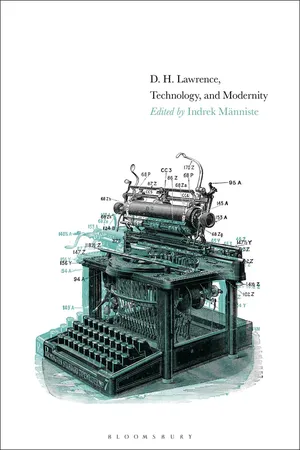
This collection of newly commissioned essays by a cast of international scholars fills a genuine void and investigates Lawrence's peculiar relationship with modern technology and modernity in its many and varied aspects. Addressing themes such as pastoral vs. industrial, mining, war, robots, ecocriticism, technologies of the self, film, poetic devices of technology, entertainment, and many others, these essays help to reevaluate Lawrence's complicated standing within the modernist literary tradition and reveal the true theoretical wealth of a writer whose whole life and work, according to T.S. Eliot, "was an assertion of what the modern world has lost."
- 256 pages
- English
- ePUB (mobile friendly)
- Available on iOS & Android
eBook - ePub
D. H. Lawrence, Technology, and Modernity
About this book
Information
D. H. LAWRENCE AND “THE MACHINE INCARNATE”: ROBOTS AMONG THE “NETTLES”
Tina Ferris
… using all life only as power, as an engine uses steam or gas
power to repeat its own egocentric motions
this is the machine incarnate:
and the robot is the machine incarnate
and the slave is the machine incarnate
and the hopeless inferior, he is the machine incarnate
an engine of flesh, useless unless he is a tool
of other men.
power to repeat its own egocentric motions
this is the machine incarnate:
and the robot is the machine incarnate
and the slave is the machine incarnate
and the hopeless inferior, he is the machine incarnate
an engine of flesh, useless unless he is a tool
of other men.
—D. H. Lawrence, “The Gulf” (Poems, 547)
Karel Čapek’s play R.U.R. (Rossum’s Universal Robots, 1920) premiered in Prague’s National Theater on January 25, 1921 and first introduced the word “Robot” (capitalized) in reference to an artificial humanoid workforce. Rossum derives from the Czech word “rozum” meaning “reason” or “intellect;” and Čapek’s older brother, Josef, suggested “robota” meaning “forced labor,” “servitude,” and “drudgery.” Although Čapek’s robots were manufactured organic life-forms stamped from synthetic protoplasm, these cyborgs were pictured in advertising as metallic to emphasize their unnaturalness. D. H. Lawrence, who was friends with Aldous Huxley (Brave New World, 1932), was familiar with speculative fiction having read Samuel Butler’s Erewhon (1872) and many of H. G. Wells’s works.
Lawrence was among the first generation to make literary use of the word “robot,” and he does so with a passion in a series of poems written in 1929. He mentions robots 47 times, as well as other closely related terms like “automata,” “machine incarnate,” and “mechanical man,” in a tight cluster of about three dozen poems from “The ‘Nettles’ Notebook.” The most famous of these include “The triumph of the machine,” which states that “… no engine can reach into the marshes and depths of a man” (Poems, 538), and “The gods! the gods!” which says of sea-bathers that “… all was dreary, great robot[s]” except for one “woman, shy and alone” (Poems, 561). Robots also appear in early drafts of Lady Chatterley’s Lover (referencing Clifford and the proletariat)1 and a few late essays and letters,2 but not to the same intensity. Why was Lawrence obsessed with robots in his poetry?
Robot obsessions
Čapek’s popular antifascist play was quickly translated into other languages. The American Broadway premier of R.U.R. took place in October of 1922, followed by openings in London, Chicago, and Los Angeles in 1923. Lawrence was in America at that time and possibly became aware of it then. During the seven years between the English translation and Lawrence’s robot poems, the term acquired a wealth of subtext (both past and contemporary). Robots continued to gain popularity throughout the 1920s due to several events that built upon or enhanced Čapek’s play—most notably the anticipated premier of Fritz Lang’s visually impressive silent film, Metropolis; the debut of Britain’s first electric robot named Eric; and the modern art of the Italian Futurist movement. By placing Lawrence’s poems into historical context, we can observe him joining the dialog by experimenting with this new concept. The word “robot” succinctly encapsulated many of his ideas about industrialization, mass production, class division, and the spinning wheels of progress—all damaging to the soul. He thus incorporates the robot, complete with its cultural connotations, into his personal lexicon and adapts it to his own philosophy.
Čapek’s play, coming on the heels of the First World War, gathered international attention almost overnight, with the word “robot” replacing the older term “automaton.” Ivan Klíma comments on what was then a uniquely original theme: “an artificial human being, a brilliant worker, a Robot deprived of all ‘unnecessary’ qualities: feelings, creativity, and the capacity for feeling pain. In R.U.R., Robots gradually take over all the work and duties of people, even their military obligations. Čapek asked what such a revolutionary invention would do to humanity.”3 It was a question he had long dwelled upon. In 1908 the Čapek brothers had co-written a short story called “The System” that contained the essence of the play. The character of Ripraton talks of labor problems and large-scale production in manufacturing: “The world is nothing but raw material … the task of industry is to exploit the entire world … Everything must be speeded up … The worker must become a machine, so that he can simply rotate like a wheel. Every thought is insubordination! … I have sterilized the worker, purified him.”4 Lawrence harbored some of these same concerns of dehumanization in his own stories. Čapek amplified the growing modernist attitude that resulted from viewing everything, including the human body, as a mechanism that could be fine-tuned for specific purposes.
R.U.R.’s cast of characters includes the inventor, Old Mr. Rossum, representing the metaphysical scientist who wishes to make God obsolete; his bio-engineer son, who merely applies science to increase production; Domin, the factory director and true-believer of a “grandiose” plan that offers “salvation, well-being, and good fortune” in the form of cheap, dependable labor; Helena, who is president of the Humanity League and concerned for the robot welfare; and the architect, Alquist, “a hero who defends traditional human values” and acts as the voice of conscience.5 The robots are essentially “living” for the humans, who become stagnant and infertile instead of using leisure to “perfect themselves.”6 Alquist prays, “God, enlighten Domin and all those who err. Destroy their work and help people return to their former worries and labor. Protect the human race from destruction … Rid us of the Robots.”7 Helena burns Rossum’s secret formula, but the robots attack and wipe out humanity. Two of the advanced robots evolve to acquire empathy, however, and become the new Adam and Eve. Alquist’s concluding soliloquy conveys thankfulness that “life will not perish! It will begin anew with love; it will start out naked and tiny; it will take root in the wilderness, and to it all that we did and built will mean nothing.”8 R.U.R.’s timely success helped technocratic themes to proliferate, and thus robots could be found popping up across multiple genres of interwar society.
Seven years after Čapek’s play, the German director Fritz Lang created his robot-vision, called “Maschinenmensch” [mechanical man], in the large-scale, feature-length film Metropolis (1927). The screenplay was adapted from a novel written by his wife, Thea von Harbou, and filmed at Ufa Studios.9 Lang was inspired by the modern Manhattan skyline to develop his own Art Deco city of the future: “I looked into the streets—the glaring lights and the tall buildings—and there I conceived Metropolis.”10 Although Lang liked telling this creation-myth, planning had already commenced; but the buzzing American nightlife undoubtedly made a strong impact. According to Holger Bachmann, “the city of lights had a darker side for Lang, an undercurrent, a threatening second layer—the ‘undercity’ he would depict in Metropolis. In fact, it was the notion of a covered-up, repressed, uglier face of the modern city that fuelled his imagination.”11
Metropolis showcased ground-breaking special effects and was intended to prove that German cinema could compete with Hollywood12—Germany’s über-film. But after a disappointing premiere in Berlin, it was brutally chopped and reedited for international markets without regard for plot continuity, a common distribution practice that attests to the plasticity of film. Again the critics’ appraisals were mixed, with most at least praising the visual spectacle and supreme craftsmanship. H. G. Wells wrote a particularly hostile review in the New York Times Magazine (April 1927). As a future forecast, he called the film “silly” and remarked that it “gives in one eddying concentration almost every possible foolishness, cliché, platitude and muddlement about mechanical progress and progress in general, served up with a sauce of sentimentality that is all its own.”13 Wells added that “Čapek’s Robots have been lifted without apology, and that soulless mechanical monster of Mary Shelley’s, who has fathered so many German inventions, breeds once more in this confusion.”14 Iris Barry, another contempora...
Table of contents
- Cover
- Half-Title Page
- Title Page
- Dedication
- Contents
- List of Illustrations
- Notes on Contributors
- Foreword
- Acknowledgments
- List of Abbreviations
- Chronology
- INTRODUCTION
- D. H. LAWRENCE’S LONG PASSAGE FROM A RURAL TO AN INDUSTRIAL WORLD
- “COLLIERS IS A DISCONTENTED LOT”: “THE MINER AT HOME” IN THE NATION AND THE 1912 NATIONAL COAL STRIKE
- D. H. LAWRENCE AMONG THE EARLY MODERN BOHEMIANS
- D. H. LAWRENCE AND “THE MACHINE INCARNATE”: ROBOTS AMONG THE “NETTLES”
- “MEN NO MORE THAN THE SUBJECTIVE MATERIAL OF THE MACHINE”: LAWRENCE, MACHINERY, AND WAR-TIME PSYCHOLOGY
- TO PRODUCE, OR NOT TO PRODUCE, THAT IS THE QUESTION: TECHNOLOGY, DEMOCRACY, AND WAR IN WOMEN IN LOVE
- HIERARCHY, BEAUTY, AND FREEDOM: D. H. LAWRENCE’S RESPONSE TO TECHNO-INDUSTRIAL MODERNITY
- “THE ART OF LIVING”: D. H. LAWRENCE’S TECHNOLOGIES OF THE SELF
- ENGINEERING AWAY HUMANITY: LAWRENCE ON TECHNOLOGY AND MENTAL CONSCIOUSNESS IN LADY CHATTERLEY’S LOVER AND PANSIES
- LAWRENCE’S ALLOTROPIC “GLADIATORIAL”: RESISTING THE MECHANIZATION OF THE HUMAN IN WOMEN IN LOVE
- GREEN LAWRENCE? CONSCIOUSNESS, ECOLOGY, AND POETRY
- D. H. LAWRENCE AND FILM: RECONSIDERING FIDELITY IN KEN RUSSELL’S WOMEN IN LOVE
- POETICS OF TECHNOLOGY: D. H. LAWRENCE AND THE WELL-TEMPERED COUNTERPOINT
- TRAINS IN D. H. LAWRENCE’S CREATIVE WRITING
- ON ENTERTAINMENT: THE LASSITUDE OF LAWRENCE’S DEAD NOVEL
- Bibliography
- Index
- Copyright
Trusted by 375,005 students
Access to over 1.5 million titles for a fair monthly price.
Study more efficiently using our study tools.
Frequently asked questions
Yes, you can cancel anytime from the Subscription tab in your account settings on the Perlego website. Your subscription will stay active until the end of your current billing period. Learn how to cancel your subscription
No, books cannot be downloaded as external files, such as PDFs, for use outside of Perlego. However, you can download books within the Perlego app for offline reading on mobile or tablet. Learn how to download books offline
Perlego offers two plans: Essential and Complete
- Essential is ideal for learners and professionals who enjoy exploring a wide range of subjects. Access the Essential Library with 800,000+ trusted titles and best-sellers across business, personal growth, and the humanities. Includes unlimited reading time and Standard Read Aloud voice.
- Complete: Perfect for advanced learners and researchers needing full, unrestricted access. Unlock 1.5M+ books across hundreds of subjects, including academic and specialized titles. The Complete Plan also includes advanced features like Premium Read Aloud and Research Assistant.
We are an online textbook subscription service, where you can get access to an entire online library for less than the price of a single book per month. With over 1.5 million books across 990+ topics, we’ve got you covered! Learn about our mission
Look out for the read-aloud symbol on your next book to see if you can listen to it. The read-aloud tool reads text aloud for you, highlighting the text as it is being read. You can pause it, speed it up and slow it down. Learn more about Read Aloud
Yes! You can use the Perlego app on both iOS and Android devices to read anytime, anywhere — even offline. Perfect for commutes or when you’re on the go.
Please note we cannot support devices running on iOS 13 and Android 7 or earlier. Learn more about using the app
Please note we cannot support devices running on iOS 13 and Android 7 or earlier. Learn more about using the app
Yes, you can access D. H. Lawrence, Technology, and Modernity by Indrek Männiste in PDF and/or ePUB format, as well as other popular books in Literature & English Literary Criticism. We have over 1.5 million books available in our catalogue for you to explore.