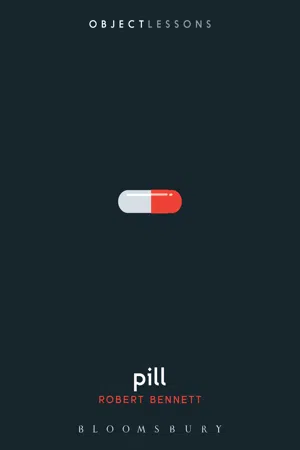
Object Lessons is a series of short, beautifully designed books about the hidden lives of ordinary things.
"You are what you eat." Never is this truer than when we use medications, from beta blockers and aspirin to Viagra and epidurals-and especially psychotropic pills that transform our minds as well as our bodies.
Meditating on how modern medicine increasingly measures out human identity not in T. S. Eliot's proverbial coffee spoons but in 1mg-, 5mg-, or 300mg-doses, Pill traces the uncanny presence of psychiatric pills through science, medicine, autobiography, television, cinema, literature, and popular music. Robert Bennett reveals modern psychopharmacology to be a brave new world in which human identities- thoughts, emotions, personalities, and selves themselves-are increasingly determined by the extraordinary powers of seemingly ordinary pills.
Object Lessons is published in partnership with an essay series in The Atlantic.
eBook - ePub
Pill
About this book
Information
1 THORAZINE (C17H19ClN2S): THE PSYCHOPHARMACOLOGICAL REVOLUTION
Mary Jane Ward’s 1946 semi-autobiographical novel, The Snake Pit—later adapted by Anatole Litvak into a 1948 film of the same name—depicts the deplorable state of mental asylums in the 1940s. Its protagonist, Virginia Cunningham (Olivia de Havilland), is repeatedly frustrated by an understaffed, regimented medical bureaucracy of unresponsive psych nurses and intrusive psychiatrists, including the “sneer[ing]” Nurse Davis (Helen Craig), and she is repeatedly treated with electroconvulsive “shock” therapy (ECT), a common “cure” of the day administered as nonchalantly as if it were an everyday “commodity like the morning milk.” Initially, Virginia describes the hospital as a “zoo” or even a “jail” full of “queer women” who are treated like “criminals,” frequently prohibited from talking because it’s “against the rules,” and routinely forced to “stand in line”: “At first I didn’t notice the cage but then I saw it and I smelled the animals.”
As the novel unfolds, Ward describes a seemingly unending series of petty humiliations that illustrate the then current state of psychiatric treatment: Virginia is poorly fed (when not force-fed through a tube), stingy psych nurses ration her toilet paper sheet by sheet (when the toilet paper is not out altogether), her toilets and dormitory have no doors for privacy, she is forced to do menial chores like mopping or polishing the floor, the hospital dé cor is “ugly” if not “hideous,” she is forced to bathe together with other women, the women all smell badly because their clothes are never washed, and many of the women have sores caused by some mystery disease going around the hospital. Ultimately, Virginia is confined to the “snake pit” where the incurably insane are essentially herded into a padded cell and frequently constrained by physical restraints such as straightjackets:
It was strange. Here I was among all those people, and at the same time I felt as if I were looking at them from some place far away. The whole place seemed to me like a deep hole and the people down in it like strange animals, like snakes, and I’d been thrown into it. Yes, as though, as though I were in a snake pit.Additional insight into the deplorable state of psychiatric treatment in the 1940s will undoubtedly be further presented in Netflix’s forthcoming series, Ratched, which will retell the story of One Flew Over the Cuckoo’s Nest from the perspective of the monstrous Nurse Ratched.
In addition to ECT, 1940s asylum patients were also frequently treated with metrazol—induced convulsions and insulin coma therapy or even lobotomies—à la Patrick McMurphy in Cuckoo’s Nest: all brain-damaging treatments designed to cure mental illnesses by purposely damaging the brain itself. As Robert Whitaker explains, lobotomists, in particular, purposely sought to “continually increase the scope of brain damage. The greater the damage, it appeared, the better the results.” Routinely described as “harmless” at the time, lobotomies were nonetheless specifically designed to “permanently destroy a part of the brain thought to be the center of human intelligence.” In fact, despite its macabre overtones psychosurgery was considered such a significant medical breakthrough that Egas Moniz received the 1949 Nobel Prize in medicine for his pioneering work on lobotomies. Moreover, in an industry shaped in part by eugenicist paradigms, Franz Kallmann deemed asylum patients not “biologically satisfactory,” the American Eugenics Society labeled them “cancers in the body politic,” and a 1927 US Supreme Court case authorized their compulsory medical sterilization. At its most extreme, in the case of Nazi Germany, the mentally ill were even considered part of the final solution itself and sacrificed to gas chambers or lethal injections together with Jewish victims of the Holocaust.
It cannot be underestimated, then, how profoundly Henri-Marie Labroit’s 1950 discovery of chlorpromazine—a neuroleptic best known by its trade name Thorazine—revolutionized the treatment of the mentally ill. As Richard J. Miller explains, this discovery, the “result of an extremely long and convoluted series of events,” began with extensive experimentation with industrial dyes in the textile industry which, in turn, later evolved into the early stages of the pharmaceutical industry as chemists began “testing dyes for any potential therapeutic activities,” including as antihistamines, anesthesia, antiemetics, treatments for burns, and eventually as antipsychotics. For example, Prontosil Red, a red azo dye called sulfamidochrysoidine, was shown to protect mice from streptococcal infection, while methylene blue (a phenothiazine) was proven to have antimalarial properties. When it was later found that methylene blue “selectively stained nerve cells,” psychochemists began to examine whether there might also be “effects of the dye on patients with psychiatric disorders,” a process that would reach its full fruition with Labroit’s successful demonstration that chlorpromazine’s “greatest utility” was in the “treatment of psychotic illnesses,” most notably schizophrenia and manic depression. This discovery helped launch a full-fledged “psychopharmacological revolution” as psychotropic pills, simple chemical compounds, rapidly began to replace more draconian physical treatments such as ECT and lobotomies.
As Allen Frances explains, before the 1950s the “psychotropic drug business was small,” and medications such as opiates and barbiturates were “nonspecific in their effects,” “caused big-time problems with addiction and overdose,” and were largely “useless” in treating actual mental illnesses. With the advent of Thorazine, however, everything changed almost overnight: Pharmacotherapy began to “spread like wildfire” as biochemists and neurologists developed new “chemical theor[ies] of mental illness” and started isolating particular drugs as “act[ing] on specific chemical processes in the brain” (Healy 2002, Valenstein). For the first time it became widely believed that mental illnesses could be cured with simple pills. Time magazine and U.S. News and World Report quickly proclaimed chlorpromazine a new “wonder drug,” while the New York Times declared that it would “revolutionize” the treatment of mental illnesses. Soon, both the popular press and the medical literature began to depict what Robert Whitaker describes as a rosy picture of “hopeless patients suddenly being returned to normal”—all by the power of simple pills.
Ultimately, then, the significance of Thorazine extends far beyond the medication itself: The discovery of Thorazine did not simply create a new medication to treat a specific illness, but more significantly it led to a much wider epochal paradigm shift in our understanding of the relationship between chemicals and the human mind in toto. As David Healy (2002) explains, “With chlorpromazine and reserpine a new science was born”: “For the first time a bridge had been built between behavior and neurochemistry,” and consequently the “possibility abruptly opened up that psychiatry could become scientific.” While today ideas of brain chemistry, chemical imbalances, a “biochemical theory of mental disorders,” and a “growing reliance on drugs to treat all psychological and behavioral problems” are more or less taken for granted, even de rigueur, before the 1950s most neurologists still believed that the interactions in the brain were electrical rather than chemical in nature, and psychoanalytic “talk” therapies which focused on dissecting early family experiences clearly dominated more biochemically oriented approaches to psychiatry and neuroscience (Valenstein). In fact, in sharp contrast to today’s thinking, the very “possibility that a drug could repair a defective brain or undo the effects of life experiences seemed unrealistic and to some, absurd” and “many thought treatment of psychosis was in principle impossible” (Valenstein, Healy 2002). As Scott Stossel notes, as late as “midcentury the notion that psychiatric drugs could be widely and safely prescribed—let alone scientifically measured—was novel.”
Now, however, the situation is reversed: Today “all pathways through the brain seem to end in the use of pharmaceuticals” as “physicians are increasingly being pressured to neglect everything but drugs and chemical explanations in treating patients with mental disorders” (Rose 2007, Stossel). Thorazine, then, marked a profound psychopharmacological turning point in the history of psychiatry, placing simple pills for the first time at the front and center in the treatment of mental illnesses. And, in many ways, Thorazine—together with the psychopharmacological revolution that it helped produce—lived up to, at least some of, the hype. New pills helped empty psychiatric hospitals, initiating a decades-long decrease in the number of institutionalized patients, pills enabled ever-growing numbers of the mentally ill to receive effective treatment outside of institutions, and pills also helped institutionalized patients themselves became markedly more manageable. Ultimately, Thorazine revolutionized the course of psychiatry, initiating a process that to this day continues to transform the discipline of psychiatry ever and ever closer to something that increasingly resembles a mere branch of psychopharmacology. Supplanting psychoanalysis and psychosurgery as the new treatment du jour, pills emerged as psychiatry’s next big thing. With the advent of Thorazine, psychiatric pills now promised a brave, new future for the entire field of psychiatry: “Most commentators on the period are happy to portray the era as a deep dark age, from which the discovery of chlorpromazine emerged to lead us to the sunny uplands of modern psychopharmacotherapy” (Healy 2002).
The story of Thorazine—like the stories of so many other psychotropic medications—however, is no simple psychopharmacological fairytale. Thorazine may have revolutionized the treatment of mental illness, introducing the very possibility of the psychotropic pill itself, but psychiatric medications have offered no simple panacea. Far from presenting some linear metanarrative of inevitable scientific progress, a clear understanding of the brain’s complex neurochemistry, or even an isomorphic one-cure-for-one-disease model of medicine, the psychopharmacological revolution that Thorazine helped launch has proven to be nothing less than a Pandora’s box. It has opened troubling new epistemological and ethical questions, produced constantly shifting and at times even contradictory scientific theories, and offered at best only partial and imperfect remedies, which often cause side effects as troubling as the diseases they purport to cure. In short, Thorazine helped revolutionize a new psychopharmacological paradigm shift that profoundly influenced the course of psychiatric medicine, opening the floodgates to an ever-escalating array of new psychotropic pills, but these pills themselves have proven not only complicated and uncertain but also imperfect and unreliable, contradictory and convoluted. Pills have indeed become the new wave of psychiatry’s future, but like waves themselves the emerging field of psychopharmacology has ultimately proven to be both turbulent and tumultuous.
To begin with, Thorazine has at times proven to be an effective remedy, but it offers no certain guarantees, and studies of its effectiveness perhaps suggest that its net benefits are inconclusive at best. Initially, studies rapidly accumulated demonstrating noticeable, even notable, success rates with Thorazine, at times even declaring it nothing short of miraculous. For example, Heinz Lehman pioneered a series of papers in the 1950s which concluded that chlorpromazine “had a dramatic effect on acute schizophrenia,” while a 1964 study by Philip May demonstrated that “chlorpromazine on its own produced better results than any other treatment” (Breggin, Healy 2002). Meanwhile, a 1961 National Institute for Mental Health analysis found its own encouraging results: 50 percent of patients treated with chlorpromazine and other phenothiazines were deemed cured, 75 percent were considered much or very much improved, and as high as 95 percent showed some improvement.
More recently, however, studies have proven far less sanguine. In fact, Gordon Paul’s 1972 analysis, Maurice Rappaport’s 1978 study, and T. J. Crow’s 1986 report all actually found negative correlations between drug treatment and improved health, suggesting that psychiatric patients may actually perform worse when treated with Thorazine and other neuroleptics. Moreover, an extensive 1980 meta-data analysis performed by Paul Keck and Ross Baldessarini, both advocates of psychiatric medications themselves, concluded that “drug efficacy in the long-term treatment of chronic patients is equally unconfirmed,” with neuroleptics often performing no better than simple sedatives and narcotics or even placebos (Breggin). In the end, the initial euphoria surrounding Thorazine now seems misguided. However significant and effective Thorazine has been, it has fallen far short of being the miracle pill or wonder drug that it was once proclaimed. Much more than a simple drug itself, Thorazine opened the floodgates for widespread psychopharmacological experimentation with pills of all kinds, even though its own ability to “cure” mental illnesses has been neither guaranteed nor unproblematic.
In fact, Thorazine’s promise of restored mental health in a simple pill may actually offer little measurable improvement over previous physical therapies. Like ECT and lobotomies before it, Thorazine and other neuroleptics actually “work” by blocking three prominent dopaminergic pathways in the brain: the nigrostriatal pathway which controls motor movement, the mesolimbic pathway which regulates emotion, and the mesocortical system, which enables communication between the ventral tegmentum and the brain’s frontal lobe. Consequently, neuroleptics simultaneously function as “chemical restraints” by curbing the “ne urotransmitter activity that underlies motor movement,” as “tranquilizers” by dampening emotional responses, and as a kind of “pharmacological lobotomy” by limiting communication between the frontal lobe and the rest of the brain (Whitaker). In many respects, then, Thorazine offers little more than neurosurgery in pill form, and Peter Sterling even argues that a “psychiatrist would be hard-put to distinguish a lobotomized patient from one treated with chlorpromazine” (quoted in Breggin). The method of delivery may have changed to appear seemingly more humane, but Thorazine itself may not offer all that significant of an improvement over the shock treatment and lobotomies it has largely replaced.
In addition, Thorazine has been demonstrated to produce numerous side effects, at times even as debilitating as the diseases it attempts to cure. Even from “very early on, physicians in Europe and the United States realized that chlorpromazine frequently induced Parkinson’s disease symptoms—the shuffling gait, the masklike visage, and even drooling” (Whitaker). In fact, even early studies showed that as many as 37 percent or even two-thirds of patients treated with chlorpromazine developed Parkinson’s-like symptoms. In addition, other patients treated with neuroleptics have shown “signs of basal ganglion dysfunction,” “deficits similar to those caused by encephalitis lethargica,” “apathy, disinterest, and other lobotomylike effects,” “psychic indifference,” and “psychomotor retardation” or the “enforced paralysis of mind and body that routinely results from treatment with neuroleptics” (Whitaker, Breggin). Most importantly, Thorazine has been strongly, almost inextricably, linked to the development of tardive diskenesia, a permanent movement disorder that causes abnormal muscle twitching.
Ultimately, Peter R. Breggin suggests that “rather than treating a disease, the neuroleptics create a disease,” making neuroleptics not miracle pills but rather “highly toxic drugs” that are “among the most dangerous medications ever used in medicine.” Consequently, when the anti-psychiatry movement of the late1960s began to emerge, Thorazine’s effectiveness was boldly challenged: “Where chlorpromazine had been hailed as liberating the mad from their chains sixteen years earlier, it was now seen as the dreaded camisole chimique (or chemical straightjacket) and its self-professed creator was a target for the revolutionaries” (Healy 2002). In fact, Robert Whitaker goes so far as to argue that “all of the traits that we have come to associate with schizophrenia—the awkward gait, the jerking arm movements, the vacant facial expression, the sleepiness, the lack of initiative—are symptoms due, at least in part, to a drug-induced deficiency in dopamine transmission” caused not by the normal course of the disease itself, but instead as the iatrogenic side effects of its pharmacological treatment. Consequently, the emergence of psychopharmacology may not have been a revolution as much as a rabbit hole. Instead of providing clear, definitive answers, psychiatric pills may have only opened up a series of brave, new questions, the most significant of which may be the “potentially unmanageable problem . . . that it becomes impossible once patients have taken antipsychotics for some time to know where the treatment ends and the disease begins” because many of the “neurotic and dysthymic features that are considered negative features of schizophrenia” are actually “treatment-induced phenomena rather than manifestations of the illness” (Healy 2002).
Ultimately, then, Thorazine did help inaugurate a novel psychopharmacological theory of medicine—that mental illnesses can be cured with simple pills—but the complexities and contradictions of Thorazine and its fellow neuroleptics also challenged traditional, simplistic models of medicine itself. For medications, especially psychotropic ones, do not work like Coke machines: You cannot simply plop in a pill and wait for your desired cure to come out with no strings attached. Instead of offering a simple, even simplistic, isomorphic model of medicine as one pill for one disease, Allen Frances contends that mental disorders are “too heterogenous in presentation and in causality to be considered simple diseases”: It is more likely that “our currently defined disorders will eventually turn out to be many different diseases.” Consequently, psychiatric diseases today are most commonly treated with a complex “cocktail” of diverse medications each with its own unique profile and set of complications.
Instead of simplifying the treatment of mental illness, then, psychiatric pills have seemed to only make it all the more confusing. The field of psychiatry has never turned back from its newfound reliance on, even addiction to, psychotropic pills, but creating the right pill has proven both complicated and elusive. In fact, Peter R. Breggin notes that by the early 1990s, the neuroleptics alone had proliferated to include
Haldol (haloperidol), Thorazine (chlorpromazine), Stelazine (trifluoperazine), Vesprin (trifluopromazine), Mellaril (thioridazine), Proloxin or Permitil (fluphenazine), Navane (thiothixene), Trilafon (perphenazine), Tindal (acetophenazine), Taractan (chlorprothixene), Loxitane or Daxolin (loxapine), Moban or Lidone (molindone), Serentil (mesoridazine), Orap (pimozide), Quide (piperacetazine), R...
Table of contents
- Cover
- Half-Title
- Series
- Title
- Contents
- Introduction: Pharmageddon
- 1 Thorazine (C17H19ClN2S): The psychopharmacological revolution
- 2 Valium (C16H13ClN2O): The psychopharmacology of everyday life
- 3 Lithium (Li2CO3): The psychopharmacological thriller
- 4 Prozac (C17H18F3NO): Existential quagmires
- 5 Adderall ((C9H13N)2• H2SO4 + (C9H13N)2• H2SO4 + (C9H13N)2• C6H10O8 + (C9H13N)• C4H7NO4• H2O): Psychopharmacology unbound
- Coda: Waiting for brad pitt
- Acknowledgments
- List of illustrations
- Selected Sources
- Index
- Copyright
Trusted by 375,005 students
Access to over 1.5 million titles for a fair monthly price.
Study more efficiently using our study tools.
Frequently asked questions
Yes, you can cancel anytime from the Subscription tab in your account settings on the Perlego website. Your subscription will stay active until the end of your current billing period. Learn how to cancel your subscription
No, books cannot be downloaded as external files, such as PDFs, for use outside of Perlego. However, you can download books within the Perlego app for offline reading on mobile or tablet. Learn how to download books offline
Perlego offers two plans: Essential and Complete
- Essential is ideal for learners and professionals who enjoy exploring a wide range of subjects. Access the Essential Library with 800,000+ trusted titles and best-sellers across business, personal growth, and the humanities. Includes unlimited reading time and Standard Read Aloud voice.
- Complete: Perfect for advanced learners and researchers needing full, unrestricted access. Unlock 1.5M+ books across hundreds of subjects, including academic and specialized titles. The Complete Plan also includes advanced features like Premium Read Aloud and Research Assistant.
We are an online textbook subscription service, where you can get access to an entire online library for less than the price of a single book per month. With over 1.5 million books across 990+ topics, we’ve got you covered! Learn about our mission
Look out for the read-aloud symbol on your next book to see if you can listen to it. The read-aloud tool reads text aloud for you, highlighting the text as it is being read. You can pause it, speed it up and slow it down. Learn more about Read Aloud
Yes! You can use the Perlego app on both iOS and Android devices to read anytime, anywhere — even offline. Perfect for commutes or when you’re on the go.
Please note we cannot support devices running on iOS 13 and Android 7 or earlier. Learn more about using the app
Please note we cannot support devices running on iOS 13 and Android 7 or earlier. Learn more about using the app
Yes, you can access Pill by Robert Bennett in PDF and/or ePUB format, as well as other popular books in Literature & Literary Criticism Theory. We have over 1.5 million books available in our catalogue for you to explore.