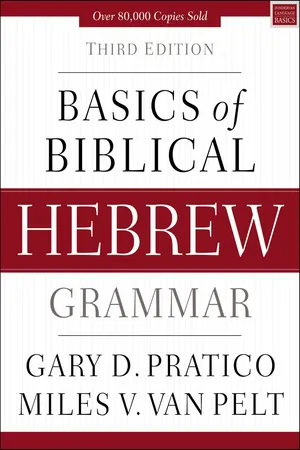
Basics of Biblical Hebrew Grammar
eBook - ePub

Basics of Biblical Hebrew Grammar

Third Edition

,
  1. 480 pages
  2. English
  3. ePUB (mobile friendly)
  4. Available on iOS & Android
eBook - ePub

Basics of Biblical Hebrew Grammar

Third Edition

,

About this book

Clear. Understandable. Carefully organized. Basics of Biblical Hebrew Grammar by Gary D. Pratico and Miles V. Van Pelt is the standard textbook for colleges and seminaries. Since its initial publication in 2001 its integrated approach has helped more than 80, 000 students learn Biblical Hebrew.

The third edition of Basics of Biblical Hebrew Grammar represents a significant updating and revision of the previous edition with the goal of providing students with the best possible tool for learning Biblical Hebrew.

Some of the keys to the effectiveness of Basics of Biblical Hebrew Grammar in helping students learn is that it:

  • Combines the best of inductive and deductive approaches

  • Uses actual examples from the Hebrew Old Testament rather than “made-up” illustrations

  • Emphasizes the structural pattern of the Hebrew language rather than rote memorization, resulting in a simple, enjoyable, and effective learning process

  • Employs colored text that highlights key features of nouns and verbs, allowing easy recognition of new forms

  • Includes appendices of verbal paradigms and diagnostics for fast reference and a complete vocabulary glossary

  • Displays larger font and text size, making reading easier

By the time students have worked their way through Basics of Biblical Hebrew Grammar they will have learned:

  • The Hebrew Alphabet

  • Vocabulary for words occurring 70 times or more in the Hebrew Bible

  • The Hebrew noun system

  • The Hebrew verbal system

A robust suite of learning aids is available for purchase to be used alongside the textbook to help students excel in their studies. These include a workbook; video lectures for each chapter featuring the author; flashcards keyed to vocabulary in each chapter; a laminated study sheet with key concepts; audio of the vocabulary for each chapter to aid in acquisition; and a compact guide to help refresh students refresh their memory on language forms, grammar, and word meanings.

Frequently asked questions

Yes, you can cancel anytime from the Subscription tab in your account settings on the Perlego website. Your subscription will stay active until the end of your current billing period. Learn how to cancel your subscription.
No, books cannot be downloaded as external files, such as PDFs, for use outside of Perlego. However, you can download books within the Perlego app for offline reading on mobile or tablet. Learn more here.
Perlego offers two plans: Essential and Complete
  • Essential is ideal for learners and professionals who enjoy exploring a wide range of subjects. Access the Essential Library with 800,000+ trusted titles and best-sellers across business, personal growth, and the humanities. Includes unlimited reading time and Standard Read Aloud voice.
  • Complete: Perfect for advanced learners and researchers needing full, unrestricted access. Unlock 1.4M+ books across hundreds of subjects, including academic and specialized titles. The Complete Plan also includes advanced features like Premium Read Aloud and Research Assistant.
Both plans are available with monthly, semester, or annual billing cycles.
We are an online textbook subscription service, where you can get access to an entire online library for less than the price of a single book per month. With over 1 million books across 1000+ topics, we’ve got you covered! Learn more here.
Look out for the read-aloud symbol on your next book to see if you can listen to it. The read-aloud tool reads text aloud for you, highlighting the text as it is being read. You can pause it, speed it up and slow it down. Learn more here.
Yes! You can use the Perlego app on both iOS or Android devices to read anytime, anywhere — even offline. Perfect for commutes or when you’re on the go.
Please note we cannot support devices running on iOS 13 and Android 7 or earlier. Learn more about using the app.
Yes, you can access Basics of Biblical Hebrew Grammar by in PDF and/or ePUB format, as well as other popular books in Theology & Religion & Ancient Languages. We have over one million books available in our catalogue for you to explore.

Information

Hebrew Alphabet 1

1.1 The Hebrew alphabet consists of twenty-three consonants or letters. It is written from right to left. The first step in learning Hebrew requires that you memorize the alphabet in order. You will also want to learn the names of the Hebrew letters and how each letter is pronounced.
Hebrew Letter Name Pronunciation
א Alef (silent)
ב Bet b as in boy
ג Gimel g as in God
ד Dalet d as in day
ה He h as in hay
ו Waw w as in way
ז Zayin z as in Zion
ח Ḥet ch as in Bach
ט Tet t as in toy
י Yod y as in yes
ב Kaf k as in king
ל Lamed l as in lion
מ Mem m as in mother
נ Nun n as in now
ס Samek s as in sin
ע Ayin (silent)
פ Pe p as in pastor
צ Tsade ts as in boots
ק Qof k as in king
ר Resh r as in run
שׂ Sin s as in sin
שׁ Shin sh as in ship
ת Taw t as in toy
Red Font Illustration Page 1
1.2 Right to Left. As mentioned above, Hebrew is written from right to left, not left to right as in English. In the following order, beginning on the right, carefully study and memorize the twenty-three consonants of the Hebrew alphabet.
א ב ג ד ה ו ז ח ט י ב ל מ נ ס ע פ צ ק ר שׂ שׁ ת
1.3 Final Forms. Five of the Hebrew letters have final forms. That is to say, when one of these letters occurs at the end of a word, it is written differently than when it appears at the beginning or in the middle of a word. The changing of a letter’s form, however, does not change its pronunciation. The five final forms are listed below. These final forms must be memorized. Remember that the Hebrew examples are written from right to left.
Regular Form Final Form Example Translation
כ ך דרך road, way
מ ם עם nation, people
נ ן זקן old man, elder
פ ף כסף money, silver
צ ץ ארץ earth, land
1.4 Begadkephat Letters. Six of the Hebrew consonants have two possible, but closely related, pronunciations. Collectively, these are known as the begadkephat consonants. This term is a mnemonic device allowing for the easy memorization of these six letters (בגדכפת). To distinguish between the two pronunciations, a dot called Daghesh Lene was inserted into the consonantal character (בּגּדּכּפּתּ). The presence of the Daghesh Lene indicates a hard pronunciation and its absence denotes a soft pronunciation. A Daghesh Lene will only appear in the begadkephat letters. You must memorize the different pronunciations for each consonant indicated below.
Begadkephat Letter Pronunciation Begadkephat Letter Pronunciation
בּ b as in boy כּ k as in king
ב v as in vine כ ch as in Bach
גּ g as in God פּ p as in pastor
ג gh as in aghast פ ph as in alphabet
דּ d as in day תּ t as in toy
ד dh as in the ת th as in thin
Red Font Illustration Page 2
1.5 Pronouncing א and ע. You have learned that א and ע are silent, lacking any phonetic value. While א is indeed silent, the consonant ע does have some phonetic value. For English speakers, however, the pronunciation of ע is so subtly nuanced that, for all practical purposes, we are considerin...

Table of contents

  1. Cover Page
  2. Title Page
  3. Copyright Page
  4. Dedication
  5. Table of Contents
  6. How to Use This eBook
  7. Acknowledgements
  8. Introduction to the Third Edition
  9. Abbreviations and Symbols
  10. Table: Additional Information
  11. Table: Something You Should Know, Consider, or Memorize
  12. Why Study Hebrew?
  13. Section 1: The Basics of Hebrew Writing
  14. Section 2: The Basics of Hebrew Nouns and Nominals
  15. Section 3: Introduction to Hebrew Verbs and the Qal Stem
  16. Section 4: Introduction to the Derived Stems
  17. Section 5: Reading and Studying Your Hebrew Bible
  18. Appendices
  19. Hebrew-English Lexicon
  20. Subject Index
  21. Red Font Illustrations Index