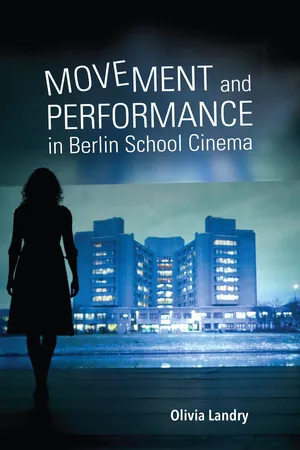
Through a study of the contemporary German film movement the Berlin School, Olivia Landry examines how narrative film has responded to our highly digitalized and mediatized age, not with a focus on stasis and realism, but by turning back to movement, spectacle, and performance. She argues that a preoccupation with presence, liveness, and affect—all of which are viewed as critical components of live performance—can be found in many of the films of the Berlin School. Challenging the perception that the Berlin School is a sheer adherent of "slow cinema," Landry closely analyzes the use of movement, dynamism, presence, and speed in a broad selection of films to show how filmmakers such as Christian Petzold, Angela Schanelec, Thomas Arslan, and Christoph Hochhäusler invoke the pulse of the kinesthetic and the tangibly affective. Her analysis draws on an array of film theories from early materialism to body theories, phenomenology, and contemporary affect theories. Arguing that these theories readily and energetically forge a path from film to performance, Landry traces a trajectory between the two through which live experience, presence, spectacle, intersubjectivity, and the body in motion emerge and powerfully intersect. Ultimately, Movement and Performance in Berlin School Cinema expands the methodological and disciplinary boundaries of film studies by offering new ways of articulating and understanding movement in cinema.
- 227 pages
- English
- ePUB (mobile friendly)
- Available on iOS & Android
eBook - ePub
Movement and Performance in Berlin School Cinema
About this book
Information
Subtopic
German History1Media, Death, and Liveness
A WOMAN ENTERS a bank. She wishes to deposit a large sum of money on behalf of her crooked new boss. At the teller’s counter, she appears stereoscopically in fictional film footage and in a surveillance video image. There is a slight overlapping in action between these two shots. The woman nods to the teller, smiles, and turns to leave. This is a test. She has been given too much money. What will she do with the rest? The grainy, ghostly texture of the surveillance image is at once the solidification of the anonymous alien gaze—structurally extradiegetic in its affect—and the gaze of a dispersed network of authority. This is clearly not her boss’s gaze, although she will get caught (by her boss) when she later attempts to mail the extra money to her ex-husband. In Christian Petzold’s 2007 film Yella, about a woman from the former East Germany in search of upward mobility in the West, a new job, a new start, and a new life mean death. The eponymous protagonist (played by Nina Hoss) is already dead. She is a ghost. But flesh is flesh in film, and in horror films in particular, for as Brigitte Peucker reminds us: “the ghost materializes and is revealed to have a body” (2007, 108). While not a horror film per se, Yella takes its cue most notably from Herk Harvey’s horror cult classic Carnival of Souls (1962). Indeed, Stanley Cavell’s conception of the “flesh and blood” actor (1981) assumes full form. In this brief snapshot of surveillance video, death, crime, and liveness intersect in a formal compendium of media modes exclusively meant for the viewer. If anyone catches Yella here, it is us.
Christian Petzold once declared that he works in “the cemetery of genre cinema” (quoted in Abel 2013, 72). I would expand this and propose that he also works in “the cemetery of media.” Without being overtly self-reflexive, there is a haunting quality, a play between absence and presence, between life and death, between past and present, that subtends the mediatic entanglements of the films of Petzold and a number of his fellow Berlin School filmmakers. Accompanying this is an awareness of the precarious status of cinema as a dying (perhaps already dead) medium and an urgency to not necessarily resuscitate it but to rethink its place among media, (re)presentation, and imaging. That cinema, or film, for that matter, attempts to reaffirm its status within a culture of new and digital media, is nothing new. As Karen Beckman and Jean Ma assert in the introduction to Still Moving, “The issue of the medium specificity has become a central concern for scholars in the field of cinema studies (in response to new media)” (2008, 2). Yet the remediation techniques employed by the Berlin School as a means of mediatic reassertion through the forging of new and old alliances, is a topic that bears its own curiosities. The drive toward performance and therefore immediacy and liveness that this book broadly tracks in the Berlin School films begins thus with the question of the medium, its treatment, and its status. If current media, film included, attempt to, in the words of Jay David Bolter and Richard Grusin, “fulfill our apparently insatiable desire for immediacy” (2000, 5), how do the Berlin School films answer this call? How do they effect a presumable drive toward the live? This is the urgency of the present chapter.
Liveness as a concept is tautological. In the prologue to the second edition of his contentious study Liveness: Performance in Mediatized Culture (2008), performance scholar Philip Auslander states that “liveness is a moving target, a historically contingent concept whose meaning changes over time and is keyed to technological development” (xii). Such a teleology suggests that liveness did not exist before the advent of media technology (ibid.); that is, before things could be recorded, everything was live anyway. It was only with the supposed loss of liveness through mediation/mediatization, such as film, television, computers, laptops, tablets, smartphones, and other such handheld (and wearable!) devices, that the existence of liveness and its ontology came into question.1 Despite the urgency of liveness’s charge in our digital age of ever-newfangled devices and new media, the scholarly inquiry surrounding it still has a narrow breadth. It is a concern generally relegated to specialized studies within film, such as documentary, musicals, pornography, and television. Liveness has, however, gained notable traction in theater and performance studies, and it is even considered by many to be a disciplinary touchstone.
To begin to better understand liveness, we must also pay heed to its apparent foil, mediation.2 José Esteban Muñoz describes mediation as “a text that is not dealing with clouded imperatives to tell what ‘really’ happened or to give the reader a plastic ‘you were there’ sensation. The text is instead profoundly evocative, suggestive, and . . . ambivalent” (1999, 58). Muñoz’s definition curiously begins by means of exclusion: mediation is not this or that. According to Muñoz, mediation is concerned with neither the hard facts—“what ‘really’ happened”—nor real experience, “a plastic ‘you were there’” (ibid.). Hence, mediation is also not liveness. Instead, mediation, as something “evocative, suggestive, and . . . ambivalent” (1999, 58), is something that entreats interpretation; it is transcendent, even dialectical. Mediation presents not only a temporal and spatial but also a critical remove. What is particularly striking about Muñoz’s distinction is the approbational, to the point of defensive, language he applies to mediation, as the “text.” It is not “dealing with clouded imperatives” but is rather “profoundly evocative, suggestive.” Muñoz has certainly been recognized for his skepticism of performance studies’ fetishism of the live, one he has notably referred to as a burden, particularly for minority performance communities. To this end, he has wittingly treated the equally important performance aspects of film, literary texts, and recorded performance in his work.
It is evident through Muñoz’s defensive formulation of mediation that liveness has and continues to be a highly contested topic in performance studies—some may even argue to the point of being overwrought. Tavia Nyong’o muses that since the early twenty-first century there seems to be a circular movement of nostalgia for liveness followed by nostalgia for mediation and so forth. Such a pattern marks and shapes performance studies trends (2009, 174). Though rooted in performance studies, the nebulous nature of liveness, as both a conditional concept as well as a historically shifting phenomenon (often an accessory to the advent of new technologies and media), invites the potentiality for more flexible and even cross-disciplinary investigations. Precisely the openness, fluidity, and contingency of the concept of liveness, burden or not, are what the following seeks to highlight in the context of film. Returning to Muñoz’s definition of mediation, deduction tells us that liveness implies a spatiotemporal immediacy, a presence—and a here and now. Like the text, film does not readily fit into such an ontological mold. Is it (still) possible for a viewer to experience a film as though it were live, similar to a theater play, that is, as though its characters were standing several feet away, or at least within viewing distance, and its action unfolding at that very moment? Following Muñoz and others, a performance analysis certainly does not strictly hold to an imperative of liveness, as liveness is only one of many discourses in performance studies; yet the challenge that liveness poses to narrative film is more complex and heuristic than it might first appear.
One of the starting points of an investigation of film and liveness is to question the very nature of film in its contemporary role and function. In her study Death 24x a Second: Stillness and the Moving Image (2006), Laura Mulvey reposes André Bazin’s ever-pertinent ontological question “What is cinema?” with the aim of understanding how cinema—especially contemporary—cinema works. She examines the state of cinema in the context of new media, not least digital film, internet, even post-cinema productions (video installations, and the like). In Mulvey’s account, “The specificity of cinema, the relation between its material base and its poetics, dissolves while other relations, intertextual and cross media, begin to emerge” (18). With the digital age came a transformation of the cinematic mode, which developed through a relinquishing of the old mediatic kinships and an embracing of the new. Movement and Performance in Berlin School Cinema tracks both. The Berlin School films offer compelling examples of both an ontological distancing from an older media, photography, and the embracing of a co-opting of a new medium, CCTV (closed-circuit television). Thus, the following builds and expands on Mulvey’s inquiry by examining how contemporary cinema is shaped by recent forms of remediation that both repel and attract.
Simply put, remediation is the act of repurposing one medium by another. But its function is inscribed by a recent history of new media and the paradoxical move to at once erase media and multiply them—“invoking the twin logics of immediacy and hypermediacy” (Bolter and Grusin 2000, 5). In the context of a “new” remediated cinema, the present study seeks to shed light on the effects of current pursuits of a potentially renewed live culture in the films of the Berlin School. Beyond simply approaching film as a locus of intermediality or a hybrid form of live performance and recorded media, then, I too revisit Bazin’s ([1976] 2005) question about the ontology of cinema vis-à-vis contemporary culture’s nostalgic pursuit of the live and liveness (returning to Nyong’o’s assertion) and ask how this quality has influenced the Berlin School films and the way they may be viewed.
This chapter examines how the Berlin School is shaped by remediation techniques and how these techniques achieve registers of the “real” and the “live.” To carry out this task, the following turns to a rather well-seasoned method of exploring film’s encounters with other media. But it offers more than a straightforward compare-and-contrast method, and instead draws out the resonance of these encounters. The first section will consider the frequent employment of photographic images in a selection of films. Moving away from Bazin’s classic realist claim about cinema’s photographic quality (an utterly old kinship), in the Berlin School films, photography is juxtaposed against the filmic image in a forging of mediatic difference. More specifically, this separation of film and photography demonstrates a temporal displacement: a time out of joint and an image out of joint; the past becomes the preserved subject of the photograph and the present emerges as the scene of film. But less concerned with simply reinforcing the binary between photography as a still medium and film as a mobile one, in its remediation with photography, I propose that film accrues new effects, especially that of real time. The second section shifts to another variance of remediation and the inclusion of surveillance-camera footage in a spate of Berlin School films. That both photography and surveillance-camera footage have an intrinsic conjunction to reality and realistic representation is the linchpin that sets up this shift from one form of remediation to another. Contrary to photography, however, surveillance-camera footage has a compelling phenomenological and ideological relationship to real-time experience, aligning it ontologically and epistemologically with live-broadcast television, whose own “promise of presence and immediacy [is] made available by video technology’s capacity to record and transmit images simultaneously” (Feuer 1983, 14). The insertion of surveillance-camera footage in a number of the Berlin School films (especially Petzold’s features) thematically and formally casts an impression of present time that undergirds the impression of these films’ own real-time modality. Surveillance-camera footage, furthermore, transposes the film image into a style of immediate, live broadcast. Along these lines, Thomas Y. Levin reads surveillance-camera footage as a critical “diegetic recasting of cinematic narration as a ‘live’ and thoroughly televisual multicamera production” (2002, 591). Indeed, in Levin’s account, surveillance-camera footage cites the live televisual medium in film. This chapter teases out both the differences and similarities between such distinct processes of remediation and how they literally animate the modalities of film form. Further, the deployment of photography and surveillance-camera footage in narrative film proffers disparate and complex strategies to display the impression and possibility of the liveness of film.
An inquiry into the effects of liveness in the Berlin School also presumes a reading of death and how its ghostly residual power often plays out structurally—that is, mediatically—in these films. Avery Gordon’s concept of haunting resonates with the fraught relationship between mediation and liveness. “Haunting,” she writes, “raises specters, it alters the experience of being in time, the way we separate the past, present, and the future. These specters or ghosts appear when the trouble they represent and symptomize is no longer being contained or repressed or blocked from view. The ghost . . . is not the invisible or some ineffable excess” (2008, xvi). If haunting is inherently the process of becoming phenomenologically present, then it importantly indicates an experience of modified (or renewed) perception of time and space. Intersecting themes of real and symbolic death and haunting with reflections on liveness and mediation, I argue that the Berlin School films exceed the viewer’s perceptions and expectations of narrative cinema. These films enfold theatrical and filmic concepts of the on- and the off-stage/screen and effectively throw into question not only the division between liveness and mediation but also those between life and death, presence and absence. In theater, for instance, the dead quite often occupy a place and time somewhere between the on stage and the off stage. These are the spectral figures that haunt the stage; they are what Jacques Derrida refers to as a “coup-de-théâtre” in his Specters of Marx (1994), most famously embodied as the ghost of Hamlet’s father. Rebecca Schneider explains that these figures are often “staged” and played by live actors (2011, 109); they are, however, theatrically poised in a kind of transcendental off—present but not, dead but also live.3 The transcendental off represents a space and time distinct from the present one. Derrida’s theatrical ghosts, intended as a metonymy for the spirit of Marxism, also thematically overlap with the crisis of old media in the age of new media. He introduces the concept of hauntology, the portmanteau of “haunting” and “ontology,” to represent a way of thinking about “Being” as much more than simple ontology (consider, for instance, the complex mystical and abstract nature of the commodity for Marx). Hauntology contains both the real and virtual of the thing as well as the disjunctive character of the two (see Derrida 1994, 10). I recast the concept here to set up mediations on the digital image, which is likewise frequently framed as the site of presence and absence, proximity and distance, potential and loss, life and death.
In the Berlin School films, however, the representation of the dead is assigned not to the digital but to the photographic or (to a lesser extent) surveillance-camera footage. This mediatic displacement of death has a twofold function: it circumvents both the ethical and the real problem of representing death on the screen. By means of remediation, films produce an off, that is, an out-of-frame effect. The insertion of the photograph into the diegesis, for instance, physically marks a metaphysical absence that gestures to a time and place outside of the film. Because the photograph becomes an image framed within an image (the film), this act of inserting generates a transcendental off, which may be considered formally as an internal off. An aperture rather than an interpretative blind spot, the photograph allows us a glimpse of something that is also not there. Under these formal conditions, as Domietta Torlasco proposes, film finds a way “to engage its viewers in the temporality of a death out of joint” (2008, 6). While related research has been done on the films of Petzold, especially his Ghost Trilogy, including Die innere Sicherheit (The State I Am In, 2000), Gespenster (Ghosts, 2005), and Yella (2007), this study revisits these films, as well as his earlier work in Toter Mann (Something to Remind Me, 2001) and his later feature Phoenix (2014) with the endeavor to integrate their thematic affinity for death and ghosts, into a broader conversation about the Berlin School and its many guises and minutiae. Broadening the scope of this study, I also turn to narratively disparate films: Angela Schanelec’s Mein langsames Leben (Passing Summer, 2001), Christoph Hochhäusler’s Unter dir die Stadt (The City Below, 2010), Deutschland 09. 13 Kurze Filme zur Lage der Nation: Séance (2010), and Eine Minute Dunkel (A Minute of Darkness, 2011), and finally Benjamin Heisenberg’s Der Räuber (The Robber, 2010). To varying degrees, all of these films pore over the power of death and the challenge of its representation in film, which has traditionally been perceived as a medium that gives life to dead things. In these films, the representation of the dead ostensibly displaces the boundaries between real and imaginary, on- and off-screen, as well as the boundaries of the film medium itself. In sum, remediation serves to incite and animate film beyond its own conventions of representation in the direction of liveness.
Enlivening the Image; or, What Film Can Do for Photography
Tracing the encounter between film and photography is a path much taken. A return to the photographic is a perennial project of film scholars in the unrelenting probing of film’s ontology. From the various returns of earlier film theorists (André Bazin, Christian Metz, Roland Barthes) to more recent travelers (Garrett Stewart [1999], Laura Mulvey [2006], and Karen Beckman and Jean Ma [2008]), the following notes its place in a longer film scholarly tradition. At the same time, it moves in slightly different directions and attempts to offer new points of entry to thinking about the juxtaposition of film and photography. The Berlin School films explore—and to some extent even exploit—the mediatic distinction between cinema and...
Table of contents
- Cover
- Title Page
- Copyright
- Contents
- Acknowledgments
- Note on Film Titles and Foreign-Language Citations
- Introduction: A Cinema against Stasis
- 1. Media, Death, and Liveness
- 2. Theatricality Bleeds, the Presence of Dance
- 3. Between Movement and Affect: The Body’s Shared Point of Sense
- 4. Accelerating Performance: From Car Travel to Car Crash
- 5. Nina Hoss’s Performance of the Fugitive Body; or, What to Do with Movement
- Conclusion: Performance on the Move
- Filmography
- References
- Index
Trusted by 375,005 students
Access to over 1.5 million titles for a fair monthly price.
Study more efficiently using our study tools.
Frequently asked questions
Yes, you can cancel anytime from the Subscription tab in your account settings on the Perlego website. Your subscription will stay active until the end of your current billing period. Learn how to cancel your subscription
No, books cannot be downloaded as external files, such as PDFs, for use outside of Perlego. However, you can download books within the Perlego app for offline reading on mobile or tablet. Learn how to download books offline
Perlego offers two plans: Essential and Complete
- Essential is ideal for learners and professionals who enjoy exploring a wide range of subjects. Access the Essential Library with 800,000+ trusted titles and best-sellers across business, personal growth, and the humanities. Includes unlimited reading time and Standard Read Aloud voice.
- Complete: Perfect for advanced learners and researchers needing full, unrestricted access. Unlock 1.5M+ books across hundreds of subjects, including academic and specialized titles. The Complete Plan also includes advanced features like Premium Read Aloud and Research Assistant.
We are an online textbook subscription service, where you can get access to an entire online library for less than the price of a single book per month. With over 1.5 million books across 990+ topics, we’ve got you covered! Learn about our mission
Look out for the read-aloud symbol on your next book to see if you can listen to it. The read-aloud tool reads text aloud for you, highlighting the text as it is being read. You can pause it, speed it up and slow it down. Learn more about Read Aloud
Yes! You can use the Perlego app on both iOS and Android devices to read anytime, anywhere — even offline. Perfect for commutes or when you’re on the go.
Please note we cannot support devices running on iOS 13 and Android 7 or earlier. Learn more about using the app
Please note we cannot support devices running on iOS 13 and Android 7 or earlier. Learn more about using the app
Yes, you can access Movement and Performance in Berlin School Cinema by Olivia Landry in PDF and/or ePUB format, as well as other popular books in Media & Performing Arts & German History. We have over 1.5 million books available in our catalogue for you to explore.