- 96 pages
- English
- ePUB (mobile friendly)
- Available on iOS & Android
eBook - ePub
About this book
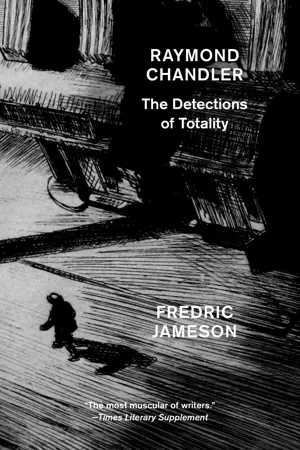
Raymond Chandler, a dazzling stylist and portrayer of American life, holds a unique place in literary history, straddling both pulp fiction and modernism. With The Big Sleep, published in 1939, he left an indelible imprint on the detective novel. Fredric Jameson offers an interpretation of Chandler's work that reconstructs both the context in which it was written and the social world or totality it projects. Chandler's invariable setting, Los Angeles, appears both as a microcosm of the United States and a prefiguration of its future: a megalopolis uniquely distributed by an unpromising nature into a variety of distinct neighborhoods and private worlds. But this essentially urban and spatial work seems also to be drawn towards a vacuum, an absence that is nothing other than death. With Chandler, the thriller genre becomes metaphysical.
Information
Topic
LetteraturaSubtopic
Critica letterariaChapter 1
Shill Game
I
A long time ago when I was writing for the pulps I put into a story a line like “He got out of the car and walked across the sun-drenched sidewalk until the shadow of the awning over the entrance fell across his face like the touch of cool water.” They took it out when they published the story. Their readers didn’t appreciate this sort of thing—just held up the action. I set out to prove them wrong. My theory was that the readers just thought they cared about nothing but the action; that really, although they didn’t know it, the thing they cared about, and that I cared about, was the creation of emotion through dialogue and description.1
That the detective story represented something more to Raymond Chandler than a mere commercial product, furnished for popular entertainment purposes, can be judged from the fact that he came to it late in life, with a long and successful business career behind him. He published his first and best novel, The Big Sleep, in 1939, when he was fifty years old, and had studied the form for almost a decade. The short stories he had written over that period are for the most part sketches for the novels, episodes that he will later take over verbatim as chapters in the longer form: and he developed his technique by imitating and reworking models produced by other detective story writers: a deliberate, self-conscious apprenticeship at a time of life when most writers have already found themselves.
Two aspects of his earlier experience seem to account for the personal tone of his books. As an executive of the oil industry, he lived in Los Angeles for some fifteen years before the depression put him out of business, enough time to sense what was unique about the city’s atmosphere, and in a position to see what power was and what forms it took. And, though a born American, he spent his school years, from the age of eight, in England, and had an English public school education.
For Chandler thought of himself primarily as a stylist, and it was his distance from the American language that gave him the chance to use it as he did. In that respect his situation was not unlike that of Nabokov: the writer of an adopted language is already a kind of stylist by force of circumstance. Language can never again be unselfconscious for him; words can never again be unproblematical. The naive and unreflective attitude towards literary expression is henceforth proscribed, and he feels in his language a kind of material density and resistance: even those clichés and commonplaces which for the native speaker are not really words at all, but instant communication, take on outlandish resonance in his mouth, are used between quotation marks, as you would delicately expose some interesting specimen: his sentences are collages of heterogeneous materials, of odd linguistic scraps, figures of speech, colloquialisms, place names and local sayings, all laboriously pasted together in an illusion of continuous discourse. In this, the lived situation of the writer of a borrowed language is already emblematic of the situation of the modern writer in general, in that words have become objects for him. The detective story, as a form without ideological content, without any overt political or social or philosophical point, permits such pure stylistic experimentation.
But it offers other advantages as well, and it is no accident that the chief practitioners of art-for-art’s sake in the late modern novel, Nabokov and Robbe-Grillet, almost always organize their works around a murder: think of Le Voyeur and La Maison de Rendezvous; think of Lolita and Pale Fire. These writers and their artistic contemporaries represent a kind of second wave of the modernist and formalistic impulse which produced the great modernism of the first two decades of the twentieth century.2 But in the earlier works, modernism was a reaction against narration, against plot: here the empty, decorative event of the murder serves as a way of organizing essentially plotless material into an illusion of movement, into the formally satisfying arabesques of a puzzle unfolding. Yet the real content of these books is an almost scenic one: the motels and college towns of the American landscape in Lolita, the island of Le Voyeur, the drab provincial cities of Les Gommes or of Dans le labyrinthe.
In much the same way, a case can be made for Chandler as a painter of American life: not as a builder of those large-scale models of the American experience which great literature offers, but rather in fragmentary pictures of setting and place, fragmentary perceptions which are by some formal paradox somehow inaccessible to serious literature.
Take for example some perfectly insignificant daily experience, such as the chance encounter of two people in the lobby of an apartment building. I find my neighbor unlocking his mailbox; I have never seen him before, we glance at each other briefly, his back is turned as he struggles with the larger magazines inside. Such an instant expresses in its fragmentary quality a profound truth about American life, in its perception of the stained carpets, the sand-filled spittoons, the poorly shutting glass doors, all testifying to the shabby anonymity of a meeting place between the luxurious private lives that stand side by side like closed monads behind the doors of the private apartments: a dreariness of waiting rooms and public bus stations, of the neglected places of collective living that fill up the interstices between the privileged compartments of middle-class living. Such a perception, it seems to me, is in its very structure dependent on chance and anonymity, on the vague glance in passing, as from the window of a bus, when the mind is intent on some more immediate preoccupation: its very essence is to be inessential. For this reason it eludes the registering apparatus of great literature: make of it some Joycean epiphany and the reader is obliged to take this moment as the center of his world, as something directly infused with symbolic meaning; and at once the most fragile and precious quality of the perception is irrevocably damaged, its slightness is lost, it can no longer be half-glimpsed, half-disregarded—the meaningless is arbitrarily given meaning.
Yet put such an experience in the framework of the detective story and everything changes. I learn that the man I saw does not even live in my building, that he was in reality opening the murdered woman’s mailbox, not his own; and suddenly my attention flows back onto the neglected perception and sees it in renewed, heightened form without damaging its structure. Indeed, it is as if there are certain moments in life which are accessible only at the price of a certain lack of intellectual focus: like objects at the edge of my field of vision which disappear when I turn to stare at them head-on. Proust felt this keenly, his whole aesthetic presupposing some absolute antagonism between spontaneity and self-consciousness. For Proust we can only be sure we have lived, we have perceived, after the fact of the experience itself; for him the deliberate, willful project to meet experience face to face in the present is always doomed to failure. In a minor way the unique temporal structure of the best detective story is also a pretext, a more organizational framework, for such isolated perception.
It is in this light that the well-known distinction between the atmosphere of English and American detective stories is to be understood. Gertrude Stein, in her Lectures in America, sees the essential feature of English literature to be the tireless description of “daily life,” of lived routine and continuity, in which possessions are daily counted up and evaluated, in which the basic structure is one of cycle and repetition. American life, American content, on the other hand, is a formless one, always to be re-invented, an uncharted wilderness in which the very notion of experience itself is perpetually called into question and revised, in which time is an indeterminate succession from which a few decisive, explosive, irrevocable instants stand out in relief. Hence the murder in the placid English village or in the fog-bound London club is read as the sign of a scandalous interruption in a peaceful continuity; whereas the gangland violence of the American big city is felt as a secret destiny, a kind of nemesis lurking beneath the surface of hastily acquired fortunes, anarchic city growth and impermanent private lives. Yet in both, the moment of violence, apparently central, is nothing but a diversion: the real function of the murder in the quiet village is for order to be felt more strongly; while the principal effect of the violence in the American detective story is to allow it to be experienced backwards, in pure thought, without risks, as a contemplative spectacle which gives not so much the illusion of life as the illusion that life has already been lived, that we have already had contact with the archaic sources of that Experience of which Americans have always made a fetish.
II
We looked at each other with the clear innocent eyes of a couple of used car salesmen. (HW, IX, 361)3
European literature is metaphysical or formalistic because it takes the nature of the society, of the nation, for granted and works out beyond it. American literature never seems to get beyond the definition of its starting point: any picture of America is bound to be wrapped up in a question and a presupposition about the nature of American reality. European literature can choose its subject matter and the width of its lens; American literature feels obliged to put everything in, knowing that exclusion is also part of the process of definition, and that it can be called to account as much for what it doesn’t say as for what it does.
The last great period of American literature, which ran more or less from one world war to the other, explored and defined America in a geographical mode, as a sum of separate localisms, as an additive unity, at its outside limit an ideal sum. But since World War II, the organic differences from region to region have been increasingly obliterated by standardization, and the organic social unity of each region has been increasingly fragmented and abstracted by the new closed lives of the individual family units, by the breakdown of cities and the dehumanization of transportation and of the media which lead from one monad to another. Communication in this new society is upwards, through the abstract connecting link, and back down again. The isolated units are all haunted by the feeling that the center of things, of life, of control, is elsewhere, beyond immediate lived experiences. The principal images of interrelationship in this new society are mechanical juxtapositions: the identical prefabricated houses in the housing project, swarming over the hills; the four-lane highway full of cars bumper to bumper and observed from above, abstractly, by a traffic helicopter. If there is a crisis in American literature at present, it should be understood against the background of this ungrateful social material, in which only trick shots can produce the illusion of life.
Chandler lies somewhere between these two literary situations. His whole background, his way of thinking and of seeing things, derives from the period between the wars. But by an accident of place, his social content anticipates the realities of the fifties and sixties. For Los Angeles is already a kind of microcosm and forecast of the country as a whole: a new centerless city, in which the various classes have lost touch with each other because each is isolated in its own geographical compartment. If the symbol of social coherence and comprehensibility was furnished by the nineteenth-century Parisian apartment house (dramatized in Zola’s Pot-Bouille) with its shop on the ground floor, its wealthy inhabitants on the second and third, petty bourgeoisie further up, and workers’ rooms on top along with the maids and servants, then Los Angeles is the opposite, a spreading out horizontally, a flowing apart of the elements of the social structure.
Since there is no longer any privileged experience in which the whole of the social structure can be grasped, a figure must be invented who can be superimposed on the society as a whole, whose routine and life-pattern serve somehow to tie its separate and isolated parts together. The equivalent is the picaresque novel, where a single character moves from one background to another, linking “picturesque” but not intrinsically related episodes together. In doing this the detective in a sense once again fulfills the demands of the function of knowledge rather than that of lived experience: through him we are able to see, to know, the society as a whole, but he does not really stand for any genuine experience of it. Of course the origin of the literary detective lies in the creation of the professional police, whose organization can be attributed not so much to a desire to prevent crime in general as to the will on the part of modern governments to know and thus to control the varying elements of their administrative areas. The great continental detectives (Lecoq, Maigret) are generally policemen, but in the Anglo-Saxon countries where governmental control sits far more lightly on the citizens, the private detective, from Holmes to Chandler’s Philip Marlowe, took the place of the government functionary, until the postwar return of the police procedural.
As an involuntary explorer of the society, Marlowe visits either those places you don’t look at or those you can’t: the anonymous or the wealthy and secretive. Both have something of the strangeness with which Chandler characterizes the police station: “A New York police reporter wrote once that when you pass in beyond the green lights of the precinct station you pass clear out of this world into a place beyond the law” (LL, XXIII, 418). On the one hand those parts of the American scene which are as impersonal and seedy as public waiting rooms: run-down office buildings, the elevator with the spittoon and the elevator man sitting on a stool beside it; dingy office interiors, Marlowe’s own in particular, seen at all hours of the clock, at those times when we have forgotten that offices exist, in the late evening, when the other offices are dark, in the early morning before the traffic begins; police stations; hotel rooms and lobbies, with the then characteristic potted palms and overstuffed armchairs; rooming houses with managers who work illegal lines of business on the side. All these places are characterized by belonging to the mass, collective side of our society: places occupied by faceless people, who leave no stamp of their personality behind them, in short, the dimension of the interchangeable, the inauthentic:
Out of the apartment houses come women who should be young but have faces like stale beer; men with pulled-down hats and quick eyes that look the street over behind the cupped hand that shields the match flame; worn intellectuals with cigarette coughs and no money in the bank; fly cops with granite faces and unwavering eyes; cokies and coke peddlers; people who look like nothing in particular and know it, and once in a while even men that actually go to work. But they come out early, when the wide cracked sidewalks are empty and still have dew on them. (HW, VIII, 358)
The presentation of this kind of social material is far more frequent in European art than in our own: as if somehow we were willing to know anything about ourselves, the worst kind of secret, just as long as it was not this nameless, faceless anonymity. But it suffices to compare the faces of actors and participants in almost any European movie with those in American ones to note the absence in ours of the whole-grain lens and the dissimilarity between the visual representation and the features of people around us in the street. What makes this somewhat more difficult to observe is that of course our view of life is conditioned by the art we know, which has trained us not to see what the texture of ordinary people’s faces is, but rather to invest them with photographic glamour.
The other side of American life with which Marlowe comes into contact is the reverse of the above: the great estate, with its retinue of servants, chauffeurs, and secretaries; and around it, the various institutions which cater to wealth and preserve its secrecy: the private clubs, set back on private roads in the mountains, patrolled by a private police which admits members only; the clinics in which drugs are available; the private religious cults; the luxury hotels with their security personnel; the private gambling ships, anchored out beyond the three-mile limit; and a little further away, the corrupt local police who rule a municipality in the name of a single man or family, and protect the various kinds of illegal activity which spring up to satisfy money and its wants.
But Chandler’s picture of America has an intellectual content as well: it is the converse, the darker concrete reality, of an abstract intellectual illusion about the United States. The federal system and the archaic federal Constitution developed in Americans a double image of their country’s political reality, a dual system of political thoughts which never intersect with each other. On the one hand, a glamorous national politics whose distant leading figures are invested with charisma, an unreal, distinguished quality adhering to their foreign policy activities, their economic programs given the appearance of substance by the appropriate ideologies of liberalism or conservatism. On the other hand, local politics, with its odium, its ever-present corruption, its deals and perpetual preoccupation with undramatic, materialistic questions such as sewage disposal, zoning regulations, property taxes, and so forth. Governors are halfway between the two worlds, but for a mayor, for example, to become a senator involves a thoroughgoing metamorphosis, a transformation from one species into another. Indeed, the qualities perceived in the political macrocosm are only illusory, the projection of the dialectical opposite of the real qualities of the microcosm: everyone is convinced of the dirtiness of politics and politicians on the local level, and when everything is seen in terms of interest, the absence of greed becomes the feature which dazzles. Like the father whose defects are invisible to his own children, the national politicians (with occasional stunning exceptions) seem to be beyond personal self-interest, and this lend...
Table of contents
- Cover Page
- Halftitle Page
- Title Page
- Copyrigt Page
- Dedication
- Contents
- Chapter 1: Shill Game
- Chapter 2: Mapping Space
- Chapter 3: The Barrier at the End of the World
- Notes
Trusted by 375,005 students
Access to over 1.5 million titles for a fair monthly price.
Study more efficiently using our study tools.
Frequently asked questions
Yes, you can cancel anytime from the Subscription tab in your account settings on the Perlego website. Your subscription will stay active until the end of your current billing period. Learn how to cancel your subscription
No, books cannot be downloaded as external files, such as PDFs, for use outside of Perlego. However, you can download books within the Perlego app for offline reading on mobile or tablet. Learn how to download books offline
Perlego offers two plans: Essential and Complete
- Essential is ideal for learners and professionals who enjoy exploring a wide range of subjects. Access the Essential Library with 800,000+ trusted titles and best-sellers across business, personal growth, and the humanities. Includes unlimited reading time and Standard Read Aloud voice.
- Complete: Perfect for advanced learners and researchers needing full, unrestricted access. Unlock 1.5M+ books across hundreds of subjects, including academic and specialized titles. The Complete Plan also includes advanced features like Premium Read Aloud and Research Assistant.
We are an online textbook subscription service, where you can get access to an entire online library for less than the price of a single book per month. With over 1.5 million books across 990+ topics, we’ve got you covered! Learn about our mission
Look out for the read-aloud symbol on your next book to see if you can listen to it. The read-aloud tool reads text aloud for you, highlighting the text as it is being read. You can pause it, speed it up and slow it down. Learn more about Read Aloud
Yes! You can use the Perlego app on both iOS and Android devices to read anytime, anywhere — even offline. Perfect for commutes or when you’re on the go.
Please note we cannot support devices running on iOS 13 and Android 7 or earlier. Learn more about using the app
Please note we cannot support devices running on iOS 13 and Android 7 or earlier. Learn more about using the app
Yes, you can access Raymond Chandler by Fredric Jameson in PDF and/or ePUB format, as well as other popular books in Letteratura & Critica letteraria. We have over 1.5 million books available in our catalogue for you to explore.