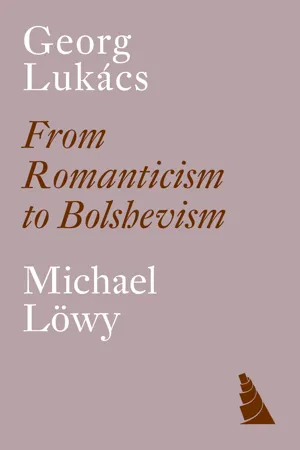
The philosophical and political development that converted Georg Luk?cs from a distinguished representative of Central European aesthetic vitalism into a major Marxist theorist and Communist militant has long remained an enigma. In this this now classic study, Michael L?wy for the first time traced and explained the extraordinary mutation that occurred in Luk?cs's thought between 1909 and 1929. Utilizing many as yet unpublished sources, L?wy meticulously reconstructed the complex itinerary of Luk?cs's thinking as he gradually moved towards his decisive encounter with Bolshevism. The religious convictions of the early Luk?cs, the peculiar spell exercised on him and on Max Weber by Dostoyevskyan images of pre-revolutionary Russia, the nature of his friendships with Ernst Bloch and Thomas Mann, were amongst the discoveries of the book. Then, in a fascinating case-study in the sociology of ideas, L?wy showed how the same philosophical problematic of Lebensphilosophie dominated the intelligentsias of both Germany and Hungary in the pre-war period, yet how the different configurations of social forces in each country bent its political destiny into opposite directions. The famous works produced by Luk?cs during and after the Hungarian Commune-Tactics and Ethics, History and Class Consciousness and Lenin-were analysed and assessed. A concluding chapter discussed Luk?cs's eventual ambiguous settlement with Stalinism in the thirties, and its coda of renewed radicalism in the final years of his life.
In this new edition, L?wy has added a substantial new introduction which reassess the nature of Luk?cs's thought in the light of newly published texts and debates.
- 220 pages
- English
- ePUB (mobile friendly)
- Available on iOS & Android
eBook - ePub
About this book
Information
Notes
Introduction
1 ‘Manifesto of the Communist Party’, in Marx, The Revolutions of 1848, Harmondsworth, 1978, p. 72 (translation modified).
2 On the relationship between ‘science’ and ‘ideology’, ‘a class standpoint’ and ‘objectivity’, see M. Löwy, Dialectique et révolution, Paris, 1973.
3 See L. Goldmann, Recherches dialectiques, Paris, 1969, p. 42.
4 G. Lukács, History and Class Consciousness, London, 1971, p. 27.
5 Ibid., p. 57.
6 Marx, Capital, vol. 1, Harmondsworth, 1976, p. 176.
7 See the writings of Lucien Goldmann: The Human Sciences and Philosophy, London 1969; Recherches dialectiques, and others. We cannot, of course, in the scope of this introduction, go into the key questions of historical materialism. The above remarks are intended simply as a set of ‘programmatic’ theses laying down the methodological guidelines of this study.
I. Towards a Sociology of the Anti-Capitalist Intelligentsia
1 Lukács, ‘Zur Organisationsfrage der Intellektuellen’, Kommunismus, vol. 1, no. 3, 1920, pp. 17–18.
2 Lukács, ‘La politique culturelle de la Commune de Budapest’ (1969), in Action Poétique, no. 49, 1972, p. 29.
3 ‘Radical. Adj. which seeks to act on the underlying cause of the effects one wishes to change’, Petit Robert dictionary, p. 1447. [Cf. the definition given by the Shorter Oxford Dictionary: ‘going to the root or origin … esp. radical change, radical cure’ – translator’s note.]
4 Such revolt, of course, does not always lead to socialism, and may even lead to fascism.
5 Cf. Lucien Goldmann, Towards a Sociology of the Novel, London, 1975, p. 11.
6 Thus, Salvador Dali was expelled from the group of surrealists, who gave him the dishonourable nickname ‘Avida Dollars’ [‘dollar-greedy’].
7 Lukács calls this ‘the moral crisis of the internal lie [of] the bourgeoisie’. (‘The Old Culture and the New Culture’, in Lukács, Marxism and Human Liberation, New York, 1978, p. 10.)
8 J.-M. Brohm, ‘Introduction’ to F. Jakubowsky, Les superstructures idéologiques dans la conception matérialiste de l’histoire, Paris, 1971, p. 60. It should be added, however, that Marxist humanism is not merely the continuation but the dialectical Aufhebung of bourgeois humanism.
9 Lukács, Brève histoire de la littérature allemande, Paris, 1949, p. 94.
10 Within this class a particularly important role was played by a social category absent in Catholic countries like France: the scions of Protestant pastors. ‘It is especially the son of the Protestant parson in whom the Enlightenment stirs doubts of the traditional religion, but who does not therefore succumb to the opposite extreme of an abstract rationalism. He experiences a transformation of his religious attitude. All his traditional habits of thought and emotional reactions which were fostered by the religious life in the parsonage survive the impact of the Enlightenment. Deprived of their positive content, they are directed with redoubled strength against the rationalist atmosphere of the time.’ (K. Mannheim, ‘Conservative Thought’, in Essays on Sociology and Social Psychology, London, 1953, p. 123.) See also R. Aron, German Sociology, London, 1957, p. 114: ‘German philosophers, especially in the nineteenth century, came largely from a background of officials, particularly church officials; the clergyman’s son is the typical representative…. Even if they have lost their religious faith they retain a certain feeling for religion as the highest form of spiritual aspiration…. This kind of religion without God leads to a recognition of the role of the emotions, which cannot be reduced to reason, and frequently inspires a protest against capitalist, rationalized society.’
11 Mannheim, pp. 87–90. In Mannheim’s view there is a certain affinity between conservative and proletarian thought: ‘Although deriving from entirely different basic aims, this affinity nevertheless unites the two modes of thought in opposition to the aims of the bourgeois capitalist world, and the abstractness of its thought.’ (Ibid., p. 92.) In the section on Hungarian intellectuals, we shall return to Mannheim’s essay and examine its relationship to Lukács’s thought.
12 Adam Müller, Deutsche Staatsanzeigen, 1816, quoted here from J. Droz, Le romantisme politique en Allemagne, Paris, 1963, pp. 98–9.
13 Ibid., p. 95.
14 Ibid., pp. 165–6.
15 ‘Manifesto of the Communist Party’, in Marx, The Revolutions of 1848, Harmondsworth, 1978, p. 88.
16 Ibid., p. 92: ‘While this “true” socialism thus served the governments as a weapon for fighting the German bourgeoisie, it, at the same time, directly represented a reactionary interest, the interest of the German philistines. In Germany the petty-bourgeois class, a relic of the sixteenth century, and since then constantly cropping up again under various forms, is the real social basis of the existing state of things. To preserve this class is to preserve the existing state of things in Germany. The industrial and political supremacy of the bourgeoisie threatens it with certain destruction – on the one hand, from the concentration of capital; on the other, from the rise of a revolutionary proletariat. “True” socialism appeared to kill these two birds with one stone. It spread like an epidemic.’
17 ‘Introduction to the Critique of Hegel’s Philosophy of Right’, in Marx, Early Writings, Harmondsworth, 1975, pp. 255–7.
18 Nietzsche, The Genealogy of Morals, New York, 1956, pp. 186–7 (translation modified).
19 Nietzsche, Beyond Good and Evil, Chicago, 1955, pp. 190–1.
20 Nietzsche, The Genealogy of Morals, p. 187.
21 Lukács, ‘Nietzsche als Vorläufer der faschistischen Asthetik’ (1934), in F. Mehring, G. Lukács, Friedrich Nietzsche, Berlin, 1957, p. 57. See also p. 48: ‘In his attitude to the cultural effects of capitalist development, Nietzsche begins from the positions of romantic anti-capitalism – from its critique of the culture-destroying results of the “machine-age”.’ Lukács quotes the following passage as a typical example of Nietzsche’s approach: ‘Soldiers and leaders always have a much higher relationship to one another than worker and employer. For the present, at least, all civilization based on a military foundation stands high above all so-called industrial civilization; the latter in its present form is in general the lowest form of existence known up to the present time.’ (Ibid., p. 55.)
22 The anarchist Rudolf Rocker quotes approvingly the following words of Nietzsche: ‘Culture and the state… are antagonists.… The one prospers at the expense of the other. All great periods of culture are periods of political decline. Whatever is great in a cultured sense is non-political, is even antipolitical.’ (R. Rocker, ‘The Ideology of Anarchism’, in I.L. Horowitz (ed.), The Anarchists, New York, 1964, pp. 191–2.) The link is clear between this position and Thomas Mann’s views in his 1918 Reflections of an Unpolitical Man.
23 F. Ringer, The Decline of the German Mandarins: The German Academic Community, 1890–1933, Cambridge, Massachusetts, 1969, p. 7. According to Ringer, ‘if industrialization is slow and state-controlled, if the traditional social organization persists for a long time, then burgher intellectuals are more likely to concentrate attention exclusively upon the rights of the learned. They will seek to constitute a kind of nobility of the educated to supersede the “merely traditional” ruling class …’ (ibid., p. 7).
24 From Max Weber, Essays in Sociology (ed. Gerth and Mills), London, 1967, p. 427. Weber’s preceding remarks on China can be almost literally applied to t...
Table of contents
- Cover Page
- Title Page
- Copyright Page
- Dedication
- Contents
- Acknowledgements
- Introduction
- I. Towards a Sociology of the Anti-Capitalist Intelligentsia
- II. How an Intellectual Becomes a Revolutionary
- III. Lukács’s Leftist Period (1919-21)
- IV. ‘History and Class Consciousness’ 1923
- V. Lukács and Stalinism
- Notes
- Index
Trusted by 375,005 students
Access to over 1.5 million titles for a fair monthly price.
Study more efficiently using our study tools.
Frequently asked questions
Yes, you can cancel anytime from the Subscription tab in your account settings on the Perlego website. Your subscription will stay active until the end of your current billing period. Learn how to cancel your subscription
No, books cannot be downloaded as external files, such as PDFs, for use outside of Perlego. However, you can download books within the Perlego app for offline reading on mobile or tablet. Learn how to download books offline
Perlego offers two plans: Essential and Complete
- Essential is ideal for learners and professionals who enjoy exploring a wide range of subjects. Access the Essential Library with 800,000+ trusted titles and best-sellers across business, personal growth, and the humanities. Includes unlimited reading time and Standard Read Aloud voice.
- Complete: Perfect for advanced learners and researchers needing full, unrestricted access. Unlock 1.5M+ books across hundreds of subjects, including academic and specialized titles. The Complete Plan also includes advanced features like Premium Read Aloud and Research Assistant.
We are an online textbook subscription service, where you can get access to an entire online library for less than the price of a single book per month. With over 1.5 million books across 990+ topics, we’ve got you covered! Learn about our mission
Look out for the read-aloud symbol on your next book to see if you can listen to it. The read-aloud tool reads text aloud for you, highlighting the text as it is being read. You can pause it, speed it up and slow it down. Learn more about Read Aloud
Yes! You can use the Perlego app on both iOS and Android devices to read anytime, anywhere — even offline. Perfect for commutes or when you’re on the go.
Please note we cannot support devices running on iOS 13 and Android 7 or earlier. Learn more about using the app
Please note we cannot support devices running on iOS 13 and Android 7 or earlier. Learn more about using the app
Yes, you can access Georg Lukàcs by Michael Löwy, Patrick Camiller in PDF and/or ePUB format, as well as other popular books in Política y relaciones internacionales & Biografías literarias. We have over 1.5 million books available in our catalogue for you to explore.