The basic discoveries underlying Marx's critique of political economy - labour power, surplus value, use value - are all in some way built upon the concept of need. From Marx's varying and passing interpretations of a theory of need, Agnes Heller unravels the main tendencies and demonstrates the importance which Marx attached to the "restructuring" of a system of needs going beyond the purely material.
She also brings out those aspects, especially the idea of "radical needs" which point to revolutionary activity and to the project which Marx could only foresee but which for us today is of real urgency: the "society of associated producers". Thus Agnes Heller's study is not only the first full presentation of a fundamental aspect of Marx, but the basis for a discussion of the utmost contemporary relevance.
- 144 pages
- English
- ePUB (mobile friendly)
- Available on iOS & Android
eBook - ePub
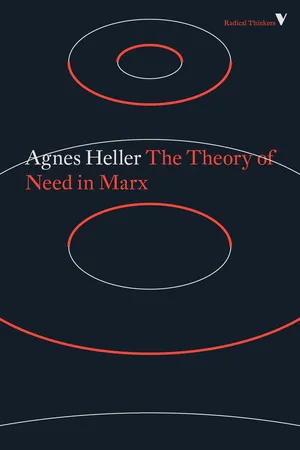
The Theory of Need in Marx
About this book
Information
Topic
PhilosophySubtopic
Political PhilosophyV
The “System of Needs” and the “Society of
Associated Producers”
Marx’s analysis of the society of associated producers is philosophically founded upon the concept of the system of needs. From the philosophical point of view, individual concrete needs cannot be analysed in isolation, since neither isolated needs nor isolated types of need exist. Every society has its own characteristic system of needs, which is therefore in no way valid for judging the system of needs of another society. “Is the entire system of needs founded on estimation or on the whole organisation of production? Most often, needs arise directly from production or from a state of affairs based on production.”91 Here I shall briefly summarise Marx’s description of the dominant system of needs in capitalism (I have already spoken of it in the second chapter). The structure of needs is reduced to the need for possession, which subordinates the entire system to itself. All this is manifested in the members of the ruling class as the need quantitatively to increase needs of a single quality and the objects with which to satisfy these needs, whilst in the working class it is manifested as the reduction to simple needs of existence, that is to “natural needs” and to their satisfaction. Qualitative needs are quantified; needs as ends are turned into needs as means and vice versa. Since needs of heterogeneous qualities cannot develop, men’s pleasures remain “crude” and “brutal”, and some of their needs become “fixed”. Relations of interest dominate relationships between human beings.
Production, the relations of production, social relations and systems of needs are, as we know, different aspects of a single formation, in which each is the precondition of the other. The structure of needs is an organic structure inherent in the total social formation. The structure of needs in capitalist society belongs therefore exclusively to capitalist society. It cannot be used to judge any other society in general and least of all that of “the associated producers”, since the latter is the opposite not only of capitalist society but of every civilised society that has existed to date; it is the first non-alienated society, “the realm of freedom”.
But if a system of needs is specific to a given social formation, how can the subjective forces arise which are to overturn this given society? Every (civilised) society is a class society founded upon the division of labour, in which there is also a “division” in the system of needs. The exploited classes generally ask for no more than a better satisfaction of the needs assigned to them. However, these same exploited masses become conscious (in various different historical conditions) of the existing opposition between their needs and those of the dominant classes. In this case they seek to get rid of everything that stands in the way of the satisfaction of their needs and to make their own system of needs general, as well as to make certain aspects of the ruling class’s system of needs realisable for themselves. This leads either to the overturning of the social order or to the general ruin of the productive forces. In the first event a new ruling class organises itself (and the way in which the bourgeois state arose is the classic example of this); in the second case society is unable to function (in the passage cited from the Grundrisse, Marx interprets the fall of the Roman Empire in this latter sense).
Needs that transcend the present in this sense, however, are not radical needs. This is because need does not transcend the system of needs as a whole but only the “division” of it. The need of the slave to be a free man is not a new need, because the society that enslaves him is a society of free men. The bourgeoisie’s need to take political power is likewise not a new need; it is simply a demand for the satisfaction of a need which is already available to others, and for the elimination of the obstacles to this satisfaction. The radical needs of the working class created by capitalism are, however, different by definition. Their nature is such that they cannot previously have been satisfied in the given society, either by the bourgeoisie or by the proletariat. (The Being of the bourgeoisie is just as alienated as that of the proletariat.)
Therefore it is exclusively the radical needs which lead to the complete restructuring of the system of needs; on this, Marx has no doubts whatever. The system of needs under capitalism belongs to capitalism. But it is precisely this “pure” society which, by developing the productive forces sufficiently to overcome the division of labour, can and does create needs that belong to its Being but do not belong to its system of needs. Thus only the radical needs enable man, in the interests of satisfying them, to bring about a social formation which is radically, “from the root”, different from the previous one, a society in which the radically new system of needs will be different from all earlier ones.
It is therefore absurd to try to use the current, existing structure of needs as a basis for judging the system of needs which is Marx’s precondition for the society of associated producers. Without the concept of restructuring the system of needs, the assertion that labour and surplus value will become a vital need is simply incomprehensible. For Marx, the complete restructuring of the system of needs in communism is the sine qua non for any assertion about the future society. One can already read, in the Economic and Philosophic Manuscripts of 1844, that even the “senses” of “socialised” human beings will be different from what they are now. In the Grundrisse, Marx writes about the development of the wealth of human life in free time: “Free time — which is both idle time and time for higher activity — has naturally transformed its possessor into a different subject.”92 (The stimulus for Marx to discuss this problem more deeply arises from the question of “natural” and “luxury” needs, that is, the question of overcoming the opposition between them. “These questions about the system of needs … — at what point is this to be dealt with?”93) Marx regards the radical restructuring of needs, capacities and senses as “natural”. But since the society of associated producers also represents a totality, a “social formation” just as every other society does, the foundations of its operative mechanism and of the radically new structure of needs are interdependent. The new system of needs therefore becomes comprehensible only in relation to the functioning of the new social body, just as the functioning of the new social “formation” as a whole is comprehensible only in relation to the new system of needs.
The “society of associated producers” is thus the society in which radical needs come to be satisfied, and around which a new structure of needs is built. It is therefore also a society in which radical philosophy and radical theory are realised and surmounted. (This does not, of course, mean the unqualified surmounting of philosophy as such, but of the radical philosophy which must grip the masses in order to become a material force. This will become clearer later on.)
The system of needs in communism must be dealt with from two distinct aspects: from that of material and non-material needs, and from that of the relation between these two types within a single structure of needs. By “material needs” I mean needs whose objects and means of satisfaction (used in consumption and in productive consumption) must be produced and continually reproduced. Needs of a non-material character are, in contrast, those whose objects of satisfaction are not “produced” in the organic interchange with nature or are not produced at all. (I know that this is not a “pure” distinction. To satisfy the need for art, production is to some extent necessary: houses must be built, books must be printed. But the need for art as such is not satisfied either by the house or by the book but by the work of art, which as an objectivation does not belong to the sphere of production.) The distinction between these two aspects is not arbitrary. It is based on an essential distinction which Marx applied. In his view, the sphere of production is the field which will always remain “the realm of necessity”; above it is the “realm of freedom”, which subordinates production to its own ends. Needs that can be satisfied only through institutions (this also applies to social and community satisfaction of needs) are partly of a material nature, since they absorb material means, and partly not, since they are satisfied by human activity (Marx cites schools and hospitals as examples). The need for public institutions is partly of a material nature (for example, the construction of dwellings) and partly not (rendering services of a non-material nature). For Marx, at least in the “second phase” of communism, this is natural, since the opposition between productive and unproductive labour, which is constituted by capitalism, ceases to exist, since there is no longer either exchange or exchange value, labour power is not a commodity, etc. The category of “socially necessary labour time” will be interpretable only in relation to the process of material production. (The concept of “socially necessary labour time” is not applicable to any “free” activity, whether medicine, teaching, planning, or scientific and artistic activity.) Certainly, all this does not hold true for “the first phase of communism”, in so far as the division there is regulated on the basis of labour supplied, for which “the socially necessary labour time” must obviously be measured in every activity involving labour. On this point Marx does not give any detailed analysis, limiting himself simply to the observation that in this phase the system of equal rights for unequal individuals prevails, i.e. the legal system of bourgeois society. We cannot imagine this mechanism without commodity and money relations. In the well known tenth paragraph of The Communist Manifesto, which describes the measures necessary for laying the basis for the first phase of communism, there is no hint of the overcoming of commodity production. Marx and Engels speak only of “measures … which appear economically insufficient and untenable, but which, in the course of the movement, outstrip themselves, necessitate further inroads upon the old social order and are unavoidable as a means of entirely revolutionising the mode of production.”94 In the eyes of Marx and Engels this transition appears as inevitable, and they do not take the actual problems into consideration. Likewise, it is unclear whether the realisation of the first phase of communism also brings with it the overcoming of commodity production, or whether this will be characteristic of the second phase. Marx and Engels rarely deal with the “how”? of the transition; they limit themselves to the comparison of “ideal types”. Since we are analysing Marx’s theory of need, we too can work only with these “ideal types”. We are therefore forced to exclude a problem which is crucial for us today, namely the problem of transition (which of course can last for centuries), and to refrain from analysing his model of transition, or rather his possible models. It is necessary also to make another limitation: given that we are analysing Marx’s theory of needs, we shall consider the model of “associated producers” only from this latter point of view and leave the other aspects aside, important as they may be.
To be able to analyse the relationship of needs to material production and its products, we must also find out exactly what role is played by material production in Marx’s idea of the “society of associated producers”. We need to examine the following aspects:
(a)Is production developed?
(b)To what extent does the development of production represent the growth of “social wealth”?
(c)Is there a division of labour?
(d)Do necessary and surplus labour exist or not?
(e)What are the proportions between the production of direct consumer goods and means of production on the one hand, and the production of those goods which are essential for the “social satisfaction of needs” on the other?
To the first question, Marx’s reply is an unequivocal yes. The society of the future is also a society of material wealth, which continues to grow. This idea is encountered in virtually all of Marx’s works. I shall cite just one example as proof. In the third volume of Theories of Surplus Value, he describes the two alternatives for increasing “disposable time”. One alternative would be to produce greater wealth in half the current average labour time. The other would be to reduce the labour time by half in such a way as to direct the remaining half towards the satisfaction of “necessary needs” as they are at present. Marx considers it a theoretical mistake, a lack of clarity, to confuse these two alternatives. He explicitly declares himself to be in favour of the first of them.
The base for the future development of production will be the extraordinary growth in the proportion of fixed capital, which is quite possible because the increase in production will be independent of the valorisation of capital. The increase in the proportion of fixed capital to levels that are impossible under capitalism is the guarantee that material production will require ever less living labour. This is the only way to reduce labour time uninterruptedly whilst maintaining a constant increase in production. This does not of course mean that dead labour will dominate living labour (because the capital relation no longer exists); on the contrary, living labour will prevail over dead.
The idea of unlimited progress in material production is a clear characteristic of Marx’s thought; his ideas on the rate of increase of production are, however, contradictory on more than one occasion. On the one hand, he assumes that capitalism arrives at a point where the development of the forces of production (and in particular the increase in fixed capital) ceases, and that therefore the rate of material production in the society of associated producers would have to be more rapid, at least in comparison with the situation in latter-day capitalism. On the other hand, the increased rate of material production (which we shall have more to say about later) is determined by the needs of the associated producers. However, in parallel with the growing wealth, these needs will be less and less directed towards material consumer goods. This already suggests a new structure of needs which is of decisive importance. In the new structure of needs, Marx uses a sort of “saturation model”: material consumer goods (those which serve immediate consumption) would play an increasingly limited role in the structure of needs of individuals, or at any rate their proportion would be less. They would be limited by other needs, not by production itself, since production does not overtake needs but is directed towards them. On the basis of the model indicated, it is in fact inconceivable that any new material needs could arise from production itself, i.e. that new types of need could be “produced”. All this should indicate a fall-off in the rate of increase of production, at least after a certain level of wealth is attained.
Marx believed that he could already see this “structural change”, in the “radical needs” of the proletariat of his day. This can also be seen from his comments on the theses of the proetarian ideologist, Galiani. The latter’s basic thesis was, as we know, that “true wealth … is man”. Marx supported this view, and added: “The whole objective world, the “world of goods’, vanishes here as a mere aspect … of socially producing men.”95
And so we come to the second problem. To what extent does the development of production represent the growth of “social wealth”? We can extract two quite distinct problems from this question (though they usually appear together):
1)To what extent can labour be considered the source of material wealth?
2)To what extent can production (including the material wealth which is realised in production) be considered the sole source of wealth in general?
It should be pointed out that Marx regards the two questions as completely separable in principle, mainly because the source of use values (wealth in use values being actual material wealth) is labour and nature, not labour alone. (A radical analysis of this problem can be found in the Critique of the Gotha Programme and elsewhere.)
(1) Marx gives different answers to the first question, which we shall consider in due course.
It is bourgeois society which considers labour to be the only source of material wealth, a society dominated by the contradiction between use value and exchange value which is embodied in commodity production. (In Theories of Surplus Value, Marx accuses some of Ricardo’s critics of remaining within the system of categories of bourgeois society, in that they still consider labour the sole source of wealth even when they draw conclusions from this which are opposed to those of Ricardo.) Still more important, however, is the fact that according to Marx’s conception of labour, the labour performed in production in the society of associated producers decreases to a minimum and even ceases to exist. It becomes, therefore, absurd to see labour as the source of (material) wealth, or to apply the criterion of labour time to (material)...
Table of contents
- Cover Page
- Halftitle Page
- Title Page
- Copyright Page
- Contents
- Introduction
- I. Preliminary Observations on Marx’s Concept of Need
- II. The General Philosophical Concept of Needs and the Alienation of Needs
- III. The Concept of “Social Need”
- IV. “Radical Needs”
- V. The “System of Needs” and the “Society of Associated Producers”
- Notes
- Index
Trusted by 375,005 students
Access to over 1.5 million titles for a fair monthly price.
Study more efficiently using our study tools.
Frequently asked questions
Yes, you can cancel anytime from the Subscription tab in your account settings on the Perlego website. Your subscription will stay active until the end of your current billing period. Learn how to cancel your subscription
No, books cannot be downloaded as external files, such as PDFs, for use outside of Perlego. However, you can download books within the Perlego app for offline reading on mobile or tablet. Learn how to download books offline
Perlego offers two plans: Essential and Complete
- Essential is ideal for learners and professionals who enjoy exploring a wide range of subjects. Access the Essential Library with 800,000+ trusted titles and best-sellers across business, personal growth, and the humanities. Includes unlimited reading time and Standard Read Aloud voice.
- Complete: Perfect for advanced learners and researchers needing full, unrestricted access. Unlock 1.5M+ books across hundreds of subjects, including academic and specialized titles. The Complete Plan also includes advanced features like Premium Read Aloud and Research Assistant.
We are an online textbook subscription service, where you can get access to an entire online library for less than the price of a single book per month. With over 1.5 million books across 990+ topics, we’ve got you covered! Learn about our mission
Look out for the read-aloud symbol on your next book to see if you can listen to it. The read-aloud tool reads text aloud for you, highlighting the text as it is being read. You can pause it, speed it up and slow it down. Learn more about Read Aloud
Yes! You can use the Perlego app on both iOS and Android devices to read anytime, anywhere — even offline. Perfect for commutes or when you’re on the go.
Please note we cannot support devices running on iOS 13 and Android 7 or earlier. Learn more about using the app
Please note we cannot support devices running on iOS 13 and Android 7 or earlier. Learn more about using the app
Yes, you can access The Theory of Need in Marx by Agnes Heller in PDF and/or ePUB format, as well as other popular books in Philosophy & Political Philosophy. We have over 1.5 million books available in our catalogue for you to explore.