- 824 pages
- English
- ePUB (mobile friendly)
- Available on iOS & Android
eBook - ePub
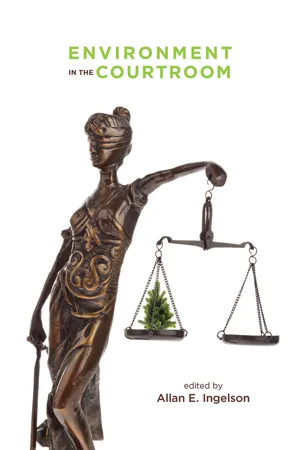
Environment in the Courtroom
About this book
Canadian environmental law is a dynamic and exciting area that is playing an increasingly important role in furthering sustainable development policy. Environmental law has distinctive relevant principles, operating procedures, implications, and importance in comparison with other areas of law, and these distinctions must be appreciated both within the legal community and by all those who are concerned with the way that courts handle environmental cases.
Environment in the Courtroom provides extensive insight into Canadian environmental law. Covering key environmental concepts and the unique nature of environmental damage, environmental prosecutions, sentencing and environmental offences, evidentiary issues in environmental processes and hearings, issues associated with site inspections, investigations, and enforcement, and more, this collection has the potential to make make a significant difference at the level of understanding and practice.
Containing perspective and insight from experienced and prominence Canadian legal practitioners and scholars, Environment in the Courtroom addresses the Canadian provinces and territories and provides context by comparison to the United States and Australia. No other collection covers these topics so comprehensively. This is an essential reference for all those interested in Canadian environmental law.
Information
Section 1
Key Environmental
Concepts and the Unique Nature of Environmental Damage
Concepts and the Unique Nature of Environmental Damage
1
Sustainable Development under Canadian Law
Paule Halley and Pierre-Olivier DesMarchais
Sustainable development represents a new paradigm, casting doubt on the belief that development can be based on sporadic and unlimited economic growth thanks to the planet earth’s ability to perpetually provide adequate resources to keep pace with it. That belief has been replaced with uncertainty and concern in the face of deteriorating ecosystems, climate and biodiversity, and other risks associated with irreversible changes. Sustainable development is trying to become established for the long term and to sever its ties with any developmental approach that does not take into account the restricted nature of the planet earth’s resources.1
The implementation of sustainable development has mobilized most national and international organizations and a great number of participants. The task at hand is colossal and meets with much resistance. For legal experts, sustainable development remains a dynamic concept, the subject of much debate and reflection.2 Here, we will content ourselves with introducing the origins of sustainable development, outlining significant milestones in its development on the international stage, and examining its implementation in Canadian law through its guiding principles.
Origins and Definitions of Sustainable Development
The concept of “sustainable development” first appeared on the international stage in 1980, in World Conservation Strategy published by the International Union for Conservation of Nature and Natural Resources: “For development to be sustainable it must take account of social and ecological factors, as well as economic ones.”3 It then gained prevalence in 1987 with the publication of the report Our Common Future by the World Commission on Environment and Development (the Brundtland Report): “Sustainable development is development that meets the needs of the present without compromising the ability of future generations to meet their own needs.”4 The two main principles that inform these definitions are equity and integration, which have established the present-day model of sustainable development and influence the legislation and interpretations surrounding its scope, conditions of application, and implementation.
It was at the second United Nations Conference on Environment and Development, held in Rio de Janeiro in 1992, that the international community undertook to establish “a new and equitable global partnership” through the integration of the goal of sustainable development in policy and public decision making. The Rio Declaration on Environment and Development 5 clearly defines the concept of sustainable development, most notably its conditions of equity: “the right to development must be fulfilled so as to equitably meet developmental and environmental needs of present and future generations”;6 and integration: “in order to achieve sustainable development, environmental protection shall constitute an integral part of the development process and cannot be considered in isolation from it.”7
Since then, this change in the approach to development has been reiterated by the international community on numerous occasions8 and has flourished in the areas of both international environmental law and international trade.9 For example, the preambles to the Marrakesh Agreement Establishing the World Trade Organization10 and the North American Free Trade Agreement11 recognize that the rules governing international trade must favour the sustainable use of resources and that member states are obligated to promote sustainable development.12
The goal of sustainable development in international law is given concrete expression in guiding principles that set out its purpose, means of application and implementation. The Rio Declaration, for example, lays down 27 guiding principles, among which it is possible to distinguish those that are inherent to sustainable development from those that are operational principles.13 Today, these guiding principles represent the foundation for many international conventions. Thus, the principle of public participation is at the heart of the Aarhus Convention on Access to Information, Public Participation in Decision-making and Access to Justice in Environmental Matters;14 the precautionary principle was codified in the 1996 Protocol to the Convention on the Prevention of Marine Pollution by Dumping of Wastes and Other Matter,15 while the prevention principle is the basis for the United Nations Convention on the Law of the Non-navigational Uses of International Watercourses,16 and the procedure for evaluating environmental impact contained in the Convention on Environmental Impact Assessment in a Transboundary Context.17
International organizations have expressed opini...
Table of contents
- Preface
- Section 1 Key Environmental Concepts and the Unique Nature of Environmental Damage
- Section 2 Environmental Prosecutions
- Section 3 Sentencing and Environmental Offences
- Section 4 Evidentiary Issues in Environmental Prosecutions and Hearings
- Section 5 Inspections and Enforcement Issues: On-site and in Court
- List of Contributors
- Index
Trusted by 375,005 students
Access to over 1.5 million titles for a fair monthly price.
Study more efficiently using our study tools.
Frequently asked questions
Yes, you can cancel anytime from the Subscription tab in your account settings on the Perlego website. Your subscription will stay active until the end of your current billing period. Learn how to cancel your subscription
No, books cannot be downloaded as external files, such as PDFs, for use outside of Perlego. However, you can download books within the Perlego app for offline reading on mobile or tablet. Learn how to download books offline
Perlego offers two plans: Essential and Complete
- Essential is ideal for learners and professionals who enjoy exploring a wide range of subjects. Access the Essential Library with 800,000+ trusted titles and best-sellers across business, personal growth, and the humanities. Includes unlimited reading time and Standard Read Aloud voice.
- Complete: Perfect for advanced learners and researchers needing full, unrestricted access. Unlock 1.5M+ books across hundreds of subjects, including academic and specialized titles. The Complete Plan also includes advanced features like Premium Read Aloud and Research Assistant.
We are an online textbook subscription service, where you can get access to an entire online library for less than the price of a single book per month. With over 1.5 million books across 990+ topics, we’ve got you covered! Learn about our mission
Look out for the read-aloud symbol on your next book to see if you can listen to it. The read-aloud tool reads text aloud for you, highlighting the text as it is being read. You can pause it, speed it up and slow it down. Learn more about Read Aloud
Yes! You can use the Perlego app on both iOS and Android devices to read anytime, anywhere — even offline. Perfect for commutes or when you’re on the go.
Please note we cannot support devices running on iOS 13 and Android 7 or earlier. Learn more about using the app
Please note we cannot support devices running on iOS 13 and Android 7 or earlier. Learn more about using the app
Yes, you can access Environment in the Courtroom by Alan Ingleson in PDF and/or ePUB format, as well as other popular books in Diritto & Tribunali. We have over 1.5 million books available in our catalogue for you to explore.