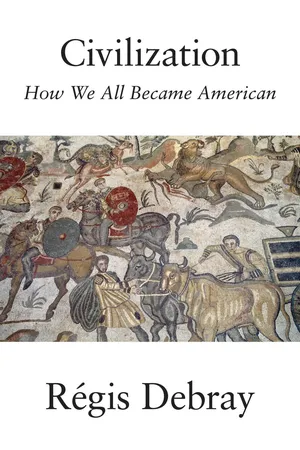
'Civilisation' - a hard term to define. But while every society has a distinctive culture, authentic civilisations must offer those they subjugate an attractive way of life. Their imprint outlasts their imperium.
A century ago, Debray argues, there was a European civilisation of which America was an outlying culture; but today the relationship is reversed. 'In 1900, an American of taste was a European in exile; in 2000, a trendy European is a frustrated American - or one waiting for a visa'. Characteristic of American civilization is its three overarching fetishes: space, image and happiness. America is a civilization of space and image, whereas Europe was one of time and writing. And its kitsch infantilism blinds itself to the tragic complexities of human life. A measure of America's success is how its 'globish' jargon has so successfully infiltrated European languages.
For Debray, the dominance of American civilisation is a historical fait accompli, yet he sees a model for Europe in Vienna after its exclusion from the German Reich. For decades to come, Europe can still offer a rich cultural seedbed. 'Some will call it decadence, others liberation. Why not both?'
- 192 pages
- English
- ePUB (mobile friendly)
- Available on iOS & Android
eBook - ePub
About this book
Information
1
What Does ‘Civilization’ Mean?
Civilization – a word that sings and is sung in all sorts of scenes. A wandering fairy that evaporates in an iridescent blur. So many reasons to cry wolf. Why should we take account of it again? Because there is no time to be lost – and that vaporous, ethereal, shape-shifting word is covering up a reality that could not be more pressing or more concrete.
Paul Valéry did not want us to waste too much time defining these vague entities, which he knew to be mortal. Let us grant him that it is easier to identify, at a distance at least, a savage than one who is civilized. The former has red skin, a feather through the nose, earrings; the latter is more elusive. A more serious definition would have to suggest, whether we like it or not, a delimited period of time (stopping the meter) and a confined extent of space (a ‘here’ and no further). Yet the distinguishing characteristic of a living civilization is its capacity for metabolism: it transforms itself as it absorbs and stimulates others. They who would make of it a fixity only mummify a being which in reality feeds on borrowings and exchanges. A civilization also means windows and ventilators, missionaries and merchants. Marco Polo, taking the Silk Road, blew a little Italian air into the Mongol Empire, and a little of the air of Asia into Pisa intra muros. The Mexican peon scales the twenty-one-foot fence and learns English; the West Coast must start learning Spanish again. Here, to breathe is to mingle. Isolates are abstractions and isolators do themselves no favours. ‘You don’t belong here, clear off’ amounts to ‘let me decay in my bolt-hole’.
Yet we must also admit that even if we are reluctant to draw their outlines too exactly, civilizations do it for us, by excluding one another – covertly or openly. They mix, but they also abrade. The friction between them, aggravated by migration, gives rise to eczema. Here and there, in the face of refugees, demands arise not for borders but their opposite – for barriers of cement, if not indeed barbed wire. The sedentary does not want the nomad; neither does the Wasp want the Chicano, nor the Turk the Armenian or Greek; and so on. It is a long road from globalization to ‘happily ever after’. All is nomadic, all is criss-crossed, all is diffused, yes. But not everything can go everywhere. The proof of the pudding is in the eating, and the proof of civilizations is that they do not digest just anything. Fernand Braudel observes that civilizations have invisible customs posts, filtration systems without filters. No bull of excommunication or deportation order is in any way required, so spontaneously does allergy do its work. Italy and the Iberian Peninsula did not let the Reformation in. Shiite Persia blocked Sunni incursions, Arab or Ottoman. Marxism could not be grafted onto the Anglo-Saxon world, with the exception of a few academic enclaves. After two centuries of Anglican occupation, Christians number a mere 2 per cent of the population of today’s India. With the exception of the Syro-Malabar Catholics of Kerala, Hinduism held fast: the Gospel made no dent on the Vedas. Hindi has not been defeated by English, and India will remain singular as much as it remains plural, with its twenty-three official languages and some five hundred dialects. The ‘American way of life’ may have covered the body of Mother India with a mantle of malls and screens, bars and music videos, ring roads and fast food, but it will not find it easy to abolish what amounts to the soul of this breakwater of humanity: wonder at the cosmos, laughter at the joke that is life, which makes of death, for each individual, a comma, not a full stop. In spite of the global market and of consumerism, India has some chance of remaining a civilization, instead of becoming a mere folk culture among others.
‘Concrete’ comes from the Latin ‘concretus’, meaning solid, consistent, thick, and from the verb ‘concrescere’, to solidify slowly, binding together disparate elements, mortar or stones. The concrete is complicated; and the complicated, discouraging. Hybrids produced by a mélange of epochs do not have a good reputation; the mixed bloodlines of early days offend the bearers of glorious titles, who like to assume clear borders and pure origins, when they themselves are already confluences. Soldiers of Christ the King are liable to grimace when told that Christianity is a dark-skinned Eastern religion, or that it was Islam, its adversary, that introduced them to the Aristotelian legacy on which they pride themselves, received by Muslims from Syriac translators, themselves Christians, from Baghdad. Ex oriente lux. Of the Jewish people themselves, to whom we owe so much, but who in turn owe a great deal to Mesopotamia, which gave us writing and the Creator, it can be said that they were born in Egypt, acquired their identity in Babylon and wrote their history in Alexandria. A lineage of memory requires a straighter line. And from what a mishmash comes our Father Christmas with his hood and his white beard, whose effigy was burnt as pagan by a bishop in the forecourt of Dijon Cathedral on 23 December 1951, to general acclaim. Santa Claus arrived from America in great style, but he had disembarked there long ago from Scandinavia – and further back from Roman Saturnalia, and yet further from prehistoric cults like that surrounding the Druidic mistletoe. How many tributaries for a little Christmas tree!
And what zigzags for a proud and pure ‘Christian civilization’! From the start, three sedimentations. At the beginning, a Jewish ritual, the scriptural proclamation expressed by Joshua, later called Jesus, namely the reading of a passage of Scripture given a contemporary interpretation, in a Sabbath homily in the synagogue. Then, in the second century, a philosophical movement that integrated this Judaic dissidence into the sphere of Hellenism, in the language and categories of Greece. Then, the third stage in the third century, the incorporation of this theology into the language and law of Rome, allowing it to become the candidate to succeed ‘Roman civilization’. This process of growth through transposition, which generated such a successful amalgam, was no obstacle to a denial of debts, bleaching of colours, annexation of creditors, a false birth certificate, all part and parcel of the work of the self on selfhood. If it did not transfigure its history into legend, with beautiful lies and the fabrication of far-fetched, improbable founding heroes – the Japanese goddess Amaterasu, Aeneas or Vercingetorix – a civilization would not be a place of belonging, a home, but an academy of sciences.
Where does the blurred appearance that makes us cautious about them come from? These nebulae are not to be seen with the naked eye. They are meshes of tenuous thread, like a collective unconscious all the better shared for not being conscious; unlike a military alliance or a political confederation, a system without any parts; an unseen, all-encompassing entity, an ethos without ethics, a brotherhood without brothers. Civilizations possess a persistence that can harden beyond expectation when a foreign body attacks them from the outside (witness Arabic-Islamic or Slavic Orthodox reactions today) and soften beyond imagination when the rift is from within (Shiites and Sunnis; Russians and Ukrainians). This comes from far in the past, no one knowing exactly where, and reappears without anyone really knowing why. What insists, persists and refuses to sign is a creature that snaps its fingers at our attachment to ideas of copyright. The continuing action of what has ceased to exist – Christendom, the Ming dynasty, the Ottoman Empire – is an offence to common sense. There is something in the very notion of a civilization that is an affront to the forward-looking, emancipated mind – as if it were an unformed thought mistakenly cast in sticking plaster, a hindrance to the freedom of the consumer, or some other millstone. A we that can at any moment remind an isolated me rebuts the monad that would see itself as self-generated, the child of its own works and sole author of its life, dreaming of the ability to choose a body, a sex, a language, a memory, as it sees fit.
The worst is that this is a conspiracy without a conspirator. It is impossible to shout ‘Death to Charlemagne!’, who embroiled us with Byzantium, the second Rome, and so eventually with Moscow, the third, over a fairly bizarre controversy (the Holy Spirit – did it just come from the Father or from the Father and the Son?); ‘Down with Mohammed!’, the Bedouin ‘coming into our midst to slit the throats of our sons’ and our priests; or ‘Damn Confucius!’, who made China incomprehensible, if not impenetrable, to us. Such outbursts would have little effect. We understand that this ball and chain has often been judged reactionary or fatalistic. Yet those who would make a clean sweep of civilization regularly break their teeth on this thing that is not a thing – elusive, tough and stubborn.
Robespierre and Lenin could have redoubled their efforts, without their activism changing either language or climate, national diet or family model – indeed, all that the passage from horse to high-speed train, from the abacus to the computer, from capitalism to socialism and back again, has left fundamentally unaltered. The Soviet Russian never bade farewell to St Sergius or borscht, any more than a priest-eating Frenchman did to the division of the lunar month into four weeks, a biblical inheritance, or the hour into sixty minutes, a legacy from Babylon. And we are not going to see a Sixth Republic in France abolishing the Gregorian calendar (the First got nowhere with its republican calendar).
A civilization, wrote the historian Charles Seignobos, is a grid of ‘roads, ports and quays’. It is also the way time is divided, and space demarcated; a main course, a favourite colour, a recognizable headgear. Kemal banned the headscarf and the veil, but while the fez disappeared, the hijab resurfaced. The mark of a civilization is a culinary base that no act of will, good or bad, can prevent from rising to the surface of the sauce. Colour prints of Stalin were not presented as icons, nor statues of Mao as a new version of ancestor worship – nor indeed our own Mariannes as so many Virgin Marys without the halo. It would kill the effect to reveal its source, but without the ‘paleo’ there is no ‘neo’. A futurology without genealogy is no more than a ripple in a children’s pool.
If pure calculation of interest were to govern our alliances and affinities, it would be logical, to use a contemporary example, for the Russian Federation – rejected by Europe and surrounded by NATO – to make common cause with China, but as even certain Russians say themselves: a marriage of convenience, yes, we can imagine that, but little chemistry – ‘we are not of the same family’. As for those who have fabricated a Europe united on paper, pink or blue, ignoring the fault-line that runs from Riga to Split, a fracture inherited from the Filioque quarrel that has separated West from East since the eighth century, they have not achieved and will not achieve anything for their pains. No peace conference will dissipate an underlying mistrust and animosity between Arabs and Persians, Hindus and Muslims, even Lutherans and Papists, not to mention South and North Americans. Since every new religion is a heretical version of an older one – Buddhism of Hinduism, Christianity of Judaism, Protestantism of Catholicism, and so on – there is no civilization which has staked its claim somewhere in Babel without opposing another one; the dead lie heavy on the neck of the amnesiac. This affectio societatis offers no comfort to beaming notions of world improvement, global governance or other United Colors of Benetton – or for that matter, talk of collective security or cosmopolitan homilies. Everything that unites us also divides us, and it is about as likely that a universal human civilization will come into being – anywhere other than on the podiums of the United Nations or UNESCO – as that an extra-terrestrial with two heads and four legs should deign to land on our planet. Tomorrow is not that Sunday. Plurality is the law of the earth, Hannah Arendt maintained. Fine! But we would do well to remember that this plurality promises as many slammed doors as open windows, as many knives pulled as hands shaken.
Let us first distinguish, then, between ‘culture’ and ‘civilization’, these ‘sets of attitudes and skills learnt by men as members of society’, as Lévi-Strauss termed them. They are too often confused (Hegel took the one for the other). In the Age of Enlightenment, Mirabeau and Voltaire invented ‘Civilization’ as proper noun, the exit from ‘Barbarism’. Germany, a short while later, would oppose ‘Kultur’, a living particularity rooted in a people and a soil, to ‘Zivilisation’, inert and deracinated, its procedures applicable anywhere. ‘Today it is the duty of man to ensure that civilization does not destroy culture nor technology the human being’, warned the Berlin historian Theodor Mommsen. And the Anglo-Saxon anthropologists who with good reason translated moral idea into social fact, reserved ‘culture’ for primitive societies and ‘civilization’ for modern ones. So there is a good deal of interference on the line and fog on the road. Let us try a clarification.
What distinguishes ‘the first and most complex of the permanent forms of social life’ from others that might at first glance appear more readily visible, like the tribe, the nation or the state? First, spatially – by the range of their diffusion: Islam in one variety or other extends from Dakar to Jakarta. Here foundations are wider than the structures that are built on them. Then, temporally – by their longevity: Rome lasted a thousand years, China is nearing its third millennium. Their depths are not easily broken. China has seen many a dynasty, many a massacre and many a great helmsman, and may see others. But its pagodas will still be there. Storks pass; steeples remain.
No culture without agriculture, no civilization without the city. Etymology distributes vocations. Here a locus, there a topos – in each case, a mould capable of accommodating, and of shaping, several catchments. Even if the most intensive cultivation is beneath the walls of a city, or close at hand, it can always return to compost – it is rural. A civilization, on the other hand, is carved in stone – it is urban. It needs centres of accumulation and redistribution, and urbanization cannot occur just anywhere. The shores of the sea and the banks of great rivers, which allow the cheap transportation of goods and commodities, attract it quite naturally. More propitious for cultures, sensu stricto, are mountainous zones difficult to access. Steppes, massifs and high plateaux encourage a particularist resilience. Geography is a home port for one, a springboard for the other. A culture remains single, while a civilization has children. The first is to the second what a kingdom is to an empire – or a retrenchment to a propagation. There is, for example, a Basque culture, bringing together seven provinces straddling the Pyrenees border, but it stops north of the Adour and south of the Ebro: it does not seek to encroach on Gascony or Aragon. Many Basques have emigrated, their descendants populating Latin America; St Ignatius of Loyola and St Francis Xavier were far from sedentary; but the pelotari, chistera and trinquet (player, glove and court of the game of pelota), the makila (shepherd’s staff), the pastorale (psalmodic theatre), smuggling, berets, piperade (dish made with peppers) and, first and foremost, the enigmatic Basque language, the true criterion of belonging, have one kingdom and only one: the Basque Country. Basque culture, like Yezidi, or, more accurately, Kabyle or Aymara, does not want anyone treading on its sandals, but equally it does not step on anyone else’s. Basqueness adheres to Basques, and no one else. It seeks no sphere of ‘co-prosperity’.
No need, on the other hand, to be born in Italy or a champion of the Pax Romana in order to speak Latin and think like a Roman – as St Augustine, a Berber, or Thomas Aquinas did. No need either to have an American passport, or even speak fluent English, to adopt US manners and customs. As a mother tongue irradiates into regional dialects, so a civilization opens out the culture from which it originates – the Sinosphere includes China, Japan, Mongolia, Tibet, Korea, Vietnam, Singapore. A civilization contracts when its forces begin to decline. This retraction or clenching, which signals a retreat, is called a culture. Hellenic civilization extended to the Indus, Christian from Patagonia in the west to Kerala in the east, the faith of Hejaz spread across Byzantium and Persia to North India. Buddha, born in India, crossed the Himalayas into China, but the Mediterranean was forbidden him, Zoroastrian Persia blocking his missionaries to the west by a tissular incompatibility. A civilization is not made by spontaneous generation. A culture constructs sites; a civilization builds roads. It presupposes and requires a foreign policy. A civilization acts; it is offensive, unlike a culture, which is defensive and reacts. The correct term would really be ‘civilization’.
Let us take heed of this ‘-ion’, the suffix of action, the action of the great city on its hinterland, the urbs on the ager. There is no civilization that is not rooted in a culture, but this does not become a civilization unless it also has a fleet and an ambition, a great dream and a mobile force. In that sense, Pericles represented the moment of culture in the Greek world and Alexander its moment of civilization. A little empire, that of Philip II of Macedonia, was necessary between them. English Puritanism, a local culture, planted the seeds of a civilization across the Atlantic, and American neo-Protestantism has now crossed the ocean in the opposite direction, to spread the American way of life in Africa. When a root acquires wings, it can create branches extra muros. Such wings do not grow all by themselves.
A language or a religion, or still better a mixture of the two, can create a lasting encampment: Hebrew and Judaism are a case in point. A civilization demands more: an empire (Abbasid, Carolingian, Spanish, British, American …). And whoever says ‘empire’ also says ‘armed force’, as whoever says ‘army’ says ‘war and conquest’. Local cultures also sometimes have to take up arms, to survive or to be reborn, but these are wars of necessity, defence or liberation. A civilization practises war by choice, wars of invasion or colonization. No Hellenism without hoplites, no Islam without cavalry. No Christianity without Templars, no Ottomanism without Janissaries. A funny paradox: the antonym of ‘barbarism’ always has pools of blood in its baptismal fonts, St Bartholomew’s Days without which civilization would not be what it is. Like every other, Christianity has an embarrassment of choice in matter of ethnocides: from the massacre of the Hierosolomites (1099) or the Albigensians (1209) during the Crusades, to the annihilation of pre-Columbians in the mid-sixteenth century and the extermination of Amerindians three centuries later. Civilizers with clean white hands do not exist: all have a black book in the drawer. A regional dialect could, at the end of the feudal era, attain the status of national language by equipping itself with cannon and a centralized monarchy (as with François I in France). But the inventors of cartography (a mark of civilization) would sooner or later need triremes, gunboats or aircraft, to not just reach other shores but camp on them. That is expensive. Taxes have to be levied, ports opened, forests planted, engineers recruited, along with blacksmiths for the cavalry.
‘Imperial civilizations’ are a pleonasm. Just as an empire is multi-ethnic, a civilization in the prime of its life needs every talent available and will make satellites out of a number of cultures, be these enclaves, outposts or relays: Nepal and Indonesia are not India, any more than Vietnam or Mongolia are China, or today’s Italy, France or Mexico are America. A spaghetti Western has an Italian flavour, and primaries in France cost less than in the States (our ‘participant finance’, with dinners at €7,500 a head, is fundraising on the cheap). The modulator can be modulated; to each partner their unit of measure. A nebula requires more than one star.
The American model is a paradigm in this respect, in its capacity to project both forces and forms outwards. Beyond the first circle of the family (Great Britain, Australia, New Zealand, Canada and the United States – the absolutely trustworthy countries sharing a single intelligence system, the Five Eyes), its centre of diffusion radiates in all directions, with bridgeheads on five continents, and a rosary of skylines, megalopolises new or renovated, functioning as antennae – or so many ‘free zones’, gated communities in the global village. Tokyo, Singapore, Dubai, Tel Aviv, Lagos, Lima … In addition to these ‘civilized’ coastlines, some others above or behind them are cities that subsist on culture, from Kyoto to Kuala Lumpur, Mecca, Jerusalem and Cuzco. For all that is globalized requires its local colour. If a civilization has its multiples, these are neither clones nor mere replicas. When a civilization is at full strength, it acts like an inflected language in which every foreigner can create their own hyphened version (Italian-American, Chinese-American) without jettisoning their particular baggage. Of the current formula that globalizes a very specific local profile, we have an Arabic version, abstemious and deluxe (Abu Dhabi); an Israeli version, high-tech and muscular (Tel Aviv); a Sino-Asiatic version, crowded but orderly (Shanghai); a Latino version that is borderline and disorderly (Panama); a crazy, congested African version (Johannesburg). This archipelago is united by business and commerce, but since an economy by itself has never made up a civilization, it must satisfy a certain number of other requirements: a film festival, a museum of contemporary art, an annual art fair, an economic forum, architectural feats (the highest tower, the longest bridge), shopping malls and six-starred hotels. The United Arab Emirates, in just thirty years, have fulfilled all their obligations save one: no love parade.
To return for a moment to the hard kernel of a civilization: military force, which is a necessary but not sufficient condition, always needs the enhancement of an imaginary to fire hearts, storehouses to fill stomachs, and a magisterium to occupy minds. Imposition by force – military, financial or both – is ineffectual without the radiance of a symbolic code which alone has the power to make the dispersed pieces into a whole...
Table of contents
- Cover Page
- Halftitle Page
- Title Page
- Copyright Page
- Contents
- Acknowledgements
- Note to Reader
- 1. What Does ‘Civilization’ Mean?
- 2. When Did Europe Stop Doing Civilization?
- 3. When Did France Become a Culture?
- 4. What Is the New Civilization?
- 5. Why Do We Still Close Our Eyes?
- 6. What Is New about the New Rome?
- 7. Why Is ‘Decadence’ Pleasant and Indispensable?
- Notes
Trusted by 375,005 students
Access to over 1.5 million titles for a fair monthly price.
Study more efficiently using our study tools.
Frequently asked questions
Yes, you can cancel anytime from the Subscription tab in your account settings on the Perlego website. Your subscription will stay active until the end of your current billing period. Learn how to cancel your subscription
No, books cannot be downloaded as external files, such as PDFs, for use outside of Perlego. However, you can download books within the Perlego app for offline reading on mobile or tablet. Learn how to download books offline
Perlego offers two plans: Essential and Complete
- Essential is ideal for learners and professionals who enjoy exploring a wide range of subjects. Access the Essential Library with 800,000+ trusted titles and best-sellers across business, personal growth, and the humanities. Includes unlimited reading time and Standard Read Aloud voice.
- Complete: Perfect for advanced learners and researchers needing full, unrestricted access. Unlock 1.5M+ books across hundreds of subjects, including academic and specialized titles. The Complete Plan also includes advanced features like Premium Read Aloud and Research Assistant.
We are an online textbook subscription service, where you can get access to an entire online library for less than the price of a single book per month. With over 1.5 million books across 990+ topics, we’ve got you covered! Learn about our mission
Look out for the read-aloud symbol on your next book to see if you can listen to it. The read-aloud tool reads text aloud for you, highlighting the text as it is being read. You can pause it, speed it up and slow it down. Learn more about Read Aloud
Yes! You can use the Perlego app on both iOS and Android devices to read anytime, anywhere — even offline. Perfect for commutes or when you’re on the go.
Please note we cannot support devices running on iOS 13 and Android 7 or earlier. Learn more about using the app
Please note we cannot support devices running on iOS 13 and Android 7 or earlier. Learn more about using the app
Yes, you can access Civilization by Régis Debray, David Fernbach in PDF and/or ePUB format, as well as other popular books in Politics & International Relations & Civil Rights in Politics. We have over 1.5 million books available in our catalogue for you to explore.