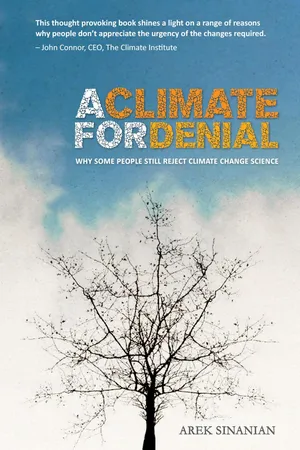
A Climate for Denial
eBook - ePub
Available until 23 Dec |Learn more

A Climate for Denial

Why Some People Still Reject Climate Change Science

  1. 154 pages
  2. English
  3. ePUB (mobile friendly)
  4. Available on iOS & Android
eBook - ePub
Available until 23 Dec |Learn more

A Climate for Denial

Why Some People Still Reject Climate Change Science

About this book

Why is it that despite overwhelming evidence and fundamental science, some people still don't accept that climate change is real and that human activity is contributing to it? Is it because the science is not being understood? Is it because it is difficult to accept that humans are capable of changing the climate? Is there a link between climate change scepticism and ideology? Is there a link between the belief in the science and belief in God? If you know anyone who challenges the science of climate change - or completely denies it's happening at all - then this book is for you, and for them. Don't worry, your friend is human after all, and such behaviour can be explained. A Climate for Denial gives a summary of the reasons your friend is a sceptic.

Frequently asked questions

Yes, you can cancel anytime from the Subscription tab in your account settings on the Perlego website. Your subscription will stay active until the end of your current billing period. Learn how to cancel your subscription.
No, books cannot be downloaded as external files, such as PDFs, for use outside of Perlego. However, you can download books within the Perlego app for offline reading on mobile or tablet. Learn more here.
Perlego offers two plans: Essential and Complete
  • Essential is ideal for learners and professionals who enjoy exploring a wide range of subjects. Access the Essential Library with 800,000+ trusted titles and best-sellers across business, personal growth, and the humanities. Includes unlimited reading time and Standard Read Aloud voice.
  • Complete: Perfect for advanced learners and researchers needing full, unrestricted access. Unlock 1.4M+ books across hundreds of subjects, including academic and specialized titles. The Complete Plan also includes advanced features like Premium Read Aloud and Research Assistant.
Both plans are available with monthly, semester, or annual billing cycles.
We are an online textbook subscription service, where you can get access to an entire online library for less than the price of a single book per month. With over 1 million books across 1000+ topics, we’ve got you covered! Learn more here.
Look out for the read-aloud symbol on your next book to see if you can listen to it. The read-aloud tool reads text aloud for you, highlighting the text as it is being read. You can pause it, speed it up and slow it down. Learn more here.
Yes! You can use the Perlego app on both iOS or Android devices to read anytime, anywhere — even offline. Perfect for commutes or when you’re on the go.
Please note we cannot support devices running on iOS 13 and Android 7 or earlier. Learn more about using the app.
Yes, you can access A Climate for Denial by Arek Sinanian in PDF and/or ePUB format, as well as other popular books in Biological Sciences & Ecology. We have over one million books available in our catalogue for you to explore.

Information

What has been achieved so far?
A simplistic timeline of greenhouse gases and climate change
50,000 years or so ago
  • Humans are going about their business, trying to survive, hunting and gathering, using fire for warmth, cooking and security. Survival is the only focus and procreation is part of it.
  • The carbon footprint of the average person on Earth is miniscule and it’s entirely due to the burning of wood.
2500 years ago
  • Humans now use bronze for tools and are starting to farm animals and grow crops.
  • The carbon footprint of the average person on Earth is still miniscule and it’s mainly due to the burning of wood, charcoal, natural oils and fat.
  • Money and material possessions are important but mainly for survival and some for spiritual reasons.
250 years ago
  • The Industrial Revolution begins and the whole world is very excited about harnessing and utilising energy provided mainly by coal.
  • Humans begin to use coal to generate steam and it provides power for manufacturing, transport and much more.
  • Life expectancy and quality of life for humans begins its exponential rise.
  • Humans now control their environment and technology developments begin their dominance in human existence.
190 years ago
  • Greenhouse gases are identified by Jean-Baptiste Fourier (although he doesn’t call them that).
  • In the latter half of the 19th century, humans find ways to use fossil fuels in the form of coal and crude oil. Coal is used in heating and coal gas is used for lighting, cooking and heating. The internal combustion engine is invented. These developments lead to the building of factories, the mass production of goods, and more ways of using energy. This in turn means cheaper goods and higher rates of consumption. And so begins the spiral of consumerism.
  • Late in the 19th century, humans develop the technology to harness the energy in coal to generate electricity, which becomes the main driver of economic, social and environmental change.
  • The Industrial Revolution is leading to a miraculous and sustained advancement in human existence through scientific and technological developments.
115 years ago
  • Humans are now aware of the effect of greenhouse gases on our atmosphere and climate.
  • Humans in the developed world are busy developing new ways to use fossil fuels, with little attention to the huge amounts of greenhouse gases being emitted into the atmosphere.
  • Compounding the growing human hunger for energy is an explosion of world population due to technology, better medical science and food production.
  • Humans no longer see themselves as part of nature, but believe that they can control it and take care of it. The lack of balance between development and survival is seemingly of little concern.
  • Greenhouse gas emissions are invisible and their accumulation in the atmosphere has subtle and long-term affects not realised by the vast majority of the world’s population.
50 years ago
  • Humans are beginning to realise that the consumption of resources is far exceeding the Earth’s capacity.
  • There is an acute awareness of the environmental damage humans are causing. Identified environmental degradation includes pollution of the soil, the oceans, rivers, the food humans consume a...

Table of contents

  1. Introduction
  2. Context
  3. The structure of the book
  4. A few technical terms
  5. Part A. Background and History
  6. Global agreements and actions to date
  7. So what is being rejected?
  8. What does climate change mean?
  9. What has been achieved so far?
  10. Renewables and greenhouse gas emissions (China, US, Texas, California)
  11. Part B. Reasons for Denial
  12. Introduction
  13. The need to belong
  14. A little knowledge
  15. Belief and evidence
  16. Cherry picking
  17. Cause and effect
  18. Religion and God
  19. I don’t like the solution
  20. Distrust of authority
  21. Globalisation
  22. Perceptions of risk
  23. It’s complicated, really
  24. Dealing with a wicked, diabolical problem
  25. Fear of change
  26. Guilt (and Blame)
  27. Ideology and politics
  28. Spreading the word
  29. We’ll find a way
  30. Part C. Where to Now?
  31. Introduction
  32. A combination of factors
  33. What we’ve learnt so far
  34. Where do we need to be?
  35. Jumping the hurdles
  36. Part D. Concluding Remarks
  37. Bibliography
  38. Appendix