Blockchain for Business 2019
eBook - ePub

Blockchain for Business 2019

A user-friendly introduction to blockchain technology and its business applications

  1. 258 pages
  2. English
  3. ePUB (mobile friendly)
  4. Available on iOS & Android
eBook - ePub

Blockchain for Business 2019

A user-friendly introduction to blockchain technology and its business applications

About this book

Your one-stop guide to blockchain technology and its business applications

Key Features

  • Assimilate blockchain services such as Ethereum and Hyperledger to transform industrial applications
  • Know in and out of blockchain technology to understand various business use cases
  • Understand various common and not-so-common challenges faced in blockchain development

Book Description

Blockchain for Business 2019 is a comprehensive guide that enables you to bring in various blockchain functionalities to extend your existing business models and make correct fully-informed decisions. You will learn how decentralized applications are transforming numerous business sectors that are expected to play a huge role in the future. You will see how large corporations are already implementing blockchain technology now. You will then learn about the various blockchain services, such as Bitcoin, Ethereum, Hyperledger, and others to understand their use cases in a variety of business domains. You will develop a solid fundamental understanding of blockchain architecture.

Moving ahead, you will get to grips with the inner workings of blockchain, with detailed explanations of mining, decentralized consensus, cryptography, smart contracts, and many other important concepts. You will delve into a realistic view of the current state of blockchain technology, along with its issues, limitations, and potential solutions that can take it to the next level.

By the end of this book, you will all be well versed in the latest innovations and developments in the emerging blockchain space.

What you will learn

  • Understand the fundamentals of blockchain and how it was developed
  • Gain a good understanding of economic concepts and developments
  • Develop a base for concepts such as cryptography, computer networking, and programming
  • Understand the applications of blockchain and its potential impact on the world
  • Become well versed with the latest developments in the blockchain space
  • Explore blockchain frameworks, including decentralized organizational structures, networks, and applications

Who this book is for

This book is for financial professionals, business executives, managers, and enthusiasts who are interested in getting well-versed with blockchain technology in various business domains. This book will help boost your existing business models using blockchain services. No prior experience of blockchain is required.

Frequently asked questions

Yes, you can cancel anytime from the Subscription tab in your account settings on the Perlego website. Your subscription will stay active until the end of your current billing period. Learn how to cancel your subscription.
No, books cannot be downloaded as external files, such as PDFs, for use outside of Perlego. However, you can download books within the Perlego app for offline reading on mobile or tablet. Learn more here.
Perlego offers two plans: Essential and Complete
  • Essential is ideal for learners and professionals who enjoy exploring a wide range of subjects. Access the Essential Library with 800,000+ trusted titles and best-sellers across business, personal growth, and the humanities. Includes unlimited reading time and Standard Read Aloud voice.
  • Complete: Perfect for advanced learners and researchers needing full, unrestricted access. Unlock 1.4M+ books across hundreds of subjects, including academic and specialized titles. The Complete Plan also includes advanced features like Premium Read Aloud and Research Assistant.
Both plans are available with monthly, semester, or annual billing cycles.
We are an online textbook subscription service, where you can get access to an entire online library for less than the price of a single book per month. With over 1 million books across 1000+ topics, we’ve got you covered! Learn more here.
Look out for the read-aloud symbol on your next book to see if you can listen to it. The read-aloud tool reads text aloud for you, highlighting the text as it is being read. You can pause it, speed it up and slow it down. Learn more here.
Yes! You can use the Perlego app on both iOS or Android devices to read anytime, anywhere — even offline. Perfect for commutes or when you’re on the go.
Please note we cannot support devices running on iOS 13 and Android 7 or earlier. Learn more about using the app.
Yes, you can access Blockchain for Business 2019 by Peter Lipovyanov in PDF and/or ePUB format, as well as other popular books in Computer Science & Cryptography. We have over one million books available in our catalogue for you to explore.

Information

Five Forces of Bitcoin - #1 Blockchain

In the previous chapters, we learned about the history of money, the rise of Bitcoin, and the hows and whys surrounding Bitcoin. In this chapter, we will begin our journey of an in-depth review of Bitcoin. This chapter will cover the following topics:
  • Introduction to Bitcoin's five forces
  • The first force – blockchain
  • Different types of blockchain

Introduction to Bitcoin's five forces

Now that we know what double-spending is, and how Bitcoin resolves this issue, we are ready to continue further and provide a holistic view of Bitcoin's architecture and ecosystem.
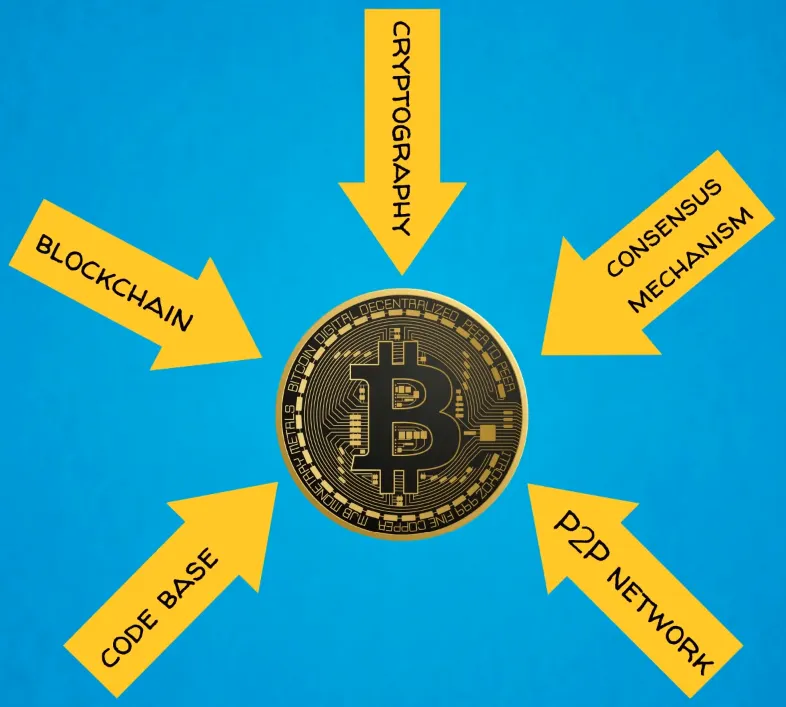
The main pillars of Bitcoin are the following fundamental technologies and concepts:
  • Blockchain or distributed ledger technology (DLT)
  • Cryptography
  • Consensus mechanism rooted in game theory, which, in this case, is Proof-of-Work
  • Peer-to-peer network
  • Software code base
We call this framework Bitcoin's five forces.
This framework can be seen in the following diagram:
In the next five chapters, we will delve into the specifics of each of these areas and will explain how they are combined to make Bitcoin's mechanism tick. Stay tuned, as things are getting really interesting!

The first force – blockchain

Finally, we got to the point where we can give a straight answer to the question, which everyone has been asking and which is central to this book—what is blockchain?
Blockchain is a decentralized database, which is distributed over a computer network, with each computer in that network storing an identical copy of the same database filesystem. In the context of financial transactions, this is also referred to as DLT because a ledger is an accounting book or a collection of financial records.
In finance, we use a ledger to record all accounting related to a specific entity. A company's bank account would have a ledger that contains many, many transactions. Every time money comes in, or goes out, a new entry would have to be registered in the ledger. In the same way, a blockchain distributed ledger keeps the same information related to a series of transactions across multiple computers, forming a peer-to-peer network.

Why blockchain is better

The idea of hundreds or thousands of computers storing the same file does sound a bit strange at first, doesn't it? It wouldn't be a surprise if your first thought was redundancy. But such redundancy provides security and ensures there is no central point of failure in the entire system. It protects from attempts to manipulate the system by bad actors.
This in turn provides the opportunity to eliminate any centralization or, in other words, to cut out the middlemen. Such decentralized blockchains work through a consensus mechanism or algorithm. There are different types of consensus algorithms and we'll cover the main ones later on in the book.
For the moment, it's important to understand that these consensus algorithms enable the different nodes (which are basically the participants in the network) to verify new transactions and maintain a uniform view of the up-to-date state of the ledger.

How blockchain works

After new transactions are verified, they are ordered and grouped into blocks, which are then linked to previous blocks. Each new block is built on top of the last block in chronological order.
Each of these blocks is a type of data structure containing information and, more precisely, transaction records. Generally, distributed databases can contain any kind of data, not just financial or economic data, but blockchain's security and design make it especially suitable to use for value exchanges. Hence, the expression that blockchain is the internet of value or the internet of money.
Transactions once put on the blockchain are normally irreversible and their record is permanent and immutable.
New blocks are created at regular intervals of time and are timestamped. Each new block is linked to the chain of previous blocks, hence the term blockchain.
We should note that Satoshi never mentioned blockchain in the original whitepaper. He mostly referred to the technology as a Proof-of-Work chain. The closest he came to saying blockchain was with phrases such as the next block in the chain or chain of blocks. The term blockchain was popularized by early Bitcoin companies, such as blockchain.info.
Next, we'll dig a bit deeper and discuss why blockchain has the potential to revolutionize the financial and industrial world and how it can improve the communication and informational asymmetries between trading partners.

Different types of blockchain

The usefulness of blockchain technology comes from its security, immutability, and transparency. All the nodes have access to the updated and verified information stored in the database simultaneously, and at all times. These features enable huge potential financial and industrial applications. Both the private and public sectors can benefit from blockchain technology. The following sections focus extensively on such applications and on the way blockchain can transform industries and businesses around the world.
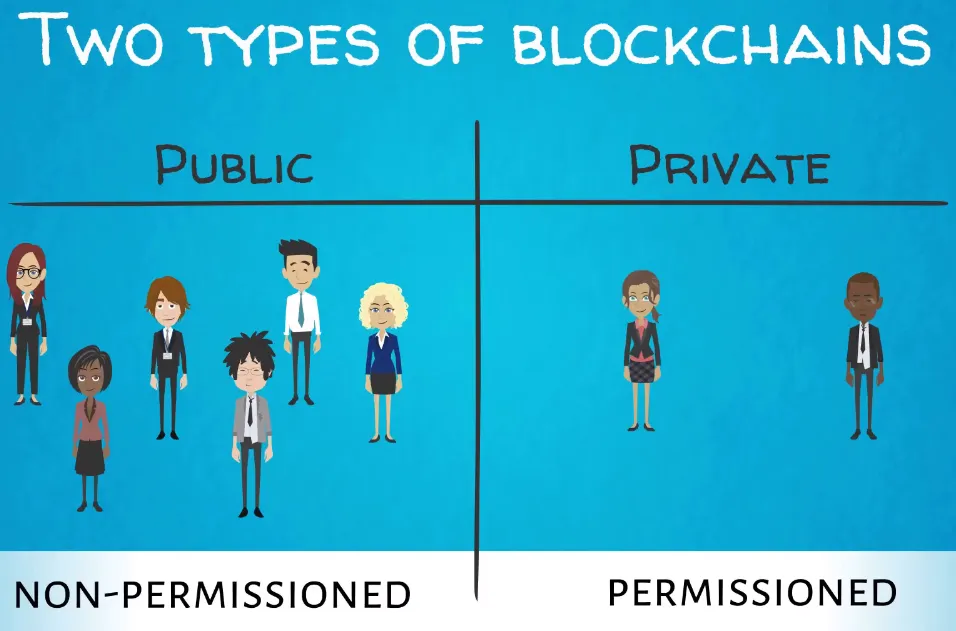
Before we move on, we should mention that blockchain can be classified broadly into two main categories:
  • Public or permission-less blockchains
  • Private or permissioned blockchains
This can be seen in the following diagram:
This distinction comes down to who owns the network infrastructure. It is similar to the distinction between the internet and corporate intranets.

Public blockchains

The first type is a public network, which everyone with the right hardware and software can join, support, and use. This is the case with the Bitcoin blockchain, as well as most other public cryptoassets. Here, the benefits of decentralization are the most prominent:

Private blockchains

The second type is owned by an organization or a consortium and is open only to its members or whoever has a permission to access it, which is granted by a gatekeeper. This is much closer to a centralized database, despite the fact that it's still a distributed computer system.
Many large financial institutions and other corporations are actively developing such private blockchains to streamline their operations and benefit from the efficiency blockchain architecture brings about, while still maintaining the privacy required for their internal operations.

Value of blockchain

We've already seen that recording information and organizing it in a ledger resembles an accounting system. Blockchain is a pretty sophisticated accounting system from a technological point of view, but still an accounting system.
A blockchain distributed ledger is stored and maintained by an entire computer network, rather than on a single computer, server, or piece of paper. This is a true element of innovation. If you are still not convinced by the value proposition blockchain brings, consider the fact that the accounting system as we know it today has existed since the 15th century.
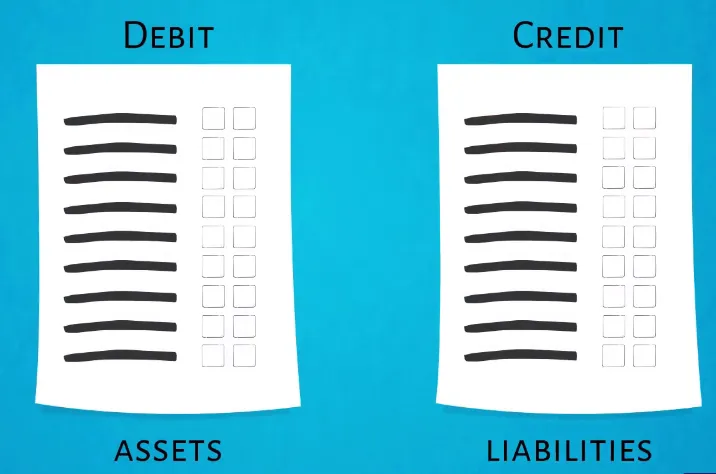
Yes, that's right! The double-entry accounting system was introduced by Luca Pacioli in 15th century Italy. It is based on the idea that we have two effects on each side of a transaction: a debit and a credit. This formed the basis for company balance sheets, which are ledgers of assets and liabilities (in other words, what a company owns and what it owes). By codifying these rules, Pacioli provided much needed order and tools to enable enterprises to scale efficiently and track and communicate all of their financial information. This is illustrated in the following diagram:
Over time, the complexity of economic transactions has increased, and business enterprises and government bodies can find it handy to have some new tools. In Pacioli's time, business audits were done regularly, on a daily basis. This is not the case anymore. It's impractical to have real-time reporting at the scale at which corporations operate nowadays, at least not in the traditional way. Such lack of accountability has resulted in a number of high-profile corporate disasters and bankruptcies. We've all heard the cases of Enron, WorldCom, and Bernie Madoff's Ponzi scheme, to name a few.
Blockchain can change all this! With its transparency, security, and immutability, it can provide almost real-time audited reporting to stakeholders and regulatory bodies. Imagine how much efficiency and further progress such technology can bring to the world!

Areas where blockchain can be handy

Think about the current state of the banking system. At present all banks are required to do careful due diligence on each and every one of their clients to prevent financial crime, such as money laundering and terrorist financing. This requirement is called know your customer (KYC) and takes a huge amount of time and paper processing by large teams at each bank. Each bank does KYC separately, so the process can be repeated many times over for the same clients if they have dealings with different financial institutions. Imagine how this process can be optimized if a group of banks shares a private blockchain, where each client is onboarded only once, and all parties can trust the information in it. The regulators and other government authorities could also access a...

Table of contents

  1. Title Page
  2. Copyright and Credits
  3. About Packt
  4. Contributors
  5. Preface
  6. Bitcoin, Blockchain, and Cryptoassets
  7. A Brief History of Money
  8. The Birth of Bitcoin and the Advantages of a Decentralized Payment System
  9. Five Forces of Bitcoin - #1 Blockchain
  10. Five Forces of Bitcoin - #2 Cryptography
  11. Five Forces of Bitcoin - #3 Consensus Algorithm
  12. Five Forces of Bitcoin - #4 P2P Network
  13. Five Forces of Bitcoin - #5 Software Code Base
  14. How Ethereum Took the Idea of Blockchain to the Next Level
  15. Ethereum - A Global Platform for Decentralized Applications
  16. Blockchains Focused on Specific Sectors and Use Cases
  17. Corporate Blockchains
  18. The Disruptive Potential of Blockchain Technology
  19. Blockchain and AI
  20. Current Issues and Potential Solutions to Take Blockchain to the Next Level
  21. Other Books You may Enjoy