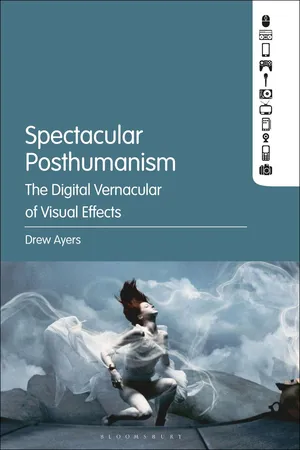
Spectacular Posthumanism examines the ways in which VFX imagery fantasizes about digital disembodiment while simultaneously reasserting the importance of the lived body. Analyzing a wide range of case studies-including the films of David Cronenberg and Stanley Kubrick, image technologies such as performance capture and crowd simulation, Game of Thrones, Terminator: Genisys, Planet Earth, and 300-Ayers builds on Miriam Hansen's concept of "vernacular modernism" to argue that the "vernacular posthumanism" of these media objects has a phenomenological impact on viewers. As classical Hollywood cinema initiated viewers into the experience of modernism, so too does the VFX image initiate viewers into digital, posthuman modes of thinking and being. Ayers's innovative close-reading of popular, mass-market media objects reveals the complex ways that these popular media struggle to make sense of humanity's place within the contemporary world.
Spectacular Posthumanism argues that special and visual effects images produce a digital, posthuman vernacular, one which generates competing fantasies about the utopian and dystopian potential of a nonhuman future. As humanity grapples with such heady issues as catastrophic climate change, threats of anonymous cyber warfare, an increasing reliance on autonomous computing systems, genetic manipulation of both humans and nonhumans, and the promise of technologically enhanced bodies, the anxieties related to these issues register in popular culture. Through the process of compositing humans and nonhumans into a seemingly seamless whole, digital images visualize a utopian fantasy in which flesh and information might easily coexist and cohabitate with each other. These images, however, also exhibit the dystopic anxieties that develop around this fantasy. Relevant to our contemporary moment, Spectacular Posthumanism both diagnoses and offers a critique of this fantasy, arguing that this posthuman imagination overlooks the importance of embodiment and lived experience.
- 264 pages
- English
- ePUB (mobile friendly)
- Available on iOS & Android
eBook - ePub
About this book
Information
Part One
Hybrid Bodies
In the lead-up to the release of Star Wars: Episode VII: The Force Awakens (Abrams 2015), the publicity surrounding the film took pains to distance this entry in the franchise from the previous—and widely despised—prequel films (Episodes I–III, Lucas, 1999–2005). At the heart of this extra-textual promotional rhetoric was an anxiety regarding the interplay of practical special effects and digital visual effects. Hailed as “the year of Hollywood’s practical effects comeback” by theverge.com, 2015 witnessed the release of a few notable blockbuster action films that emphasized their skillful negotiation between practical and digital effects (Opam 2015). Among these were Mission: Impossible—Rogue Nation (McQuarrie 2015)—Tom Cruise really hangs from an Airbus A400!; Mad Max: Fury Road (Miller 2015)—Miller really shot in the Namibian desert with a real flame-throwing guitar!; and Furious 7 (Wan 2015)—they “really freaking did drop cars from a C-130 airplane!” (Chan 2015). The production and marketing teams of these films seem to have internalized an anxiety over the phenomenological authenticity of their films, and as evidenced by behind-the-scenes “making of” featurettes, the promotional rhetoric highlights the profilmic aspects of the films while downplaying the digital components of the composite image. In other words, what is emphasized isn’t the novelty of CGI spectacle but rather the seamless and “invisible” combination of practical and digital effects. It’s so good, these promotional materials argue, that audiences won’t be able to tell the difference. (Or, using Dan North’s [2008] terminology, audiences won’t be able to “spot the joins.”)
Material promoting The Force Awakens, for example, attempts to counter the widespread fan dissatisfaction with the heavy use of CGI and VFX in the three Star Wars prequels. The discourse surrounding the film took pains to emphasize its practical special effects and the fact that it was shot on “real” 35 mm film. A promotional video from Comic-Con 2015 exemplifies this anxiety. The video begins with narration by Mark Hamill (Luke Skywalker), speaking to the analog desires and digital anxiety of the film:
Real sets, practical effects; you’ve been here, but you don’t know this story. Nothing’s changed, really. I mean everything’s changed, but nothing’s changed. That’s the way you want it to be, really. To see the way the technology has evolved, and yet, keeping one foot in the pre-digital world. (Star Wars 2015)
Accompanying this narration are images of miniature models, location-based sets, rubber costumes, and film moving through the gates of a real, live film camera. The goal of this promo reel is to link old and new, analog and digital worlds. It embraces our digital present (and future) while paying homage to our analog past.
While this merging of analog and digital, at least superficially, appears to be harmonious, there is a deeper anxiety at work here, one that fears the loss of profilmic authenticity at the expense of the digital. What we find in much of contemporary blockbuster action, science fiction, and fantasy cinema is an ambivalence toward embodiment and authenticity, an ambivalence that is typical of vernacular posthumanism. On the one hand, the film industry and its audiences, in a general sense, have accepted the widespread practice of digital tinkering in every part of the production workflow. Ranging from spectacular uses of VFX such as performance capture, massive crowd scenes, and epic battles, to more mundane uses like color correction, lighting, and environmental tweaks, digital trickery has become a core component of contemporary image production, from image acquisition, to post-production, to exhibition.
On the other hand, cinema displays an anxiety about its authenticity, and action and sci-fi cinema—genres long preoccupied with the physicality of the body—makes it a point to reassert the importance of the profilmic body amid digital environments, crowds, and agents. Lisa Purse, for example, in her analysis of “virtual action bodies” like Spider-Man (Spider-Man 2, Raimi 2004) and the Hulk (Hulk, Lee 2003), argues that the “inherent visual instability” of these virtual bodies creates an “unease” in the reception of these films (2007, 13). Purse later states that the virtual body’s “inherent malleability generates anxieties that are rooted in primal cultural fears about metamorphosis and its characterization of the human body as mutable” (2007, 15).
In contemporary cinema, the body, like the digital image, has become a composite, a layered construction that can be altered and manipulated. Just as the digital image is malleable and moldable, so too is the body. Both the image and the bodies within the image are subject to the logic of the digital information age, which requires that all things be reduced to the common equivalent of code, equally exchangeable and transferable with each other. Within this context, bodies become simply another expression of code, something that can be layered and composited within the digital image.
What the two chapters in this section are concerned with are the ways in which this logic of the image, with its attendant concerns of the interaction between profilmic and digital forces, produces hybrid bodies. These hybrid bodies straddle the analog and digital, keeping a foot in the world of practical effects while exploiting the advantages of digital effects. The images of these hybrid bodies also speak in a unique vernacular, one that models a particular kind of posthuman existence and initiates viewers into a posthuman mode of being. At times threatening, these bodies are eventually domesticated as they transition from practical to digital realization.
Beginning with a discussion of the films of David Cronenberg and concluding with an analysis of the technology of performance capture, this section draws connections and continuities between expressions of posthuman modes of being as imagined by both practical special effects and digital visual effects. Each technology and practice of vision offers unique ways of imagining the posthuman, and each is concerned with producing methods of augmenting the form of images for visual consumption. As my analysis will demonstrate, the transition from practical augmentation of the body to digital augmentation of the body was more an evolution than a revolution. One method has not replaced the other, and practical and digital effects are almost always used in combination with each other. In fact, the case studies featured throughout this book will highlight how the two are ontologically quite similar. The examples I discuss do, however, produce quite different fantasies and reveal quite different anxieties about the state of the lived body.
As a master of body horror and unsettling practical effects, Cronenberg provides an apt beginning to this journey in Chapter 1. Cronenberg’s films reveal deep anxieties about the violation of the human body and psyche, and in general, they present a dystopian view of the posthuman condition. Chapter 2 continues the theme of hybrid bodies with a discussion of technologies of performance capture, which take the movements and “performance” of an actor, combine these with software interpellation and animator input, and produce a virtual performance. Rather than focus on the images produced by performance capture, my analysis examines the technology that produces the images, and I view performance capture as a posthuman assemblage of human and nonhuman forces. Whereas the Cronenberg films discussed in Chapter 1 view the posthuman body as threatening, performance capture largely hides its apparatus of production, producing bodies that, for all of their technical wizardry, present a mundane, banal form of posthumanism, an everyday, vernacular vision of posthuman being. The digital images that performance capture produces present a utopian merging of human and machine wherein the apparatus of production becomes “invisible” and the human is seamlessly augmented and improved through its collaboration with technology.
1
Cronenberg’s New Flesh
David Cronenberg’s films violate not only the bodies of their characters but also their own bodies, the bodies of the films themselves. The technologies—both analog and digital—that produce Cronenberg’s images rupture both the profilmic bodies depicted on screen and the visual space established within the screen. In her seminal work on the topic of film phenomenology, The Address of the Eye, Vivian Sobchack argues that a film’s body—including the screen, the image, the recording apparatus, and projection equipment—is not merely something to be observed and experienced by the viewer. Rather, the film’s body itself possesses intentionality and sensuous existence. In other words, “the film is not … merely an object for perception and expression; it is also the subject of perceptions and expression” (Sobchack 1992, 167). Sobchack elaborates further:
If we allow that we are our bodies and their visibly intentional conduct in the world, if we reflect upon our existence and understand that we are the subjects of our visual experience as well as visual objects for other visual subjects, then we cannot but recognize that the film’s body and its visibly intentional conduct enjoy the same existential privilege. (1992, 248)
The body of film, according to Sobchack, should be viewed as an experiencing body on the same existential plane as all other bodies. Though the film’s body might not possess the same faculties of perception and cognition as the viewer’s body, the body of film is nevertheless a body with intention, a body that can return the looks of the viewer.
Here, Sobchack is, in her own way, predicting recent work in the fields associated with the “nonhuman turn,” which Richard Grusin defines as scholarship “engaged in decentering the human in favor of a turn toward and concern for the nonhuman, understood variously in terms of animals, affectivity, bodies, organic and geophysical systems, materiality, or technologies” (2015, vii). Including such subfields as actor-network theory (ANT), affect theory, animal studies, assemblage theory, brain sciences, new materialism, new media theory, speculative realism, and systems theory, the nonhuman turn, to borrow Ian Bogost’s pithy phrase, posits that “all things equally exist, yet they do not exist equally” (2012, 11). Rather than viewing nonhuman entities simply as products of human discourse or as creations of human perceptions and experiences of the world, work confronting the nonhuman views humans and nonhumans as entangled and implicated with each other. It denies hierarchies of being and advocates for a recognition of the unique modes of agency and subjectivity of all entities. As Bogost’s adage indicates, however, recognizing the equality of existence of all things does not require a denial of uneven relationships of power among humans and nonhumans.
Returning to Sobchack’s theory of film phenomenology, she views the film’s body as occupying an equal existential plane to that of the human viewer. Just as the viewer’s body inhabits the world in a very particular way with all of the attendant sensations, experiences, and perceptions produced by its encounter with the world, so too does the film’s body inhabit the world in its own unique way. Moreover, as with the viewer’s body, the film’s body both acts on and is acted upon by the world. The film’s body is not a neutral, inactive entity in the world. It both alters and is altered by that which it encounters. Other scholars, notably Laura Marks (2000, 2002) and Jennifer Barker (2009), have followed Sobchack in exploring, respectively, the “skin” of the film’s body and the living corporeality of the film’s body (including the film’s viscera and musculature). Elena del Rio has extended Sobchack’s film phenomenology and applied it to a Deleuzian theory of sensation and performance (2008). My own analysis of the body of Cronenberg’s films will follow the lines of flight of these scholars, noting in particular the extent to which the bodies on screen interact with the visual technologies and apparatuses used to produce those bodies.
Most of the protagonists in Cronenberg’s films experience some sort of physical transformation, evisceration of the flesh, or rending of the body—for example, Rose’s growth of a fleshy stinger in Rabid (1977); the various tumors, lesions, and placental sacs of characters in The Brood (1979); Max Renn’s abdominal VCR in Videodrome (1983); Seth Brundle’s grotesque transformation into an insect in The Fly (1986); the mechanized and sexualized wounds of Crash (1996); and the spinal bioports of eXistenZ (1999). These fleshy transformations don’t only take place at the level of profilmic representation, however. Like a surgeon cutting into the flesh of the body, so too does the technological apparatus of image production slice into the film’s body, and this is most evident in Dead Ringers, a film whose vernacular posthumanism adeptly models the sensations of the posthuman experience.
Dead Ringers tells the story of identical twins, Elliot and Beverly Mantle (both masterfully played by Jeremy Irons), who are highly successful and well-respected gynecologists. From a young age, the twins have been interested in matters of fertility and the female body, though they are notably disinterested in human reproduction itself, as well as its attendant emotional components. In the opening scene of the film, the young Mantle twins (they are probably around 12 years old) are discussing their newfound knowledge about sex. Sex, in their discussion, is not something erotic but rather something to be investigated scientifically and examined rationally. They’re curious about why humans need to have sex, and they conclude that, unlike fish, humans don’t live in water, so they must “internalize the water” for the sperm to reach the egg. Imagining an aquatic human and the type of sex they’d have, the twins decide:
Mantle Twin #1 (the twins aren’t named at this point): They’d have a kind of sex, but the kind where you wouldn’t have to touch each other.
Mantle Twin #2: I like that idea.
This scene is immediately followed by a short scene of the young twins performing “play” surgery on a small model of the body.
These opening moments of the film establish the distant, de-eroticized attitude toward sex shared by the Mantle twins. After a brief sequence establishing the twins’ success at Harvard medical school—due, in part, to their invention of a new surgical retractor—the film proceeds to show us the daily rhythms of the Mantle twins’ adult lives. The twins operate a successful and highly regarded fertility clinic, and they share all aspects of their lives. They frequently trade places at social events (though the film makes clear that Elliot is the more outgoing brother, while Beverly is the more reserved, bookish brother), they share an apartment, and they share lovers. Prior to the inciting incident of the film, the Mantle brothers appear to view sex as a simple biological need. Elliot woos the women, sleeps with them, and Beverly then swaps places with Elliot as the women’s lover. There is no indication that either twin views these relationships romantically, and they both seem to avoid emotional entanglements. Instead, the goal of the twins is to share one life between the two of them, each experiencing exactly what the other experiences.
Part of their strategy for achieving this shared existence is keeping a distance from the emotional messiness of romantic relationships and reproduction. Drawing on their youthful interest in seeing and knowing the female body, the Mantle twins’ medical practice is focused solely on female fertility. Their goal is not reproduction per se but rather manipulating the female body so that its potential to bear children might be realized. The Mantles are more concerned with controlling and modifying the female body than with seeing bodies proliferate out of their control through reproduction.1 An exchange from the film illustrates this point. During a consultation, a patient asks Beverly to examine her husband to see if he’s the problem with their inability to conceive a child. To which Beverly responds: “We don’t do husbands. We don’t deliver babies either. We make women fertile, and that’s all we do. To achieve anything in life, one has to keep life simple … don’t you think?”
This simplicity is exactly what the Mantle twins abandon when they take on actress Claire Niveau (Genevieve Bujold) as a patient. In his examination of Claire, Beverly discovers that she has a “trifurcated cervix,” which, while “fabulously rare,” renders Claire infertile. The twins each become fascinated with Claire, due in no small part to her physiological curiosity. Claire’s infertility renders her the ideal mate for the twins, as there is no potential for reproduction. The twins’ dual relationship with Claire, however, eventually causes a rupture in their relationship, and Beverly begins to show signs of wanting to keep her for himself, while Elliot sees Claire as simply another conquest for the brothers (he is attracted to her celebrity as an actress).
Beverly’s desire to live a separate life from his brother is what motivates the rest of the film and its tragic ending. In the scenes during their time at...
Table of contents
- Cover
- Halftitle Page
- Title Page
- Dedication Page
- Contents
- List of Figures
- Acknowledgments
- Introduction: Vernacular Posthumanism and VFX
- Part One: Hybrid Bodies
- Part Two: Digital Bodies and Authenticity
- Part Three: Machinic and Digital Spectacle
- Conclusion: A Drone Future
- Notes
- Bibliography
- Index
- Imprint
Trusted by 375,005 students
Access to over 1.5 million titles for a fair monthly price.
Study more efficiently using our study tools.
Frequently asked questions
Yes, you can cancel anytime from the Subscription tab in your account settings on the Perlego website. Your subscription will stay active until the end of your current billing period. Learn how to cancel your subscription
No, books cannot be downloaded as external files, such as PDFs, for use outside of Perlego. However, you can download books within the Perlego app for offline reading on mobile or tablet. Learn how to download books offline
Perlego offers two plans: Essential and Complete
- Essential is ideal for learners and professionals who enjoy exploring a wide range of subjects. Access the Essential Library with 800,000+ trusted titles and best-sellers across business, personal growth, and the humanities. Includes unlimited reading time and Standard Read Aloud voice.
- Complete: Perfect for advanced learners and researchers needing full, unrestricted access. Unlock 1.5M+ books across hundreds of subjects, including academic and specialized titles. The Complete Plan also includes advanced features like Premium Read Aloud and Research Assistant.
We are an online textbook subscription service, where you can get access to an entire online library for less than the price of a single book per month. With over 1.5 million books across 990+ topics, we’ve got you covered! Learn about our mission
Look out for the read-aloud symbol on your next book to see if you can listen to it. The read-aloud tool reads text aloud for you, highlighting the text as it is being read. You can pause it, speed it up and slow it down. Learn more about Read Aloud
Yes! You can use the Perlego app on both iOS and Android devices to read anytime, anywhere — even offline. Perfect for commutes or when you’re on the go.
Please note we cannot support devices running on iOS 13 and Android 7 or earlier. Learn more about using the app
Please note we cannot support devices running on iOS 13 and Android 7 or earlier. Learn more about using the app
Yes, you can access Spectacular Posthumanism by Drew Ayers in PDF and/or ePUB format, as well as other popular books in Media & Performing Arts & Film & Video. We have over 1.5 million books available in our catalogue for you to explore.