Why are filmmakers such as J.J. Abrams, Christopher Nolan and Quentin Tarantino continuing to shoot their movies on celluloid in the digital age of cinema? Are these filmmakers choosing the photochemical process of celluloid images purely for aesthetics purposes? Or could their preference for celluloid have something to do with analogue's intimate connection to the subject of lack and desire?
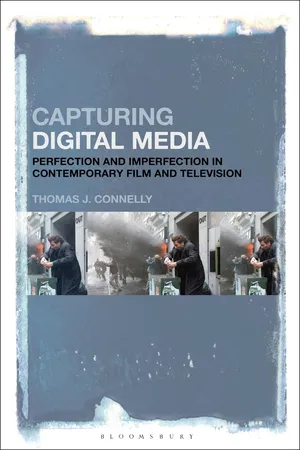
Capturing Digital Media: Perfection and Imperfection in Contemporary Film and Television examines the relationship between the perfection of the digital form and the imperfection of the human subject in recent film and television. Using a number of key psychoanalytic terms and new media concepts, Capturing Digital Media shows that the necessity of imperfection is where we locate the human subject of desire within the binary logic of the digital. It argues that the perfection of digital must be wounded by forms of imperfection in order to make media texts such as film and television desirable. But even as films and television texts incorporate forms of imperfection, digital perfection remains a powerful attraction in our engagement with moving images, such as high definition screens, spectacular digital effects, and state-of-the-art sound.
eBook - ePub
Capturing Digital Media
Perfection and Imperfection in Contemporary Film and Television
- 200 pages
- English
- ePUB (mobile friendly)
- Available on iOS & Android
eBook - ePub
Capturing Digital Media
Perfection and Imperfection in Contemporary Film and Television
About this book
Information
Chapter 1
Perfecting the Imperfect: Children of Men and War of theWorlds
The climactic “uprising” long take in Alfonso Cuarón’s sci-fi political thriller Children of Men has been recognized for its complex and detailed orchestration in establishing character and environment. Shot handheld, the sequence follows Theo (Clare Owen) as he navigates the gun battle between the refugees and the British. Theo is in search of Kee (Claire-Hope Ashitey) and her “miracle” baby. He has been hired to bring Kee to a group of scientists called the “Human Project” who are trying to find the cause of the worldwide plague of infertility. The uprising sequence is one of a number of long takes Cuarón employs in Children of Men as a means to create a “real time” effect. Visual effect supervisor Frazer Churchill stated that both Cuarón and his cinematographer Emmanuel Lubezki likened the style of Children of Men to Gillo Pontecorvo’s political film The Battle of Algiers (1966).1 Certainly Children of Men’s documentary style long takes remind us of André Bazin’s championing of cinematic realism. For Bazin, aesthetics such as the long take and depth of focus photography add “ambiguity into the structure of the image,” evoking an exploratory and heightened spectatorship without the intrusion of the cut.2 The uprising sequence offers a point-and-shoot perspective, emphasizing a “continuity of dramatic space”3 and shot duration that elevates viewers’ spectatorship as if they are literally dodging bullets alongside Theo. Yet the uprising long take was filmed in a number of sequences using digital compositing and invisible transitions to give the illusion of one continuous shot.
Cuarón’s long-take spectacle raises a number of discussion points pertaining to digital imagery and cinematic realism. The long take, traditionally, has not been a part of Hollywood’s mode of filmmaking because of its association with a pensive style of cinema often referred to as “slow cinema” and its emphasis on the passing of time. Although many filmmakers, such as Michelangelo Antonioni, Abbas Kiarostami, and Michael Haneke, have effectively utilized the long take as part of a shooting style that evokes a meditative and contemplative spectatorship, nothing is intrinsically slow about the long take. As such, the long take is open to other assigned meanings such as speed and acceleration as in the case of Children of Men. Cuarón’s use of the long take in the uprising sequence subordinates its construction of time and space in the same way an invisible style of editing attempts to elide viewers’ sense of mediation associated with classical Hollywood narration. At the same time, Cuarón’s documentary style and washed-out look imagines the science-fiction landscape, where the raw and imperfect are brought to the surface to create an immediate and realist effect.
The uprising sequence illustrates the ways in which digital media can assist filmmakers in achieving their vision as well as correcting mistakes in postproduction. As reported by Churchill, during one of the sequences, an explosion of fake human blood splatters onto the camera lens. But within moments, the blood on the lens gradually disappears through the use of digital animation. The blood squib was detonated prematurely, and Cuarón was unable to stop the take because so many elements in the sequence were happening at once. The “squib” incident clearly illustrates one of the challenges of containing contingencies and accidents in the elaborate production of the long take. But Cuarón decided to keep the mistake, which required two tasks for Churchill and his special effects team: they had to add more blood digitally to mask the transition in order to enjoin the next sequence—and then digitally remove the blood from the entire image before it became a distraction.4 The blood on the frame in Children of Men, in this respect, literally brings the presence of death to the frame as an overwhelming threat that must then be reduced to sustain viewers’ interest in the action unfolding in the narrative.
The uprising sequence and squib incident in Children of Men demonstrate what I describe as perfecting the imperfect. The erasure of mediation and the emphasis on the human presence behind the camera are two central features of the recent development of the long take. The production of the mobile long take historically has a strong correlation to the development of new film technologies to better stage and move the camera through cinematic space. This progress can be traced from early advents of camera supports to current uses of digital technologies and robotics. In certain cases, practitioners of cinema can impact technological advances in the moment of production. Recently, however, there has been a turn toward the imperfection of the long take, drawing attention to the camera’s presence and the degradation of the film image. The imperfection of the long take can be located in filmmakers’ purposeful insertion of mistakes, handheld photography, and degraded images. This “mistakist” style of filmmaking has certain tendencies of realist cinema in the desire to add the human and organic. At the same time, filmmakers such as Cuarón have paradoxically utilized digital technologies to create a spectatorship of imperfection and uncertainty in creating elaborate and hyperkinetic long takes. Part of understanding the interrelation of these two forces is the development of moving-image technologies in relation to Hollywood classic narration.
Perfecting the long-take and technological advances
Although quick cutting practices are the predominant style of most movies, the long take continues to fascinate filmmakers, whether it is used to establish character and space, such as the Copacabana nightclub scene in GoodFellas (1990) where the camera follows Henry Hill (Ray Liotta) and his girlfriend, Karen (Lorraine Bracco), from behind as they move through the labyrinth of the back entrance, the crowded kitchen area, and finally into the open space of the dining hall, or the pensive and haunting stillness of the long take of a Paris residence that opens Michael Haneke’s Caché (2005).
But the long take has also been a concern for Hollywood’s mode of production in subordinating the construction of narrative time and space. The long take traditionally has not been a part of Hollywood’s classic narrative because of its potential to reveal the construction of filmic time and space. To create the illusion of a seamless and transparent narrative, many movies, particularly Hollywood cinema, organize shots in a manner that aesthetically diminishes gaps and ambiguities. As David Bordwell explains in his study of the classical Hollywood style, the handling of narrative temporality and spatiality “gears our expectations toward the resolution of suspense,” which is evident, for example, in the deadline or appointment narrative.5 Speed has an intimate relationship to the invisible editing model because it immediately removes the presence of mediation for the purposes of narrative immersion. Narrative time and space are constructed through the mode of practices generated by the classical narrator system, and these modes must be compressed or remain absent from the story to create the illusion of a unified and transparent system of storytelling. Therefore, shot length becomes crucial in terms of compressing gaps and avoiding lingering dead time. By emphasizing dead time within a film’s narrative, or by dwelling longer on ambivalently motivated images, the system of mediation can potentially reveal itself to viewers. Instead of punctuating narrative causality, the film begins to question (or enter into dialogue with) the construction of time and space itself. For this reason, once the story is broken down and divided into shots, long takes, according to Bordwell, are usually discouraged in the classical Hollywood mode of production, because they can draw attention to the film’s mediation of time and space.
I do share Bordwell’s account that many films follow the mode of classical Hollywood narrative in avoiding ambiguities and unmotivated dead time. But there are numerous examples of the long take that attempt to heighten viewers’ spectatorship without drawing significant attention to a film’s mediating process. As long as we do not interpret the long take as always emphasizing duration that halts the narrative flow, long continuous shots are capable of producing the same effect of invisible editing that Bordwell sees as essential to classical Hollywood narrative.
Consider the long take in the Hampton robbery scene in Joseph H. Lewis’s crime drama Gun Crazy (1950). The sequence involves a bank heist, which transpires from the point of view of outlaws Bart and Annie, played by John Dall and Peggy Cummins. According to Lewis, the scene was four-pages long and scheduled for eleven camera shots, but he decided to film the scene in one long take. At the time, there were no camera support technologies available to Lewis for him to pull off this spectacular long take on location. Lewis used a stretch Cadillac and removed all of the seats to fit in the camera operator and a bare bones production crew. Eschewing the script, Lewis had actors Dall and Cummins improvise their dialogue to enhance the suspense and realism of the scene.6 Here the “real time” effect in the bank robbery scene rouses a high level of suspense and anticipation without drawing significant attention to the film’s construction of time and space as a distraction.
It is also important to stress that narrative films are rarely composed purely of long takes. We must consider that the long takes are part of a film style. Intra-sequence cuts, as well as editing patterns within a scene, can impact the expression of the long take in relation to the film as a whole. As Brian Henderson points out, “The long take is not in itself a principle of construction (in them), but is a part of a shooting style, or characteristic way of shooting and building sequences.”7 Orson Welles’s The Magnificent Ambersons (1942), for example, opens with fast-paced editing as a way of capturing the jubilant and affluent life of the Ambersons. But with the invention of the automobile, things gradually fall apart for the Ambersons. Welles represents this transformation through deliberate long takes that conspicuously slow the pacing of the film. In this regard, the film’s cutting pattern in relation to the long take plays an important role in both representing the decay of time and expressing the family’s tragic descent.
The commonality of the above examples is what I describe as the perfection of the long take. In them, the long take may speed up or slow down the pace and flow of information, but the staging and movement of the camera perpetuates a tradition of not drawing significant attention to its mediating presence, such as an intrusive camera bump or camera shake. Part of understanding this aspect of the long take is exploring how technological advancements of the camera have aided filmmakers in achieving their vision. It is worth highlighting a few of these achievements as a way to transition into today’s film technologies.8
German filmmaker F. W. Murnau’s camera style made a strong impression on Hollywood and camera support technologies of the 1920s. In Lutz Bacher’s detailed research on the mobile long take, he explains that technological developments of the motion picture camera during the last years of the silent period are a result of Murnau’s influence.9 Almost all film cameras at the time were hand-cranked by the camera operator; however, Murnau’s cinematographer, Karl Freund, used a Stachow camera, which was much lighter and had a spring-motor cranking mechanism.10 These small but effective new advances in camera technology helped Murnau and Freund focus specifically on sophisticated camera movements in order to further serve the narrative, such as the “unchained camera” in The Last Laugh (1924) that tracks backward and forward, up and down, and side to side as a means to express character interiority.
During the 1940s, more filmmakers such as Otto Preminger and Vincent Minnelli employed longer takes that involved intricate camera movement. This required new types of camera support to meet filmmakers’ aesthetic demands. A significant invention that emerged during this period was the crab dolly, a camera support that allowed more flexibility of movement. During the making of Hitchcock’s The Paradine Case (1947), cinematographer Lee Garmes and his camera crew had to solve the problem of filming a complex traveling long take. They came up with a four-wheeled dolly, which permitted the camera operator to move forward and turn sideways at a 90-degree angle—a method of steering termed “crabbing.” According to Garmes, the crab dolly “offered for the first time the means of shooting a continuous take and at the same time afforded all the variety of viewpoints that ordinarily would be achieved in a succession of takes made with the camera in different set ups at different angles.”11 The crab dolly proved fruitful in Hitchcock’s experiment with extreme long takes in Rope (1948), because the camera operator could follow the characters through space without jerky or obtrusive movements. The technology of dollying also helped Hitchcock solve the set problem of moving the camera from room to room. He placed the walls and furniture on wheels, so they could be easily and quietly pushed aside as the camera and characters moved in tandem. To Hitchcock, the success of Rope’s experimentation by necessity subordinates the presence of the moving camera with the help of the crab dolly and movable walls.
Perhaps more significant is the combination of camera and electronic supports that aid the moving camera. The video assist, for example, is a system which diverts light from the camera’s viewfinder into a video monitor for the camera operator and director to view and track the subject’s movements in space. The video assist could also be used for instant playback. But more importantly, the interfacing of the video monitor allowed more sets of eyes to work in tandem with the perspective of the camera operator, allowing better precision in filming complex takes—as with the intricate Steadicam movements through the corridors of the Overlook Hotel in Stanley Kubrick’s The Shining (1980).
The Steadicam photography in The Shining not only exemplifies Kubrick’s penchant for long takes and the moving camera, but also shows significant technical achievements in the production of the moving image. The Shining offers another example of new film technologies and camera supports being created in the moment of production. Kubrick was not satisfied with the quality of images being fed from the Steadicam to the video monitor, so he helped to design wireless transmitters that were hidden in the set so the camera could move freely. Garrett Brown, under the direction of Mick Mason and Harold Payne, also designed custom mounts on the Steadicam so it could be put on wheels. However, they needed a movable camera support or dolly that could closely and precisely follow Danny (Danny Lloyd) on his Big Wheel as he navigated the corridors of the hotel. Both Kubrick and Brown used the Ron Ford wheelchair prototype as the solution.
But it was not just moving the camera through the maze of the Overlook Hotel that interested Kubrick. He also employed the Steadicam for sta...
Table of contents
- Cover
- Half-Title
- Dedication
- Title
- Contents
- Acknowledgements
- Introduction: Analog and Digital Forms and Star Wars
- Chapter 1 Perfecting the Imperfect: Children of Men and War of theWorlds
- Chapter 2 Time-Looping Narrative: Source Code, Looper, and Edge of Tomorrow
- Chapter 3 The Database, Gaming, and First-Person Shooter Perspective in Gus Van Sant’s Elephant
- Chapter 4 Subjective Vision and the Intimate Spectacle: Cloverfield
- Chapter 5 Making Sense of Mumblecore
- Chapter 6 The Politics of Homemade Filmmaking: Y Tu Mamá También and End of Watch
- Chapter 7 Time-Shifting, Dreams, and Uncertainty in The Sopranos
- Chapter 8 Please Set Your Belief to 16:9
- Conclusion
- Notes
- Index
- Copyright
Trusted by 375,005 students
Access to over 1.5 million titles for a fair monthly price.
Study more efficiently using our study tools.
Frequently asked questions
Yes, you can cancel anytime from the Subscription tab in your account settings on the Perlego website. Your subscription will stay active until the end of your current billing period. Learn how to cancel your subscription
No, books cannot be downloaded as external files, such as PDFs, for use outside of Perlego. However, you can download books within the Perlego app for offline reading on mobile or tablet. Learn how to download books offline
Perlego offers two plans: Essential and Complete
- Essential is ideal for learners and professionals who enjoy exploring a wide range of subjects. Access the Essential Library with 800,000+ trusted titles and best-sellers across business, personal growth, and the humanities. Includes unlimited reading time and Standard Read Aloud voice.
- Complete: Perfect for advanced learners and researchers needing full, unrestricted access. Unlock 1.5M+ books across hundreds of subjects, including academic and specialized titles. The Complete Plan also includes advanced features like Premium Read Aloud and Research Assistant.
We are an online textbook subscription service, where you can get access to an entire online library for less than the price of a single book per month. With over 1.5 million books across 990+ topics, we’ve got you covered! Learn about our mission
Look out for the read-aloud symbol on your next book to see if you can listen to it. The read-aloud tool reads text aloud for you, highlighting the text as it is being read. You can pause it, speed it up and slow it down. Learn more about Read Aloud
Yes! You can use the Perlego app on both iOS and Android devices to read anytime, anywhere — even offline. Perfect for commutes or when you’re on the go.
Please note we cannot support devices running on iOS 13 and Android 7 or earlier. Learn more about using the app
Please note we cannot support devices running on iOS 13 and Android 7 or earlier. Learn more about using the app
Yes, you can access Capturing Digital Media by Thomas J. Connelly in PDF and/or ePUB format, as well as other popular books in Social Sciences & Film History & Criticism. We have over 1.5 million books available in our catalogue for you to explore.