eBook - ePub
Available until 23 Dec |Learn more
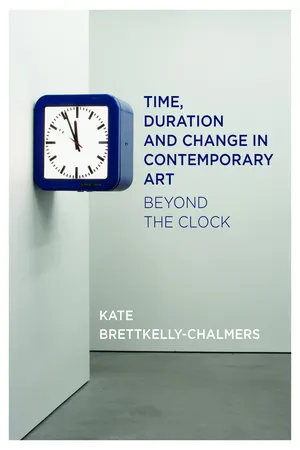
Time, Duration and Change in Contemporary Art
Beyond the Clock
This book is available to read until 23rd December, 2025
- English
- ePUB (mobile friendly)
- Available on iOS & Android
eBook - ePub
Available until 23 Dec |Learn more
About this book
Time, Duration and Change in Contemporary Art presents a major study of time as a key aesthetic dimension of recent art practices. This book explores different aspects of time across a broad range of artistic media and draws on recent movements in philosophy, science and technology to show how artists generate temporal experiences that resist the standardized time of modernity: Olafur Eliasson's melting icebergs produce fragile temporal ecologies; Marina Abramovi?'s performances test the durations of the human body; Christian Marclay's The Clock conflates past and present chronologies.
This book examines alternative frameworks of time, duration and change in prominent philosophical, scientific and technological traditions, including physics, psychology, phenomenology, neuroscience, media theory and selected environmental sciences. It suggests that art makes a crucial contribution to these discourses not by 'visualizing' time, but by entangling viewers in different sensory, material and imaginary temporalities.
This book examines alternative frameworks of time, duration and change in prominent philosophical, scientific and technological traditions, including physics, psychology, phenomenology, neuroscience, media theory and selected environmental sciences. It suggests that art makes a crucial contribution to these discourses not by 'visualizing' time, but by entangling viewers in different sensory, material and imaginary temporalities.
Frequently asked questions
Yes, you can cancel anytime from the Subscription tab in your account settings on the Perlego website. Your subscription will stay active until the end of your current billing period. Learn how to cancel your subscription.
No, books cannot be downloaded as external files, such as PDFs, for use outside of Perlego. However, you can download books within the Perlego app for offline reading on mobile or tablet. Learn more here.
Perlego offers two plans: Essential and Complete
- Essential is ideal for learners and professionals who enjoy exploring a wide range of subjects. Access the Essential Library with 800,000+ trusted titles and best-sellers across business, personal growth, and the humanities. Includes unlimited reading time and Standard Read Aloud voice.
- Complete: Perfect for advanced learners and researchers needing full, unrestricted access. Unlock 1.4M+ books across hundreds of subjects, including academic and specialized titles. The Complete Plan also includes advanced features like Premium Read Aloud and Research Assistant.
We are an online textbook subscription service, where you can get access to an entire online library for less than the price of a single book per month. With over 1 million books across 1000+ topics, we’ve got you covered! Learn more here.
Look out for the read-aloud symbol on your next book to see if you can listen to it. The read-aloud tool reads text aloud for you, highlighting the text as it is being read. You can pause it, speed it up and slow it down. Learn more here.
Yes! You can use the Perlego app on both iOS or Android devices to read anytime, anywhere — even offline. Perfect for commutes or when you’re on the go.
Please note we cannot support devices running on iOS 13 and Android 7 or earlier. Learn more about using the app.
Please note we cannot support devices running on iOS 13 and Android 7 or earlier. Learn more about using the app.
Yes, you can access Time, Duration and Change in Contemporary Art by Kate Bretkelly-Chalmers in PDF and/or ePUB format, as well as other popular books in Art & Art General. We have over one million books available in our catalogue for you to explore.
Information
Part I
Chapter 1
Marking Time in Conceptual Art
On 4 January 1966, the Japanese artist On Kawara made the first work of the Today series: a simple, monochromatic painting that declared the day’s date. That year, the German artist Hanne Darboven began annotating a chain of mathematical permutations that were also based on the divisions of the Roman calendar. Her drawings would become part of the Konstruktionen series: thousands of handwritten calculations collated into annual volumes. A year earlier, in Warsaw, the Polish artist Roman Opalka created the first painting of what would become a decades–long series. This painting begins with the number 1 inscribed in white paint in the top left-hand corner of the canvas and ends with the number 35,327 in the lower right corner. Opalka would continue to paint numbers in strict sequential order, filling hundreds of canvases with linear inscriptions. This remarkable conceptual art project, and those by Kawara and Darboven, would continue for the next 40 years, each concluding in the first decades of the twentieth century.3
This chapter explores the significant artistic commitment to observing the time of numbers in works by Kawara, Darboven and Opalka. Their conceptual projects are important because they offer a means of scrutinizing the global prominence of time as a numerical system of measurement – the great universal gauge of all worldly activities. While many of the artists discussed in this book have sought out durational alternatives to the strictures of this temporal standard, Kawara, Darboven and Opalka each adopted the time of numbers as the abiding logic of their works of art. On a daily basis, these artists created paintings and drawings whereby time was marked in numerical increments – temporal values that are, in turn, given to describe the notable longevity of their respective conceptual projects.
Like many conceptual artists of the 1960s, Kawara, Darboven and Opalka established artistic systems and procedures that challenged traditional western artistic conventions, such as pictorial representation and precious material value. Their works communicate information, not through figurative means, but through officious and seemingly bureaucratic systems of numerical measurement. Stepping away from these important art histories, this chapter considers what the long-term conceptual works by Kawara, Darboven and Opalka actually say about time itself. It explores how these projects contribute to the Enlightenment principle that mathematical time should stand apart from the world as a solid, reliable measure of change and activity and its techno-scientific legacy: the remarkable global standardization of time across the industrial era.
Works by Kawara, Darboven and Opalka are especially compelling because, while they truly embrace numerical time as an authoritative measure of their own activities, they also ‘take’ time itself. The act of artistic measurement is never far removed from the artistic activities of the body that it, in turn, seeks to measure. Marcel Duchamp’s critique of spatial standardization in the work Three Standard Stoppages (1913–14) offers a useful point of comparison in considering how the tautological procedures employed by Kawara, Darboven and Opalka cast doubt on the objective authority of universal time. While they lack Duchamp’s satirical bite, their conceptual projects sustain an important critique of the time of standardized numbers and its relationship to the labouring activities of the body.
Absolute time, mathematical and true
The history of seventeenth-century scientific and philosophical transformations is certainly well-known, but is worth reiterating here because the temporal principles introduced by thinkers such as Isaac Newton and Immanuel Kant continue to shape the modern understanding of time. The great inventor of calculus, Newton famously conceived of a ‘River of Time’ that stood as the reliable measure of all people, properties, objects and events. While the scientific description of time as an independent dimension would be entirely undone by Albert Einstein’s 1905 special theory of relativity – a subject discussed in Part III of this book – the philosophical premise of a universal timescale still underpins the contemporary authority of the 24-hour time standard. Time exists like a great ‘clock in the sky’ that unites all differences and divergences under a single temporal umbrella.
In the late seventeenth century, Newton’s major achievement was to overturn the prevailing scientific wisdom in positing ‘absolute time’ as a fixed mathematical entity. The dominant Aristotelian belief was that time was not a separate and distinct dimension, but the measure of physical motion: a derivative of the movement of worldly objects and events, natural rhythms and changeable phenomena. By contrast, Newton famously insisted that ‘absolute, true, mathematical time’ existed for and of itself; flowing ‘equably without relation to anything external’.4 Unfastened from the seemingly capricious and unpredictable rhythms of the natural world, Newton’s absolute time stood as a temporal ‘container’ – one that was fundamentally indifferent to its own contents.
At the very beginning of his celebrated book on time and film, Cinema 2: The Time-Image, Gilles Deleuze acknowledges Immanuel Kant’s role in completing this philosophical and scientific transformation. He writes: ‘from the Greeks to Kant, a revolution took place in philosophy: the subordination of time to movement was reversed…’5 Kant did not entirely oblige the autonomy of Newtonian time because he could not conceive of a temporality that was independent of the human perceptual capacities to grasp it.6 But he did embrace the application of a strict mathematical time to the objects and events that do appear in phenomenal experience. Kant’s philosophical position is well known: time maintains a special status as an ideal and transcendent dimension that, while not directly given in human experience, exists as the universal condition of all experiential appearances. These conditions are fundamental inasmuch as they transcend historical, cultural and social contexts. In short, the Kantian subject can experience objects and events ‘in’ time, and organize these activities according to mathematical intervals, because this time is already ‘hardwired’ in the brain as part of its inherent cognitive architecture.7
Ultimately, the legacy of Kant and Newton’s thought is a time of rational certainty that structures both human experience and the world beyond it.8 This time presents an unequivocal and reliable standard that consists of a past that does not change, a present that is quantifiable and, most importantly, a future that can be predicted. What is lost to this determinist picture of the universe is a time of movement, change, dynamism and becoming – a subject that will become significant for the artists discussed in Part IV of this book.
Modern time, standardized and universal
Beginning roughly in the middle of the nineteenth century and drawing to a close with the First World War, the great social and technological transformations of the industrial era were underscored by the rationalist temporal ambitions of the Enlightenment. In the ever-expanding imperial territories of Europe, Great Britain and Northern America, time was established as a universal standard that regulated both labour practices and the exchange of goods and information. While the 24-hour timescale and the seven-day week derive from the Babylonian sexagesimal system and Gregorian calendar, the global time standard is a relatively recent temporal convention. At the International Meridian Conference of 1884, a quorum of world powers agreed to measure time at the point at which the sun passed the Prime Meridian marker in Greenwich, England, thereby establishing a global standard that united a variety of independent and local timekeeping systems.
The social geographers Jon May and Nigel Thrift offer one of the most comprehensive and nuanced accounts of how the industrial era shaped basic understanding and experiences of time.9 They write that the swift expansion of railway networks allowed for hugely dispersed territories to be traversed, occupied and settled at a pace not seen before.10 Similarly, the exchange of information along telegraphic wires meant that systems of communication became detached from the physical journeys and concrete geographic borders to which they were once bound. Simply put, the world was seen to become faster and closer – a technocratic transformation that Karl Marx famously described as the ‘annihilation of space by time’.11
Such changes are understood as a source of both wonderment and anxiety: a transformative means of cultural ‘advancement’, but also a machinic framework of control and coercion. New technologies of exchange aided in the modernist progression of ‘advanced’ societies, but they were also seen to hasten the seemingly natural speed of both work and life in a way that put acute pressure on the individual who simply could not keep up with the pace of change. That time and technology are ‘too fast’ for our lives is a key narrative of modernity. Charlie Chaplin’s aptly named Modern Times (1936) offers the perfect cinematic image of this sentiment, in which the iconic figure of the Little Tramp is pulled through the rotating cogs of a giant factory conveyor belt – a clock-like mechanism that appears to squeeze his small and comically floppy body.
A number of media theorists and historians have drawn a special analogy between this sense of technological acceleration in the industrial age and the temporal values of our digital era.12 The social theorist Judy Wajcman writes that the telegraph in particular caused ‘people to wonder, much as the Internet does today, about the rapid and extraordinary shifts it wrought in the spatial and temporal boundaries of human relationships’.13 Modern time has since lost its geographic and solar markers in favour of atomic measurement that completely exceeds human observational capacities altogether. The fiercely precise atomic clock defines a single second as the ‘time it takes a Cesium-133 atom at the ground state to oscillate exactly 9,192,631,770 times’.14 Imperceptible to the human eye, these microscopic vibrations offer a system of measurement that will only deviate one second every twenty million years.
How and why the time of modernity and the time of the digital era are related is the subject of some debate that is explored in greater depth in Chapter 2. For the art historian Charlie Gere, the emancipatory promise of modern technological change has ultimately become ‘the means by which the human element was – and indeed still is – being increasingly marginalized by a system which is too complex and operates too fast to tolerate such elements’.15 For other thinkers, including May, Thrift and Wajcman, this picture of technological change is not nearly as singular or determinate. These social theorists understand technology not as an external force, but a social practice that is shaped by cultural and societal conditions – an idea also pursued in the following chapter.16
At face value, the meticulous and somewhat austere systems of Kawara’s Today series, Darboven’s Konstruktionen project and Opalka’s Infinity series do embrace the modern, technocratic authority of numerical time. Day in and day out, these artists steadfastly marked time by applying paint to canvas and ink to paper. In some sense, their bodies could be seen to assume the mechanical ‘tick’ of the machine: repetitive, numerical, highly rational and precise.
Nonetheless, these significant conceptual art projects should not be thought of as simple temporal markers – they are not timekeeping devices. Kawara’s, Darboven’s and Opalka’s conceptual systems are social practices of time that scrutinize and even subvert its modern authority over the labouring body. The most compelling feature of each of these projects is a tautological twist: Kawara, Darboven and Opalka ‘take’ time to mark time. Their repetitive procedures lend a human intimacy to a timescale whose very purpose is to float above that which it measures – they cast doubt on its numerical indifference to the everyday vicissitudes of life and work.
Painting t...
Table of contents
- Cover Page
- Title Page
- Copyright
- Contents
- Acknowledgements
- Introduction
- Part I: Time
- Part II: Duration
- Part III: (Interregnum): Relativity
- Part IV: Change
- Stone in Hand: A Brief Conclusion
- Note
- Bibliography
- Index