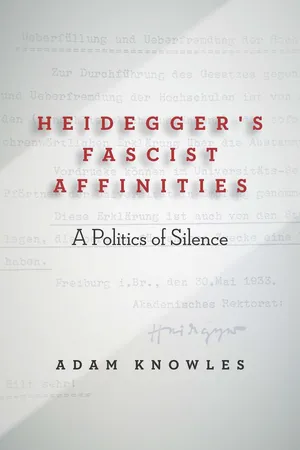
Reexamining the case of one of the most famous intellectuals to embrace fascism, this book argues that Martin Heidegger's politics and philosophy of language emerge from a deep affinity for the ethno-nationalist and anti-Semitic politics of the Nazi movement. Himself a product of a conservative milieu, Heidegger did not have to significantly compromise his thinking to adapt it to National Socialism but only to intensify certain themes within it. Tracing the continuity of these themes in his lectures on Greek philosophy, his magnum opus, Being and Time, and the notorious Black Notebooks that have only begun to see the light of day, Heidegger's Fascist Affinities argues that if Heidegger was able to align himself so thoroughly with Nazism, it was partly because his philosophy was predicated upon fundamental forms of silencing and exclusion. With the arrival of the Nazi revolution, Heidegger displayed—both in public and in private—a complex, protracted form of silence drawn from his philosophy of language. Avoiding the easy satisfaction of banishing Heidegger from the philosophical realm so indebted to his work, Adam Knowles asks whether what drove Heidegger to Nazism in the first place might continue to haunt the discipline. In the context of today's burgeoning ethno-nationalist regimes, can contemporary philosophy ensure itself of its immunity?
- 251 pages
- English
- PDF
- Available on iOS & Android
eBook - PDF
About this book
Information
Publisher
Stanford University PressYear
2019Print ISBN
9781503608788
9781503608191
eBook ISBN
9781503608795
Table of contents
- Cover
- Contents
- Acknowledgments
- List of Abbreviations
- Prologue: Hidden in Plain Sight
- 1 Heidegger’s Politics of Silence
- 2 Völkisch Affinities and Renewal of the German Spirit
- 3 The Unsaid in Being and Time
- 4 Withdrawal in Aristotle’s Metaphysics
- 5 Being the Measure: The Pedagogy of Male Self-Mastery
- 6 Being without Measure: Silencing the Feminine
- 7 Land and Volk: The Silent Place of the Black Notebooks
- Epilogue: Philosophy and Totalitarianism
- Notes
- References
- Index
Trusted by 375,005 students
Access to over 1.5 million titles for a fair monthly price.
Study more efficiently using our study tools.
Frequently asked questions
Yes, you can cancel anytime from the Subscription tab in your account settings on the Perlego website. Your subscription will stay active until the end of your current billing period. Learn how to cancel your subscription
No, books cannot be downloaded as external files, such as PDFs, for use outside of Perlego. However, you can download books within the Perlego app for offline reading on mobile or tablet. Learn how to download books offline
Perlego offers two plans: Essential and Complete
- Essential is ideal for learners and professionals who enjoy exploring a wide range of subjects. Access the Essential Library with 800,000+ trusted titles and best-sellers across business, personal growth, and the humanities. Includes unlimited reading time and Standard Read Aloud voice.
- Complete: Perfect for advanced learners and researchers needing full, unrestricted access. Unlock 1.5M+ books across hundreds of subjects, including academic and specialized titles. The Complete Plan also includes advanced features like Premium Read Aloud and Research Assistant.
We are an online textbook subscription service, where you can get access to an entire online library for less than the price of a single book per month. With over 1.5 million books across 990+ topics, we’ve got you covered! Learn about our mission
Look out for the read-aloud symbol on your next book to see if you can listen to it. The read-aloud tool reads text aloud for you, highlighting the text as it is being read. You can pause it, speed it up and slow it down. Learn more about Read Aloud
Yes! You can use the Perlego app on both iOS and Android devices to read anytime, anywhere — even offline. Perfect for commutes or when you’re on the go.
Please note we cannot support devices running on iOS 13 and Android 7 or earlier. Learn more about using the app
Please note we cannot support devices running on iOS 13 and Android 7 or earlier. Learn more about using the app
Yes, you can access Heidegger's Fascist Affinities by Adam Knowles in PDF and/or ePUB format, as well as other popular books in Philosophy & Phenomenology in Philosophy. We have over 1.5 million books available in our catalogue for you to explore.