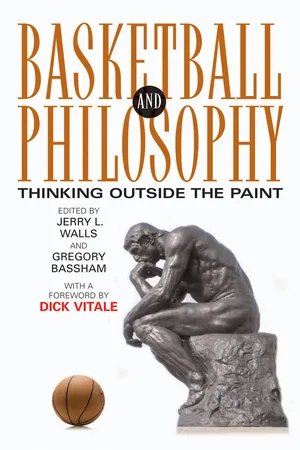
What can the film Hoosiers teach us about the meaning of life? How can ancient Eastern wisdom traditions, such as Taoism and Zen Buddhism, improve our jump-shots? What can the "Zen Master" (Phil Jackson) and the "Big Aristotle" (Shaquille O'Neal) teach us about sustained excellence and success? Is women's basketball "better" basketball? How, ethically, should one deal with a strategic cheater in pickup basketball? With NBA and NCAA team rosters constantly changing, what does it mean to play for the "same team"? What can coaching legends Dean Smith, Rick Pitino, Pat Summitt, and Mike Krzyzewski teach us about character, achievement, and competition? What makes basketball such a beautiful game to watch and play? Basketball is now the most popular team sport in the United States; each year, more than 50 million Americans attend college and pro basketball games. When Dr. James Naismith, the inventor of basketball, first nailed two peach baskets at the opposite ends of a Springfield, Massachusetts, gym in 1891, he had little idea of how thoroughly the game would shape American—and international—culture. Hoops superstars such as Michael Jordan, LeBron James, and Yao Ming are now instantly recognized celebrities all across the planet. So what can a group of philosophers add to the understanding of basketball? It is a relatively simple game, but as Kant and Dennis Rodman liked to say, appearances can be deceiving. Coach Phil Jackson actively uses philosophy to improve player performance and to motivate and inspire his team and his fellow coaches, both on and off the court. Jackson has integrated philosophy into his coaching and his personal life so thoroughly that it is often difficult to distinguish his role as a basketball coach from his role as a philosophical guide and mentor to his players. In Basketball and Philosophy, a Dream Team of twenty-six basketball fans, most of whom also happen to be philosophers, proves that basketball is the thinking person's sport. They look at what happens when the Tao meets the hardwood as they explore the teamwork, patience, selflessness, and balanced and harmonious action that make up the art of playing basketball.
eBook - ePub
Basketball and Philosophy
Thinking Outside the Paint
- 304 pages
- English
- ePUB (mobile friendly)
- Available on iOS & Android
eBook - ePub
Basketball and Philosophy
Thinking Outside the Paint
About this book
Information
Publisher
The University Press of KentuckyYear
2007Print ISBN
9780813191867
9780813124353
eBook ISBN
9780813138145
Topic
PhilosophySubtopic
Philosophy History & TheoryFOURTH QUARTER
Metaphysical Madness
SHOOTING WITH CONFIDENCE
THE HISTORY OF basketball is full of three o'clock superstars you've never heard of. They consistently hit nine out of ten shots from outside the three-point arc, and it's not unusual for them to have made their last fifty free throw attempts. Absolute superstars they are. But they do all this at three o'clock—during team practices and pregame shootarounds. Once the eight o'clock tip-off comes, they're completely different players. In games they suddenly become shaky free throw shooters, and their three-point percentage plummets toward single digits.
Ever hear of Josh Carrier? He played for the University of Kentucky from 2001 to 2005. During his senior year alone, Kentucky played on national television over a dozen times. But if you've never heard of him, it's understandable: he was rarely on the floor. Although he was a highly recruited three-point specialist, and although from all reports he consistently torched the nets in practice, his shooting prowess never transferred to game-time situations. In limited playing time, he finished his career shooting 26 percent from the three-point line, 29 percent from the field, and a dismal 42 percent from the foul line.
Many college teams have their own Josh Carrier: a player who lights it up in practice and sometimes dominates team scrimmages. A player whom fans see in summer pickup games and then run off to hype to the skies in Internet chat rooms. But all these hopes end in disappointment. In the tense atmosphere of game situations, their confidence evaporates into thin air, and with it seems to go their talent as well.
Why the Dramatic Drop in Performance?
This kind of drop in a player's performance is obviously linked to his emotions. We all have experiences on a daily basis that illustrate the truth that our emotions can greatly impact our physical bodies. Our hearts race and our palms sweat when we anticipate a first date. When we're nervous about speaking in public, our mouths become dry. When we're making a sales presentation to an important client, our hands shake. When we're scared, we feel sick to our stomach and weak in the knees.
Athletes of all kinds know all too well the physical effects of emotions like nervousness and anxiety. Celtics great Bill Russell routinely used to throw up before big games. Billiard players talk about their arms feeling as though they weigh fifty pounds each when a crucial frame is on the line. For basketball players, it's not difficult to imagine how the involuntary physical effects of emotional pressure might throw off their jump shot.
But what exactly is the source of these negative emotions for basketball players? And, more important, is there any way for a player to control these emotions? Is there any hope that three o'clock superstars can learn to channel the confidence they feel in practice to big games, where it really counts?
Let's begin our diagnosis by noting that there are two different sources for such detrimental emotions. The first source doesn't involve the player's beliefs, but the second does.
Oh My! What Was He Thinking?!
Emotions can arise in us even before we're aware of how stressful our situation is. Sometimes the sheer scope and unfamiliarity of an environment are enough to send emotions rushing through us, even before we've had time to reflect on what's happening. Consider the special feel of a play-off game at tip-off time, or the deafening noise of a hostile crowd, or the confusion of a last-second scramble to try to run a play when the game is on the line. These things can cause a player to go into emotional overload. And with these acute emotions come the physical effects we fans have come to recognize. The player feels his head spinning. He loses his bearings on the court. We speak of a player getting “rattled” or looking like a deer caught in a car's headlights.
The classic example of getting rattled in this way has to be Georgetown's Fred Brown, who gave North Carolina the 1982 NCAA championship when he passed the ball to James Worthy in the closing seconds of the game. Of course, Fred was nearly outdone eleven years later when Michigan's All-American center Chris Webber made repeated efforts in the closing moments of the game to ensure another Carolina victory, including calling a timeout that Michigan didn't have.1 These are times when the emotions of the moment interfere with the brain's ability to process information as it normally would, times that allow Dick Enberg to utter his trademark, “Oh my, what was he thinking?!”
Sports psychologists sometimes teach relaxation techniques to players. The players might be told to imagine themselves in a familiar or “safe” place like their practice gym. The players are taught to breathe deeply and slowly. These are techniques for combating the first kind of detrimental emotion: the kind that arises simply from the pressure and unfamiliarity of the moment. Sometimes these techniques work. But if you take a freshman point guard, and put him in a Final Four game televised around the world, and throw a full-court press at him that his coach didn't have time to go over at the pregame meeting … well, I don't care what breathing techniques he's been taught, he's going to get rattled!
Shaky Beliefs = Shaky Jump Shot
The second source of choke-producing emotions is more widely experienced than the first and is therefore of even more interest to us. This second source involves a player's beliefs.
Everyday examples make clear the connection between beliefs and emotions. If you're speeding on the highway and believe you see a policeman on the shoulder of the road holding a radar gun, you experience a rush of emotion. If you believe your child might have wandered off at the mall, you feel a sudden jolt of panic. If you're a guy at the arena and you suddenly realize there are no urinals in the restroom you absentmindedly walked into, again there's a rush of emotion.
In each of these cases, you want things to be a certain way. You desire not to get a speeding ticket; you desire not to lose your child; you desire that you not be caught in the ladies’ room. And when you believe that these desires might not be fulfilled, you experience a rush of blood and adrenaline and the corresponding emotions of fear and anxiety.
So it is in basketball. Every player wants to do well, to be a hero instead of a goat. Every player desires to make his next shot. But when a player starts to believe that the next shot might not go in, then the emotions of fear and anxiety start to surface. And we've already seen how such emotions can throw off a player's shooting.
The interesting question now becomes: is there a way for a player to control her beliefs? When fans sense that one of their home players is playing tentatively, they sometimes yell, “C'mon! Shoot it!” They're urging the player to trust in her ability, to believe in herself. But can a player choose to believe that her next shot will go in?
You've Gotta Believe, Son, You've Gotta Believe
Our everyday language suggests that we can sometimes choose what we will believe. We say things like, “I refuse to believe that,” “Why won't you believe me?” and “I've decided that such a course of action would be a mistake.” Despite what this language suggests, however, there is a big looming problem. Philosophers have offered powerful arguments that no one is capable of deciding to believe anything.
To see the philosophical problem inherent in the idea of choosing to believe something, consider the difference between believing something to be true and wanting it to be true. Suppose I told you that Dennis Rodman was in a local bookstore signing copies of his latest book, A Wallflower in the NBA. You might take my word for it and believe that he's in the bookstore. Wanting to let Rodman know what you think of his rapacious rebounding and shameless exhibitionism, you might also want him to be in the bookstore. So, as you hop in your car and head for the bookstore, you both believe and desire that he's there signing books.
As you enter the store, you see that there is no book signing and that I was only pulling your leg. What happens to your desire? Well, nothing. You can still desire that Dennis Rodman be in the bookstore. You can even choose to imagine that he's in the store. But you won't be able to believe that he's in the bookstore. And this is because our beliefs have a certain connection to the truth that our desires and imaginings do not.
Our beliefs—unlike our desires and imaginings—are representational in nature. They represent what we think is already true of the world. As the philosopher Bernard Williams (1929-2003) puts it, our beliefs “aim at truth,” that is, “purport to represent reality.”2 In other words, to hold a belief is to think that the belief represents some fact about the actual world. Now, if I could somehow choose to believe something, Williams points out, then I would realize that my belief stems from my own free choice, and thus doesn't necessarily have any connection with facts about the actual world. But now we have a big problem. For, if I realize that my belief doesn't necessarily have any connection with what's true about the actual world, then it's not a belief in the first place!
Another way of putting this is to say that our beliefs are our “maps” of the world. Just as a map represents what's true of the actual world, so, hopefully, do our beliefs. Imagine if a mapmaker were to choose where to put the borders of the fifty states. Suppose he says to himself, “I think I'll put Florida up here today, and I'll put Kansas on the East Coast, and I'll make Wyoming the shape of an oval.” If a mapmaker realized that the map before him was simply the product of his own choices and didn't therefore necessarily represent the actual borders of the fifty states, then he couldn't consider it a genuine map. Similarly, if a person knows that his belief is merely the product of his own choice, then it simply cannot be an actual belief.
He's Sure Cocky, but It Works
So the underconfident basketball player is in a real bind. Unless he can believe that his next shot is going in, his emotions will have detrimental effects on his performance. Yet, a player can't believe such a thing simply by choosing to believe it, because our beliefs aren't within our direct voluntary control.
Still, there are strategies that are available to the player who wants to shed the self-limiting effects of underconfidence. To understand these strategies, we first need to consider what it is that separates the underconfident player from the player who is brimming with confidence.
One characteristic of truly great players is that they all seem to have a ridiculously high level of confidence. I remember one postgame interview with Larry Bird in which the reporter noted that Bird tended to be a streaky shooter. He asked Bird if, after missing a few shots in a row, he ever doubted his ability to take the final shot at crunch time. Bird replied that he always believes his shots are going in and that he is always surprised when one of them misses. He went on to say, “If I miss nine in a row, I expect the tenth one to go in for sure.”
Bill Walton tells another story about Bird's unflappable confidence. One night Bird made a three-point shot against Phoenix, but the officials didn't count it. When Celtics coach K. C. Jones began drawing up a play during the next timeout, Bird interrupted him: “To heck with the play,” he said. “Give me the ball and tell all the rest of the guys to get out of the way.” Walton recalls:
K. C. wasn't in the mood to have his authority challenged.
“Shut up. Larry,” he said. “I'm the coach here.”
And then he started diagramming his play. “All right, now, Dennis, you take the ball out and get it to Kevin. Kevin you throw it to Larry and then everybody get the hell out of the way.”
The game was in Phoenix and Bird walked out of the huddle and went straight to the Suns’ bench. He stood in front of the Phoenix bench, turned to their players and said, “I'm getting the ball right here and I'm gonna put it in the hoop. Watch my hand as I follow through.”
D. J. threw the ball to Kevin. Kevin threw the ball to Bird and Bird made the shot.3
The reason this kind of confidence is remarkable is that our beliefs generally tend to develop from evidence that is presented to us. Just as a jury considers evidence and renders a judgment as to whether the defendant is guilty, so we, too, form most of our beliefs on the basis of what we think the evidence suggests.
Suppose we're at a game where Larry Bird has missed nine shots in a row. (Of course, Bird probably never missed that many shots in a row in his life, but let's assume this for the sake of argument.) Surely, we wouldn't be confident that his next shot was going in. Based on the evidence of nine straight misses, we'd reckon that he's just having a really, really bad day. Certainly we wouldn't be confidently expecting his next shot to go in. Yet, Bird stated that he would confidently expect his next shot to go in. And I have no doubt that this is true in the case of Larry Bird.
Confident players like Bird seem to be unaffected by any evidence that would suggest that they aren't shooting well and could very well miss their next shot. How can this be? Philosophers who study psychology have a ready explanation.
The Power of Wishful Thinking
Studies have shown over and over that a person who strongly wants something to be true will often come to believe that it is true. Everyday experiences also bear this out. Consider the heated rivalries in basketball over the years, like Duke versus North Carolina, Kentucky versus Louisville, or the Celtics versus the Lakers. Have you ever watched one of these games on TV with fans from each team in the same room? It's amazing how each set of fans will scream at the referees throughout the game. Each side is absolutely convinced that the majority of the referees’ missed calls are going against their own team.
What's behind this phenomenon? Well, both sets of fans strongly desire that their team win, and this subconsciously affects what they believe about the referees. Each side may even insist that they are “setting their biases aside” and are just describing what is “objectively” going on in the game. But we know better. Philosopher Francis Bacon (1561-1626) put his finger on the problem when he said, “Whatever a man wishes were true, that he more readily believes.”4
High school and college coaches will probably be the first to agree with Bacon's statement. Coaches must often deal with parents who are convinced that their son is destined for stardom and can't understand why he isn't getting more playing time. Parents can also be among those who encourage their son to enter his name into the NBA draft, when the rest of the world can see he isn't anywhere near ready. What's going through the minds of these parents? Francis Bacon's statement says it all.
Players like Larry Bird want to win and want to succeed so much that they can be oblivious to anything that would suggest that they somehow shouldn't take the last shot of the game. Again, this confidence serves them well on the court. But what of the player who lacks confidence? If desiring something to be true tends to lea...
Table of contents
- Cover Page
- Title Page
- Copyright Page
- Dedication Page
- Contents
- Power Foreword
- Acknowledgments
- Tip-Off
- First Quarter: Baseline Values, Enduring Lessons
- Second Quarter: Prime-Time Players, Coaches, and Sages
- Third Quarter: Shooting From The Perimeter
- Fourth Quarter: Metaphysical Madness
- The Lineup
- Index
Trusted by 375,005 students
Access to over 1.5 million titles for a fair monthly price.
Study more efficiently using our study tools.
Frequently asked questions
Yes, you can cancel anytime from the Subscription tab in your account settings on the Perlego website. Your subscription will stay active until the end of your current billing period. Learn how to cancel your subscription
No, books cannot be downloaded as external files, such as PDFs, for use outside of Perlego. However, you can download books within the Perlego app for offline reading on mobile or tablet. Learn how to download books offline
Perlego offers two plans: Essential and Complete
- Essential is ideal for learners and professionals who enjoy exploring a wide range of subjects. Access the Essential Library with 800,000+ trusted titles and best-sellers across business, personal growth, and the humanities. Includes unlimited reading time and Standard Read Aloud voice.
- Complete: Perfect for advanced learners and researchers needing full, unrestricted access. Unlock 1.5M+ books across hundreds of subjects, including academic and specialized titles. The Complete Plan also includes advanced features like Premium Read Aloud and Research Assistant.
We are an online textbook subscription service, where you can get access to an entire online library for less than the price of a single book per month. With over 1.5 million books across 990+ topics, we’ve got you covered! Learn about our mission
Look out for the read-aloud symbol on your next book to see if you can listen to it. The read-aloud tool reads text aloud for you, highlighting the text as it is being read. You can pause it, speed it up and slow it down. Learn more about Read Aloud
Yes! You can use the Perlego app on both iOS and Android devices to read anytime, anywhere — even offline. Perfect for commutes or when you’re on the go.
Please note we cannot support devices running on iOS 13 and Android 7 or earlier. Learn more about using the app
Please note we cannot support devices running on iOS 13 and Android 7 or earlier. Learn more about using the app
Yes, you can access Basketball and Philosophy by Jerry L. Walls, Gregory Bassham, Jerry L. Walls,Gregory Bassham in PDF and/or ePUB format, as well as other popular books in Philosophy & Philosophy History & Theory. We have over 1.5 million books available in our catalogue for you to explore.