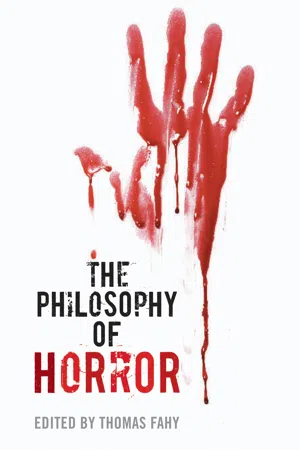
Sitting on pins and needles, anxiously waiting to see what will happen next, horror audiences crave the fear and exhilaration generated by a terrifying story; their anticipation is palpable. But they also breathe a sigh of relief when the action is over, when they are able to close their books or leave the movie theater. Whether serious, kitschy, frightening, or ridiculous, horror not only arouses the senses but also raises profound questions about fear, safety, justice, and suffering. From literature and urban legends to film and television, horror's ability to thrill has made it an integral part of modern entertainment. Thomas Fahy and twelve other scholars reveal the underlying themes of the genre in The Philosophy of Horror. Examining the evolving role of horror, the contributing authors investigate works such as Mary Shelley's Frankenstein (1818), horror films of the 1930s, Stephen King's novels, Stanley Kubrick's adaptation of The Shining (1980), and Alfred Hitchcock's Psycho (1960). Also examined are works that have largely been ignored in philosophical circles, including Truman Capote's In Cold Blood (1965), Patrick Süskind's Perfume (1985), and James Purdy's Narrow Rooms (2005). The analysis also extends to contemporary forms of popular horror and "torture-horror" films of the last decade, including Saw (2004), Hostel (2005), The Devil's Rejects (2005), and The Hills Have Eyes (2006), as well as the ongoing popularity of horror on the small screen. The Philosophy of Horror celebrates the strange, compelling, and disturbing elements of horror, drawing on interpretive approaches such as feminist, postcolonial, Marxist, and psychoanalytic criticism. The book invites readers to consider horror's various manifestations and transformations since the late 1700s, probing its social, cultural, and political functions in today's media-hungry society.
- 272 pages
- English
- ePUB (mobile friendly)
- Available on iOS & Android
eBook - ePub
The Philosophy of Horror
About this book
Information
Publisher
The University Press of KentuckyYear
2010Print ISBN
9780813136554
9780813125732
eBook ISBN
9780813139548
Topic
PhilosophySubtopic
Philosophy History & TheoryIndex
The index that appeared in the print version of this title does not match the pages in your eBook. Please use the search function on your eReading device to search for terms of interest. For your reference, the terms that appear in the print index are listed below.
abandonment
Abbott and Costello Meet Frankenstein (1948)
abuse
accountability
adaptation
Adorno, Theodor
aesthetic interpretation
aesthetics
aggression
Aja, Alexandre
Alice (A Nightmare on Elm Street 4: The Dream Master)
alienation
aliens
Alien vs. Predator (2004)
Althusser, Louis
Amanda (Saw series)
America
Angel
Angelus (Buffy the Vampire Slayer/Angel)
anger
animal
anxiety
Aristotle
art
“art-horror,”. See also natural horror
assumptions
Atlantic Paranormal Society, The (TAPS)
audience
authority
autonomy
avant-garde art
avian flu. See also flu pandemic
Baby Firefly (The Devil's Rejects)
Baier, Annette
barbarism
Baudrillard, Jean
Beauchamp, Christine
beauty
belief
Big Daddy (Land of the Dead)
Big Lebowski, The
biological terrorism
Birds, The
Black Cat, The
Bobby Carter (The Hills Have Eyes)
bourgeois
Brain That Wouldn't Die, The
Brenda Carter (The Hills Have Eyes)
bricolage
Bride of Frankenstein, The. See also Frankenstein
brutality
Buffy Summers (Buffy the Vampire Slayer/Angel)
Buffy the Vampire Slayer
Buffyverse
Cabin Fever
Call of Cthulu, The
camp sensibility
cannibalism
Cantor, Paul A.
capitalism
capital punishment
Capote, Truman
Caravaggio
Carroll, Noël
Carter family (The Hills Have Eyes)
chaos
characterization
Child's Play
Chiller
Christine
cinematic genre
civilized
civil laws
Civil War (American)
Clarke, Gerald
class
struggle
cliches
Clover, Carol J.
Clutter family
code
Cokal, Susann
collapse
Collingwood parents (The Last House on the Left)
commodification
common sense
comm...
Table of contents
- Cover
- Title
- Copyright
- Contents
- Acknowledgments
- Introduction
- Horror and the Idea of Everyday Life: On Skeptical Threats in Psycho and The Birds
- Through a Mirror, Darkly: Art-Horror as a Medium for Moral Reflection
- The Justification of Torture-Horror: Retribution and Sadism in Saw, Hostel, and The Devil's Rejects
- Hobbes, Human Nature, and the Culture of American Violence in Truman Capote's In Cold Blood
- Making Their Presence Known: TV's Ghost-Hunter Phenomenon in a “Post-” World
- The Vampire with a Soul: Angel and the Quest for Identity
- Ideological Formations of the Nuclear Family in The Hills Have Eyes
- Zombies of the World, Unite: Class Struggle and Alienation in Land of the Dead
- The Fall of the House of Ulmer: Europe vs. America in the Gothic Vision of The Black Cat
- From Domestic Nightmares to the Nightmare of History: Uncanny Eruptions of Violence in King's and Kubrick's Versions of The Shining
- “Hot with Rapture and Cold with Fear”: Grotesque, Sublime, and Postmodern Transformations in Patrick Süskind's Perfume
- Shock Value: A Deleuzean Encounter with James Purdy's Narrow Rooms
- Making Monsters: The Philosophy of Reproduction in Mary Shelley's Frankenstein and the Universal Films Frankenstein and The Bride of Frankenstein
- Kitsch and Camp and Things That Go Bump in the Night; or, Sontag and Adorno at the (Horror) Movies
- Contributors
- Index
Trusted by 375,005 students
Access to over 1.5 million titles for a fair monthly price.
Study more efficiently using our study tools.
Frequently asked questions
Yes, you can cancel anytime from the Subscription tab in your account settings on the Perlego website. Your subscription will stay active until the end of your current billing period. Learn how to cancel your subscription
No, books cannot be downloaded as external files, such as PDFs, for use outside of Perlego. However, you can download books within the Perlego app for offline reading on mobile or tablet. Learn how to download books offline
Perlego offers two plans: Essential and Complete
- Essential is ideal for learners and professionals who enjoy exploring a wide range of subjects. Access the Essential Library with 800,000+ trusted titles and best-sellers across business, personal growth, and the humanities. Includes unlimited reading time and Standard Read Aloud voice.
- Complete: Perfect for advanced learners and researchers needing full, unrestricted access. Unlock 1.5M+ books across hundreds of subjects, including academic and specialized titles. The Complete Plan also includes advanced features like Premium Read Aloud and Research Assistant.
We are an online textbook subscription service, where you can get access to an entire online library for less than the price of a single book per month. With over 1.5 million books across 990+ topics, we’ve got you covered! Learn about our mission
Look out for the read-aloud symbol on your next book to see if you can listen to it. The read-aloud tool reads text aloud for you, highlighting the text as it is being read. You can pause it, speed it up and slow it down. Learn more about Read Aloud
Yes! You can use the Perlego app on both iOS and Android devices to read anytime, anywhere — even offline. Perfect for commutes or when you’re on the go.
Please note we cannot support devices running on iOS 13 and Android 7 or earlier. Learn more about using the app
Please note we cannot support devices running on iOS 13 and Android 7 or earlier. Learn more about using the app
Yes, you can access The Philosophy of Horror by Thomas Fahy in PDF and/or ePUB format, as well as other popular books in Philosophy & Philosophy History & Theory. We have over 1.5 million books available in our catalogue for you to explore.