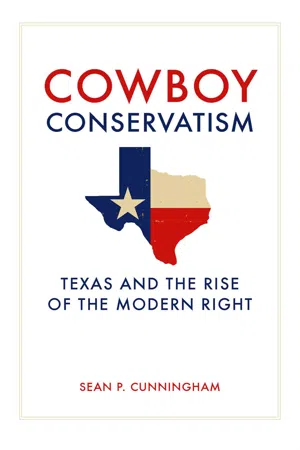
During the 1960s and 1970s, Texas was rocked by a series of political transitions. Despite its century-long heritage of solidly Democratic politics, the state became a Republican stronghold virtually overnight, and by 1980 it was known as "Reagan Country." Ultimately, Republicans dominated the Texas political landscape, holding all twenty-seven of its elected offices and carrying former governor George W. Bush to his second term as president with more than 61 percent of the Texas vote.Sean P. Cunningham examines the remarkable history of Republican Texas in Cowboy Conservatism: Texas and the Rise of the Modern Right. Utilizing extensive research drawn from the archives of four presidential libraries, gubernatorial papers, local campaign offices, and oral histories, Cunningham presents a compelling narrative of the most notable regional genesis of modern conservatism. Spanning the decades from Kennedy's assassination to Reagan's presidency, Cunningham reveals a vivid portrait of modern conservatism in one of the nation's largest and most politically powerful states. The newest title in the New Directions in Southern History series, Cunningham's Cowboy Conservatism demonstrates Texas's distinctive and vital contributions to the transformation of postwar American politics.
- 320 pages
- English
- ePUB (mobile friendly)
- Available on iOS & Android
eBook - ePub
About this book
Information
Chapter 1
The Eyes of Texas
Political Culture and Tradition
In his seminal 1949 study of southern politics, the esteemed political scientist V. O. Key offered a detailed analysis of the Texas political culture and tradition at midcentury. Assessing the state’s regional identity, he argued that the “changes of nine decades have weakened the heritage of southern traditionalism, revolutionized the economy, and made Texas more western than southern.” On the relationship between politics and economics, Key asserted that Texas was primarily “concerned about money and how to make it, about oil and sulfur and gas, about cattle and dust storms and irrigation, about cotton and banking and Mexicans.” In this context, Key argued that trumping virtually all other issues in Texas was the persistent debate over the extent, scope, and role of government in shaping the economy. Finally, on the issue of electoral politics, Key argued that Texas, more than any other southern state, and in “as sharp a form as is possible under a one-party system,” operated within a strained political culture rooted in the discourse of political ideology. According to Key, factions of conservatives and liberals, exemplified by colorful and powerful personalities, dominated the state’s midcentury political culture, while most Texans based their own political behaviors upon the publicly constructed definitions ascribed to each personality, faction, and ideology.1
For these and other reasons, the Texas political culture and tradition was—and is—complicated and unique. That complexity is largely rooted in the pride Texans have in their state’s distinctive and colorful history—a history that is the stuff of legend. Schoolchildren in Texas grow up with those legends; they are compelled to do so by law. From the honor and courage exemplified by the 183 men who held off as many as 6,000 Mexican soldiers for thirteen days at the Alamo before sacrificing their lives for the dream of independence to the state’s brief period as an independent republic to secession and rebellion to cattle drives, cowboys, Indian wars, and the Old West, Texans have long prided themselves on the legends that buttress their state’s unique history.2 When mixing these with other, more stereotypically southern and western traditions, Texans have constructed a history and a political culture that defy simple regional categorization. This amalgam of legends, traditions, and cultures has contributed to the formation of a unique political heritage notable for its colorful personalities, its conservative commitment to tradition and loyalty, and its somewhat paradoxical positioning as a state often at the forefront of change, radical factionalism, and political disunion. Understanding the modern Texas political culture and tradition, the origins of which are arguably more than two centuries old, is fundamental to understanding the transformational paths taken by conservatives and liberals, Democrats and Republicans in the 1960s and 1970s.
Revolution, Republic, Rebellion, Reconstruction,
and Radicalism
Texas history is peppered with stories of conflict. Following a period of exploration that began in the late sixteenth century, which inaugurated centuries of conflict between the Native Americans already well established in Texas and encroaching Europeans, much of late seventeenth- and eighteenth-century Texas was shaped by competition between Spain and France. Spain eventually established dominance in Texas, but between 1810 and 1821 a war for independence was fought and finally won, pushing Spain permanently out of Texas while creating the independent nation of Mexico. By 1835, Mexico was struggling against a war of rebellion in Texas. Mexico fought to maintain control over the largely Anglo population it had enticed to move into the region in hopes of creating a geographical buffer zone between its new nation and the ever-expanding United States. Most new migrants to Mexican Texas had come from the American South in search of opportunities that were either inaccessible in the United States or had been denied them. Slaves came, too, though obviously not by choice. The Anglo-American settlers rebelled against Mexican authority, in part because they wanted to protect their “property” against the antislavery laws being advanced by the newly dictatorial Mexican regime of Antonio López de Santa Anna. They rebelled for other reasons as well, including a patriotically American belief in representative democracy and local autonomy couched in the stereotypical frontier mentality of the American West. After legendary battles at the Alamo and San Jacinto, Texans won their independence from Mexico in 1836.
Yet independence did not end the conflicts. Between 1836 and 1845, Texas existed as an independent republic, plagued by debt, military instability, and diplomatic ambiguity. Annexation to the United States was finalized in 1845, though not formally completed until February 1846. The annexation debates were essential to the development of Democratic dominance in Texas. Though once relatively popular in the South, the Whig Party forfeited most of its support in the region due to its stance on slavery and, in Texas, its stance on annexation. Nationally, Whigs led the opposition to Texas annexation; Democrats, increasingly the party of the South, led the fight for it. In 1848, a war between the United States and Mexico, fought in part over Texas’s disputed status, ended with the Treaty of Guadalupe Hidalgo, which, among other things, established the Rio Grande River as Texas’s southern boundary. By 1860, Texas Democrats—Sam Houston’s vociferous unionism notwithstanding—were working closely with other southern Democrats to ensure that proslavery planks were included in their national party’s platform. As prospects for resolution faded and the sectional conflict deepened, secession became a reality for South Carolina, Mississippi, Florida, Alabama, Georgia, and Louisiana. Secession became reality for the Lone Star State on March 2, 1861—exactly twenty-five years, to the day, since Texas had declared independence from Mexico. Even in 1861, Texans had a flair for the dramatic.
Like all other southern states joining the Confederacy, Texas seceded from the Union because of slavery, not states’ rights. In fact, the most “southern” aspects of the state’s complicated regional identity are rooted in the politics of slavery, annexation, secession, war, and reconstruction. In its “Declaration of the Causes,” Texas political leaders made clear that their decision to join the United States had been dependent upon the protection of “negro slavery.” The formation of the Republican Party, the secession document explained, posed a grave threat to the “beneficent and patriarchal system of African slavery.” Nonetheless, over time—and in large part because of the state’s Reconstruction experience—Texans, as did most other southerners, constructed a memory of secession and war rooted in the notion of rugged individualism and states’ rights, not merely the protection of slavery.3
As recently as the 1990s, it was common for Texas politicians, and even some newspaper editorialists, to analogize the images of Reconstruction to contemporary federal expansion, while using those same images to communicate fear and provoke generations-old hostilities. These images have included unwelcome “Yankee” carpetbaggers who came “in the dark of night, looted the liberties of Texans,” and left state citizens “broke and bitter.” Despite the fact that much of this popular memory was constructed out of fallacious material (carpetbaggers held no more than 25 percent of all offices during Reconstruction, for instance), the memory that Texans retained of the post–Civil War period profoundly reinforced preexisting attitudes about the role of government. These attitudes also shaped an evolving hostility toward all sources of control and dominance based outside the state. As Randolph Campbell put it, “Reconstruction alone did not shape the future of political life in Texas, but the era contributed heavily to the popular opposition to taxing and spending for public purposes and to the general lack of civil rights that characterized the state’s politics after the 1870s.”4
As Texas struggled against and within the framework of Reconstruction, the state also continued to evolve in ways that made it unique and increasingly different from the rest of the South. The emergence of the cattle industry coincided with growing tensions between Native American tribes in the northwest and western portions of the state, while remembered tales of cowboys, gunfighters, and the stereotypically “Wild West” are rooted in the abbreviated but no less significant reality of those personalities and activities.
Among the best examples of the fusion of southern and western traditions in Texas was the radicalization of the countryside that eventually formed the Populist Party, arguably the most successful third-party movement in American history. The late nineteenth century was a period of adjustment and frustration for farmers across the country. In Texas, a growing population and convenient access to railroads contributed to the general shift from subsistence to commercial agriculture. Increasingly tied to the national market, Texas farmers put more land under plow, despite (and even causing) lower prices for their less diversified harvests. Former slaves competed with Mexican Americans and Mexican immigrants in an economic structure in which landowning became increasingly unrealistic and manual labor, tenancy, and sharecropping were the norm. More monopolized landholdings, competition between the races, lower prices at market, and the general sense that Americans were moving toward an industrial society and away from the Jeffersonian vision of a nation connected by small, independent farmers, challenged the status and prestige of men and women whose families had inherited the yeoman dream.5
Farmers responded to these hardships in different ways. Organizations like the Grange educated farmers and fostered social interaction and cooperation but did not address economic grievances. During the final days of Reconstruction, however, farmers began to focus on these grievances and increasingly blamed their problems on outside forces. The populist tendency to blame “foreign agents of control” both reinforced and intensified the state’s tradition of valuing independence and localism while distrusting non-Texan corporations or governments. Monopolistic railroads were blamed for gouging farmers with exorbitant shipping rates. Northeastern banks were blamed for saddling farmers with unrealistic interest rates, making the repayment of loans a virtual impossibility. Northeastern investors were blamed for profiting off the system and exacerbating conditions. By the late 1870s, farmers had grown angrier, more hostile, and more political, and in September 1877, many of them met in Lampasas, Texas, where they organized the National Farmers’ Alliance and Industrial Union. Over the next decade, this organization, more commonly known as the Southern Farmers’ Alliance, agitated against the distant entities it perceived to be at the heart of local problems.6
In 1890, Texans, thanks in large part to the support of populist farmers, elected James Stephen Hogg their new governor. Though a loyal Democrat, as the state’s attorney general, Hogg had made a name for himself among populists, prosecuting monopolistic railroads and introducing antitrust legislation to Texas a year before Congress passed the Sherman Anti-Trust Act. Hogg was among the first to embrace populism by absorbing the movement into the Democratic Party. Still, the push for a third party continued. In 1892, the Farmers’ Alliance, along with several other competing alliances, met in Omaha to nominate national third-party candidates and adopt a platform under the banner of the People’s Party. The People’s—or “Populist”—Party enjoyed widespread success in the South and West, carrying four states in the 1892 presidential election, sending nearly fifty men to Congress over the course of the decade, and electing governors in several western states. Populism proved so powerful that by the mid-1890s, electoral necessity forced the Democratic Party to do what some Democrats, like Texas’s Hogg, had already done—adopt much of the movement’s agenda.7
Though populism quickly became a Texas Democratic tenet, the movement, broadly speaking, nevertheless reflected many Texans’ willingness to break from tradition and challenge the political status quo. Texas farmers viewed their worsening conditions in the context of national economic changes. In response, they quickly identified a set of enemies upon which they could shower blame. Throughout the twentieth century, Texans continued to lead charges against various incarnations of “the establishment” even as they consistently elected conservative Democrats who rhetorically nodded to the people while actually advocating policies that maintained and even consolidated power in the hands of landowners and corporations. This homegrown establishment—defined by George Green as a conglomeration of conservative politicians and oil, banking, insurance, and other corporate interests intent on maintaining power—perfected the practice of blame shifting while projecting itself as an agent of the people.8
At the end of the nineteenth century, the Texas political culture reflected a blending of the patriotic and independence-minded individualism memorialized by the state’s revolution and rebellion, a historical pattern of organizing against established and distant authorities, and the one-party dominance that gave voice to it all. In the coming decades, that culture of populist conservatism persisted even as it adjusted to much unexpected and transformative change.
Progressivism, Backlash, and Depression
The twentieth century began for Texans in a glorious, oil-drenched bonanza. As the reincorporation of Populists into the Democratic Party became increasingly certain, a massive oil strike was made near Beaumont on a small hill known as Spindletop. Production from this well alone reached 17.5 million barrels in 1902 and inspired a boom in drilling across the state that would eventually lead to the establishment of Texas as the nation’s energy-producing giant. As oil boomed, cities grew; as cities grew, the nation evolved, and Texans joined other Americans in a collective search for order, efficiency, and reform.9
Texas progressivism was fueled, in part, by a populist impulse toward reform that had never fully disintegrated, despite partisan fusion. Texas progressivism was also hastened by the Galveston hurricane of 1900, the most devastating natural disaster in American history, in which some six thousand people had perished, along with nearly half of the city’s edifices. To rebuild Galveston, local leaders developed a new system of city government designed to maximize efficiency through appointments and commissions. Within two decades Galveston’s progressive form of city government was adopted by several Texas cities and, eventually, by more than five hundred other cities across the nation.10
Reforms in city government aside, Texas progressivism was primarily driven by the politics of prohibition. In 1917, Senator Morris Sheppard (DTX) authored a prohibition amendment that, when ratified two years later, became the Eighteenth Amendment to the U.S. Constitution. Sheppard, whom Texans had elected to the Senate in 1912, was popular because of his orations on the “Lost Cause,” lower tariff rates, antitrust issues, and the need to solve the credit problems still plaguing farmers. He played a powerful role in the Senate until his death in 1941, consistently balancing the state’s conservative traditions with its impulse for populist agitation and change.11
By 1920, new personalities, issues, and organizations emerged to usher in an astounding decade of political change. The most powerful independent organization in Texas during the early 1920s was the Ku Klux Klan. The Klan first organized in Texas in 1920 in Houston. Soon, Klan chapters were dotted around much of the state. Advertising itself as a protector of Christianity, the Klan attracted a largely middle-class membership on the basis of its call for “100 percent Americanism.” The Texas Klan of the early 1920s rallied supporters by demagoguery on issues other than just race, identifying numerous agents of unwelcome and “foreign” influence. Most influential was the Klan’s grand call for “law and order,” morality, and specifically prohibition. By 1923, the Texas Klan boasted more than 150,000 members, all of whom were male. On the momentum of Klansman Earle Mayfield’s surprising election to the U.S. Senate in 1922, the Texas Klan ran and won seats in the state legislature and local offices in 1924.12
The Klan’s momentum, however, slowed considerably later in 1924, thanks largely to a statewide backlash against organized terror and vigilantism. The Klan’s candidate for governor that year lost his bid to Miriam Ferguson, better known as “Ma,” largely because the hooded society failed to replicate its alliance with the now anti-Klan prohibitionists who had helped carry Mayfield to the Senate two years earlier. Instead, aided by growing public outcries against the Klan, Ferguson became the first female governor in Texas history, though all who voted for her knew very well that her husband, Jim—better known as “Pa”—would actually be the one in charge. Jim Ferguson had served as governor from 1915 to 1917 when, despite being reelected to a second term, he was impeached for a series of scandals and other conflicts, most notably one involving academic freedom at the University of Texas. This dramatic publicity, melded with an effective populist (and wet) political style, enabled the Fergusons to dominate Texas politics during the 1920s, not by consistently winning elections, but by consistently being an issue in and of themselves. “Fergusonism” carried the banner of po...
Table of contents
- Cover
- Half title
- Title
- Copyright
- Dedication
- Contents
- List of Maps and Illustrations
- Preface
- Acknowledgments
- Introduction
- 1. The Eyes of Texas: Political Culture and Tradition
- 2. Growing Pains: The Politics of Extremism
- 3. Reconstructing Conservatism: Antiliberalism and the Limits of “Law and Order”
- 4. “I am a Sick American”: Race, Fear, and the Limits of Backlash Politics
- 5. Poisons: Establishments in Crisis
- 6. Civil War: Populist Conservatism and the 1976 Campaigns
- 7. The Gathering Storm: Republican Momentum and the Albatross of Jimmy Carter
- 8. Revolution: Reagan and Texas in 1980
- Conclusion
- Notes
- Bibliography
- Index
Trusted by 375,005 students
Access to over 1.5 million titles for a fair monthly price.
Study more efficiently using our study tools.
Frequently asked questions
Yes, you can cancel anytime from the Subscription tab in your account settings on the Perlego website. Your subscription will stay active until the end of your current billing period. Learn how to cancel your subscription
No, books cannot be downloaded as external files, such as PDFs, for use outside of Perlego. However, you can download books within the Perlego app for offline reading on mobile or tablet. Learn how to download books offline
Perlego offers two plans: Essential and Complete
- Essential is ideal for learners and professionals who enjoy exploring a wide range of subjects. Access the Essential Library with 800,000+ trusted titles and best-sellers across business, personal growth, and the humanities. Includes unlimited reading time and Standard Read Aloud voice.
- Complete: Perfect for advanced learners and researchers needing full, unrestricted access. Unlock 1.5M+ books across hundreds of subjects, including academic and specialized titles. The Complete Plan also includes advanced features like Premium Read Aloud and Research Assistant.
We are an online textbook subscription service, where you can get access to an entire online library for less than the price of a single book per month. With over 1.5 million books across 990+ topics, we’ve got you covered! Learn about our mission
Look out for the read-aloud symbol on your next book to see if you can listen to it. The read-aloud tool reads text aloud for you, highlighting the text as it is being read. You can pause it, speed it up and slow it down. Learn more about Read Aloud
Yes! You can use the Perlego app on both iOS and Android devices to read anytime, anywhere — even offline. Perfect for commutes or when you’re on the go.
Please note we cannot support devices running on iOS 13 and Android 7 or earlier. Learn more about using the app
Please note we cannot support devices running on iOS 13 and Android 7 or earlier. Learn more about using the app
Yes, you can access Cowboy Conservatism by Sean P. Cunningham in PDF and/or ePUB format, as well as other popular books in History & North American History. We have over 1.5 million books available in our catalogue for you to explore.