The ongoing struggle for civil rights and social justice lies at the heart of America's evolving identity. The pursuit of equal rights is often met with social and political trepidation, forcing citizens and leaders to grapple with controversial issues of race, class, and gender. Renowned scholar Harvard Sitkoff has devoted his life to the study of the civil rights movement, becoming a key figure in global human rights discussions and an authority on American liberalism.
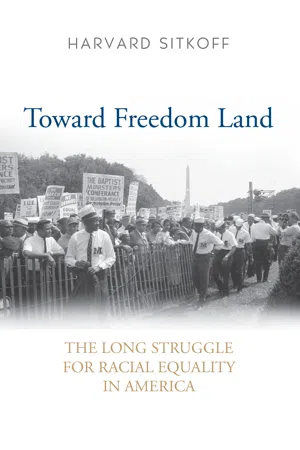
Toward Freedom Land assembles Sitkoff 's writings on twentieth-century race relations, representing some of the finest race-related historical research on record. Spanning thirty-five years of Sitkoff 's distingushed career, the collection features an in-depth examination of the Great Depression and its effects on African Americans, the intriguing story of the labor movement and its relationship to African American workers, and a discussion of the effects of World War II on the civil rights movement. His precise analysis illuminates multifaceted racial issues including the New Deal's impact on race relations, the Detroit Riot of 1943, and connections between African Americans, Jews, and the Holocaust.
- 232 pages
- English
- ePUB (mobile friendly)
- Available on iOS & Android
eBook - ePub
About this book
Information
Racial Militancy and
Interracial Violence in
the Second World War
To many, “Racial Militancy and Interracial Violence in the Second World War” appeared to be merely a variation on the theme of the Detroit race riot article published two years earlier. It was similarly praised by New Leftist historians for describing “the brutality toward and degradation of black soldiers during World War II, the military’s refusal to protect its black members from white mobs, and Roosevelt’s total disregard for violent race riots. Like Wilson’s southern advisers, Roosevelt’s southern advisers refused to alleviate or prevent the numerous lynchings and vicious race riots which occurred throughout the country” (Blanche Wiesen Cook, Alice Kessler Harris, and Ronald Radosh, eds., Past Imperfect: Alternative Essays in American History [New York: Alfred A. Knopf, 1973], 237). Although this was a correct summation of the conditions underlying the riots, what went largely misunderstood or ignored at the time was the extent to which this later essay stressed the stifling, stunting effect of wartime racial violence on black militancy. The riots forced black organizations and newspapers to urge the struggle out of the streets and into the courtroom. Winning white allies and promoting better race relations superseded hopes for an all-black mass direct-action movement. Despite this change, attributing black wartime gains to aggressive militancy won favor among the New Left generation of historians. It became commonplace to describe the Second World War as the watershed in the black freedom struggle and to ascribe that pivotal event to wartime African American militancy. I still don’t think so. Let the debate go on. “Racial Militancy and Interracial Violence in the Second World War” first appeared in Journal of American History 58 (December 1971), 661–81, and is reprinted by permission of the Organization of American Historians.
World War II opened a quarter of a century of increasing hope and frustration for the black man. After a decade of depression, the ideological character of the war and the government’s need for the loyalty and manpower of all Americans led blacks to expect a better deal from President Franklin D. Roosevelt. With a near unanimity rare in the Negro community, civil rights groups joined with the Negro press and influential, church, labor, and political leaders to demand “Democracy in Our Time!”1 Individuals and organizations never before involved in a protest movement found it respectable, even expedient, to be part of the new militancy in the black community.2 The war stimulated racial militancy, which in turn led to increased interracial violence that culminated in the bloody summer of 1943. Negro leaders then retreated, eschewing mass movements and direct action in favor of aid from white liberals for their congressional and court battles. While many of the goals of the early war years remained, the mood and tactics became increasingly conservative.3 Paradoxically, the wartime violence which summoned forth the modern civil rights movement, enlisting in the struggle scores of liberal organizations and tens of thousands of whites previously blind or indifferent to American racism, also smothered the embryonic black movement for equality by tying it ever more closely to liberal interracialism, which all too easily accepted the appearance of racial peace for the reality of racial justice. By the end of the war two trends emerged which would shape the course of the next two decades. Jim Crow had stumbled badly enough to heighten the aspirations of many Negroes that they would soon share the American Dream; and leadership in the battle for civil rights had been taken over by various communist-front organizations, labor unions, religious groups fighting intolerance, and social scientists making a career of studying race relations.4
At the beginning of this war, unlike World War I, few Negro leaders asked blacks to close ranks and ignore their grievances until the war ended.5 Rather, the very dependency of the government on the cooperation of the Negro intensified his demand for civil rights. “If we don’t fight for our rights during this war,” said one Harlem leader, “while the government needs us, it will be too late after the war.”6 Memories of the false promises of World War I stirred a reader of the Amsterdam-Star News to write: “Remember, that which you fail to get now you won’t get after the war.”7 Some Negro columnists openly advocated a prolonged war as the best hope for destroying the racial status quo. And the Negro press proclaimed the “time ripe for a new emancipation” and mobilized a “Double V” campaign to fight fascism and racism both abroad and at home.8
The Negro press headlined evidence of blacks excluded from defense jobs, blood plasma segregated by the Red Cross, abused Negro soldiers, and white hostility and violence. Circulation increased 40 percent as the Negro newspapers, functioning primarily to foster race solidarity and prod increasing militancy, campaigned to embarrass America’s war for democracy by publicizing America’s Jim Crow policies and practices.9 Membership in the National Association for the Advancement of Colored People (NAACP) multiplied nearly ten times during the war, and the number of its chapters tripled.10 The Congress of Racial Equality, organized in 1942, experimented with nonviolent action to end segregation in the North and stimulated students at Howard University and interracial groups in various cities to begin sitting-in and experimenting with other forms of direct confrontation.11 To “demand the right to work and fight for our country,” A. Philip Randolph labored to build his March-on-Washington Committee into an all-black mass protest movement.12 Even Negro fraternal, business, and professional societies collaborated in the battle against oppression on the home front. Everywhere he turned, the urban black found new Negro organizations enlisting in the crusade and new leaders and journals exhorting him to demand equality. Each concession wrested from the government and every sign of the weakening of white supremacy added new converts, made fund-raising easier, and stimulated greater confidence and higher hopes.13
The establishment of the United Nations, the anti-imperialistic pronouncements of government officials, and a steady stream of articles, books, letters, and speeches—especially those of Pearl S. Buck, Eleanor Roosevelt, Wendell Willkie, and Henry Wallace—disputing the scientific basis of racism and urging America to practice what it preached further augmented the militancy of black America.14 The attempt to educate the public to stop discrimination and end prejudice reached its peak in 1944 with the publication of Gunnar Myrdal’s An American Dilemma. Eschewing the socioeconomic explanations popularized by American Marxists in the 1930s, Myrdal described the race problem as a moral problem for white America, brought about by the collision between the American Creed’s promise of equality and liberty and the denial of them to the Negro. Woefully underestimating the extent and depth of American racism, Myrdal optimistically predicted that Americans would resolve their dilemma by ending discrimination and segregation.15
The growth of Negro political power also stimulated hope for change. The steady migration of blacks to the North and the return, after 1938, of many white Republicans to their traditional voting habits prematurely led Negro leaders to believe that Franklin D. Roosevelt could be persuaded to support civil rights.16 He refused to do so in 1940, but Willkie’s strong bid for the Negro vote and the inclusion of a solid civil rights plank in the Republican platform forced the president to approve an antidiscrimination clause in the Selective Service Act, promote Colonel Benjamin O. Davis as the first Negro brigadier general, and appoint William Hastie as civilian aide to the secretary of war and Colonel Campbell Johnson as executive assistant to the director of Selective Service. Black political pressure also opened the way for new Reserve Officers’ Training Corps units in Negro colleges and an air force aviation school for blacks at Tuskegee.17 These actions barely affected black life in America, but as possible first steps to be lengthened as the Negro vote grew in the North, they showed Negro leaders the power of the vote and the need for coordinated efforts. Moreover, the fact that President Roosevelt did respond, if only with gestures, increased black expectations. But the paucity of the response further clarified the disparity between Negro goals and gains—between democratic myths and realities.18
The experience of living in Jim Crow America led the Negro to be acutely conscious of his deprivations and impatient with all impediments to first-class citizenship. Magazines and newspapers at the beginning of the war charted his plummeting morale and increased assertiveness.19 Only a few blacks, mainly the followers of Leonard Robert Jordan’s Ethiopia Pacific League and Elijah Muhammad’s Temple of Islam, actually flirted with treason; many simply, but loudly, held their loyalty in check.20 A Harlem doctor driving through Manhattan with a large sign on his car reading, “IS THERE A DIFFERENCE? JAPS BRUTALLY BEAT AMERICAN REPORTER GERMANS BRUTALLY BEAT SEVERAL JEWS AMERICAN CRACKERS BRUTALLY BEAT ROLAND HAYES & N...
Table of contents
- Cover
- Half title
- Title
- Copyright
- Contents
- Acknowledgments
- Introduction
- The Preconditions for Racial Change
- The New Deal and Race Relations
- The Detroit Race Riot of 1943
- Racial Militancy and Interracial Violence in the Second World War
- African American Militancy in the World War II South: Another Perspective
- Willkie as Liberal: Civil Liberties and Civil Rights
- African Americans, American Jews, and the Holocaust
- Harry Truman and the Election of 1948: The Coming of Age of Civil Rights in American Politics
- Martin Luther King Jr.: Seeing Lazarus, 1967–1968
- The Second Reconstruction
- Index
Trusted by 375,005 students
Access to over 1.5 million titles for a fair monthly price.
Study more efficiently using our study tools.
Frequently asked questions
Yes, you can cancel anytime from the Subscription tab in your account settings on the Perlego website. Your subscription will stay active until the end of your current billing period. Learn how to cancel your subscription
No, books cannot be downloaded as external files, such as PDFs, for use outside of Perlego. However, you can download books within the Perlego app for offline reading on mobile or tablet. Learn how to download books offline
Perlego offers two plans: Essential and Complete
- Essential is ideal for learners and professionals who enjoy exploring a wide range of subjects. Access the Essential Library with 800,000+ trusted titles and best-sellers across business, personal growth, and the humanities. Includes unlimited reading time and Standard Read Aloud voice.
- Complete: Perfect for advanced learners and researchers needing full, unrestricted access. Unlock 1.5M+ books across hundreds of subjects, including academic and specialized titles. The Complete Plan also includes advanced features like Premium Read Aloud and Research Assistant.
We are an online textbook subscription service, where you can get access to an entire online library for less than the price of a single book per month. With over 1.5 million books across 990+ topics, we’ve got you covered! Learn about our mission
Look out for the read-aloud symbol on your next book to see if you can listen to it. The read-aloud tool reads text aloud for you, highlighting the text as it is being read. You can pause it, speed it up and slow it down. Learn more about Read Aloud
Yes! You can use the Perlego app on both iOS and Android devices to read anytime, anywhere — even offline. Perfect for commutes or when you’re on the go.
Please note we cannot support devices running on iOS 13 and Android 7 or earlier. Learn more about using the app
Please note we cannot support devices running on iOS 13 and Android 7 or earlier. Learn more about using the app
Yes, you can access Toward Freedom Land by Harvard Sitkoff in PDF and/or ePUB format, as well as other popular books in Social Sciences & African American History. We have over 1.5 million books available in our catalogue for you to explore.