Revelations of abuse at Baghdad's Abu Ghraib prison and the U.S. detention camp at Guantánamo Bay had repercussions extending beyond the worldwide media scandal that ensued. The controversy surrounding photos and descriptions of inhumane treatment of enemy prisoners of war, or EPWs, from the war on terror marked a watershed moment
in the study of modern warfare and the treatment of prisoners of war. Amid allegations of human rights violations and war crimes, one question stands out among the rest: Was the treatment of America's most recent prisoners of war an isolated event or part of a troubling and complex issue that is deeply rooted in our nation's military history?
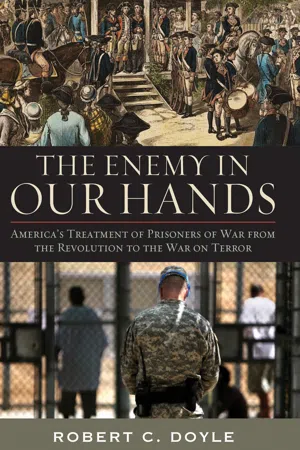
Military expert Robert C. Doyle's The Enemy in Our Hands: America's Treatment of Prisoners of War from the Revolution to the War on Terror draws from diverse sources to answer this question. Historical as well as timely in its content, this work examines America's major wars and past conflicts—among them, the American Revolution, the Civil War, World Wars I and II, and Vietnam—to provide understanding of the United
States' treatment of military and civilian prisoners. The Enemy in Our Hands offers a new perspective of U.S. military history on the subject of EPWs and suggests that the tactics employed to manage prisoners of war are unique and disparate from one conflict to
the next. In addition to other vital information, Doyle provides a cultural analysis and exploration of U.S. adherence to international standards of conduct, including the 1929 Geneva Convention in each war. Although wars are not won or lost on the basis of how EPWs are treated, the treatment of prisoners is one of the measures by which history's conquerors are judged.
eBook - ePub
The Enemy in Our Hands
America's Treatment of Prisoners of War from the Revolution to the War on Terror
- 488 pages
- English
- ePUB (mobile friendly)
- Available on iOS & Android
eBook - ePub
The Enemy in Our Hands
America's Treatment of Prisoners of War from the Revolution to the War on Terror
About this book
Information
Publisher
The University Press of KentuckyYear
2010Print ISBN
9780813134604
9780813125893
eBook ISBN
9780813139616
Topic
HistoriaSubtopic
Historia militar y marítimaONE
Prisoners of Independence
British and Hessian Enemy Prisoners of War
During this unhappy contest, there be every exercise of humanity, which the nature of the case will possibly admit of.—General George Washington
With the exception of spies such as British Major John André and some others, during the Revolution the Americans treated enemy prisoners of war (EPWs) relatively well. General George Washington made it known in letters to British General Lord William Howe that he considered it his duty to be humane and generous in his treatment of British and Hessian prisoners of war (POWs), and he often complained to Howe that Americans were not being treated with the same care. Writing to Howe on 23 September 1776, he noted that “during this unhappy contest, there be every exercise of humanity, which the nature of the case will possibly admit of.”1 He was right, at least to a degree: there were instances of serious hostilities toward British POWs by American officers and civilians, most of which never came to Washington's attention. Some did, however, as the British charges of mistreatment by Colonel David Henley against some British officers showed.
During the Revolution, captures and exchanges large and small took place from the beginning to the end of the war. At first, status became a serious issue. As far as the British were concerned, from 1775 to 1776 the American war in Massachusetts consisted of rebellious individuals and local militias organized to defend the colonies against Indian attacks, and any rebels captured were considered to be civil prisoners guilty of treason against the Crown. The British, however, were more concerned about subduing the rebellious Massachusetts colony than conducting public war. Hence, those soldiers who came into captivity were not executed but held in jails. After the Declaration of Independence was signed and announced during the summer of 1776, everything changed. This act presented the British with a wholly new set of problems—specifically, how to treat those Americans who surrendered and became actual prisoners of war: hang them as traitors or, perhaps, use them as bargaining chips to get their own soldiers back. As usual, privates, corporals, and sergeants counted for little. Writing to Howe, Washington stated, “The exchange of privates, I shall take the earliest opportunity in my power to carry into execution; but their being greatly dispersed through New England Governments, in order to their better accommodation, will prevent it for some time.”2 Officers, however, became increasingly more important in potential exchanges.
As the war progressed, important Continental officers were captured and then exchanged. For example, Colonel Benedict Arnold surrendered after his defeat in Canada in 1775 and was subsequently exchanged. British General Prescott was exchanged for American Brigadier General Lord Stirling in 1776. Writing to the president of Congress on 25 September 1776, Washington expressed his humane philosophy, one that he held for the war's duration, that Congress must pay attention to its support of Americans in British captivity. After the Battle of Long Island in August 1776, Washington reported, “As to those taken on the 15th, they greatly exceed the number that I supposed fell into their hands in the retreat from the City.” Stressing that Congress must appoint officers, called commissaries of prisoners, to tend to American prisoners, he reminded Congress, “I took the liberty of urging more than once that the prisoners might be treated with humanity and have their wants particularly attended to.”3 Washington's rationale was simple: if Congress supported American prisoners in British hands, if and when they were released or exchanged, they would be fit for further duty. Washington also made certain that the British could support their POWs in American hands.
The American Continental Army, various state militias, and naval forces captured more than 14,000 enemy soldiers and sailors. Their status never became a problem for the Americans as it did for the British; where to put them did. Because the American Revolution rose in intensity from a localized New England rebellion to a world war for the British and a total war for the Americans, housing and feeding vast numbers of enemy military prisoners became a major concern, particularly for the Americans. In the eighteenth century, belligerents were expected to supply and pay their own prisoners in enemy hands and appoint commissaries of prisoners to tend to their needs. In Philadelphia, American Tory Joshua Loring became the commissary of prisoners for the British, whereas the Americans appointed Elias Boudinot at first and several others from 1776 to 1783.
Small group captures took place throughout the war on both sides. British soldiers captured in the Revolution and again in the War of 1812 were held in dungeons, makeshift jails, and barracks and were exchanged much the way Americans were.4 Senior officers were usually exchanged by direct correspondence and agreements between General Washington and British General Howe and later Sir Henry Clinton. There were three large group captures of British and Hessian troops: 919 Hessian troops under the command of Colonel Johann Gottlieb Rall (killed in action) at the Battle of Trenton in 1776 (General Washington commanding the Americans); 2,600 British (commanded by Major General John Burgoyne), 2,400 Hessian (commanded by Major General Friedrich Adolph, Baron von Riedesel), and 800 Canadian EPWs at the Battle of Saratoga in 1777 (General Horatio Gates commanding the Americans); and 7,241 EPWs at the Battle of Yorktown in 1781 under the command of General Charles Lord Cornwallis (Washington and French General Rochambeau commanding the Americans). A smaller engagement, the Battle of King's Mountain in South Carolina's backwoods in 1780, yielded over 500 Loyalist EPWs and ended most armed Loyalist activities in the Revolution.
Christmas Day 1776 was an important day for General George Washington and the Continental Army. In his biography of Washington, Douglas Southall Freeman asks how the Hessians could have allowed themselves to be surprised by the ragtag Continentals at Trenton. Perhaps it was the horrid weather; after all, it was late December in central New Jersey. Perhaps it was the German propensity to celebrate Christmas heartily. Washington's army was in terrible condition after the beatings it had taken: 1,500 dead at the Battle of Long Island, White Plains, and Fort Washington, where the Americans lost 2,000 POWs to the Hessians, and at Fort Lee, where the British caught General Nathanael Greene off guard and captured the bulk of Greene's materials. If anyone was frustrated with the fall campaign of 1776, it was General George Washington. He needed a victory, any victory, to sustain his army.5
It was clearly good fortune for the Americans that the Hessians failed to spot Washington's attacking columns after they recrossed the partially frozen Delaware River. The battle was a complete surprise, and it took only two hours, from 8 to 10 AM on Christmas morning, for the Americans to neutralize the large Hessian force.6 Colonel Rall died of his wounds after speaking briefly to General Washington on his death bed, one of the twenty-five to thirty Hessians killed in action at Trenton. In addition to the EPWs, Washington captured six pieces of brass artillery and 900 to 1,000 stands of arms.7 It was an impressive morning's work and something that would take place again, though on a much larger scale, at Saratoga, New York, in October 1777 when Major General Horatio Gates defeated Lieutenant General John Burgoyne.
John Burgoyne, or “Gentleman Johnny,” had a bold plan: he wanted to march a large British force south from Canada to Albany, New York, to cut the colonies in two. If this were accomplished, he, along with General Sir William Howe in New York City and General Sir Guy Carleton in Canada, believed the distasteful American war might conclude in their favor. On paper the plan looked good, but Burgoyne had little notion of New York's difficult terrain along the invasion route, and when he attempted to march south from friendly Canada, he permitted huge supply columns consisting of cooks, hospital attendants, servants, smiths, carpenters, officers' wives, ammunition wagons, and drovers with herds of cattle to follow close by.8 It was surely a recipe for failure.
Slowly, the Americans cut down Burgoyne's force in a series of engagements. At Sword's Farm at dawn on 17 September 1777, a party of British soldiers (disobeying orders not to forage) was attempting to dig up a potato patch when they were surprised by a group of Daniel “Big Dan” Morgan's expert Virginia riflemen, who killed, wounded, and captured about thirty men.9 Fighting continued with attacks and counterattacks on both sides and great loss of life on the British side, with about a third of Burgoyne's main force lost. The Americans continued their relentless pursuit using sharpshooters or snipers with special homemade rifles that were deadly accurate, especially against British officers.
In retreat, the British soldiers suffered not only from exhaustion but also from a lack of supplies and fits of rainy, cool autumn weather. It was becoming evident to Burgoyne that he needed help from Clinton and Howe if he were to get his army past General Gates and safely to Albany. One attempt was Clinton's expedition up the Hudson River. It had limited success, but he could not relieve Burgoyne. Daniel Taylor, a Loyalist dispatch rider, attempted to take a secret message to Burgoyne on 8 October, but the Americans captured him and read the message: “Nothing now between us but Gates. I sincerely hope this little success of ours may facilitate your operations. I heartily wish you success.”10 For his efforts, Taylor was tried, convicted of being a spy, and hanged.
After more fighting and the loss of more officers, including the distinguished Brigadier General Simon Fraser, and facing the ferocity of American troops under Benedict Arnold, who was nothing short of mad in battle, Burgoyne found himself outflanked and was forced to retreat to Saratoga in a soaking rain. The British were wet, hungry, tired, and nearly completely surrounded. With American cannonades constantly falling into his own troops' positions, Burgoyne realized he had to discuss terms with Gates. He sent his adjutant general, Major Kingston, to see if the Americans might be interested in a deal. Gates was thrilled; capturing Burgoyne and his army in the field was the mark of true generalship. According to Sergeant Roger Lamb of the Royal Welsh Fusileers, Burgoyne wrote to Gates: “He [Burgoyne] is apprised of the superiority of your numbers, and the disposition of your troops, to impede his supplies, and render his retreat a scene of carnage on both sides. In this situation he is compelled by humanity, and thinks himself justified by established principles, and precedents of state, and of war, to spare the lives of brave men upon honorable terms.” Gates took this as an offer to surrender and wrote back: “General Burgoyne's army being exceedingly reduced by repeated defeats, by desertions, sickness, &c. their provisions exhausted, their military horses, tents and baggage taken or destroyed, their retreat cut off, and their camp invested, they can only be allowed to surrender prisoners of war.”11
After some bargaining, especially about the fate of the Loyalist soldiers in Burgoyne's command, Gates permitted Burgoyne to create a unique surrender document. Instead of calling it a surrender or a capitulation, it became known as the Convention. Before signing it, however, Burgoyne advised his Loyalists not to surrender but to make their way back north to Canada. According to Susan Burnham Greeley, those who were able to escape did so, saying, “Canada, you see, has always been a refuge for the oppressed.”12 Gates and Burgoyne agreed to the following major provisions: the prisoners were to be marched to Boston and transported to Great Britain, with the understanding that they could never again return to fight in America. It all seemed so simple and gentlemanly, especially when Gates, Burgoyne, and their staff officers sat down together for dinner and drinks. General von Riedesel's wife Friederike, following her husband and having suffered considerably during the battle's cannonades, was aghast at the cordial hospitality the opposing generals extended to each other.
What became known as the Convention Army consisted of 2,600 British soldiers, 2,400 Hessians, and 800 Canadians, but the agreement between these two generals carried little weight in Congress, which jealously guarded its own prerogatives. In other words, a jurisdictional dispute erupted between General Gates and Congress over all these EPWs. Congress refused to honor the Convention of Saratoga and released only General Burgoyne and several staff officers. In separate groups, the remainder marched from state to state and from camp to camp. British Major General William Phillips, acting as senior British officer, kept order and discipline in this captive army, which remained in America until 1783.13 Virginians set up the first American POW camp in 1779 to house British and Germans, just a year after the military police were created as the Marechaussee Corps.
Battles count as the currency of war. The British surrender at Saratoga in 1777 brought the French into a treaty with the Americans against the British, their traditional enemy, and elevated the American Revolution into an important segment of a world war. Though the British won the world war, it cost them the American colonies. The French played no small part, especially at the concluding battle at Yorktown, Virginia, in October 1781, which was actually the culmination of the British southern campaign that had begun in 1780 with the successful siege of Charleston, South Carolina. It was the fifth year of the war, and times were not good. The Continental dollar had become a worthless currency and was often not accepted by merchants. To say that the country was war weary would be an understatement, and the British knew it. Sir Henry Clinton in New York decided that the time was ripe to take the American South.
Clinton amassed a 100-ship flotilla with 8,500 men for the nineteen-day siege against Charleston, commanded by American General Benjamin Lincoln. After constant bombardments, Lincoln surrendered, and the British took 5,466 American POWs. This was the worst day for American arms until General William Hull's 1812 surrender to the British in Detroit and later the surrender of American forces to the Imperial Japanese Army at Bataan in 1942. The British put most of these men into their prison ship system, where many died. The Americans operated prison hulks too. Connecticut, New York, Virginia, and Massachusetts all operated hulks for British EPWs during the war, complete with stinking dungeons, bad water, skimpy provisions, and overcrowding.14 Perhaps it would be fair to call it vengeance, but the use of prison hulks was common at the time. Not common were the many deaths in them. In all, the British took well over 18,000 American POWs, but the actual number who died is not clear.15
Aside from General Lincoln's surrendered regulars in Charleston, there were only ill-trained, part-time militias in the South. This sad fact led Clinton to return to New York and leave General Charle...
Table of contents
- Cover Page
- Title Page
- Copyright Page
- Dedication
- Contents
- Foreword
- Preface
- Acknowledgments
- Introduction: The Enemy: Imposing the Condition of Captivity
- 1. Prisoners of Independence: British and Hessian Enemy Prisoners of War
- 2. Habeas Corpus: War against Loyalists and Quakers
- 3. The Second American Revolution: Cartel and Enemy Prisoners of the War of 1812
- 4. Manifest Destiny versus Nativism: Mexico, 1846–1848
- 5. Prisoners of Politics: A Very Uncivil War
- 6. Indians as POWs in America: From Discovery to 1914
- 7. Spaniards and Insurrectos: Spanish-American War (1898) and War in the Philippines (1899–1905)
- 8. Over There and Over Here: Enemy Prisoners of War and Prisoners of State in the Great War
- 9. Pensionierte Wehrmacht: German and Italian POWs and Internees in the United States
- 10. The Reborn: Japanese Soldiers as Enemy Prisoners of War and American Nisei Internees
- 11. After the Victory: Optimism, Justice, or Vengeance?
- 12. Prisoners at War: Forced Repatriation and the Prison Revolts in Korea
- 13. Vietnam Quagmire: Enemy Prisoners of War, Phoenix, and the Vietcong Infrastructure
- 14. To Desert Storm and Beyond: Enemy Prisoners of War and the Conflict of Rules
- 15. Iraqi Freedom, Abu Ghraib, and Guantánamo: The Problem of the Moral High Ground
- 16. The Evolution of New Paradigms: Reflections on the Past, Present, and Future
- Appendixes
- Notes
- Bibliography
- Index
- Back Cover
Trusted by 375,005 students
Access to over 1.5 million titles for a fair monthly price.
Study more efficiently using our study tools.
Frequently asked questions
Yes, you can cancel anytime from the Subscription tab in your account settings on the Perlego website. Your subscription will stay active until the end of your current billing period. Learn how to cancel your subscription
No, books cannot be downloaded as external files, such as PDFs, for use outside of Perlego. However, you can download books within the Perlego app for offline reading on mobile or tablet. Learn how to download books offline
Perlego offers two plans: Essential and Complete
- Essential is ideal for learners and professionals who enjoy exploring a wide range of subjects. Access the Essential Library with 800,000+ trusted titles and best-sellers across business, personal growth, and the humanities. Includes unlimited reading time and Standard Read Aloud voice.
- Complete: Perfect for advanced learners and researchers needing full, unrestricted access. Unlock 1.5M+ books across hundreds of subjects, including academic and specialized titles. The Complete Plan also includes advanced features like Premium Read Aloud and Research Assistant.
We are an online textbook subscription service, where you can get access to an entire online library for less than the price of a single book per month. With over 1.5 million books across 990+ topics, we’ve got you covered! Learn about our mission
Look out for the read-aloud symbol on your next book to see if you can listen to it. The read-aloud tool reads text aloud for you, highlighting the text as it is being read. You can pause it, speed it up and slow it down. Learn more about Read Aloud
Yes! You can use the Perlego app on both iOS and Android devices to read anytime, anywhere — even offline. Perfect for commutes or when you’re on the go.
Please note we cannot support devices running on iOS 13 and Android 7 or earlier. Learn more about using the app
Please note we cannot support devices running on iOS 13 and Android 7 or earlier. Learn more about using the app
Yes, you can access The Enemy in Our Hands by Robert C. Doyle in PDF and/or ePUB format, as well as other popular books in Historia & Historia militar y marítima. We have over 1.5 million books available in our catalogue for you to explore.