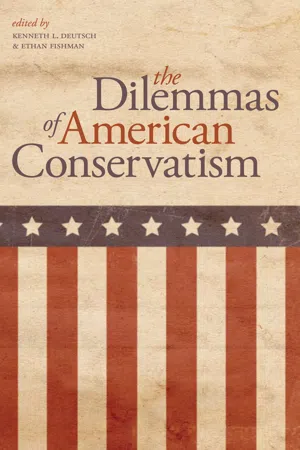
In the second half of the twentieth century, American conservatism emerged from the shadow of New Deal liberalism and developed into a movement exerting considerable influence on the formulation and execution of public policy in the United States. During that period, the political philosophers who provided the intellectual foundations for the American conservative movement were John H. Hallowell, Eric Voegelin, Leo Strauss, Richard Weaver, Russell Kirk, Robert Nisbet, John Courtney Murray, Friedrich Hayek, and Willmoore Kendall. By offering a comprehensive analysis of their thoughts and beliefs, The Dilemmas of American Conservatism both illuminates the American conservative imagination and reveals its most serious contradictions. The contributing authors question whether a core set of conservative principles can be determined based on the frequently diverging perspectives of these key philosophers.
eBook - ePub
The Dilemmas of American Conservatism
- 232 pages
- English
- ePUB (mobile friendly)
- Available on iOS & Android
eBook - ePub
The Dilemmas of American Conservatism
About this book
Information
Willmoore Kendall, Man of the People
DANIEL MCCARTHY
Few leading intellectuals of the early postwar conservative movement considered themselves majority-rule democrats. But Willmoore Kendall (1909–1967) was one who did. While James Burnham looked to a Machiavellian elite as the “defenders of freedom” and others of the Right defined themselves in opposition to what José Ortega y Gasset had called (in the title of his famous book) “the revolt of the masses,” Kendall grounded his understanding of conservatism in the customs and attitudes of the American people.1 This did not make him the father of right-wing populism: Senator Joseph R. McCarthy, for one, needed no help from Kendall in attracting a mass following, although Kendall was indeed “one of the great philosophical defenders of the Senator.”2 Rather, what this “wild Yale don”3 achieved was to reconcile philosophical conservatism, particularly in its anticommunist and antiliberal modes, with the American political system, even at its most frankly democratic. His distinctive contribution to the postwar Right, historian George H. Nash has argued, was to Americanize and politicize the conservative intellectual movement.4
Kendall did this through brilliant readings of America's foundational documents, including not only the Constitution, the Federalist, and the Bill of Rights but also the Mayflower Compact, the Fundamental Orders of Connecticut, and the Virginia Declaration of Rights, among others. He sharply contrasted the tradition of these documents against modern liberalism's commitment to a totally open society. For Kendall, the American political system was properly “closed,” and the keys to interpreting it were to be found not in theories of individual rights but in such concepts as deliberative assembly, constitutional morality, and public orthodoxy.
Today, no institute, foundation, or center bears Willmoore Kendall's name. Yet his contemporaries acknowledged him as one of the foremost, if not preeminent, conservative thinkers of his time. Jeffrey Hart called him “beyond any possibility of challenge, the most important political theorist to have emerged … since the end of World War II.”5 Leo Strauss considered Kendall “the best native [i.e., American] theorist of [his] generation.”6 Hart and Strauss were friends of Kendall's and philosophically sympathetic to him, but even critics, such as libertarian Murray Rothbard, recognized Kendall's gifts. Rothbard believed that Kendall's majoritarianism and hostility to theories of natural rights marked him as “the philosopher of the lynchmob,” yet he credited him as “a very keen and stimulating thinker, incisive, and with a sharply radical spirit with a propensity to dig to the roots of issues without fear or favor.”7
Why, then, has Kendall fallen into relative obscurity? Nash, the dean of conservative historiographers, has suggested three reasons. First, Kendall died at a comparatively young age (fifty-eight), before he could complete his projected oeuvre. Second, the corpus of his work in political philosophy is diffuse, consisting of just one original book (John Locke and the Doctrine of Majority-Rule); a volume of revised essays and reviews (The Conservative Affirmation); a posthumous anthology of other essays, talks, and unpublished fragments (Willmoore Kendall Contra Mundum); and another posthumous work completed by George W. Carey (The Basic Symbols of the American Political Tradition). “There is a tendency among intellectuals,” Nash suggests, “to study and memorialize those who leave their thoughts behind in the form of finished books rather than scattered articles (however luminous).” Third, “the most important reason for Kendall's still somewhat shadowy place in the conservative pantheon” according to Nash, was “his own ‘volatile’ personality and intellect.… So colorful was he, and so fascinating, that there has been a tendency to remember him more as ‘the most unforgettable character I've met’ than as a deep and daring conservative thinker.”8 “When writing about Willmoore Kendall,” Carey concurs, “a strong temptation exists to deal with the man, not his teachings or theory.”9 Indeed, Kendall was such a remarkable man that, like Allan Bloom, he inspired a story by Saul Bellow (“Mosby's Memoirs,” in Kendall's case).10 However unfortunate it may be that Kendall's life and personality sometimes eclipsed interest in his work, his biography is important for understanding both the development of his thought and his impact on modern American conservatism. This is especially true in light of the powerful indirect influence Kendall exercised on the development of conservatism through his student William F. Buckley Jr.
Kendall was born on March 5, 1909, in Konawa, Oklahoma. His father, Willmoore Kendall Sr., a Methodist minister, was blind, and Kendall's later philosophical rigor evidently owed much to his extensive reading to and discussions with his father. The senior Kendall preached in small towns throughout Oklahoma, and Nash credits this “rural, Democratic” milieu with helping to inspire Kendall's “faith in the inarticulate common man and distrust of ‘undemocratic’ elites—a feature of his thought throughout his life.”11
Young Willmoore was a prodigy. He learned to read at age two. He graduated from high school at twelve and from the University of Oklahoma at sixteen. His first book, Baseball: How to Play It and How to Watch It, was published (under the pseudonym Alan Monk) the year he turned eighteen. By 1932, he had completed course work for a Ph.D. in Romance languages at the University of Illinois. But before finishing his dissertation he accepted a Rhodes scholarship to Oxford, where he studied with philosopher R. G. Collingwood, who piqued Kendall's interest in political theory.12 Kendall also became a fervent Marxist during his time at Oxford and conceived an ambition to become “a great socialist publicist.”13
In pursuit of that dream, he worked for the United Press in Madrid between terms at Oxford, then returned to Spain as a full-time foreign correspondent after completing his studies. There he circulated among high-ranking Trotskyites; he seems to have had an aversion to Stalinism from the start. As the civil war approached, his sympathies lay firmly with the Republicans. What he saw in Spain, and later learned about the conflict after his return to the United States, cured Kendall of his youthful flirtation with communism. According to Nash: “The dictatorial, totalitarian, antidemocratic aspects of communism appalled him. He later told a friend that as Spain slid toward civil war he could tolerate the Communists’ blowing up the plants of opposition newspapers. But when they deliberately killed opposition newsboys—this was too much. Exposure to the Spanish Republic ‘really shook Willmoore up,’ one friend recalled, and within a few months, ‘his thought crystallized into fervent anti-communism.’”14
In 1936 Kendall returned to the University of Illinois, where he forfeited his credits in Romance languages and began work toward a Ph.D. in political science, which he received in 1940. His dissertation was published the following year as John Locke and the Doctrine of Majority-Rule. It was a work of startling originality, advancing a novel interpretation of Locke as a pure majoritarian and anticipating the later scholarly consensus that Locke's Second Treatise had been written before the Glorious Revolution of 1688–1689.15 Kendall regretted, however, that the work did not receive more attention from the academic mainstream.16
He had a political as well as an academic interest in Locke. “The name of Locke, associated as it is in men's minds with such values as tolerance, freedom of inquiry, love of truth, etc.,” he writes, “has become a symbol in the continuing struggle for power in the American constitution; and, as such has been extremely useful to those who prefer government by judiciary to majority-rule.” Kendall knew which side he was on and recognized the practical consequences that might flow from his research. If, he observes, “Locke's natural rights are merely the rights vouchsafed by a legislature responsible to the majority, the opponents of judicial review can easily capture for themselves a symbol that might prove extremely useful.”17
This is not to say that Kendall intended from the start to overturn the conventional understanding of Locke as a philosopher of natural rights. On the contrary, he expected his investigations to confirm “prevailing notions about Locke's political theory” and was surprised when his research led him to conclude instead that Locke was a defender of absolute majority rule.18 But that was what his close study of the Second Treatise revealed. His reading was guided by methods he had learned from Collingwood. As Kendall described this approach years later: “Let's find out, above all, what question the book is asking, the problem to which it addresses itself first and foremost; let us try first to grasp that question, then to find out what the author's overall answer to the question actually is. Let us, in a word, not make the mistake of trying to get answers to the question of parts of the book that turn out to have no bearing either upon the question or upon the answer.”19
Only after a painstaking reading that “accept[ed] no sentence or paragraph from the Second Treatise as Locke's ‘teaching’ without first laying it beside every other sentence in the treatise” did Kendall conceive his thesis: “that Locke did not say the things he is supposed to have said” about natural rights; instead, Locke's answers to the great permanent questions of political philosophy are “at every point except one, [those] of the majority-rule democrats.”20
In John Locke and the Doctrine of Majority-Rule, Kendall argues that even in Locke's state of nature there are no truly individual rights. Rights, rather, are reciprocal with social duties and communal in character, community in the state of nature being the community of all humanity. Kendall illustrates this point with an analysis of Locke's account of the right to acquire property in the state of nature. “The right has its origin,” Kendall writes, “in a need which Locke represents as a common (= community?) need,” namely, the need for property as a means of ensuring humanity's survival and flourishing as a species. Locke “is thinking of the right of property simply as a function of one's duty to enrich mankind's common heritage,” and what is more, “this same functional view of rights carries itself over into Locke's handling of the problem of rights in organized society.” Kendall characterizes the presuppositions of Locke's theory of property as “collectivist in the extreme.”21
He then proceeds to show that Locke's description of the law of nature is complex and seemingly contradictory, yet the apparent problems matter little, since “Locke's state of nature [is merely] an expository device,” as is Locke's compact theory, “whose purpose,” Kendall states, “is to lay bare the essential character of the rights and duties which belong to men as members of (legitimate) commonwealths.”22 Just as the community of the human race is the supreme authority in the state of nature, the people are sovereign in political society. And the relationship in a given commonwealth between the sovereign people and a particular government “is, quite simply, assimilable to that between principal and agent in Anglo-American law.” The people as a whole remain sovereign and may cashier the government of the day, but the people may delegate to the government unlimited power over individuals, since “even the individual's right to life is valid only to the extent that it is compatible with the good (= preservation) of his community, and it is the people, not the individual, to whom Locke has clearly imputed the power to make the necessary judgments as to what is compatible with its [i.e., the people's] preservation.”23
How is the will of the people to be expressed? Kendall reads Locke as assigning this power to the majority: “Wherever men live in community with one another, [Locke] is saying, the relations between them can be described in terms of an agreement which, in addition to assigning to the whole community that unlimited power which we have examined … assigns to the numerical majority a right to make decisions (regarding the use of that power) which are binding upon the minority. The majority-principle is, in a word, implicit in the logic of community life.”24
Kendall analyzes five arguments that Locke provides in support of majority rule, concluding that “what was really in Locke's mind” as the ultimate basis for majority rule was the belief that, “individual consents being … the only rightful title to the exercise of power,” and consent being the only truly individual right for Locke, “the right of the majority flows as ...
Table of contents
- Cover Page
- Title Page
- Copyright Page
- Contents
- Preface
- Introduction
- The Classical Realism of John H. Hallowell
- Eric Voegelin and American Conservatism
- Leo Strauss’s Fri endly Criticism of American Liberal Democracy
- The Relation of Intellect and Will in the Thought of Richard Weaver
- Robert Nisbet and the Conservative Intellectual Tradition
- John Courtney Murray as Catholic, American Conservative
- Russell Kirk
- F. A. Hayek
- Willmoore Kendall, Man of the People
- Contributors
- Index
- Back Cover
Trusted by 375,005 students
Access to over 1.5 million titles for a fair monthly price.
Study more efficiently using our study tools.
Frequently asked questions
Yes, you can cancel anytime from the Subscription tab in your account settings on the Perlego website. Your subscription will stay active until the end of your current billing period. Learn how to cancel your subscription
No, books cannot be downloaded as external files, such as PDFs, for use outside of Perlego. However, you can download books within the Perlego app for offline reading on mobile or tablet. Learn how to download books offline
Perlego offers two plans: Essential and Complete
- Essential is ideal for learners and professionals who enjoy exploring a wide range of subjects. Access the Essential Library with 800,000+ trusted titles and best-sellers across business, personal growth, and the humanities. Includes unlimited reading time and Standard Read Aloud voice.
- Complete: Perfect for advanced learners and researchers needing full, unrestricted access. Unlock 1.5M+ books across hundreds of subjects, including academic and specialized titles. The Complete Plan also includes advanced features like Premium Read Aloud and Research Assistant.
We are an online textbook subscription service, where you can get access to an entire online library for less than the price of a single book per month. With over 1.5 million books across 990+ topics, we’ve got you covered! Learn about our mission
Look out for the read-aloud symbol on your next book to see if you can listen to it. The read-aloud tool reads text aloud for you, highlighting the text as it is being read. You can pause it, speed it up and slow it down. Learn more about Read Aloud
Yes! You can use the Perlego app on both iOS and Android devices to read anytime, anywhere — even offline. Perfect for commutes or when you’re on the go.
Please note we cannot support devices running on iOS 13 and Android 7 or earlier. Learn more about using the app
Please note we cannot support devices running on iOS 13 and Android 7 or earlier. Learn more about using the app
Yes, you can access The Dilemmas of American Conservatism by Kenneth L. Deutsch, Ethan Fishman, Kenneth L. Deutsch,Ethan Fishman in PDF and/or ePUB format, as well as other popular books in Politica e relazioni internazionali & Conservatorismo e liberalismo. We have over 1.5 million books available in our catalogue for you to explore.