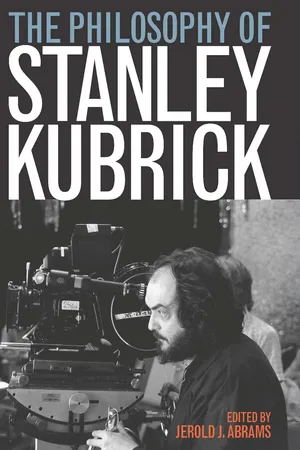
In the course of fifty years, director Stanley Kubrick produced some of the most haunting and indelible images on film. His films touch on a wide range of topics rife with questions about human life, behavior, and emotions: love and sex, war, crime, madness, social conditioning, and technology. Within this great variety of subject matter, Kubrick examines different sides of reality and unifies them into a rich philosophical vision that is similar to existentialism. Perhaps more than any other philosophical concept, existentialism—the belief that philosophical truth has meaning only if it is chosen by the individual—has come down from the ivory tower to influence popular culture at large. In virtually all of Kubrick's films, the protagonist finds himself or herself in opposition to a hard and uncaring world, whether the conflict arises in the natural world or in human institutions. Kubrick's war films (Fear and Desire, Paths of Glory, Dr. Strangelove, and Full Metal Jacket) examine how humans deal with their worst fears—especially the fear of death—when facing the absurdity of war. Full Metal Jacket portrays a world of physical and moral change, with an environment in continual flux in which attempting to impose order can be dangerous. The film explores the tragic consequences of an unbending moral code in a constantly changing universe. Essays in the volume examine Kubrick's interest in morality and fate, revealing a Stoic philosophy at the center of many of his films. Several of the contributors find his oeuvre to be characterized by skepticism, irony, and unfettered hedonism. In such films as A Clockwork Orange and 2001: A Space Odyssey, Kubrick confronts the notion that we will struggle against our own scientific and technological innovations. Kubrick's films about the future posit that an active form of nihilism will allow humans to accept the emptiness of the world and push beyond it to form a free and creative view of humanity. Taken together, the essays in The Philosophy of Stanley Kubrick are an engaging look at the director's stark vision of a constantly changing moral and physical universe. They promise to add depth and complexity to the interpretation of Kubrick's signature films.
- 288 pages
- English
- ePUB (mobile friendly)
- Available on iOS & Android
eBook - ePub
The Philosophy of Stanley Kubrick
About this book
Information
Publisher
The University Press of KentuckyYear
2007Print ISBN
9780813192208
9780813124452
eBook ISBN
9780813137193
Subtopic
Film & VideoPART ONE
THE SUBJECT AT WAR
UNDERSTANDING THE ENEMY
The Dialogue of Fear in Fear and Desire and Dr. Strangelove
Elizabeth F. Cooke
What is absurd is the confrontation of this irrational and the wild longing for clarity whose call echoes in the human heart. The absurd depends as much on man as on the world.
—Albert Camus, The Myth of Sisyphus
According to French philosopher Albert Camus, our most important task is not to discover the meaning of life but to recognize that it is, in fact, meaningless. Camus calls this human condition the absurd, the fact that although we long for clarity and meaning in our lives, none is given. Stanley Kubrick was quite taken with existentialism in general, but it is Camus’ philosophy that we see most prominently in two of his war films that are studies in how we face the absurd. These are Kubrick’s first feature-length film, Fear and Desire (1953), which he removed from the public sphere but has recently been made available by ElusiveDVD.com, and the much better known Dr. Strangelove, or: How I Learned to Stop Worrying and Love the Bomb (1964).
Fear and Desire is a study in how individuals face fear. Four soldiers are trapped behind enemy lines and must plan their escape without weapons, food, or transportation. These four men cooperate with one another, yet each must also deal with his own personal enemies. Although the setting appears to be central Europe during World War II, the narrator (David Allen) tells us that this is not a story about a particular war in history but one about any war in any time, and the soldiers “have no other country but the mind.” We learn about this “war of the mind” through the mind—through voice-over monologues (heard as private thoughts) rather than intersubjective public dialogues. These monologues reveal how differently each character confronts his fears as he questions the purpose of his life and death. Yet, as different as they are, ultimately there is only one message in the film: Each soldier must face his own internal enemy. He must face his own fear, his own mortality, and the meaninglessness of his own life alone.
We see the flip side of this existential view in Kubrick’s later film Dr. Strangelove. This film is also a study in fear, but rather than the individual’s fear of his own death, it is a study of how institutions, or collective minds, face the annihilation of the entire human race. To do this, Kubrick uses the reverse approach of Fear and Desire: rather than private monologues, he uses public and, indeed, ludicrous dialogues with insane participants. As an attempt to communicate, understand, or reach an agreement for the sake of cooperation, each dialogue is an utter failure. Each one fails to achieve any real level of understanding, fails to undo the mistakes of past dialogues, and, ultimately, fails to prevent World War III. But the reason for these failures seems to be that institutional procedures exclude the individual (who otherwise might be the only source of sanity and reason). Of course, in the end, two individuals decide the world’s fate: General Jack D. Ripper (Sterling Hayden), an insane general whose fear has become his reality, and Dr. Strangelove (Peter Sellers), an out-of-control scientist whose fear of not controlling cannot be contained. But these men are not really individuals, because they do not face the absurd as individuals. They are merely products of their institutions, and this is ultimately the cause of their insanity and the war. This is also the underlying existential message: when the individual is lost, we are all lost. Kubrick’s criticism—illustrated through one ridiculous scene after the next of the sane talking with the insane (or the drunk)—is that all procedures of institutional deliberation and communication ignore individual freedom. Individuals dissolve into a machine of bureaucracy and a mindless chain of command. In the end, a rational individual can do nothing to make a bit of difference; humans have become slaves to a larger machine that we no longer control. And this might just mean that everyone involved is insane.
So, in a sense, the message in both films is the same: the enemy is always within us, and the absurd can only be faced alone. But in Dr. Strangelove, Kubrick leaves us with little to work toward; with certain institutions in place, there is simply no appropriate response to the absurd, because the individual has been lost.
How Do We Face the World?
Philosophy has, from the beginning, attempted to get at the core of what it is to be human. Throughout the ages—from the Greeks through the Middle Ages to the modern period and today—a long and rich tradition has evolved, marked by many attempts to define human nature. Here, it is helpful to provide a brief survey of some of those attempts so that we can understand what is going on in Kubrick’s films. One of the earliest methods of philosophy was dialogue, developed in ancient Greece most prominently by Socrates and Plato. The idea here is that humans are rational and that we reason best through conversation, essentially through questions and answers. With this method we can, with a great deal of effort, get to the ultimate and eternal truths of the universe. Plato called these the Forms, the essences of reality, which remain constant despite the flux of matter.
Implicit in this method is the view that our common beliefs about philosophical issues such as reality, knowledge, justice, and the purpose of human life have something right about them, but also, inevitably, something wrong. Through critical dialogue we can unveil our mistakes, and a positive theory will emerge. The point is to start from current beliefs and engage critically with others, as well as with oneself, to improve one’s ideas. In this way, dialogue entails a commitment to openness, to conceptual change, but also to working toward these static universal truths.
This method, which survived in some form throughout the Middle Ages, was called into question in the modern world. Most famously, René Descartes, the father of modern philosophy, found the traditional methods problematic partly because they could easily leave some false beliefs unquestioned. So, Descartes set out to overhaul the method. His new method, meant to be more thorough, was one of pure intuitive introspection. Rather than engaging in dialogue with others and improving on our existing opinions, pruning and repruning them, Descartes retreated into isolation to find an absolute foundation for all beliefs in his own mind, or, more specifically, in his own pure self-consciousness. From this one absolute truth—namely, “I think, therefore I am”—he would derive all other truths deductively (and with certainty). The truths achieved through this method could be gained by any individual who engaged in this same examination. But most importantly, the absolute, certain truth could be found only by taking this subjective standpoint.
Although Plato and Descartes had virtually opposite methods—social dialectic and private intuition, respectively—they shared the goal of establishing absolute truths. Existentialism, however, is different. Coming several centuries after Descartes, it still shares the modern Cartesian emphasis on the subject’s consciousness as the starting point for philosophy, but existentialism rejects much of both the ancient and the modern philosophical traditions. For example, it rejects the modern emphasis on knowledge over action, and it rejects the traditional philosophical view, both ancient and modern, that there are universal answers to questions regarding what it means to be human. For existentialists, there are no given answers to this question. Therefore, the old answers, in the form of philosophical conceptions of a static human nature—human beings as rational or knowing subjects, as creatures of God, or as complex lumps of protein—all miss the point. For existentialists, to be human is to be a conscious and free individual, a point that no third-person perspective, whether scientific or philosophical, can grasp in the form of a definition.
What traditional approaches to human nature forget is that these static definitions are useless unless the individual decides to accept them. Attempting to provide a one-size-fits-all answer to fundamental questions of human existence ignores the individual’s responsibility to decide what his or her particular life is about. The individual cannot rely on prefabricated definitions or explanations of what it is to be human and then simply follow them. Only the individual can impose a self-definition, choosing his or her own distinct answer.
That said, the existentialists have quite distinct ideas about how the individual ought to face and answer these questions, but they all share the view that the individual must ultimately face his or her own freedom. In fact, no truth about humans can have significance unless the individual gives them significance by making choices. It is not a question of knowing the truth but of choosing a truth. For example, German philosopher Friedrich Nietzsche reminds us that we have the freedom to reject a belief in God and morality; we have the freedom to choose our own values and live by them. Danish philosopher Søren Kierkegaard emphasizes our freedom to commit ourselves to a universal ethical cause that is greater than the sum of our individual choices (the ethical stage) or to go even further and commit ourselves to something beyond a universal ethical cause and thus enter into a personal relationship with God (the religious stage). French philosopher Jean-Paul Sartre describes our freedom to reject all notions of value beyond the ones we choose, as long as we accept responsibility for the fact that our chosen actions make us who we are. We cannot hide behind anything, nor can we pretend that we are not utterly responsible for who we are. There can be no blaming our upbringing, our genetics, our social roles, or authorities of any kind, because we choose every action and attitude that make up our lives.
Once one becomes more conscious of one’s own freedom, the next step is to use it honestly, authentically, and lucidly. Of course, this is not an easy task in a world with so many opportunities to hide from freedom. We lie to ourselves all the time; we tell ourselves that we were forced to do something because we find it so difficult to bear the responsibility of being free. Yet no one, not even the existentialist, can teach another to live freely. Living freely and authentically must ultimately come from the self.
Here, the problem of method arises. Although existentialism embraces individualism, it does not hold out the Cartesian hope of gaining certainty through intuition, nor does it use Platonic dialogue. Existentialism stands opposed to both these methods, in that it does not assume the power of reason or dialogue to compel the individual to do (or believe) the right thing. Rather, existentialists tend to use literature to uncover what consciousness is like, with the goal of making the reader explicitly aware of something that he or she already knows deep down. Perhaps this is why the genre of film lends itself so readily to existentialist themes.
Camus and the Absurd
Kubrick easily falls into the existentialist camp. And while there is much in his view that resembles Sartre’s existentialism, I think his view most closely resembles Camus’ existentialism (a label that Camus rejected, preferring absurdism instead—although the two are very similar). This worldview of absurdism comes out most prominently in Camus’ great work The Myth of Sisyphus, in which he claims that the most profound philosophical problem is neither the essence of reality (à la Plato) or the foundation of knowledge (à la Descartes) but rather the problem of suicide. Faced with the human condition, one asks, Why should I not kill myself?
Recognition of the absurd results from the awareness of two things: first, that we have an incredible longing for things to make sense, for the world to have meaning; and second, that the world does not make sense. As Camus puts it: “What is absurd is the confrontation of this irrational and the wild longing for clarity whose call echoes in the human heart. The absurd depends as much on man as on the world.”1 Recognizing this absurdity is half the battle, but once absurdity is recognized, it becomes a passion, and how one lives with this passion is Camus’ central concern. Once the passion is admitted, one must choose among three real possibilities: First, one can commit suicide. Second, one can choose to believe in God or a transcendent world, replacing the absurd world with a meaningful one. In other words, one can choose to have hope. Third, one can choose to live in the cold, hard light of the absurd, struggling against meaninglessness by trying to invent one’s own meaning.
Neither of the first two options is acceptable for Camus. To commit suicide is to fail to accept the absurdity of the world, to escape, and thus to crumble under the weight of fear and trembling. It is to give up rather than to live authentically. But to have hope in some transcendent meaning amounts to the same thing. To hope is also to escape. To accept a doctrine that explains the absurdity debilitates the individual and relieves the individual of the weight of his or her own life.2 In fact, the problem with existentialist thought, for Camus, is that it is steeped in vast hope.
A large part of the motivation for hope comes from the idea of original sin. We see ourselves as guilty and seek absolution in another world. But Camus rejects this idea of original sin in all its forms. It is fundamental to the human condition that we feel innocent, and original sin is something imposed on this original innocence. Camus writes: “An attempt is made to get him to admit his guilt. He feels innocent. To tell the truth, that is all he feels—his irreparable innocence.”* Without any feeling of guilt, an individual has no real need to be saved from guilt and thus has no reason to make an appeal to God.
This, ultimately, is man’s question about the absurd, as Camus sees it: “he wants to find out if it is possible to live without appeal.” That is what Camus means when he asks, “What other truth can I admit without lying, without bringing in a hope I lack and which means nothing within the limits of my condition?” All one can do, if one is to live without lying, is to accept that “it is essential to die unreconciled and not of one’s own free will.” One must live lucidly, honestly in the face of the absurd. One must face, rather than try to escape, the absurdity, and then revolt against it. As Camus says of the individual, “The absurd is his extreme tension, which he maintains constantly by solitary effort, for he knows that in that consciousness and in that day-to-day revolt he gives proof of his only truth, which is defiance.”4
Neither committing suicide nor taking a leap of faith to believe in some doctrine about the meaning of life is a solution for Camus, because neither is honest. So, the absurd man refuses to hope. He is indifferent to the future. He doe...
Table of contents
- Cover
- THE PHILOSOPHY OF POPULAR CULTURE
- Title Page
- Copyright
- Contents
- Acknowledgments
- Introduction
- Part One: The Subject at War
- Part Two: The Subject in Love
- Part Three: The Subject and the Meaning of Life
- Part Four: The Subject in History
- Part Five: The Subject of the Future
- Filmography
- Contributors
- Index
Trusted by 375,005 students
Access to over 1.5 million titles for a fair monthly price.
Study more efficiently using our study tools.
Frequently asked questions
Yes, you can cancel anytime from the Subscription tab in your account settings on the Perlego website. Your subscription will stay active until the end of your current billing period. Learn how to cancel your subscription
No, books cannot be downloaded as external files, such as PDFs, for use outside of Perlego. However, you can download books within the Perlego app for offline reading on mobile or tablet. Learn how to download books offline
Perlego offers two plans: Essential and Complete
- Essential is ideal for learners and professionals who enjoy exploring a wide range of subjects. Access the Essential Library with 800,000+ trusted titles and best-sellers across business, personal growth, and the humanities. Includes unlimited reading time and Standard Read Aloud voice.
- Complete: Perfect for advanced learners and researchers needing full, unrestricted access. Unlock 1.5M+ books across hundreds of subjects, including academic and specialized titles. The Complete Plan also includes advanced features like Premium Read Aloud and Research Assistant.
We are an online textbook subscription service, where you can get access to an entire online library for less than the price of a single book per month. With over 1.5 million books across 990+ topics, we’ve got you covered! Learn about our mission
Look out for the read-aloud symbol on your next book to see if you can listen to it. The read-aloud tool reads text aloud for you, highlighting the text as it is being read. You can pause it, speed it up and slow it down. Learn more about Read Aloud
Yes! You can use the Perlego app on both iOS and Android devices to read anytime, anywhere — even offline. Perfect for commutes or when you’re on the go.
Please note we cannot support devices running on iOS 13 and Android 7 or earlier. Learn more about using the app
Please note we cannot support devices running on iOS 13 and Android 7 or earlier. Learn more about using the app
Yes, you can access The Philosophy of Stanley Kubrick by Jerold J. Abrams in PDF and/or ePUB format, as well as other popular books in Media & Performing Arts & Film & Video. We have over 1.5 million books available in our catalogue for you to explore.