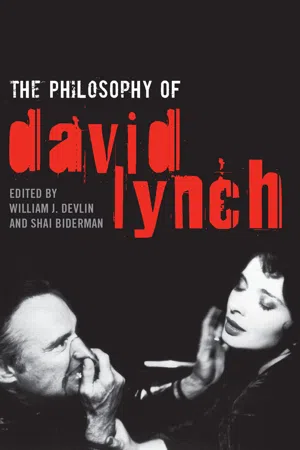
From his cult classic television series Twin Peaks to his most recent film Inland Empire (2006), David Lynch is best known for his unorthodox narrative style. An award-winning director, producer, and writer, Lynch distorts and disrupts traditional storylines and offers viewers a surreal, often nightmarish perspective. His unique approach to filmmaking has made his work familiar to critics and audiences worldwide, and he earned Academy Award nominations for Best Director for The Elephant Man (1980), Blue Velvet (1986), and Mulholland Drive (2001). Lynch creates a new reality for both characters and audience by focusing on the individual and embracing existentialism. In The Philosophy of David Lynch, editors William J. Devlin and Shai Biderman have compiled an impressive list of contributors to explore the philosophy at the core of the filmmaker's work. Lynch is examined as a postmodern artist, and the themes of darkness, logic, and time are discussed in depth. Other prominent issues in Lynch's films, such as Bad faith and freedom, ethics, politics, and religion, are also considered. Investigating myriad aspects of Lynch's influential and innovative work, The Philosophy of David Lynch provides a fascinating look at the philosophical underpinnings of the famous cult director.
eBook - ePub
The Philosophy of David Lynch
- 258 pages
- English
- ePUB (mobile friendly)
- Available on iOS & Android
eBook - ePub
The Philosophy of David Lynch
About this book
Information
Subtopic
Film et vidéoPart 1
THE WORLD OF DAVID LYNCH
“THE OWLS ARE NOT
WHAT THEY SEEM”
Our world is not inherently logical—we impose logic upon it to make sense of the random and absurd happenings all around us and to create a sense of order out of chaos. The beauty of the work of filmmaker David Lynch is that he not only recognizes this basic truth about the absurdity of human existence, he celebrates it to create his own unique worldview. By showcasing distortions and manipulations of reality, and logical paradoxes and fallacies used as the basis for his characters' actions, a typical Lynch film can be off-putting to many viewers. Because his films are often violent and sexually explicit with an unusual narrative structure and heavy symbolic content, repeated viewings may be necessary to grasp all of the many layers of meaning he builds in to the structure. As in the work of the Dutch surrealist Mauritius Escher (1898-1972), who manipulates the rules of perspective to create the appearance of three-dimensional space on a two-dimensional surface, the logic of Lynch's world at first appears twisted and chaotic. But for those existing within it, everything makes perfect sense. In Lynch's works, we often find the filmmaker manipulating the viewer by playing an illogical (even nonsensical) scene perfectly straight. The characters within the narrative do not see any humor or irony in their beliefs or actions, just as the man walking up the stairs to nowhere in an Escher work (Relativity, lithograph, 1953) doesn't realize his world is visually illogical; he just keeps walking up and down the steps. In a Lynch film, as in an Escher print, reality is carefully planned and controlled for maximum effect, even when it seems uncontrolled and illogical to the viewer. As the filmmaker, Lynch imposes his brand of logic upon the story to make sense of the random and absurd happenings all around his characters and to create a sense of order out of chaos within the film itself.
In David Lynch's The Cowboy and the Frenchman (1988), an episode for the French series The French as Seen By… (1988), Lynch tells an absurdist story involving, as the title suggests, cowboys and a Frenchman. Driving the comedic tone of this show is Lynch's play on the modern stereotypes of cowboys, Indians, and Frenchmen. The cowboys, led by the almost stone- deaf Slim (Harry Dean Stanton), are all decked out in cowboy hats, plaid shirts, and chaps. They drink longneck bottles of Budweiser, appear to be trigger-happy gunslingers (even going so far as to shoot at a bird for tweeting) and speak in Western slang. The Indian, “Broken Feather” (Michael Horse), wears a feather in his long hair, is bare-chested (clothed only in buckskin breeches and a loincloth), and speaks in pidgin English, beginning phrases with “Me no.” Meanwhile, Pierre the Frenchman (Fredric Golchan), who speaks only French, has a thin mustache, wears a dark suit, a beret, an ascot, and carries with him a suitcase full of French souvenirs: bottles of wine, loaves of baguettes, packs of cigarettes, a replica of the Eiffel Tower, and, to the cowboy's horror, a dinner plate of snails. The cowboys finally stumble onto this strange man's national identity when they find a plate of French fries in the magical bag.
This meeting between the Frenchman and the cowboys is reduced to seeming absurdity by the end, as we see cowgirls and French girls dancing together to a cowboy rock song, while Pierre learns how to say “Yippee- kay-ay” and cowboy Slim learns how to say “Ooh la la.” As Slim sings “Home on the Range,” accord between the two groups is symbolized by Pierre's presentation of a small replica of the Statue of Liberty, echoing the original friendship gift between the two nations, as the whole party shouts “Vive la France” and trigger-happy Slim shoots off his pistol. The final scene, set the next morning, finds Slim has traded his cowboy hat for Pierre's beret, while Pierre, in perfect English, rhapsodizes about pancakes, and the Indian, also in perfect English, wishes he had a suitcase like the Frenchman's.
This short film, whose actual title is The French as Seen by David Lynch, may be read as a subtle comment on the ubiquitous and often overpowering nature of American culture. The American cowboy Slim is literally deaf to all comments and criticism; U.S. politicians are often referred to as “cowboys” by foreign leaders—in 1988, Ronald Reagan (who often played a cowboy onscreen in his first career) had just finished his last term as president. Immigrants to the United States are told everyone should speak English, and by the end of the film, everyone is. The Frenchman is lucky because he can pack his bag and leave, but the Indian has no suitcase so he can't. When we first meet Broken Feather, Slim orders one of the other cowboys to apologize and pay off his gambling debt to the Indian, a double allusion to the reparations Native Americans have sought from the U.S. government for treaty violations and to their profitable reservation casinos. A hint of Lynch's ambivalence about the French also peeks through at the end in the final image: a dead snail is stuck to Slim, and he plucks it off and throws it to the ground, saying, “damn!”
The people in the film, as seen by Lynch, are on the surface an absurdist humorous play on stereotyping. Stereotyping is a form of jumping to a conclusion. For example, there is the stereotypical cowboy, as portrayed in Lynch's episode. This depiction of the cowboy—trigger-happy, beer- swilling, lassoing farm men—is rooted in the assumption that if one, a few, or most are like this or that, then they must all be like this or that. If we are told about a cowboy, someone might think that, because this person is a cowboy, he and anyone else who is a cowboy must love shooting, the great outdoors, horses, and wide-open spaces. “After all,” thinks the stereotyper, “this person is a cowboy, and they're all like that.” Broadening the analogy to all Americans versus all Frenchmen or all Indians or even all women (who are also stereotyped in the film as dancing sex kittens who bring food and beer to the men), we see Lynch's ability to take what on the surface seems an illogical absurdist comedic short and make a deeper social comment.
Lynch plays with the notion of stereotyping in The Cowboy and the Frenchman, humorously alluding to the moral and logical harm that stereotyping does to people in real life. Consider all of the racism, sexism, ageism, and every other negative “ism” that results from people inappropriately jumping to negative conclusions about groups of people. Lynch, too, recognizes the harm that can result from stereotypes. Take, for instance, The Elephant Man (1980), a film based on the real-life story of Joseph Merrick (named John Merrick in the film and played by John Hurt), a man who suffered from a congenital disorder that severely altered his physical appearance. In the film, we find that Bytes (Freddie Jones), the man who manages the Victorian freak show of which Merrick is a part, treats Merrick's oversized deformities as a disability and labels Merrick a “freak.” Labeling Merrick a freak coincides with Bytes's brutal treatment of Merrick—using such a label, Bytes is able to see Merrick as less human and therefore unworthy of being treated with kindness and respect.
The logical harm of typecasting or stereotypes occurs because the conclusion drawn isn't supported by the reasons given for that conclusion. The conclusion that they're all like that or they all must have that same feature, quality, or characteristic doesn't follow from, and cannot be fully supported by, reasons having to do with one or a few instances being like that or having the certain feature, quality, or characteristic. It is likely that there are cowboys who are trigger-happy, beer-swilling, lassoing farm men, but you could never legitimately draw the conclusion that all cowboys are like that. Likewise, not all people (or any, for that matter) with deformities can be labeled “freaks.” Stereotyping is bad and it is due to bad reasoning.
Logicians, those who study the principles of correct reasoning, have a term for the kind of bad reasoning involved in our examples of typecasting and stereotyping from Lynch's work. They call it a fallacy, and the thinking involved, fallacious reasoning.Fallacies occur whenever we jump to a conclusion, namely, when we incorrectly, illegitimately, or inappropriately draw a conclusion from reasons that don't support the conclusion. Fallacious reasoning is much too common in the real and film worlds. Racists think that just because they have had a bad experience with a person of a particular race, creed, or color, then everyone of that race must be like that. Instead of seeking to become an authority in a particular matter ourselves, we too often blindly accept what someone tells us because we perceive him or her to be an authority concerning that particular matter. Think of all of the people who came to see Merrick and believed that he must be a freak because Bytes said he was a freak. As we, the viewers, notice, these people were not justified in concluding either that they're all like that or that it's true just because Bytes said so. In these cases, the conclusions drawn don't follow from the reasons given as supposed support. In other words, these are all examples of fallacies.
In this essay, we explore Lynch's take on logic in his films. This approach entails further discussion of Lynch's strange use of logic through famous examples in his works, appreciating the bizarre, paranoid, and often fallacious reasoning associated with Lynch's characters. We argue that a Lynch work doesn't always abide by the principles of correct reasoning and often operates within a world of fallacies, yet his characters usually find a way to function within their illogical worlds.
Argumentation Is an Art—Just Not a Visual Art
Logic is the study of the principles of correct reasoning concerning the formation and evaluation of arguments. As we've seen already, people don't always abide by these principles. The way characters and people reason has consequences for how they live their lives in the film and real worlds alike. Good and bad reasoning affect the beliefs people are willing to die for, the policies we adhere to, the laws we make, and the general way in which we live our lives. For the most part, it seems as though Lynch's characters try to abide by reason to determine how to live their lives. In order to see how Lynch's characters follow the forms of good reasoning, we need to discuss the basic elements of logical reasoning. First, we describe the basic components and types of arguments. Second, we discuss two common types of arguments. Finally, we examine the evaluation of arguments.1
BOTH REAL AND IMAGINED PEOPLE NEED TO PUT FORTH GOOD ARGUMENTS
An argument is made up of two or more statements, one of which is called the conclusion. The conclusion is the statement in the argument that is supposed to be justified by, warranted by, supported by, shown to be the case by, demonstrated by, or proved to be the case by the premise or premises. A premise is a statement in the argument that is supposed to justify, warrant, support, show, demonstrate, or prove the conclusion. The basic goal of an argument is to convince or persuade oneself or others of the truth of the concluding statement. Now, Lynch makes use of logical arguments in his films, as, on many occasions, his characters attempt to rationalize the best decision or course to take in their life.
Take the character Sailor Ripley (Nicholas Cage) and his lover, Lula Pace Fortune (Laura Dern), from Wild at Heart (1990) as one example. Sailor has just been released from prison after serving time for manslaughter. Lula's jealous wicked-witch mother, Marietta Pace Fortune (Diane Ladd), tried to have him killed but, instead, Sailor killed the assassin in self-defense. Marietta has forbidden Lula to see Sailor, but she defies her mother and picks him up at the Pee Dee Correctional Institution, and they head out for New Orleans and then California, violating his parole. Marietta puts out another hit on Sailor, something he suspected she would do, so they make a stop in the humorously named town of Big Tuna, Texas (not many tuna swimming in the desert). This small town is populated by the usual bizarre Lynchian characters (such as the twitchy, dog-obsessed Bose “Double Aught” Spool, played by Jack Nance, who actually references Dorothy's dog Toto) and is also where his old “friend” Perdita (Isabella Rossellini) lives. We are never clear on the exact nature of their past relationship, but Sailor reminds her that she owes him a favor, which he has come to claim. Sailor wants to confirm that there is a contract out on him. Perdita is connected, as it were, so she knows about the network of hit men. Unfortunately for Sailor and Lula, Perdita's new boyfriend, the loathsome Bobby Peru (Willem Dafoe), is the hit man hired to carry out Marietta's contract, so Perdita lies, telling Sailor he is safe.
Sailor's reasoning pattern was correct. From his two initial premises, namely that (1) if I want help, I'll contact an old friend who'll help me; and (2) if I contact an old friend who'll help me, then I'll need to go to Texas, Sailor concludes necessarily that if I want help, then I'll need to go to Texas. But he was mistaken in the facts: Perdita is no longer his friend (in Spanish perdita means loss). And so Sailor and Lula find themselves stranded at the Hotel Iguana in Big Tuna, Texas, where their lives are now in jeopardy.
Now, arguments are made up of statements, a concluding statement (the conclusion) and at least one supporting statement (the premise). A statement is a claim, assertion, proposition, judgment, declarative sentence, or part of a declarative sentence—resulting from a belief or opinion—that communicates that something is or is not the case concerning the world, self, states of affairs, or some aspect of reality. Statements are either true or false and, again, are the results of beliefs or opinions that people have about what they perceive to be reality. Our beliefs and opinions are made known through statements, either in spoken or written form. For example, in the context of Wild at Heart, the statements “Bobby shoots two clerks during the bank robbery” and “Johnnie Farragut (Harry Dean Stanton) is a private detective” are true, whereas the statements “Sailor came on to Lula's mother” and “Sailor murdered a man in cold blood” are false.
Statements are shown to be true or false as a result of evidence, which can take the forms of either direct or indirect observation, the testimony of others, explanations, appeal to definitions, appeal to well-established theories, appeal to appropriate authority, and good arguments, to name just a few. So, that Bobby shoots two clerks is shown to be true by observing Wild at Heart, and that Johnnie Farragut is a private detective is defined by his creator, Lynch. Also, that Sailor came on to Lula's mother is false because of observation, and Sailor murdered a man in cold blood is false because of the testimony of others and authorities, observation as well as the judicial theory of self-defense and first-degree murder.
Critically thinking adults have beliefs or opinions that they think are true and that they express in written or spoken statements. However, we can't stop there. We must defend why we hold these beliefs, and so we must give a reason (the premise of our argument) for why we hold to a particular belief (the conclusi...
Table of contents
- Cover Page
- Title Page
- Copryright Page
- Contents
- Acknowledgments
- Introduction
- Part 1 - The World of David Lynch
- Part 2 - Selfhood and Subjectivity: The Existential Drive toward Self-Understanding
- Part 3 - The Self Confronts the World: Issues in Ethics, Society, and Religion
- Contributors
- Index
Trusted by 375,005 students
Access to over 1.5 million titles for a fair monthly price.
Study more efficiently using our study tools.
Frequently asked questions
Yes, you can cancel anytime from the Subscription tab in your account settings on the Perlego website. Your subscription will stay active until the end of your current billing period. Learn how to cancel your subscription
No, books cannot be downloaded as external files, such as PDFs, for use outside of Perlego. However, you can download books within the Perlego app for offline reading on mobile or tablet. Learn how to download books offline
Perlego offers two plans: Essential and Complete
- Essential is ideal for learners and professionals who enjoy exploring a wide range of subjects. Access the Essential Library with 800,000+ trusted titles and best-sellers across business, personal growth, and the humanities. Includes unlimited reading time and Standard Read Aloud voice.
- Complete: Perfect for advanced learners and researchers needing full, unrestricted access. Unlock 1.5M+ books across hundreds of subjects, including academic and specialized titles. The Complete Plan also includes advanced features like Premium Read Aloud and Research Assistant.
We are an online textbook subscription service, where you can get access to an entire online library for less than the price of a single book per month. With over 1.5 million books across 990+ topics, we’ve got you covered! Learn about our mission
Look out for the read-aloud symbol on your next book to see if you can listen to it. The read-aloud tool reads text aloud for you, highlighting the text as it is being read. You can pause it, speed it up and slow it down. Learn more about Read Aloud
Yes! You can use the Perlego app on both iOS and Android devices to read anytime, anywhere — even offline. Perfect for commutes or when you’re on the go.
Please note we cannot support devices running on iOS 13 and Android 7 or earlier. Learn more about using the app
Please note we cannot support devices running on iOS 13 and Android 7 or earlier. Learn more about using the app
Yes, you can access The Philosophy of David Lynch by William J. Devlin, Shai Biderman, William J. Devlin,Shai Biderman in PDF and/or ePUB format, as well as other popular books in Médias et arts de la scène & Film et vidéo. We have over 1.5 million books available in our catalogue for you to explore.