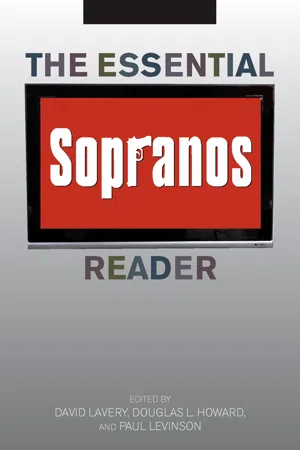
The Sopranos is recognized as the most successful cable series in the history of television. The Washington Post has called the popular series, winner of twenty-one Emmys and five Golden Globes, "the television landmark that leaves other landmarks in the dust." In every aspect—narrative structure, visual artistry, writing, intertextuality, ensemble acting, controversial themes, dark humor, and unflinching examinations of American life—The Sopranos has had few equals. Offering a definitive final assessment of the series, The Essential Sopranos Reader aims to comprehensively examine the show's themes and enduring cultural significance. Gender and ethnicity, the role of dreams, the rebirth of HBO, the series' controversial finale, and other topics come under scrutiny in this highly accessible, engaging collection. The book concludes with an interview with Dominic Chianese, who played Uncle Junior in all six seasons of the show.
eBook - ePub
The Essential Sopranos Reader
- 404 pages
- English
- ePUB (mobile friendly)
- Available on iOS & Android
eBook - ePub
The Essential Sopranos Reader
About this book
Information
PART 1
The Sopranos, David Chase,
HBO, and Television
The Sopranos as Tipping Point
in the Second Coming of HBO
By the early years of the twenty-first century, HBO was the most talked about, widely celebrated, and profitable network in television. On September 19, 2004, it made TV history by winning a staggering 32 Emmy Awards after receiving a record-setting 124 nominations (Weinraub B11). “This will never happen again,” admitted HBO’s newest chairman and chief executive officer (CEO) Chris Albrecht, who had replaced Jeffrey Bewkes in July 2002 when the latter was promoted to president and CEO of Time Warner because of his accomplishments over the previous seven years at HBO’s helm (Bauder). The Sopranos (1999–2007) also garnered the Emmy for Outstanding Drama Series in 2004, the first ever cable-and-satellite program to be recognized this way. The show won the award again in 2007. Furthermore, Home Box Office Inc. posted nearly $1.1 billion in annual profits in both 2005 and 2004 for its parent conglomerate, Time Warner, up from its previous record-setting amounts of $960 million in 2003 and $725 million in 2002 (Dempsey 1; Flint B1; Peterson; Umstead). These figures were the highest annual yields ever earned by any network in the history of television.
After 2004, however, HBO was no longer the beneficiary of the expectations game that it had been a decade earlier. Most industry watchers now assumed that the network would keep producing popular and critically acclaimed programs. Back in the mid- to late 1990s, no one other than HBO insiders expected the network to emerge as the gold standard for original television programming. By 2005, though, TV professionals and critics alike were expecting HBO to create one breakout hit after another. Dozens of original series are tested each year by the broadcast and cable-and-satellite networks, handicapped by critics, and sampled by audiences. Most of these shows fall rapidly by the wayside: an estimated 75 percent never make it beyond the first season. Still, breakout hits do occasionally transform a few select networks into the hottest destinations on TV—and The Sopranos did just that for HBO during the winter and spring of 1999.
Given their longevity, NBC, CBS, and ABC have all climbed to the top of the broadcast television world more than once during the past half century. In the cable-and-satellite TV sector, HBO was the first service to break away from the pack by adding satellite to cable distribution in 1975, causing its subscriber base to skyrocket from a mere 287,199 at the close of that year to 14.6 million a decade later (Mair 26, 158). By 1995, however, HBO had stalled at around 19.2 million subscribers (Stevens 77). Over the next decade, the HBO leadership decided to “jump fully off this cliff,” recalls Jeffrey Bewkes, the then newly appointed chairman and CEO of Home Box Office, referring to his staff’s total commitment to “produce bold, really distinctive television” (quoted in LaBarre 90). HBO set itself apart from the competition for the second time in its short history by deciding to emphasize innovative, original programming. From 1996 through 2001, HBO increased the proportion of original programming from 25 percent to 40 percent of its entire schedule (Bewkes 62).
In retrospect, HBO’s founding was a harbinger of something new and innovative that was happening to television as an industry and a technology during the early to mid-1970s. Cable entrepreneur Charles Dolan first conceived of the network in 1971 as the Green Channel with seed money from Time Inc., hiring thirty-three-year-old Wall Street lawyer Gerald Levin as part of his startup team. Dolan and his associates renamed their channel Home Box Office, reflecting their conception of a theater-like subscription television service that would offer primarily first-run movies and sporting events to its paying customers. HBO was based on an entirely different economic model than the one followed by the three major US broadcast networks (NBC, CBS, and ABC), their affiliates, and the country’s independent stations, which all sold specific audiences to sponsors. Unlike this advertiser-supported system, HBO’s subscriber format focused all of the network’s attention on pleasing and retaining its viewing audience. HBO and the other forty-five aspiring local and regional pay cable channels then trying to survive in the media marketplace were shifting the center of gravity in this sector of the television industry away from advertisers and more toward serving the needs and desires of their monthly customers.
HBO debuted on November 8, 1972, telecasting Sometimes a Great Notion (1971), starring Paul Newman, and a National Hockey League game to just 365 cable-subscriber households in Wilkes-Barre, Pennsylvania. Three months and $1 million in losses later, Time Inc. fired Dolan and instated Gerald Levin as the new president of HBO. Levin kept HBO afloat for two more years before betting the network’s future on a six-year, $7.5 million contract that allowed the channel access to RCA’s newly launched communication satellite Satcom 1 during the fall of 1975. On October 1, 1975, Home Box Office inaugurated its satellite-cable service with the much-hyped “Thrilla in Manila” heavyweight boxing match between Muhammad Ali and Joe Frazier. This brutal fourteen-round bout, won by Ali, was a hugely popular success for all concerned, especially the struggling three-year-old pay-TV company that carried the fight live from overseas. In one fell swoop, HBO became a national network, ushering in television’s cable era (1976–1994) with its first full year of regularly scheduled satellite-delivered programming.
According to influential television critic Les Brown, HBO became “the engine that was pulling cable” (Brown 316). The network’s soaring subscriber base (reaching thirteen million by 1983) had a hand in the increasing adoption of cable in the United States from 15.3 percent of TV households in 1976 to 21.7 percent in 1980 to 39.3 percent in 1983 (Leddy 35). Gerald Levin’s plan for HBO to combine cable with satellite delivery was the final innovation needed to usher in the cable era. A second television age was officially under way by 1976, as Channels magazine dubbed Levin “the man who started the revolution” (Brown 316). With the rise of cable-and-satellite TV, CBS, NBC, and ABC were caught in a kind of freefall, sharing just 67 percent of the available prime-time audience by the end of the 1980s (down from a high of 93.6 percent in 1975), with no end in sight to their spiral downward (Robins 73; Sloane F1). During the early 1990s, the ascent of cable television and the descent of the traditional broadcast networks was an unmistakable and irreversible trend. Cable penetration in the United States rose from 42.8 percent in 1985 to 63.4 percent in 1994 (Sterling and Kittross 871). At the beginning of the 1990s, basic cable attracted 20 percent of all prime-time viewers, and premium channels such as HBO added another 6 percent to this total (2000 Report on Television 17).
The executive team that directed Home Box Office in the late 1970s—Gerald Levin, Frank Biondi, and Michael Fuchs—realized even then that restricting their activities to merely being the wholesaler or intermediary between the movie studios and the nation’s growing cable companies was a dead-end arrangement for HBO. They decided that Home Box Office needed to situate itself squarely in the content development not the transmission business. Being both between and a part of the television, motion picture, and home video industries, Home Box Office was perfectly positioned to diversify into original TV and movie production, home video, and international distribution, even as these once-separate entertainment sectors were beginning to converge into one globally expanding entertainment industry by the mid-1980s. Long before the term became fashionable, HBO as a brand became synonymous with subscription television during the 1970s. More specifically, HBO’s original image or utility brand was linked primarily to its function of providing Hollywood motion pictures to cable viewers in the comfort of their own homes, despite the fact that it also produced and telecast occasional stand-up comedy, sports, and music specials.
In 1983, HBO led the way in this regard by producing its first original series, Not Necessarily the News, and its first made-for-pay-TV movie, The Terry Fox Story, which were followed by its first miniseries, All the Rivers Run, in 1984. When Michael Fuchs assumed the top job at the network in 1985, after Levin was promoted to a vice presidency at Time Inc. and Biondi became head of Columbia Pictures, his dual emphases were to increase the amount of HBO’s original programming and to establish a growing presence for the network overseas. Over time, he succeeded on both counts. Fuchs made a concerted effort to enhance HBO’s brand awareness by launching the company’s first ever national image advertising campaign, “Simply the Best,” in 1989. This initiative started the lengthy and expensive process of changing the overall impression of HBO from that of a first-run movie service to that of a premium network that produces and presents the most innovative original programming on television, in addition to offering its usual lineup of contemporaneous feature films.
After his eleven years at the helm, Fuchs’s controlling, top-down managerial style proved inhibiting for his colleagues, as did his longstanding belief that “HBO has to offer subscribers a wide range of programming they couldn’t see anywhere else” with a continuing emphasis on movies. Fuchs’s stated preference was for “commercial rather than artistic” program development (Mair 106). In contrast, his successor, Jeffrey Bewkes, who had always enjoyed a good working relationship with Fuchs as his talented financial vice president and manager, brought a more collaborative bottom-up way of doing business to the company, unleashing a great deal of creative energy and a new era at HBO (Bewkes 62). The turnaround is usually attributed to a two-day executive retreat called by Bewkes and Chris Albrecht, his new programming chief, who came to the network in 1985 to produce the first Comic Relief special, which telecast the following year. Albrecht immediately set the tone at the meeting by asking, “Do we really believe that we are who we say we are? This distinctive, high-quality, edgy, worth-paying-for service?” Bewkes and Albrecht remember that the silence in the room was deafening. The executive team at HBO then began the slow and deliberate process of “building an outstanding one-of-a-kind programming service” because being an “occasional use” cable channel was “no longer sustainable” in the survival-of-the-fittest world that was then materializing with the emergence of digital television and the widespread adoption of the Internet (Carter 1; Power 77).
The pivotal innovation that shifted consumer interest beyond just cable TV into the wondrous new world of cyberspace was the introduction, on December 15, 1994, of the first commercially available graphical browser, Netscape Navigator 1.0, which made web travel relatively easy for the vast majority of Americans. For its part, HBO transformed the creative landscape of television during the first decade (1995–2004) of TV’s current digital era. It pursued the unusual and atypical strategy for television of increasing its investment in program development (from $2 million to $4 million per prime-time hour), limiting output (thirteen episodes per series each year instead of the usual twenty-two to twenty-six), and producing only the highest-quality series, miniseries, made-for-pay-TV movies, documentaries, and specials. Along with a handful of other channels, such as MTV, ESPN, CNN, and Fox News, HBO established as strong an identity brand as any on television, spilling over into its overseas expansion (beginning with Latin America, Europe, and Asia), its DVD sales, its theatrical releases, its syndication of its own series on other channels (starting with The Larry Sanders Show on Bravo in 2002 and Sex and the City on TBS in 2004), and its production of original programs for other networks (such as Everybody Loves Raymond for CBS from 1996 through 2005).
The tipping point for HBO was the extraordinary success of The Sopranos. Whereas Oz (1997–2003) enjoyed a promising debut with 2.6 million viewers in July 1997, and Sex and the City (1998–2004) garnered 2.8 million viewers in June 1998, The Sopranos pulled in 7.5 million viewers in January 1999 (“Six Feet Above,” 62). These were robust numbers for any cable-and-satellite network at the time; for HBO, though, these audience figures were even more striking when seen within the context of a subscriber base that then totaled slightly more than 25 percent of U.S. television households. The first season of The Sopranos lasted thirteen weeks, from January 10 through March 4, 1999. The subsequent popular and critical response was unprecedented for a cable-and-satellite TV series. Only three months after the show’s premiere, Paul Brownfield of the Los Angeles Times remarked that The Sopranos had “fast become the most talked about series on television” (1). Stephen Holden of the New York Times went even further, famously writing that “The Sopranos, more than any American television in memory, looks, feels, and sounds like real life. . . . It just may be the greatest work of American popular culture of the last quarter century” (“Sympathetic Brutes,” 23).
HBO’s latest spike in popularity and prestige was just beginning. At the start of its third season in March 2001, The Sopranos attracted 11.3 million viewers (de Moraes C7; “Six Feet Above,” 62). HBO was certifiably white hot in September 2002, when The Sopranos opened its fourth season to an audience of 13.4 million—not only winning its time slot, but placing “sixth for the entire week against all other prime-time programs, cable and broadcast,” despite HBO’s “built-in numerical disadvantage.” Even though Home Box Office followed an entirely different economic model than most of the rest of the U.S. TV industry, it had beaten all the advertiser-supported networks at their own game. More significant, it was asserting once and for all that “the underlying assumptions that had driven television for six decades were no longer in effect” (Castleman and Podrazik 419). The momentum in the industry had shifted irrevocably away from the traditional broadcast networks and toward the cable-and-satellite sector of the business, with The Sopranos providing HBO the kind of breakout hit it needed to compete for viewers with any channel on television. In turn, the success of the show “transformed cable television into its own television universe” (Weinman 48).
There is little doubt in hindsight that The Sopranos struck a responsive chord with TV audiences at the turn of the twenty-first century. The fantasy lifestyle of Tony and Carmela captured the zeitgeist, parodying the out-of-control consumerist tendencies of contemporary America. Viewers easily related to a protagonist who has troubles at work, a complicated marriage, two spoiled children, and a mother from hell who can no longer live alone but resists any kind of assisted care. Such depictions of familial and workplace dysfunction rang true with many audience members during the past decade. Chris Albrecht remembers that when he first saw the pilot in 1998
I said to myself, This show is going to be about a guy who’s turning 40. He’s inherited a business from his dad. He’s trying to bring it into the modern age. He’s got all the responsibilities that go along with that. He’s got an overbearing mom that he’s trying to get out from under. Although he loves his wife, he’s had an affair. He’s got two teenage kids and he’s dealing with the realities of what that is. He’s anxious; he’s depressed; he starts to see a therapist because he’s searching for the meaning of his own life. I thought: The only difference between him and everyone I know is he’s the don of New Jersey. So, to me, the Mafia part was sort of the tickle for why you watched. The reason you stayed was because of the resonance and the relatability of all that other stuff. (Biskind)
HBO had actually been laying the promotional groundwork to take full advantage of a breakout hit like The Sopranos ever since Bewkes allocated “$25 million a year just to advertise the HBO brand.” The executive vice president for marketing, Eric Kessler, and his team kicked off a new ad campaign on October 20, 1996, to reinforce the network’s renewed focus on original series production, featuring “one of TV’s all-time great tag lines—It’s Not TV, It’s HBO” (Stevens 77; Gay 2). This branding line marked a transitional moment in the industry when cable-and-satellite channels became the first place to look for breakout programming on television, rather than the traditional broadcast networks. HBO had already established Sunday night as its own must-see-TV evening of viewing with such innovative original series as The Larry Sanders Show (1992–1998) through the debut of Sex and the City in 1998 and then, most emphatically, with The Sopranos in 1999. Moreover, these three series were simply the tip of an iceberg that would include such dramatic series as Six Feet Under (2001–2005), The Wire (2002–2008), and Deadwood (2004–2006); made-for-pay-TV movies such as A Lesson before Dying (1999), Wit (2001), and Elizabeth I (2005); miniseries such as Band of Brothers (2001) and Angels in America (2003); comedies such as Curb Your Enthusiasm (2000–); sports shows; six Oscar-winning documentaries between 1999 and 2004 alone; and theatricals such as American Splendor (2003) that were telecast on HBO after their initial runs in movie theaters.
Af...
Table of contents
- Cover
- Half title
- Title
- Copyright
- Contents
- Foreword by David Bianculli
- Introduction
- Part 1. The Sopranos, David Chase, HBO, and Television
- Part 2. Characters
- Part 3. Gendering The Sopranos
- Part 4. Cinematic Concerns
- Part 5. Dreams and Therapy
- Part 6. Ethnic and Social Concerns
- Part 7. Images of Justice and The Sopranos
- Part 8. Narrative and Intertextuality
- Part 9. Cut to Black: The Finale and the Sopranos Legacy
- Acknowledgments
- Appendix A: Characters
- Appendix B: Episode Guide
- Appendix C: Intertextual References and Allusions in Season Six
- Appendix D: A Conversation with Dominic Chianese, The Sopranos’ Uncle Junior
- Bibliography
- List of Contributors
- Index
Trusted by 375,005 students
Access to over 1.5 million titles for a fair monthly price.
Study more efficiently using our study tools.
Frequently asked questions
Yes, you can cancel anytime from the Subscription tab in your account settings on the Perlego website. Your subscription will stay active until the end of your current billing period. Learn how to cancel your subscription
No, books cannot be downloaded as external files, such as PDFs, for use outside of Perlego. However, you can download books within the Perlego app for offline reading on mobile or tablet. Learn how to download books offline
Perlego offers two plans: Essential and Complete
- Essential is ideal for learners and professionals who enjoy exploring a wide range of subjects. Access the Essential Library with 800,000+ trusted titles and best-sellers across business, personal growth, and the humanities. Includes unlimited reading time and Standard Read Aloud voice.
- Complete: Perfect for advanced learners and researchers needing full, unrestricted access. Unlock 1.5M+ books across hundreds of subjects, including academic and specialized titles. The Complete Plan also includes advanced features like Premium Read Aloud and Research Assistant.
We are an online textbook subscription service, where you can get access to an entire online library for less than the price of a single book per month. With over 1.5 million books across 990+ topics, we’ve got you covered! Learn about our mission
Look out for the read-aloud symbol on your next book to see if you can listen to it. The read-aloud tool reads text aloud for you, highlighting the text as it is being read. You can pause it, speed it up and slow it down. Learn more about Read Aloud
Yes! You can use the Perlego app on both iOS and Android devices to read anytime, anywhere — even offline. Perfect for commutes or when you’re on the go.
Please note we cannot support devices running on iOS 13 and Android 7 or earlier. Learn more about using the app
Please note we cannot support devices running on iOS 13 and Android 7 or earlier. Learn more about using the app
Yes, you can access The Essential Sopranos Reader by David Lavery, Douglas L. Howard, Paul Levinson, David Lavery,Douglas L. Howard,Paul Levinson in PDF and/or ePUB format, as well as other popular books in Social Sciences & Television. We have over 1.5 million books available in our catalogue for you to explore.