eBook - ePub
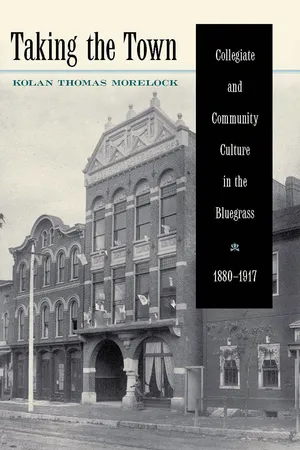
Taking the Town
Collegiate and Community Culture in the Bluegrass, 1880-1917
- 434 pages
- English
- ePUB (mobile friendly)
- Available on iOS & Android
eBook - ePub
Trusted by 375,005 students
Access to over 1.5 million titles for a fair monthly price.
Study more efficiently using our study tools.
Information
Topic
EducationSubtopic
History of EducationCHAPTER ONE
LEXINGTON IN THE GILDED AGE
Public Voices
She only requires to be more fully and correctly known to . . . become in every way the compeer of any inland city.
—Lexington, the Central City, 1887
On 2 April 1879 George W. Ranck, educator, newspaper editor, and historian, stood before his audience in Morrison Chapel on the campus of Kentucky University in Lexington to deliver a historical address during the centennial celebration of the city’s founding. Reconstruction, and the federal military occupation of the South, had ended only two years before. Lexington and other Kentucky towns and cities had sustained some damage during the Civil War, but Kentucky had generally been spared the worst of the physical destruction and desolation visited on the South. Nevertheless, the war had left the state’s economy, infrastructure, political institutions, and social fabric in “a deplorable condition.”1
Few remained untouched by the war, and its “bitter legacy” left opinion and loyalty sharply divided and community solidarity badly damaged throughout the state. Lexington’s James Lane Allen dramatically expressed the situation in Kentucky when he wrote, “not while men are fighting their wars of conscience do they hate most, but after they have fought; and Southern and Union now hated to the bottom.” The perceived federal excesses during the Reconstruction years only added to the division and rancor. Although legislated racial segregation had not yet become thoroughly entrenched in the 1870s, white sentiment was reflected in the state legislature’s refusal to ratify the Thirteenth, Fourteenth, and Fifteenth Amendments to the U.S. Constitution, abolishing slavery and extending civil rights and suffrage to blacks—constitutional changes that Lexington attorney and historian Samuel Wilson still referred to in 1928 as “the three obnoxious amendments.” Race relations between blacks and whites in Lexington, reflecting the situation throughout the emerging New South, were tense and could quickly turn violent. Four of the six known lynchings of black men in Kentucky in 1878, the year before Ranck’s centennial oration, had taken place in Fayette County.2
Though the bitter divisions of the war were still felt statewide, white sentiment, especially in the Bluegrass region, often favored the South. Moreover, the “Lost Cause” of the Confederacy had become enshrined and memorialized in monuments in Lexington as elsewhere, and ex-Confederates had come to dominate state politics through their control of the Democratic Party. There seems to have been much truth in the assertion by one author that Kentucky “waited until after the war was over to secede from the Union.” The political situation in Kentucky paralleled the Democratic “redemption” of one southern state after another in the postwar period. In Kentucky, the Democratic “redeemers” were themselves divided into two factions: the Louisville-based “New Departure” Democrats, who favored accommodation with, and modeling of, the industrialized North, and the more conservative, Bluegrass-centered “Bourbon” Democrats, who sought to maintain their vision of traditional southern ways. Nevertheless, both factions joined in a successful coalition against the Republicans, and “the vanquished ruled the victors” in Kentucky in the years after the war.3
Yet no more than a hint of these turbulent social and political conditions found its way into the text of Ranck’s centennial address at Morrison Chapel. Rather, employing only acclamatory rhetoric, he insisted that his auditors must congratulate themselves on their “liberal, enterprising and appreciative spirit” and their civilized attention to “sacred duty.” Furthermore, he assured them, they had laid aside “political divisions, religious dissensions, and prejudices of nationality and race” to gather as “one harmonious brotherhood . . . to honor the memory of the virtuous and the brave.” Invoking “that mysterious hand which marks the eras and the ages on the dial plate of time,” Ranck recounted in summary fashion and glowing terms the early history of the founding and settling of Lexington, a city he called “the literary and intellectual centre” of the region. Ranck’s address was given during the historical period often referred to as the Gilded Age, a term derived from the title of an 1873 novel by Mark Twain and Charles Dudley Warner. Historian Charles Calhoun succinctly summed up the Gilded Age as the period in which “the central fact of American Life was the evolution of the nation from a largely agricultural, rural, isolated, localized, and traditional society to one that was becoming industrialized, urban, integrated, national, and modern.” Perhaps more poetically, Grant C. Knight (biographer of James Lane Allen) characterized this period as a time when the nation was “swelling with national consciousness, girding itself for expansion, confused with a conflict between capital and labor. . . . The whole country was in a ferment.” The Gilded Age encompassed, roughly, the years 1870 to 1900. These years were also defined by those values and practices labeled “Victorian” and, in the South, by the social, political, and economic currents of the “New South” era—potent social and cultural forces blending to shape Lexington life at the time.4
A VICTORIAN CITY
Values have been well defined as “the broad dominant social attributes, behaviors, and larger goals that are advocated, promoted, and defended by a society,” and the term Victorian denotes a set of values, ideas, and assumptions widely held by the middle and upper classes during the nineteenth century. Ranck’s centennial address, as well as many Lexington press accounts during the period, was laced with elements suggestive of the Victorian mind-set. For instance, examples with regard to women, other cultures, and social welfare concerns can be examined to suggest the Victorian influence in Lexington’s public culture in the Gilded Age.5
“Feminines”
In rhetoric reflecting the Victorian belief that life is preparation for a higher, often religious purpose and that civilization is “founded on moral law,” Ranck reminded his audience that a man’s greatness is found not in his wealth, power, or ambitious achievements but rather “in the nobility of his soul.” Ranck, however, did not confine this nobility to men alone. He also ascribed high virtue to Kentucky’s women and, in doing so, recited a rhetoric of Victorian gender attitudes. For instance, Ranck lauded the pioneer women of the “forest fort” as having “toiled, . . . endured, . . . shuddered at the distant warhoop, . . . cared for the wounded, . . . prayed for the dying and mourned for the dead,” and as being “faithful unto death.” Though not quite transforming these frontier women into “female allegories”—personifications of civic virtue commonly invoked earlier in the century—Ranck was certainly invoking the Victorian ideal of “True Womanhood,” an ideal embodying “piety, purity, obedience, and domesticity.”6
Similar Victorian sentiments about women also appeared in the Lexington press. Nineteenth-century newspapers both shaped and reflected public perception and opinion, and by midcentury, the prevalent view was that the press acted as “a vast popular educator,” informing individual readers as to the general shape and nature of public life and thought. Accounts from local newspapers of any period are “historical exhibits” of publicly expressed attitudes, sentiments, and practices that are suggestive of the social and cultural currents flowing through a community. For instance, a reporter for the Lexington Daily Press covering the State College commencement in June 1885 praised a student orator for his “tribute to true womanhood [which] was both beautiful and instructive” and noted that “the ladies covered their champion in flowers.” However, praise of an entirely different kind was forthcoming the following day when the Press covered the Sayre Female Institute commencement ceremony. The reporter was “grateful” that the female graduates did not speak or read their essays because their ideas would necessarily be “crude” and their opinions “contracted.” The account concluded as follows: “Let them write and rewrite, but do not let the public patience be taxed by listening to them. . . . They are visions of beauty when they appear before the public on commencement day, but let them—as they did at the Sayre commencement—appear without the roll of manuscript, aesthetically done up with white or red ribbon.”7
Unwilling to accord women the public podium or intellectual parity, the Lexington press had no problem relegating women to domesticity—to the private rather than the public realm. Moreover, as was characteristic of Victorian gender stereotyping, the local press seemed quite willing to assign to females more delicate, easily violated sensibilities. Illustrative of both these ideas was “Woman and Home,” a regular feature in the Lexington Morning Transcript in the 1880s, the title of which assumed that the private world of the home was woman’s proper sphere. Centering women within this social and spatial boundary, the column advised and admonished them on everything from housecleaning hints to personal morality. Such advice followed logically from the widely accepted Victorian idea of “republican motherhood,” which held that women properly wielded significant influence on public life through their children, an influence exerted in private life by proper home management and moral role modeling. In the 21 August 1885 issue, “debasement” was associated with both moral and hygienic failure. The reader was advised that “debasement” of either kind was “unnatural” to woman’s finer sensibilities, seemingly for both biblical and genetic reasons, and that woman, unlike man, had “a natural desire to fly from base surroundings.” Furthermore, the article stated, even a morally debased woman maintained cleanliness “as the governing article of her creed.” Such supposedly delicate, fragile female sensibilities were revisited in 1892 in the Kentucky (Lexington) Leader when it jocosely ridiculed a local woman and her daughter who had mistaken an innocent noise for a burglar: the headline read, “Victims of Fright: Feminines Are Timid, Especially in the Dark.”8
“Savages”
George Ranck’s remarks about Native Americans in his 1879 centennial address were characteristically Victorian. Referring to American Indians as “raging bands” engaged in “savage butchery” during the colonial and revolutionary periods, Ranck concluded that they had been a “race without a history” conquered by a “race with a history”—indeed, a race “bringing along with the axe and rifle the germ of a civilizing power.” Ranck was expressing the Victorians’ ideal of civilization as embodied in white, Protestant, Anglo-Saxon culture and their view of those from outside that culture, including Native Americans, as “savage and uncivilized.”9
If Victorians were critical of, and repulsed by, “exotic,” foreign, or “savage” peoples, they were also fascinated by them, and this mixture of attraction and revulsion is clearly evident in the Lexington press of the era. A number of headlines appearing during 1885 are illustrative: an article on Mexico entitled “Creation’s Fag End,” an account subheaded “Life in the Amphibious and Filthy City of Bangkok: A Queer Land and People,” a feature on Syria called “The Children of the Desert: . . . Description of the Manners and Customs of a Romantic Race,” a description of the coast of South America entitled “A Picture of Desolation,” and a piece headlined “Groping in the Darkness: The Chinese Still Clinging to Customs of Centuries Ago.” The article on the Chinese, in a Victorian articulation of ethnocentrism and racial superiority, quoted an American military officer who found the Chinese “teachable,” and it noted that the Chinese of the northern provinces were really quite tall, whereas those from the southern regions were “small inferior physical types. It is from them that the immigrants to this country come.”10
“Noble Charity”
In January 1885 the Lexington Daily Press printed a highly complimentary essay by an unnamed “college maiden” from Hamilton College, a private women’s school on North Broadway that was later merged with Kentucky University. The exuberant essayist, praising the benevolence of Lexingtonians, noted that “everyone must know the kindheartedness of the people of Lexington from the numerous asylums they maintain.” In his centennial address, George Ranck also alluded to the social consciousness of Lexingtonians when he spoke of “that noble public charity—the Eastern Lunatic Asylum.” Founded in 1816 and formally opened in 1824, this asylum was the second hospital for the insane established in the nation. Remarkably, its main building provided space on the top floor for what was called the Lunatic Ball, a prominent community social event that was also an expression of social concern and benevolence. At the turn of the twentieth century, this dance was an annual fund-raising event attended by the elite of Lexington society. There is also evidence that a similar event was held more frequently in the mid-1880s: the Lexington Daily Press of 9 December 1885 remarked, “the monthly ball was held at the Asylum last night.”11
The asylum and its Lunatic Ball were by no means the only expressions of social concern and benevolence in the city. There was the problem of poverty, and Ranck, for one, expressed his interest and concern in 1885 by joining the Lexington Society for Improving the Condition of the Poor. Despite such evidence of organized public empathy, newspaper accounts suggest a rather harsh attitude toward the poor and toward aid for them. In a letter printed in the Lexington Morning Transcript in January 1885, the writer expressed disapproval of the city’s providing public “relief” for the poor and suggested that “applicants for relief” be made to clean the city streets for what they received in order to “weed out the lazy and unworthy class” and save “good men from pauperization.”12
This view that many of the poor, especially the homeless, were of the “lazy and unworthy class” was echoed on the pages of the Lexington Daily Press, where they were referred to as “tramps” and were styled not as truly impoverished but rather as clever liars and con artists. In a January 1885 Press article titled “A Tramp’s Philosophy,” an “old vagrant” was quoted as cynically advising neophyte beggars to “be truthful and outspoken—that is, tell them you are a Chicago fire sufferer.” These “tramps” were portrayed in the Press not only as worthless but also as annoyingly numerous. A May 1885 article called “The Tramp Season” described them as an “army on the move” and complained that “among the many nuisances to which Spring is the prelude, tramps deserve the foremost place.” The account suggested that they “concocted” a variety of stories to prey on the generosity of the “American housewife.” In addition to public “city relief” for the poor, there was the county poorhouse, described by the Press in 1885 as simple, clean, neat, and attractive—accommodations, in the Press’s view, “in every respect admirably adapted to the pauper class for which they are intended. . . . We are satisfied that it is just the place to send the beggars who infest our city and are a constant annoyance to the public.”13
Despite such harsh words, the local press exhibited a certain ambivalence toward the poor and their plight. If, on the one hand, the poor were styled as numerous and worthless, an “army” that “infested” the city, they were portrayed, on the other hand, as few in number and worthy of sympathy and benevolence. For instance, the Lexington Morning Transcript editorialized in February 1885 that there were few cases of “absolute want at our doors” and little actual destitution in Lexington, which had fared better in this regard “than most cities of her size during the present unusually severe winter.” The Transcript maintained that this was due to the “thriftiness” of the population and that “deserving people” would have “no trouble in maintaining themselves” at any time in Lexington. Yet only two weeks earlier, the same newspaper had reported a number of people “in extremely destitute circumstances, suffering from hunger and cold . . . whose sore distress is no fault of their own. . . . It...
Table of contents
- Cover
- Title
- Copyright
- Contents
- Foreword
- Acknowledgments
- Prologue: Panning for Gold
- Chapter One: Lexington in the Gilded Age: Public Voices
- Chapter Two: “Put Me in Class with the Widow Who Gave the Mite”: Lexington’s Joseph Tanner in the Gilded Age
- Chapter Three: Campus Prominence: Collegiate Literary Societies in Nineteenth-Century Lexington
- Chapter Four: Community Presence: Collegiate Literary Societies in Gilded Age Lexington
- Chapter Five: “This City’s Never Dull”: Public Culture in Progressive Era Lexington
- Chapter Six: “In Her Most Charming, Characteristic Way”: Lexington’s Margaret Preston in the Progressive Era
- Chapter Seven: The Dramatic Clubs Take the Stage: An Extracurricular Succession in Prewar Lexington
- Epilogue: Postwar Lexington—So Long, Gilded Age
- Appendixes
- Notes
- Bibliography
- Index
Frequently asked questions
Yes, you can cancel anytime from the Subscription tab in your account settings on the Perlego website. Your subscription will stay active until the end of your current billing period. Learn how to cancel your subscription
No, books cannot be downloaded as external files, such as PDFs, for use outside of Perlego. However, you can download books within the Perlego app for offline reading on mobile or tablet. Learn how to download books offline
Perlego offers two plans: Essential and Complete
- Essential is ideal for learners and professionals who enjoy exploring a wide range of subjects. Access the Essential Library with 800,000+ trusted titles and best-sellers across business, personal growth, and the humanities. Includes unlimited reading time and Standard Read Aloud voice.
- Complete: Perfect for advanced learners and researchers needing full, unrestricted access. Unlock 1.5M+ books across hundreds of subjects, including academic and specialized titles. The Complete Plan also includes advanced features like Premium Read Aloud and Research Assistant.
We are an online textbook subscription service, where you can get access to an entire online library for less than the price of a single book per month. With over 1.5 million books across 990+ topics, we’ve got you covered! Learn about our mission
Look out for the read-aloud symbol on your next book to see if you can listen to it. The read-aloud tool reads text aloud for you, highlighting the text as it is being read. You can pause it, speed it up and slow it down. Learn more about Read Aloud
Yes! You can use the Perlego app on both iOS and Android devices to read anytime, anywhere — even offline. Perfect for commutes or when you’re on the go.
Please note we cannot support devices running on iOS 13 and Android 7 or earlier. Learn more about using the app
Please note we cannot support devices running on iOS 13 and Android 7 or earlier. Learn more about using the app
Yes, you can access Taking the Town by Kolan Thomas Morelock in PDF and/or ePUB format, as well as other popular books in Education & History of Education. We have over 1.5 million books available in our catalogue for you to explore.