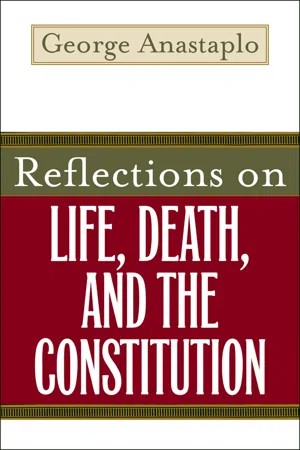
The role of law in government has been increasingly scrutinized as courts struggle with controversial topics such as assisted suicide, euthanasia, abortion, capital punishment, and torture. Reflections on Life, Death, and the Constitution explores such issues by using classical standards of morality as a starting point for understanding them. Drawing on works of literature and philosophy, and on U.S. Supreme Court decisions, George Anastaplo examines the intimate relationship between human nature and constitutional law.
- 312 pages
- English
- ePUB (mobile friendly)
- Available on iOS & Android
eBook - ePub
Reflections on Life, Death, and the Constitution
About this book
Information
Publisher
The University Press of KentuckyYear
2009Print ISBN
9780813192307
9780813125336
eBook ISBN
9780813139166
Part One
1. On Understanding the Others
I
What can be learned from other “cultures” about life and death? Can the Others truly be known, except by a rough approximation, especially when there are profound differences in language involved that are likely to elude translators? Is it primarily, or most reliably, about Ourselves that we learn when we study Others?
The point of departure, for our purposes here, is the Yukio Mishima short story “Patriotism,” which describes what we would call a suicide pact between a Japanese Army lieutenant and his wife. A traditional Japanese mode of suicide is drawn upon by the young officer. Our interest in this story is reinforced by what we know about how the author of the story orchestrated (in 1970) his own suicide at age forty-five.
We move here from this short story to glimpses of the status and modes of suicide elsewhere, ancient and modern. We can be reminded thereby of how difficult it can be truly to see Others. Particularly to be noticed are varying insights and assumptions about the nature of the human soul and about the status of what we often call the Self.
II
In Mishima’s “Patriotism” much more attention seems to be given to how the couple undertake to kill themselves than either to why they do this or to whether they should do it. The man in this short story insists upon subjecting himself, in full view of his eminently dutiful wife, to a traditional Japanese mode of suicide, the seppuku (or hara-kiri [belly-cutting]). It is hard to imagine a more painful form of suicide, a form which makes the wife’s slitting of her own throat thereafter seem genteel by comparison.
Statements are thereby being made by this couple in the story, statements which are, I have indicated, reinforced (for contemporary readers) by the mode of suicide chosen by Mishima himself in 1970. Mishima performed his suicide in the company of military-style companions, one of whom attempted to provide a merciful beheading of Mishima after the ritual disemboweling had gone far enough. This companion was then killed in turn by beheading, all of which (performed rather crudely) was said to have been done to advance nationalistic principles in postwar Japan.
The Mishima suicide, by an artist who was a serious contender for a Nobel Prize in Literature, created the stir in Japan that was evidently intended. We can be reminded of the differentness of the Japanese from us when we notice that they have many more known suicides than there are in the United States, a country with more than double the population of Japan. Reinforcing our awareness of profound differences from them is the report that Yukio Mishima could be criticized by some of his countrymen for having presumptuously used for himself an elevated form of suicide that was not appropriate for his station in life.
III
It can be instructive to compare the Japanese response to suicide with that of Western Antiquity. That the Greeks tended to look down on suicide is suggested by restrictions placed on burial sites for those who had killed themselves. But someone such as Ajax, as in Sophocles’ play, could be provided honorable burial, and others such as Orestes, Electra, and Pylades can (in one of Euripides’ plays) contemplate honorable suicides.
For the Greeks—such as Jocasta, Antigone, and Phaedra—suicide was not a “statement” (as it seems to be in the Japanese seppuku). Rather, it was primarily a release from torment, as it may also be for Shakespeare’s Romeo and Juliet. On the other hand, Socrates’ death, which has been regarded by some as suicidal, might instead be regarded as a “statement.”
Something “Socratic” may be seen in such Roman recourses to suicide as those of Cato and of Seneca. In other instances—such as those of Brutus, Cassius, and Mark Antony—suicide is the alternative to demeaning captivity as prisoners of war. This may be seen also in the recourse to suicide by Cleopatra, a fellow-traveler of the Romans, who was most “un-Japanese,” however, in her researches into the least painful way to kill oneself, researches that (according to Plutarch) included her experimenting lethally on slaves.
IV
Perhaps the most spectacular suicide in the Bible is that of the blinded Samson, who not only put an end thereby to his misery but also destroyed many of his people’s enemies in the process. Even more spectacular, of course, is the self-sacrifice of Jesus, with a view to saving (not destroying) others. This, too, is regarded by some as somewhat suicidal.
Christianity, by and large, has condemned all forms of suicide, with Job providing the model of endurance in the face of the most dreadful calamities. This response may be seen in the reservations expressed by Augustine about the suicide of Lucretia, the fatally violated matron much celebrated by the Romans. On the other hand, Augustine can justify what Samson did as having been commanded by God and Dante can honor Cato (despite his suicide) in his Divine Comedy.
A perversion of the Christian disavowal of suicide may be seen in the refusal of the villainous Macbeth, even when faced by overwhelming odds, to “play the Roman fool.” The fool of fools, it can be said by Christians, is Judas Iscariot, who adds suicide to his other monstrous sins. Furthermore, the traditional Christian antipathy to suicide is reflected in the fact that someone such as William Blackstone can report that the English law regards it as “self-murder.”
V
We can be reminded of our limitations in understanding other peoples when we hear of the epidemic of suicide bombings in the Middle East these days. Some of us can recall the shock of the dramatic acts of a few Buddhist monks setting themselves afire in Vietnam forty years ago. Then there were the suicide bombings, which evidently continue, by the Tamil Tigers in Sri Lanka.
But the scope of the suicidal attacks, first in Israel and then in Iraq, has surpassed what the world had been accustomed to. Even so, it should be noticed that the tendency of the Muslims who organize and celebrate these attacks is to call them “martyrdoms” rather than “suicides.” This seems to defer to sensibilities shaped by the longstanding Islamic prohibition of suicide.
Although religious doctrines may be drawn upon in these suicide bombings, with unlikely heavenly rewards sometimes made much of, the attacks seem to be primarily “political” in their orientation, and certainly not something done on impulse. Thus, almost all of the Muslim self-sacrificers seem to come (as Robert Pape has pointed out) from territories considered by the relevant organizations as “occupied.” Indeed, many of these self-sacrificers can even seem to be spiritual descendants of Samson.
VI
It should be evident, upon examining the spectacular ways of death embraced by others, that we should be cautious in assessing the extremes to which others go in matters of life and death. Questions can be raised here as to what is truly natural. Some may be tempted to wonder whether there is indeed any guidance provided by nature with respect to the most momentous decisions by human beings about life and death.
Modes of suicide differ around the world, with the Modern Greeks, for instance, evidently preferring (as did Sophocles’ Jocasta and Antigone) suicide by hanging to all other modes combined. But most of such cases—in Modern Greece as among us—occur among people who can be said to be, if only temporarily, “out of their minds.” By way of seeming contrast is what was once evidently not unusual (if not even a tradition) among the Hindus, the act of Sati—or widow-suicide-by-burning—and this among a people that has long been recognized as quite cultivated (or “civilized”).
Consider, for example, this excerpt from a 1993 account of prominent twentieth-century cases that followed the legal prohibition of aiding a recourse to Sati:
The earliest cases of abetment of suicide [that is, being an accessory to suicide] arose out of unfortunate incidents of Sati, which were not uncommon in India at one time and which were forbidden by law in 1833 [evidently by the British rulers of India]. [Consider, for example,] Ramdial and Others v. Emperor, AIR 1914 All.249 (14 Cri.L.J. 634) . . . , a 1914 case in which the accused were tried for the offense under Section 306 [of the Indian Penal Code] for abetting the suicide of a young widow who committed suicide by becoming a “Sati” on the death of her husband. The prosecution case was that on the death of Ram Lal due to sickness, his young widow announced her intention of committing Sati. Her family members including [the principal defendant] Ramdial, the cousin of her deceased husband, [attempted to] persuade her not to do so [but] as the widow persisted to put into action her intention, they even sent a message to the police station which was far away. Before the police could arrive, the widow directed Ramdial and some others to take the body of her deceased husband to the funeral pyre which they did. The widow followed the funeral procession. A large crowd of about two thousand people from adjoining villages, having come to know about the impending Sati, also gathered to witness the same. The prosecution witnesses [testified] that the funeral pyre was built and the dead body of the deceased was put on it by Ramdial and others at the insistence of the widow, who on her own thereafter took seven rounds of the funeral pyre, sat on it and placed the head of the corpse on her lap and demanded ghee from Ramdial who gave it to her whereupon the widow poured it on herself and the dead body of her husband and later on Ramdial also poured ghee on her and the dead body. [Ghee is a semi-fluid clarified butter made especially in India.] The wife succumbed to burns on the funeral pyre. [The defendants] admitted [all the] evidence excepting the aforesaid last overt act alleged against [Ramdial], namely [his] pouring ghee on the body of the deceased and the widow. The witnesses had deposed that the pyre was then put on fire but did not say by whom. In fact the witnesses and the accused stated in the court that when the woman demanded fire, the accused refused to give it to her, telling her that if there was any virtue in her, she could produce [fire] for herself, whereupon she whispered into the ear of the corpse and raising her arms prayed to God and shortly after the pyre burst into flames.
The status of “becoming Sati” seems to have been such that not only could this widow proceed without being physically restrained by the community (as distinguished from the police), but also that thousands gathered to watch (if not even to endorse) the spectacle (somewhat as thousands gather among us today for death-defying stock car races). This evidently old-fashioned response to what the widow had insisted upon was countered by the modern (and we would say “enlightened”) response by the appellate court upholding the convictions in this case:
The High Court . . . held that as regards the part played regarding setting fire to the funeral pyre, there was a conspiracy of silence on the part of prosecution witnesses to oblige the accused which was further clear by the story narrated by the witnesses and the accused of inventing the miraculous theory of spontaneous combustion, and that though the accused initially remonstrated the widow not to take the extreme step, they finally gave way to her determination and intentionally aided her in committing Sati . . . As regards sentences, the High Court held them to be too lenient and enhanced sentences of all the accused to four years rigorous imprisonment. [Emphasis added.]
VII
Although there may be similarities between the Hindu widow committing Sati and the lieutenant’s wife in our Mishima story, there are profound differences in circumstances. Thus, one woman acts altogether in public, the other very much in private, however public the reports of what has happened are apt to become. Also different may be the motives that are reflected in these two acts of self-sacrifice (but both differ much from that to which we are accustomed).
The lieutenant’s wife, it seems, follows the lead of her husband. It seems to be a lead developed as a patriotic response to a crisis, or at least as a reluctance on his part to engage in any military action against comrades. The Sati-embracing widow (even though her name is not given, but only her husband’s, in the Indian case report I have quoted) acts more on her own, in that she chooses to die at this time, while it is not likely that her late husband had chosen to die when he did, succumbing as he did to a chance illness.
The quite diverse institutions drawn upon, and reinforced, by these two women depended for their development upon centuries, if not even upon millennia, of experience and perhaps glorification. We can be reminded of the stark differentness of both of these sets of institutions from what we are accustomed to when we recall Chaucer’s Wife of Bath, who has buried several husbands and is still full of life and hence expectations. However unusual the Wife of Bath may be in the scope of her appetites, she is no more than an extreme (and not an unattractive) form of what we are accustomed to, the notion that each of us has, to a remarkable degree, his or her own life to lead.
VIII
The double-suicide in what is for us the weird Mishima short story works from a 1936 political struggle in Japan, a struggle that evidently found Imperial partisans deeply divided. W...
Table of contents
- Cover
- Half title
- Title
- Copyright
- Contents
- Preface
- Part One
- Part Two
- Appendixes
- Index
- About the Author
Trusted by 375,005 students
Access to over 1.5 million titles for a fair monthly price.
Study more efficiently using our study tools.
Frequently asked questions
Yes, you can cancel anytime from the Subscription tab in your account settings on the Perlego website. Your subscription will stay active until the end of your current billing period. Learn how to cancel your subscription
No, books cannot be downloaded as external files, such as PDFs, for use outside of Perlego. However, you can download books within the Perlego app for offline reading on mobile or tablet. Learn how to download books offline
Perlego offers two plans: Essential and Complete
- Essential is ideal for learners and professionals who enjoy exploring a wide range of subjects. Access the Essential Library with 800,000+ trusted titles and best-sellers across business, personal growth, and the humanities. Includes unlimited reading time and Standard Read Aloud voice.
- Complete: Perfect for advanced learners and researchers needing full, unrestricted access. Unlock 1.5M+ books across hundreds of subjects, including academic and specialized titles. The Complete Plan also includes advanced features like Premium Read Aloud and Research Assistant.
We are an online textbook subscription service, where you can get access to an entire online library for less than the price of a single book per month. With over 1.5 million books across 990+ topics, we’ve got you covered! Learn about our mission
Look out for the read-aloud symbol on your next book to see if you can listen to it. The read-aloud tool reads text aloud for you, highlighting the text as it is being read. You can pause it, speed it up and slow it down. Learn more about Read Aloud
Yes! You can use the Perlego app on both iOS and Android devices to read anytime, anywhere — even offline. Perfect for commutes or when you’re on the go.
Please note we cannot support devices running on iOS 13 and Android 7 or earlier. Learn more about using the app
Please note we cannot support devices running on iOS 13 and Android 7 or earlier. Learn more about using the app
Yes, you can access Reflections on Life, Death, and the Constitution by George Anastaplo in PDF and/or ePUB format, as well as other popular books in Law & Public Law. We have over 1.5 million books available in our catalogue for you to explore.