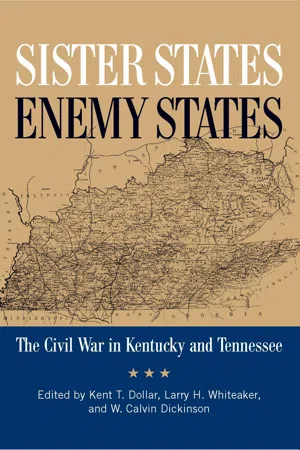
The fifteenth and sixteenth states to join the United States of America, Kentucky and Tennessee were cut from a common cloth—the rich region of the Ohio River Valley. Abounding with mountainous regions and fertile farmlands, these two slaveholding states were as closely tied to one another, both culturally and economically, as they were to the rest of the South. Yet when the Civil War erupted, Tennessee chose to secede while Kentucky remained part of the Union. The residents of Kentucky and Tennessee felt the full impact of the fighting as warring armies crossed back and forth across their borders. Due to Kentucky's strategic location, both the Union and the Confederacy sought to control it throughout the war, while Tennessee was second only to Virginia in the number of battles fought on its soil. Additionally, loyalties in each state were closely divided between the Union and the Confederacy, making wartime governance—and personal relationships—complex. In Sister States, Enemy States: The Civil War in Kentucky and Tennessee, editors Kent T. Dollar, Larry H. Whiteaker, and W. Calvin Dickinson explore how the war affected these two crucial states, and how they helped change the course of the war. Essays by prominent Civil War historians, including Benjamin Franklin Cooling, Marion Lucas, Tracy McKenzie, and Kenneth Noe, add new depth to aspects of the war not addressed elsewhere. The collection opens by recounting each state's debate over secession, detailing the divided loyalties in each as well as the overt conflict that simmered in East Tennessee. The editors also spotlight the war's overlooked participants, including common soldiers, women, refugees, African American soldiers, and guerrilla combatants. The book concludes by analyzing the difficulties these states experienced in putting the war behind them. The stories of Kentucky and Tennessee are a vital part of the larger narrative of the Civil War. Sister States, Enemy States offers fresh insights into the struggle that left a lasting mark on Kentuckians and Tennesseans, just as it left its mark on the nation.
eBook - ePub
Sister States, Enemy States
The Civil War in Kentucky and Tennessee
- 402 pages
- English
- ePUB (mobile friendly)
- Available on iOS & Android
eBook - ePub
Sister States, Enemy States
The Civil War in Kentucky and Tennessee
About this book
Information
Publisher
The University Press of KentuckyYear
2009Print ISBN
9780813133829
9780813125411
eBook ISBN
9780813139227
Part 1

Secession in Kentucky and Tennessee
Beleaguered Loyalties
Kentucky Unionism
Gary R. Matthews
On the eve of the Civil War, as the Southern states began to organize under the banner of a nascent confederacy, Jefferson Davis looked toward Kentucky with no less covetous eyes than did Abraham Lincoln and the federal government. Both presidents, Kentuckians by birth, measured the worth of the Bluegrass State to their respective nations in relative terms. Lincoln, always the gifted and pragmatic politician, viewed Kentucky much like a politician would the votes of a needed swing state in a presidential election and remained determined to deny the state’s resources to the South. Davis, a West Point graduate, instinctively assessed Kentucky’s value in military terms and recognized the defensive advantage of an unbroken Confederate line along the Ohio River. In the end, a pragmatic respect for Northern economic dominance and a love for the historic national identity bolstered by a trust in the democratic process inspired a majority of Kentuckians to seek preservation of property and self by resisting the temptations of secession. This decision, however, did not stop thousands of Kentuckians from heading south to fight for the Confederacy. Nor did it deter the ex-Confederates from assuming a high degree of political and social ascendancy in post-Appomattox Kentucky, an ascendancy that in many ways made Kentucky seem more Confederate after the guns stopped firing than it had a historic right to claim.
The postwar ascendancy of the Kentucky Confederates has created an unavoidable temptation to assess why Kentucky did not hitch its horse to the secession wagon as opposed to why it chose to remain in the Union. Such an assessment has a tendency to misinterpret Kentucky’s character in 1860 by overestimating the state’s enthusiasm for a confederacy controlled by the cotton states. For, although Kentucky was Southern, it was not, as Thomas Clark so aptly concluded, “a Southern state, comparable to Mississippi, Alabama, and South Carolina.” William Freehling has further pointed out that Kentucky was not even as Southern as its mother state, Virginia; it was more Western, a point that should be well taken. Conversely, pointing to its geographic proximity to the North, and identifying certain border state characteristics as determinative in Kentucky’s decision to remain in the Union, ignores the more subtle reasons for that decision. That being the case, it becomes incumbent to analyze the historic cultural, economic, and political components of Kentucky’s antebellum character in order to understand the determining factors in Kentucky’s stand.1
The Kentuckian of 1861 could generally trace his or her roots to the English and Scots-Irish settlers and their African American slaves who migrated over the Wilderness Trail from Virginia, North Carolina, and, to lesser degree, Pennsylvania and Maryland in the last quarter of the eighteenth century. In the settlement years preceding statehood, Kentucky was a political subdivision of Virginia. Finding itself deeply involved in the American Revolution, Virginia was unable to govern or protect Kentucky effectively. Thus, Kentuckians learned quickly that they would have to fend for themselves against the frequent Native American incursions, often inspired by the British. Richmond was also particularly inept at regulating land distribution after the American Revolution. This ineptness resulted in a land system that was mired in a swamp of confusion. It was during these years that many of the large estates of central Kentucky were put together through the purchase, more often than not by absentee Virginians, of many small squatter claims. Unlike the typical pioneer, who cleared and settled his own land, many of these absentee owners sent their overseers and slaves ahead to perform this function. Thus, by 1800, almost all the early squatters in central Kentucky were supplanted by large estate owners, who introduced slavery as a protected property right.2
With Virginia’s preoccupation with the American Revolution, Kentucky’s early settlers were thoroughly isolated and continued to be for many years, creating a society that, but for slavery, was more similar to that developing in the old Northwest territories of Indiana and Illinois than in the Southern states. Southern influences, however, were pervasive and over the years, particularly among the Bluegrass gentry of central Kentucky, developed into mainstays of society. Within a generation of Fort Boonesborough, these gentlemen farmers began to fashion their society and behavior after the plantation life of the Southern seaboard and Tidewater areas of Virginia and the Carolinas. By 1820, they had achieved a level of prosperity and permanence that matched that of the grand Southern estates on the eastern side of the Appalachians. The society and culture of the Bluegrass elite were, however, the exception and not the rule. The yeoman farmers in other parts of the state lived in a much less pretentious style and, like their brethren to the north, personally worked the soil. Slavery and its attendant culture, however, influenced Kentucky society more than any other institution, and the Bluegrass elite essentially controlled slavery. It was slavery and the gentry society, as perpetuated in the Bluegrass, that identified Kentucky with the South.3
The first half of the nineteenth century also witnessed thousands of second and third-generation Kentuckians settling in Ohio, Indiana, and Illinois. In part, much of this northern migration was prompted by slavery. Although many of the migrating Kentuckians had a moral distaste for the institution, most objected to it as a deterrent to the economic prosperity of nonslaveholders. They had discovered that it was difficult to compete with the slaveholders unless they themselves became slaveholders. The majority of these migrants were either unwilling or unable to make this compromise. Thus, an impressive number of Kentucky’s yeomen farmers of egalitarian stock sought what they believed to be more fertile fields in the free states of the Midwest. By 1860, some sixty-five thousand nativeborn Kentuckians were living in Indiana and another sixty thousand in Illinois. Likewise, a number of free-state natives, although a considerably smaller population than the northward-migrating Kentuckians, migrated southward to Kentucky. These migrations and comminglings of peoples created strong ties that bound together families and friends on both sides of the Ohio River, ties that would have a significant impact on Kentucky’s decisionmaking process in 1861.4
Despite the lack of guidance from Virginia, Kentucky emerged from the pioneer wilderness with a mind-set characterized by an egalitarianbased nationalism. In 1792, it became the first Southern state, and only the second in the nation, not to require a property qualification for either voting or holding public office. In time, its budding political philosophy would be nurtured and irrevocably molded into a strong desire for national unity through the immeasurable influence of Henry Clay, who for more than forty years dominated Kentucky politics. Although a slave owner, Clay understood the limitations of the slaveholding system, particularly its economic deterrence to industrialization. Despite a reputation for being a self-seeking, ambitious politician, he was also an adept businessman with a vision for America and Kentucky. Like most visionaries, he was an idealist. From 1820 until his death, his ideology was centrist and focused on compromise among competing interests—those of the North and the South—in order to advance economic progress. His continuous efforts to mediate those differences in sectional perspective resulted in the concept of compromise becoming deeply rooted in the Kentucky psyche as an ideal of progress.5
Clay’s vision for the future of America and Kentucky was based on what was called the American System. The American System demanded progress through industrialization. Clay adroitly politicized the need for a larger federal monetary presence in developing the national infrastructure while respecting the property rights of the slave owner. His call to the future would require Southerners, including Kentuckians, to diversify and adopt economic innovations. It was not surprising that both Northerners and Southerners determined that such a program would eventually abrogate slavery. Although many Southerners, particularly Kentuckians, understood and fully appreciated Clay’s program, few were willing to infringe on the slavocracy.6
Clay’s opinions on slavery were well known. Although he perceived slavery as a protected state right not to be infringed on by the federal government, Clay strongly believed in and publicly advocated gradual emancipation. (He was also noted for his work with colonization societies to find homes in Africa for freedmen.) This position bolstered the fledgling anti-slavery movement in Kentucky, and, by 1849, the movement had gathered sufficient steam to push—although unsuccessfully—for a state constitutional amendment abolishing slavery.
Clay’s belief in the Constitution and love for the Union was legendary among his constituents. Over the years, his fundamental belief that the preservation of the Union was in the best interest of all Kentuckians was more than once demonstrated by the employment of his political skills to effectuate his ideology of compromise during the heat of a sectional crisis. Kentuckians admired Clay for his successes and began to see their state as being in a unique geographic position to mediate grievances between North and South. With an ability to appreciate both sides of the ongoing arguments, Kentuckians were less likely to advocate any form of political extremism. Such was the case when Kentucky resisted sending a delegate to the 1850 Nashville Convention of slave states called to discuss what recourse, including secession, should be taken in the event the Compromise of 1850 became law. Likewise, in 1861, Kentucky never called a convention to determine the question of secession. Both instances suggest that political leadership in Kentucky was in the hands of conservatives who, when pressed, would disdain secession. The Kentuckians who followed Clay in Congress, particularly John J. Crittenden, also viewed compromise as a viable alternative to disunion.7
That Kentuckians were comfortable with the principles expounded by Clay was not an impediment to their supporting the rights of the slave states. They still believed in the inviolability of states’ rights. This view would come to forefront with the formation of the Republican Party, which most Kentuckians despised with the same vehemence as those in the Deep South. Generally, Kentucky congressmen sided with the slave states on roll call votes that addressed issues regarding the institution of slavery. A review of the voting patterns during the presidential elections held between 1840 and 1856 reveals that Kentuckians overwhelmingly supported candidates who were protective of states’ rights and did not threaten the slavocracy. Kentucky politicians, however, were more conservative on votes relating to the expansion of slavery, an issue that generally differentiated Kentucky from the Deep South.8
During the 1850s, Kentucky, like the rest of the nation, experienced the reshaping of political parties and the realignment of voters. For twenty years, Kentucky had been a state whose vote could be counted on to fall in the Whig Party column. Although the Whig Party suffered a shattering defeat in the 1852 presidential election, it still had a tenuous control over the Kentucky statehouse. For almost two years after the 1852 presidential election, a cadre of politically powerful Kentuckians still held to the hope of a resurgent Whig Party, a hope that dissipated with the passage of the Kansas-Nebraska Act in 1854. This piece of legislation also destroyed the relative sectional calm following the Compromise of 1850. In January 1854, Senator Archibald Dixon, a Kentuckian, introduced a bill that would have effectively repealed the Compromise of 1850. Dixon had based his political career on supporting the proslavery demands of his power base. His bill was nothing more than an attempt to influence the proslavery faction–controlled Kentucky legislature to reelect him to the Senate. Southern Democrats viewed Dixon’s bill as a Whig power play. Not to be outdone by the Whigs, they forced Stephen Douglas to introduce a similar bill to reestablish their “proslavery credentials.” John J. Crittenden and other politically astute Kentuckians immediately saw that the passage of either bill would generate a new and potentially more explosive round of sectional strife. The Dixon bill fell to the wayside as Douglas orchestrated his bill through the Senate. Crittenden, soon to take over Dixon’s Senate seat, pleaded with all the Kentucky congressmen, including Dixon, not to vote for the Douglas bill. His efforts reaped little success as the Kentucky congressional delegation backed the bill to a man.9
The implications of the passage of the Kansas-Nebraska Act were not as revolutionary in the border states as they were in the North and South. Northerners were appalled and took great exception to the passage of the act. Most Northerners viewed the machinations employed by Douglas to ensure passage of the act as morally corrupt. What followed was the destruction of the Northern Democratic and Whig parties and a search for a new sectional political entity to fight the slavocracy. By the mid-1850s, only one party, the Democratic, survived in the South. Although somewhat in need of repair, Kentucky, however, still maintained a basis for a viable two-party system.
...Table of contents
- Cover
- Half title
- Title
- Copyright
- Contents
- Preface
- Introduction
- Part 1: Secession in Kentucky and Tennessee
- Part 2: Traitors, Blacks, and Guerrillas in Wartime Kentucky and Tennessee
- Part 3: War’s Impact in Kentucky and Tennessee
- Afterword
- Contributors
- Index
Trusted by 375,005 students
Access to over 1.5 million titles for a fair monthly price.
Study more efficiently using our study tools.
Frequently asked questions
Yes, you can cancel anytime from the Subscription tab in your account settings on the Perlego website. Your subscription will stay active until the end of your current billing period. Learn how to cancel your subscription
No, books cannot be downloaded as external files, such as PDFs, for use outside of Perlego. However, you can download books within the Perlego app for offline reading on mobile or tablet. Learn how to download books offline
Perlego offers two plans: Essential and Complete
- Essential is ideal for learners and professionals who enjoy exploring a wide range of subjects. Access the Essential Library with 800,000+ trusted titles and best-sellers across business, personal growth, and the humanities. Includes unlimited reading time and Standard Read Aloud voice.
- Complete: Perfect for advanced learners and researchers needing full, unrestricted access. Unlock 1.5M+ books across hundreds of subjects, including academic and specialized titles. The Complete Plan also includes advanced features like Premium Read Aloud and Research Assistant.
We are an online textbook subscription service, where you can get access to an entire online library for less than the price of a single book per month. With over 1.5 million books across 990+ topics, we’ve got you covered! Learn about our mission
Look out for the read-aloud symbol on your next book to see if you can listen to it. The read-aloud tool reads text aloud for you, highlighting the text as it is being read. You can pause it, speed it up and slow it down. Learn more about Read Aloud
Yes! You can use the Perlego app on both iOS and Android devices to read anytime, anywhere — even offline. Perfect for commutes or when you’re on the go.
Please note we cannot support devices running on iOS 13 and Android 7 or earlier. Learn more about using the app
Please note we cannot support devices running on iOS 13 and Android 7 or earlier. Learn more about using the app
Yes, you can access Sister States, Enemy States by Kent Dollar, Larry Whiteaker, W. Calvin Dickinson, Kent Dollar,Larry Whiteaker,W. Calvin Dickinson in PDF and/or ePUB format, as well as other popular books in History & American Civil War History. We have over 1.5 million books available in our catalogue for you to explore.