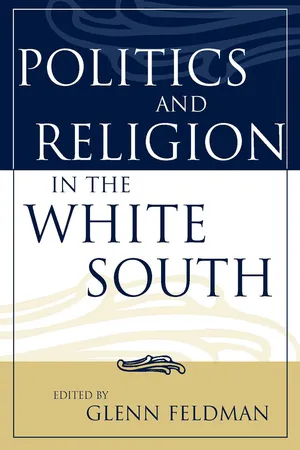
Politics, while always an integral part of the daily life in the South, took on a new level of importance after the Civil War. Today, political strategists view the South as an essential region to cultivate if political hopefuls are to have a chance of winning elections at the national level. Although operating within the context of a secular government, American politics is decidedly marked by a Christian influence. In the mostly Protestant South, religion and politics have long been nearly inextricable. Politics and Religion in the White South skillfully examines the powerful role that religious considerations and influence have played in American political discourse. This collection of thirteen essays from prominent historians and political scientists explores the intersection in the South of religion, politics, race relations, and southern culture from post–Civil War America to the present, when the Religious Right has exercised a profound impact on the course of politics in the region as well as the nation. The authors examine issues such as religious attitudes about race on the Jim Crow South; Billy Graham's influence on the civil rights movement; political activism and the Southern Baptist Convention; and Dorothy Tilly, a white Methodist woman, and her contributions as a civil rights reformer during the 1940s and 1950s. The volume also considers the issue of whether southerners felt it was their sacred duty to prevent American society from moving away from its Christian origins toward a new, secular identity and how this perceived God-given responsibility was reflected in the work of southern political and church leaders. By analyzing the vital relationship between religion and politics in the region where their connection is strongest and most evident, Politics and Religion in the White South offers insight into the conservatism of the South and the role that religion has played in maintaining its social and cultural traditionalism.
- 400 pages
- English
- ePUB (mobile friendly)
- Available on iOS & Android
eBook - ePub
Politics and Religion in the White South
About this book
Information
Topic
HistoireSubtopic
Histoire de l'Amérique du Nord
1
That Which God Hath Put Asunder
White Baptists, Black Aliens, and the
Southern Social Order, 1890–1920
Fred Arthur Bailey
Emboldened by a distinctive religious fervor, Southern Baptists leaders called down divine blessings upon racial segregation as the nineteenth century merged with the twentieth.1 “We think it may be safely asserted that God’s hand is in the clear-drawn line between the races,” pontificated a Virginia editor in 1901. “That which God hath put asunder, let not man attempt to join.” Representatives of the South’s largest Christian denomination, Southern Baptist ministers, editors, and lay leaders combined their belief in Calvinistic theology with the logic of Social Darwinism and the traditions of black slavery to affirm God’s will on ethnic policies. All spoke from a comfortable position as white supremacists at ease with their overmastery of a suppressed black class and claimed divine endorsement of their privileges. Asserting election by God, they preached that the Almighty had intentionally placed both Southern Baptists and Southern Negroes in the same geographic region. “Upon Southern Baptists God has laid the responsibility for evangelization and training of the negroes in our midst,” reasoned delegates to an Arkansas convocation. “In the providence of God, they have been laid at our doors, and in his simple faith the negro is naturally a Baptist.”2
At first glance, the confluence of racial separation and evangelistic outreach may appear to have been simple hypocrisy or an impossible contradiction. But in the mind of early twentieth-century Baptist leaders, the two concepts merged without seam. However much white religionists prayed for African Americans, they preached and practiced an upper-class theology bent more on educating Southern blacks to be obeisant workers than on saving their souls. From the perspective of Southern Baptist spokesmen, the relegation of blacks to an inferior social status was not only a needful corrective to decades of perceived social disorder, but also within their norms of a virtuous Christian society.3
Although the Southern Baptist Church cast a broad outreach to the South’s white population, its articulated views on ethnic relations arose as much from class divisions within the white community as they did from social cleavages premised on race. In common with the other Southern churches, the Southern Baptists faced internal class struggles that mirrored larger themes within their society. Southern Baptists embraced a cross section of a white society that had been recently fractured by the late nineteenth-century agrarian revolt against Redeemer or aristocratic rule.4
Under the banner of the Populist Party’s crusade, white and black farmers merged in their discontent with upper-class oppression, used the institutions of democracy to challenge the South’s entrenched aristocracy, and had in 1896 approached the overthrow of the Redeemer establishment. But their movement failed. Redeemer politicians, together with their cohorts in the press and the pulpit, shrewdly and effectively used the fearful rhetoric of Negrophobia to split the white masses from their black allies. Successful in the destruction of the Populist challenge, the South’s aristocratic leaders appreciated the need to avert future threats to their suzerainty.5 Good social order, they understood, required all Southerners—white as well as black—to appreciate the virtues of place and power. Church leaders gladly cast the authority of religion into the support of these upper-class dictums, preaching as essential the virtues of a society strictly articulated by class and race.
Yet in some important forms, late nineteenth-century evangelicalism had contributed to the power of agrarian radicalism. As Bruce Palmer showed in “Man over Money”: The Southern Populist Critique of American Capitalism, an important part of the Populist critique of capitalism was evangelical in nature and dealt with the fundamental unfairness and exploitation involved in Gilded Age politics and society. Populists did not hesitate to attack clergymen who bolstered the economic and political status quo of the Redeemers. As Frederick A. Bode explained, North Carolina populists attacked this “pure religion” of the upper classes on precisely religious grounds as “another part of a hegemonic and consensual ethos” that the Bourbons relied on to sustain control.6 Briefly and furiously challenged, the elites soon regained control of the political—and religious—situation.
From the Civil War’s conclusion to the century’s end, the Southern Baptist Church underwent an internal class struggle that paralleled the dynamic divisions extant within the South’s broader society. The church’s elites—college-educated clergy, wealthy planters, and urban professionals—dominated its extracongregational superstructure: state and general conventions, religious presses, theological seminaries. Financially comfortable, culturally sophisticated, and theologically tolerant, they offended many among their less affluent rural brethren who questioned the elites’ commitment to Baptist orthodoxy.7
Identified as “Landmark” Baptist, countryside evangelists propounded a narrow doctrine that held to the primitive practices of the first-century church as constituting true Christianity and maintaining that nineteenth-century Southern Baptists perpetuated this faith in its purest form. Accepting no fellowship beyond their narrow communion, they insisted on near-absolute congregational autonomy, seeing in their denomination’s larger polity the easy acceptance of liberal theology and ecumenism. But those opposed to “Landmarkism” condemned the movement for its propensity to array country against urban brethren and criticized its leaders for their castigation of intellectuals, merchants, and bankers. Such class-based rhetoric, the critics argued, threatened to undermine the progress being made by the New South and its businessmen who were also its architects.8
From the inception of Landmarkism in the 1850s, its leaders preached a stinging message threatening to the South’s established aristocracy. Tennessee’s James Robert Graves, its most articulate voice, demonstrated an intense commitment to civil and ecclesiastical democracy, a disdain for social hierarchies, and an empathy for the impoverished masses. He saw in the rise of global popular revolutions in general and the earlier American Revolution in particular the triumph of democracy and true Christianity over tyranny and caste. Envisioning his movement as an important element of a worldwide uprising of the poor and the downtrodden against their wealthy oppressors, he commanded his followers to be on guard against “kingcraft,” “priest craft,” and all similar hierarchies. By the 1890s Landmarkers had become increasingly alienated from a Southern Baptist Church dominated by social elites and in 1905 formalized their separation from it with the creation of the General Association of Landmark Baptists.9
The Landmark Baptists’ social radicalism easily melded into the South’s late nineteenth-century agrarian crusades with their characteristic emphasis on both class and race struggle. Rural evangelism and the Populist campaign flourished in the same soil, merging brush arbor rhetoric with stump oratory as radical politicians and sympathetic ministers urged their followers to social action. They condemned the Southern elites for oppressing the masses, lambasted the un-Christian usury demanded by bankers and merchants, and called for a social revolution to overthrow the entrenched interests.10 They found common cause with black clergy, among them black Baptists, who cherished their long tradition of blending piety with politics. Whether the black ministers supported an alliance between Republicans and Populists or embraced Populism without restraint, they and their parishioners lent needful support for white radicals intent on change.
Ironically, this black-white connection ultimately worked to the advantage of the Redeemer class. Appealing to white fears of Negro domination, Southern elites counterattacked, thereby undermining Populist support, and emerged victorious in the elections of 1896 and 1898. Secure in their domination over state legislatures, they rushed through statutes denying the franchise to most blacks and many whites, and enacted oppressive Jim Crow laws that virtually forbade social commerce between the races. Ensconced at the top of a privileged class, Southern thought-leaders—especially the clergy—determined to justify their entitlements to themselves and to those less fortunate Southerners over whom they held sway. White supremacy, buttressed by a powerful indictment of unfettered democracy, underscored the essential elements of their intellectual paradigm. Standing before a Texas Baptist convention in 1905, a prominent minister fearfully proclaimed that “never before in the history of the race was the Negro more determined on political equality. Never before was the Saxon more determined to dominate. The Negro has brute force and numbers; the Saxon all the qualities that make kings.”11
Turn-of-the-century Baptist spokesmen, identifying with the interests of the Southern patriciate, and now rid of the Landmark egalitarians, surveyed their social order and found it in disarray. They quaked at the thought of Negro empowerment, renounced any political culture amendable to black-white equality, and blessed those state officials who crusaded for franchise constriction. “The giant of the negro problem stalks forth and challenges us to subdue him,” trumpeted delegates to the Mississippi state convention in 1912. These religionists shared with their white compatriots across the South a fundamental disdain for the Negro’s intellectual and moral capacities. One Texas clergyman succinctly enumerated that as a people, their “low intelligence and high animal propensities are greatly against them,” they “have very imperfect religious teaching at best” and “are full of all manners of superstitions,” and, most dangerous of all, they “are only a few generations removed from the jungle, and many of their inherent tendencies are toward savagery.” Who knows, he asked, “what wishful images arises in their dreamy minds for the wild freedom of an ancestry they do not know?” A perceived black threat to the Southern weal demanded firm action. “Our own safety, as well as every instinct of Christianity,” points to the “necessity for christianising [sic]” the Negro, shrilly proclaimed the Georgia Baptist Convention in 1906.12
Linking their religion’s missionary imperative to their cultural preferences, the Southern Baptists denomination considered black subordination to whites an essential element in this “Christianizing” experience. Its General Convention admonished Baptists in 1912 that in the act of “saving and helping the Negroes to their best self-expression as a race, we shall save Anglo-Saxon supremacy.” This concept was accepted as a fundamental article of faith everywhere in the white South. “We are [the Negro’s] superior, made so by God,” affirmed the editor of the Alabama Baptist in 1901, and later an Alabama minister assured his Birmingham congregation that “the white man, being the superior race by birth and training, will . . . rule the inferior race.” South Carolina churchmen pledged that “we owe to the Negro a large debt—at least the debt of the strong to the weak”; Arkansas Baptists prayed that “this weaker race” would feel the impact of the white man’s effort “to lift, push and elevate” their lives; and Mississippi delegates urged their state convention to remember that “as the superior race, it is our duty . . . to accord to [the Negro] that magnanimity of conduct due from the strong to the weak.”13
Considering African-descended Southerners aliens in the midst of a God-ordained, stratified Anglo-Saxon civilization, Baptist elites championed franchise restrictions that virtually eliminated black voting while at the same time denying suffrage to significant segments of nonelite whites. These patricians identified as democracy’s essential flaw the empowerment of the downtrodden and the dispossessed, which led them to threaten an entrenched oligarchy. “The cry of unrestricted suffrage is a fad and a fiction which never has been and never ought to be,” lectured an Alabama Baptist clothed in the pseudonym “Clericus Civio.” He proclaimed that even as the “Anglo-Saxon must meet his mission in America,” the black race must accept its natural subordination in the South. “The best solution of the Negro problem for the present is an honest, uncorrupted and incorruptible white rule. Then the Negro himself will be content to be relieved of this burden of state.” The editor of a Virginia Baptist publication declared in agreement that his state’s post–Civil War experiment in democracy proved “manhood suffrage . . . a failure” and demanded that reasonable “limitation must be put on the right” to vote.14
In Georgia, Virginia, and Alabama, Baptist clergy and lay leaders alike were particularly outspoken in their insistence that their states diminish black rights. “The colossal mistake of the [nineteenth] century was made when the right of unqualified suffrage was guaranteed to the uneducated, liberated slave,” railed a correspondent to the Atlanta-published Christian Index in 1899. He assured his readers that “in the love of constitutional liberty,” the “dominant and self-assertive Anglo-Saxon” would soon abridge “the right of unlimited suffrage in the hands of our African neighbors.” J. B. Gambrel, president of Georgia’s Mercer College, agreed. “We have baptized [Negroes], communed with them, prayed with them,” he wrote. But Southern white men knew for a fact that Negroes were “not suited to control the Southern States.” In Virginia, a Baptist physician declared that the “negro, put into politics, has made a breach between the races,” while a Richmond College professor condemned the “negro’s hankering after politics [which] grows out of the desire . . . to get something for nothing,” and a prominent religious editor claimed that as “the steadfast friend of the negro,” he did “not hesitate to say that his retirement from active politics would be an unspeakable blessing.” The editor of Alabama’s principal Baptist publication demanded a state constitutional convention to end Negro suffrage, proclaiming that it would “go a long way toward solving the race question.” Rejoicing at the success of such efforts across the South, the Baptist General Convention of 1904 observed that the “altered political status” of the Negroes in many Southern States had r...
Table of contents
- Cover
- Half title
- Title
- Copyright
- Dedication
- Contents
- List of Tables
- Acknowledgments
- Introduction
- 1. That Which God Hath Put Asunder: White Baptists, Black Aliens, and the Southern Social Order, 1890–1920
- 2. Factionalism and Ethnic Politics in Atlanta: German Jews from the Civil War through the Progressive Era
- 3. Home and Hearth: Women, the Klan, Conservative Religion, and Traditional Family Values
- 4. Religion, Race, and the Right in the South, 1945–1990
- 5. “City Mothers”: Dorothy Tilly, Georgia Methodist Women, and Black Civil Rights
- 6. Billy Graham, Civil Rights, and the Changing Postwar South
- 7. Southern Baptist Clergy, the Christian Right, and Political Activism in the South
- 8. The Religious Right and Electoral Politics in the South
- 9. Donald Wildmon, the American Family Association, and the Theology of Media Activism
- 10. The Christian Right in Virginia Politics
- 11. The Mercedes and the Pine Tree: Modernism and Traditionalism in Alabama
- 12. The Status Quo Society, the Rope of Religion, and the New Racism
- Selected Bibliography
- Contributors
- Index
Trusted by 375,005 students
Access to over 1.5 million titles for a fair monthly price.
Study more efficiently using our study tools.
Frequently asked questions
Yes, you can cancel anytime from the Subscription tab in your account settings on the Perlego website. Your subscription will stay active until the end of your current billing period. Learn how to cancel your subscription
No, books cannot be downloaded as external files, such as PDFs, for use outside of Perlego. However, you can download books within the Perlego app for offline reading on mobile or tablet. Learn how to download books offline
Perlego offers two plans: Essential and Complete
- Essential is ideal for learners and professionals who enjoy exploring a wide range of subjects. Access the Essential Library with 800,000+ trusted titles and best-sellers across business, personal growth, and the humanities. Includes unlimited reading time and Standard Read Aloud voice.
- Complete: Perfect for advanced learners and researchers needing full, unrestricted access. Unlock 1.5M+ books across hundreds of subjects, including academic and specialized titles. The Complete Plan also includes advanced features like Premium Read Aloud and Research Assistant.
We are an online textbook subscription service, where you can get access to an entire online library for less than the price of a single book per month. With over 1.5 million books across 990+ topics, we’ve got you covered! Learn about our mission
Look out for the read-aloud symbol on your next book to see if you can listen to it. The read-aloud tool reads text aloud for you, highlighting the text as it is being read. You can pause it, speed it up and slow it down. Learn more about Read Aloud
Yes! You can use the Perlego app on both iOS and Android devices to read anytime, anywhere — even offline. Perfect for commutes or when you’re on the go.
Please note we cannot support devices running on iOS 13 and Android 7 or earlier. Learn more about using the app
Please note we cannot support devices running on iOS 13 and Android 7 or earlier. Learn more about using the app
Yes, you can access Politics and Religion in the White South by Glenn Feldman in PDF and/or ePUB format, as well as other popular books in Histoire & Histoire de l'Amérique du Nord. We have over 1.5 million books available in our catalogue for you to explore.