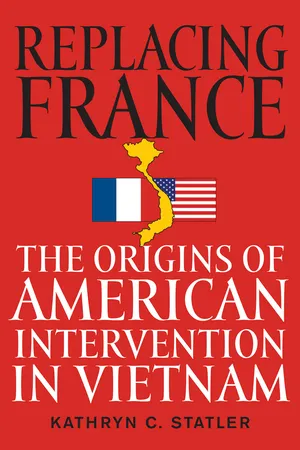
Using recently released archival materials from the United States and Europe, Replacing France: The Origins of American Intervention in Vietnam explains how and why the United States came to assume control as the dominant western power in Vietnam during the 1950s. Acting on their conviction that American methods had a better chance of building a stable, noncommunist South Vietnamese nation, Eisenhower administration officials systematically ejected French military, economic, political, bureaucratic, and cultural institutions from Vietnam. Kathryn C. Statler examines diplomatic maneuvers in Paris, Washington, London, and Saigon to detail how Western alliance members sought to transform South Vietnam into a modern, westernized, and democratic ally but ultimately failed to counter the Communist threat. Abetted by South Vietnamese prime minister Ngo Dinh Diem, Americans in Washington, D.C., and Saigon undermined their French counterparts at every turn, resulting in the disappearance of a French presence by the time Kennedy assumed office. Although the United States ultimately replaced France in South Vietnam, efforts to build South Vietnam into a nation failed. Instead, it became a dependent client state that was unable to withstand increasing Communist aggression from the North. Replacing France is a fundamental reassessment of the origins of U.S. involvement in Vietnam that explains how Franco-American conflict led the United States to pursue a unilateral and ultimately imperialist policy in Vietnam.
- 392 pages
- English
- ePUB (mobile friendly)
- Available on iOS & Android
eBook - ePub
About this book
Information
Publisher
The University Press of KentuckyYear
2007Print ISBN
9780813193304
9780813124407
eBook ISBN
9780813137322
PART 1
Neither Communism
nor Colonialism,
1950–1954
There was always a Third Force to be found free from Communism and the taint of colonialism—national democracy . . . you only had to find a leader and keep him safe from the old colonial powers.
1
Decolonization
and Cold War
THE YEAR 1950 DENOTED not only the halfway mark of the Franco-Vietminh War but also a turning point in the French approach to winning the conflict. As the year began, the March 8, 1949, Elysée treaty, promising more independence to Vietnam, languished in the French National Assembly; the French military effort against the Vietminh remained stalled; and French officials bickered among themselves about whether or not to support Vietnamese emperor Bao Dai as a viable political alternative to Vietminh leader Ho Chi Minh. Up to this point, Paris had preferred to conduct the war without interference from its allies, but when Chinese leader Mao Zedong recognized Ho Chi Minh’s government in January 1950, what had been a colonial battle suddenly became part of the globalized Cold War. Henceforth, French governments attempted to portray their engagement in Vietnam as a heroic anticommunist crusade instead of a colonial war fought to preserve the empire. By emphasizing the anticommunist nature of its war effort, Paris hoped to gain political and economic support from Washington and London. Following Mao’s recognition of the Democratic Republic of Vietnam (DRV), the French National Assembly ratified the Elysée Accords, the United States guaranteed American economic aid to France’s military effort, and Britain and the United States recognized Bao Dai’s State of Vietnam.1
Washington’s decisions to provide Paris with significant aid and to recognize Bao Dai’s State of Vietnam represented the first important steps in the long transition from the French to the American presence in Vietnam. Such steps could not have occurred without the transformation of the Indochina conflict from a colonial to an anticommunist war. This chapter thus assesses how, from 1950 to 1953, French leaders convinced a skeptical Truman administration that Indochina was much more than an exploited colony maintained for reasons of French prestige and grandeur. Indeed, French officials cleverly portrayed Indochina as an integral outpost in the new frontier battles of the Cold War. Moreover, Paris emphasized the difficulties it faced in prosecuting such a war while maintaining its contributions to European defense. These laborious efforts to change American perceptions of Indochina paid great dividends as Washington decided to commit American money, materials, political support, and personnel to the French war effort. But French efforts perhaps worked too well. As the Truman administration became convinced that Asian and European policies were inextricably linked, it began to provide economic and military aid, exactly as the French had hoped; but American officials also insisted on being involved in French decision making vis-à-vis Indochina. This insistence marked the beginning of the eventual transition from French to American influence of events in Vietnam.
Were the French sincere in painting their Indochinese war as a communist rather than colonial concern? Or, were they cynically emphasizing the communist element to acquire American aid? The answer, unsurprisingly, is a bit of both. Although the French played the communist card a little too often in their requests for materials and money in the fight against the Vietminh, they were certainly sincere in establishing a common defense policy with the Americans and British in Southeast Asia. Successive French governments worked diligently to convince their American and British partners that a coordinated defense organization in Asia would halt communist aggression, as the North Atlantic Treaty Organization (NATO) had secured western European defense. With the outbreak of the Korean War, the French successfully played on American fears of communist expansion, sparking the search for a united western policy against the communists in Indochina. Ultimately, the establishment of such a policy would prove elusive as Paris and Washington disagreed on the best way to guarantee a noncommunist Vietnam.
A COLONIAL WAR TRANSFORMED
The France that had resolutely clung to one of its few remaining indicators of world power status in 1946 appeared more willing to compromise on Vietnamese independence by 1950. Frustrated militarily, Paris commenced work on establishing a separate South Vietnamese state to oppose Ho Chi Minh’s regime in the North. A series of agreements promising conditional Vietnamese independence had been signed in the late 1940s, culminating with the March 8, 1949, Elysée Agreement, signed by French president Vincent Auriol and Vietnamese emperor Bao Dai. The agreement recognized the unification of Tonkin, Annam, and Cochinchina into the State of Vietnam, and the new state was given associate status within the French Union and a certain degree of autonomy under Bao Dai’s leadership.2 But the accords, which pleased neither Right nor Left in the French National Assembly, did not provide for total independence; Bao Dai’s government had authority over local affairs, but the French retained control over national defense and foreign affairs. Still, the French hoped the agreement would satisfy American calls for greater Vietnamese independence and thus lead to military and economic assistance from the United States.
A critic of French colonialism since World War II, the Truman administration provided little aid to the French war effort in Indochina during 1948 and 1949. U.S. officials advised French ambassador to the United States Henri Bonnet that the communist element in the Vietminh “would not suffice” to secure American assistance to France and remained skeptical of what had become known as “the Bao Dai solution.” Secretary of State Dean Acheson thought it would be unwise to commit to Bao Dai unless Paris granted more concessions toward Vietnamese independence, and even suggested sending a formal letter to the French foreign minister criticizing the Elysée Accords for not moving fast enough in this direction. U.S. ambassador to France David Bruce persuaded Acheson that such an action would be counterproductive.3 Infighting among the Office of Western European Affairs, the Bureau of Far Eastern Affairs, and the Office of Philippine and Southeast Asian Affairs also complicated American policy toward Indochina. It was not until the occurrence of a series of international events that increased the geopolitical importance of Indochina that the Truman administration began to change its views.
The Chinese communists’ victory in 1949 and the Soviet explosion of an atomic bomb the same year led the Truman administration to consider increasing its support of the Bao Dai government. Sensing an opportunity, Paris capitalized on communist successes by renewing its plea for increased American aid to Indochina. As early as May 1949, many French military officials described the war in Indochina as an anticommunist effort and insisted that Bao Dai’s establishment of a base there would stop the communist advance.4 The British also encouraged an American commitment to Southeast Asia since they feared that if Vietnam fell, areas under British influence—such as Siam, Burma, and Malaya—would be next.
The Americans listened to French and British concerns but hesitated to become involved in what they still considered to be an essentially colonial war. On July 1, 1949, National Security Council (NSC) 51 recommended greater cooperation with the British to secure French guarantees for Indochinese independence. According to NSC 51, a successful solution to the Indochina problem—Vietnamese independence—would not only halt communism, but would also demonstrate that the West could create a partnership with indigenous nationalists. In addition, Southeast Asia would be preserved as a source of western and Japanese raw materials.5 Still, by the end of 1949, Washington remained unsure about how to achieve greater Vietnamese independence.
The Truman administration was not the only indecisive player. Although Paris was determined to seek American support, it had a difficult time deciding how to proceed in Indochina. Officials in Paris and Saigon repeatedly failed to coordinate with each other, let alone with their American and British allies. French high commissioner to Indochina Leon Pignon attempted to bring some cohesiveness to French policy in Indochina, suggesting that France create a policy of action commune, or “common action,” with the Americans and British in the Far East. After China recognized Ho Chi Minh’s government, Pignon advocated that France “guarantee the borders of Indochina, recognize Bao Dai’s government, and obtain material aid from the United States.” Jean Letourneau, the French minister of overseas France, added that France should focus on moving forward as quickly as possible with Vietnamese independence. Both Pignon and Letourneau were concerned that Paris was immobilized by political infighting and would not be able to take concrete actions toward independence.6 Their fears were soon justified as Paris hesitated between supporting Bao Dai and trying to reestablish contacts with Ho Chi Minh. New losses inflicted on the French forces by the Vietminh, and the French public’s growing opposition to the war, perpetuated French difficulties in determining a course of action. After much internal debate, Paris decided to support Bao Dai rather than reconcile with Ho Chi Minh.7
On January 18, 1950, the People’s Republic of China recognized the DRV. The Soviet Union followed suit two days later. The Chinese and Soviet recognition of Ho Chi Minh’s government helped turn the war from a local anticommunist struggle into a focal point of the Cold War.8 The French Assembly quickly ratified the stalled Elysée agreements, anticipating that the United States and Britain would recognize the Bao Dai government. As expected, London and Washington recognized the State of Vietnam within a week, and an American mission was installed in Saigon shortly thereafter. The signing of the Sino-Soviet Treaty of Friendship on February 14 further heightened the western sense of urgency and led to additional American political support for the French-backed Bao Dai.
Although the American commitment to Vietnam began with a political act—recognition of the Bao Dai government—the first material step would be economic aid to France. The Truman administration began working on the question of aid early in 1950. A problem paper, drafted by a team of representatives from the Office of Western European Affairs, the Office of Philippine and Southeast Asian Affairs, and the Mutual Defense Assistance Program (MDAP), addressed the issue of U.S. policy regarding Indochina.9 The report weighed the difficulty of convincing Congress and the American public that the United States should support a colonial war against the possibility that the U.S. failure to assist the Bao Dai government might cause the French to work actively against American goals in Europe and abandon Vietnam and the rest of Indochina. The report concluded that aid was warranted on the basis that Indochina was important to U.S. security interests. By providing such aid, Washington hoped to gain significant leverage to compel Paris to grant independence to Bao Dai’s regime, although Acheson recognized that the greatest American bargaining power vis-à-vis France existed before the United States agreed to provide aid.10
French officials were also busy thinking of ways to gain leverage against their Atlantic ally. When Henri Bonnet formally requested economic and military assistance from the United States on February 16, 1950, he framed the request within the context of French budgetary and Cold War concerns. French representative to the United Nations (UN) Jean Chauvel emphasized that France could not afford “to continue being drained through Indochina” if French economic recovery were ever to be achieved. Unless the United States and Britain agreed to share some of France’s burden in Southeast Asia, France would be obliged “to liquidate its Indochina commitment.”11 The French Foreign Ministry, or Quai d’Orsay, also recognized the importance of portraying aid as a necessity in helping French leaders avoid having to make a difficult choice between Europe and Asia during a heightened Cold War. In particular, Bonnet reminded officials in Washington that France was on the only “hot” frontline in the Cold War. He recognized that American aid would bring “faster independence for the Associated States, new personnel, and implementation of the 8 March 1949 accords” while also drawing France “more closely into the Atlantic alliance with the United States.” Bonnet recommended asking for more rather than less aid and suggested French officials present themselves as “partners, not as solicitors.”12 This French gambit was successful in convincing the State Department that aid was necessary. Thus, French demands for arms and money that had been denied in 1948 and 1949 were now approved by the Truman administration. On March 10, Truman approved an initial grant of $15 million in military aid for Indochina out of MDAP funds.
At the heart of Franco-American deliberations over aid was the issue of Vietnamese independence. Once the United States began its financial investment in Indochina, it attempted to influence the conduct of the war and the uses of American aid.13 Both the United States and Britain urged the French Foreign Ministry to wrest control of Indochinese affairs from the Ministry of Overseas France. According to London and Washington, this act would provide some perceived legitimacy to the fiction of Indochinese sovereignty. But Paris had its own concerns about sovereignty and sought assurances that American aid would not entail reducing the French “civilizing influence” in Indochina. Letourneau was particularly concerned about preserving French political and cultural control. In a warning to both the Americans and the British, he pronounced in April 1950 that unless French influence was preserved, France would “not allow other countries to participate in the defense of the region.”14
Collective action in Southeast Asia appeared difficult to achieve in light of the opposing currents of the French fear of losing control and the Truman administration’s insistence on complete Vietnamese independence.15 The French believed that ratifying the 1949 Elysée Accords represented a large concession toward Vietnamese independence, but the Americans remained unconvinced. Paris suspected that insufficient, often unsatisfactory, and uniformly late American aid to Indochina was a tactic to pressure the French toward granting greater independence. Although the Pau Conference of 1950 guaranteed that Vietnam, Cambodia, Laos, and France would all have an equal voice in economic decisions, the three Indochinese states continued to insist on full independence. French concerns that the United States was encouraging this demand persisted. Although the Truman administration reiterated its support of the French war effort, an image of an anticolonial United States endured in the minds of the French.16 President Franklin Roosevelt’s calls for an international trusteeship of Indochina at the end of World War II and previous American hesitation in helping France had not been forgotten.
The issue of aid and how it was to be distributed continued to plague Franco-American relations. In March, an economic survey mission arrived in Saigon. The Griffin mission, as it came to be called, was designed to assess the need for economic and technical aid, to recommend aid programs designed to demonstrate the “genuine interest” of the United States in the people of Southeast Asia, and to help the governments there strengthen their economies and build “popular support.” In a significant boon to the French, the mission recommended the first large-scale aid—$23.5 million—for the three Indochinese countries.17 According to the Quai d’Orsay, the mission was badly informed about the political situation in Indochina, and its contacts with the Vietnamese aggravated French difficulties by giving hope to Vietnamese nationalists that they could rid themselves of French control. Quai officials insisted military aid flow to Paris, not the Bao Dai regime in Saigon, and worried that as they withdrew from internal Vie...
Table of contents
- Cover
- Half title
- Title
- Copyright
- Dedication
- Contents
- Acknowledgments
- Abbreviations
- Introduction: The Franco-American Alliance and Vietnam
- Part 1. Neither Communism nor Colonialism, 1950–1954
- Part 2. After Geneva, 1954–1956
- Part 3. War by Other Means, 1956–1960
- Conclusion: Replacing France
- Notes
- Bibliography
- Index
Trusted by 375,005 students
Access to over 1.5 million titles for a fair monthly price.
Study more efficiently using our study tools.
Frequently asked questions
Yes, you can cancel anytime from the Subscription tab in your account settings on the Perlego website. Your subscription will stay active until the end of your current billing period. Learn how to cancel your subscription
No, books cannot be downloaded as external files, such as PDFs, for use outside of Perlego. However, you can download books within the Perlego app for offline reading on mobile or tablet. Learn how to download books offline
Perlego offers two plans: Essential and Complete
- Essential is ideal for learners and professionals who enjoy exploring a wide range of subjects. Access the Essential Library with 800,000+ trusted titles and best-sellers across business, personal growth, and the humanities. Includes unlimited reading time and Standard Read Aloud voice.
- Complete: Perfect for advanced learners and researchers needing full, unrestricted access. Unlock 1.5M+ books across hundreds of subjects, including academic and specialized titles. The Complete Plan also includes advanced features like Premium Read Aloud and Research Assistant.
We are an online textbook subscription service, where you can get access to an entire online library for less than the price of a single book per month. With over 1.5 million books across 990+ topics, we’ve got you covered! Learn about our mission
Look out for the read-aloud symbol on your next book to see if you can listen to it. The read-aloud tool reads text aloud for you, highlighting the text as it is being read. You can pause it, speed it up and slow it down. Learn more about Read Aloud
Yes! You can use the Perlego app on both iOS and Android devices to read anytime, anywhere — even offline. Perfect for commutes or when you’re on the go.
Please note we cannot support devices running on iOS 13 and Android 7 or earlier. Learn more about using the app
Please note we cannot support devices running on iOS 13 and Android 7 or earlier. Learn more about using the app
Yes, you can access Replacing France by Kathryn C. Statler in PDF and/or ePUB format, as well as other popular books in History & 20th Century History. We have over 1.5 million books available in our catalogue for you to explore.