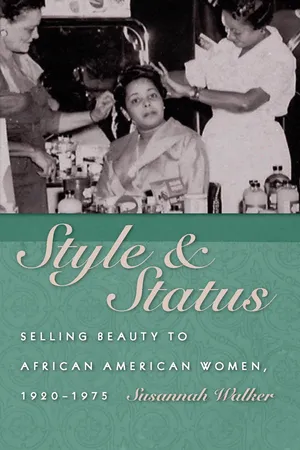
Between the 1920s and the 1970s, American economic culture began to emphasize the value of consumption over production. At the same time, the rise of new mass media such as radio and television facilitated the advertising and sales of consumer goods on an unprecedented scale. In Style and Status: Selling Beauty to African American Women, 1920–1975, Susannah Walker analyzes an often-overlooked facet of twentieth-century consumer society as she explores the political, social, and racial implications of the business devoted to producing and marketing beauty products for African American women. Walker examines African American beauty culture as a significant component of twentieth-century consumerism, and she links both subjects to the complex racial politics of the era. The efforts of black entrepreneurs to participate in the American economy and to achieve self-determination of black beauty standards often caused conflict within the African American community. Additionally, a prevalence of white-owned firms in the African American beauty industry sparked widespread resentment, even among advocates of full integration in other areas of the American economy and culture. Concerned African Americans argued that whites had too much influence over black beauty culture and were invading the market, complicating matters of physical appearance with questions of race and power. Based on a wide variety of documentary and archival evidence, Walker concludes that African American beauty standards were shaped within black society as much as they were formed in reaction to, let alone imposed by, the majority culture. Style and Status challenges the notion that the civil rights and black power movements of the 1950s through the 1970s represents the first period in which African Americans wielded considerable influence over standards of appearance and beauty. Walker explores how beauty culture affected black women's racial and feminine identities, the role of black-owned businesses in African American communities, differences between black-owned and white-owned manufacturers of beauty products, and the concept of racial progress in the post–World War II era. Through the story of the development of black beauty culture, Walker examines the interplay of race, class, and gender in twentieth-century America.
- 264 pages
- English
- ePUB (mobile friendly)
- Available on iOS & Android
eBook - ePub
About this book
Information
Chapter 1
“The Beauty Industry
Is Ours”
Developing African American Consumer
Citizenship in the 1920s and 1930s
Early in 1929, Claude Barnett, an African American newspaperman and founder of the first black-owned advertising agency, wrote letters to two of the most successful female-headed African American beauty product companies in the United States. To Freeman B. Ransom, general manager of the Madam C. J. Walker Manufacturing Company, Barnett pitched his advertising services and closed by asking whether Ransom thought “it possible to get together on a program of occupying enough space in the papers to overshadow the white firms, gradually excluding them?” Writing to his client Annie Malone of the Poro Company, Barnett warned, “Competition from white firms is constantly becoming keener,” and he advised more advertising. Having “watched the trend of events for the past few years,” he was “convinced that Poro will get a still smaller share of business unless a new impetus is given to making sales.” But Barnett wanted Malone to do more than just buy more advertising space; he also urged her to change her marketing strategy. Rather than running their usual style of ads highlighting the history and achievements of the company, Poro needed a glamorous new campaign that linked its products to beauty, prestige, and happiness for the women who used them. “Make the ads so tempting that every woman who does not use Poro will think she is missing something,” Barnett urged.1
Claude Barnett had much to gain, of course, if Poro and the Madam C. J. Walker Company decided to put more advertising in black newspapers. Barnett’s Chicago-based news distribution company, the Associated Negro Press, depended on the subscriptions of small African American newspapers throughout the country, while those newspapers struggled to secure enough advertising revenue to stay afloat. In his role as an advertising executive, Barnett sought clients, created ads, and sold advertising space in black newspapers. He encouraged those newspapers, in turn, to subscribe to his news service. This was more than just a smart business strategy in which he could profit at several stages of the newspaper publishing process. Barnett was passionate about promoting African American businesses in general; he saw consumerism as a key to the social and political advancement of black people. Barnett hoped to change the attitudes of national-brand advertisers, who mostly underestimated the spending power of black consumers and generally did not bother to advertise in African American publications. As Roland Marchand explains, mainstream advertising of the 1920s and 1930s did not target African Americans because advertisers, who tended to model their audiences from personal experience, envisioned the average “consumer citizen” as white and middle class.2
Barnett, along with a handful of other marketing professionals, worked hard to claim consumer citizenship for black Americans. At the turn of the century, Booker T. Washington had encouraged African Americans to focus on becoming effective participants in America’s capitalist economy before attempting to gain social or political equality with whites. By the 1920s and 1930s, however, vocational training, steady work habits, and entrepreneurial spirit were not the sole measures of capitalist involvement or success. Participation in American capitalism required consumption of mass-produced goods and, perhaps more important, recognition of this consumption by advertisers and marketing executives. Barnett hoped that market research (then barely in its infancy) might prove the worth of black consumers to white-owned businesses. At the same time, Barnett was a keen observer of new trends in advertising and believed that African American businesses needed to adopt a more modern approach to marketing their goods and services if they wanted to succeed, particularly if they were to compete with white-owned businesses.
Where the beauty industry was concerned, as in many industries with a significant African American presence, promoting black consumer citizenship within the increasingly complex and pervasive American marketplace clashed with economic nationalist concerns over protecting African American–owned businesses. By the 1920s and 1930s, a large proportion of beauty product advertising in black publications came from white-owned companies, which claimed an ever-increasing share of sales. Rather than welcome this trend as a rare example of white businesses’ recognition of a lucrative black consumer market, many observers saw it as a threat to one of the most vibrant and profitable of black enterprises. Thus beauty culture both demonstrated the possibilities and revealed the limits of black consumer citizenship in the context of segregation, racial discrimination, and economic inequality—all of which curtailed the ability of African Americans, be they consumers or entrepreneurs, to compete on equal terms with whites. Certainly Barnett himself must have been aware of this problem as he exhorted Malone and Walker to increase their advertising budgets. After all, this was a man who thought big when it came to business: in addition to his newspaper and advertising activities, he had, over the years, attempted to run his own beauty product company and started a literary magazine. Nevertheless, Barnett’s ambitious plans were always limited by racial prejudice and lack of capital. Companies like Poro and Madam C. J. Walker could rarely afford to increase their advertising budgets to match those of their biggest white competitors, as Barnett encouraged them to do. The very circumstances that created opportunities for black entrepreneurs nevertheless limited their businesses’ ability to grow and left them ill equipped to contend with white competition when it came. The Great Depression left smaller and less financially stable black companies even more vulnerable to this competition. Thus, in Jim Crow America in the 1920s and 1930s, economic nationalism was often the best option, but ultimately a precarious path for black businesses to take.
This is clearly illustrated in the case of commercial beauty culture. The commodification of beauty in the early twentieth century affected black women and white women alike, as the sheer volume of beauty goods and services available mushroomed and advertising itself became more emotional and didactic in tone. Selling beauty to black women created lucrative opportunities for white companies as well as for African American entrepreneurs. When Barnett urged women like Malone to advertise more and to modernize their advertising, he meant for African American commercial beauty enterprises to beat out the white competition, which was using modernized pitches and which, many African Americans seemed to agree, had no rightful place in the field. As noted above, such a position stood awkwardly juxtaposed with campaigns to get more advertising dollars from white companies into black publications, but it made sense for a number of reasons. Beauty culture was one business in which African Americans, especially women, had gained considerable success by the 1920s, and it had brought employment and money into black communities. White-owned cosmetics companies, which had considerably more resources to spend on marketing and often practiced racial discrimination in hiring, threatened the achievements of women like Malone and Walker and the thousands of black women their companies employed. Many African American beauty industry leaders also accused the white-owned companies of racism and insensitivity in their advertising, claiming that their ads encouraged black women to hate their appearance and seek a white beauty ideal. Although this was true to some extent, by the 1920s and 1930s the advertising messages of the most prominent white- and black-owned companies were quite similar. The accusation that the white companies were usurpers that promoted self-hatred in black women reflected deeper anxieties and conflicts within African American communities over whether and how they could shape black female beauty ideals and carve out some level of economic power in the context of mass consumer culture.
African Americans in a Consumer Society
Aside from cosmetics companies, few white advertisers recognized the growing participation of blacks in the consumer economy in the 1920s and 1930s. Most white marketing experts ignored African Americans, and the few analyses of black consumers that were conducted seldom moved beyond crude racial stereotypes. H. A. Haring, a contributing editor for the trade magazine Advertising and Selling, expressed a typical attitude in 1930 when he wrote, “What of the American Negro as a buyer and user of goods? Is he worth taking seriously? Is the traditional happy-go-lucky plantation life of the South still a measure of the race’s standard of living?” Haring maintained that, indeed, southern rural blacks were too poor to buy anything but “bare necessities” and were so “low” intellectually that “no form of advertising can whet the desire of possession.” But he went on to observe that the Great Migration had brought large numbers of African Americans to better-paying northern jobs and thus opened up a whole new consumer market. And what of this market? Haring noted that African Americans were enthusiastic purchasers of records, phonographs, and musical instruments and that black tastes in groceries ran to high-end brands. In an earlier article, Haring wrote that African Americans in Harlem liked to spend extra cash on luxury clothing and accessories. In short, black people were logical targets for advertisers of the luxuries and household items that filled the shelves of modern grocery, drug, and department stores. Haring argued that advertising campaigns directed at African Americans should be visual because, as he put it, blacks were “short on abstract thinking.” Despite the racist assumptions undergirding his writing, Haring did recognize the potential of the African American market and realized that it needed to be courted deliberately and directly in African American newspapers and magazines.3
The Great Migration had resulted in a steady rise in the proportion of African Americans living in cities, from 27 percent in 1916 to 35 percent in 1920 and 44 percent in 1930. By 1940, nearly half of all African Americans were urban. These wage-earning urban blacks generally had more expendable income than their rural counterparts. Even for families who could afford little more than the bare necessities, life in the city required a greater engagement with consumer culture than did life in the country. Food items that once could be grown were now bought, and nearby stores and commercial amusements were attractive to those with even a little extra money. Furthermore, advertisements in widely circulating black magazines and newspapers, publications that were produced in African American urban communities but read throughout black America, along with the prevalence of mail-order catalogs, ensured that rural and small-town African Americans were not necessarily excluded from consumer culture. By the late 1920s and early 1930s, a few marketing experts, including Claude Barnett, advertising executive William Ziff, and market researcher Paul Edwards, were busily trying to convince national-brand-name advertisers to take black consumers more seriously.4
They met with little success. With rare exceptions, companies underestimated the African American market and showed little interest in targeting it directly. In a 1930 letter to the president of the National Negro Business League, Claude Barnett complained that black newspapers got far too little advertising revenue compared with “the millions of dollars poured out into white publications for the necessities that white people buy.” To Barnett, this was not an honest oversight but a result of the racist assumption that black consumers were not worth courting. He commented that white advertisers had “built up a defense mechanism against using Negro newspapers which is marvelous and indicates concerted thinking and agreement.” An examination of African American newspapers from the 1920s and 1930s seems to confirm Barnett’s opinion. Advertisements for cars, radios, appliances, packaged foods, cleaning products, and clothing, common in white newspapers at this time, were rare in African American publications. The pages of black newspapers were instead filled with advertisements for patent medicines, “race records,” mail-order novelties, and cosmetic products. Surveys of black newspapers at the time revealed that ads for such products took up 80 to 90 percent of advertising space.5
Barnett, Ziff, and Edwards constantly stressed that the recognition of what they called the Negro market was an essential step on the road to racial equality. They represented the African American market as affluent, sophisticated, and discerning. They argued that advertisers needed to make special appeals to black consumers because they led segregated lives and were not reached effectively by mainstream advertising. In the late 1920s, Barnett founded an advertising agency in Chicago to secure advertising for the African American newspapers published weekly in dozens of U.S. cities. Barnett’s appeals to potential advertisers demonstrate his belief that recognition of the African American market by white advertisers was tantamount to recognition of black economic, social, and political progress. In a 1930 promotional letter sent to dozens of potential clients, Barnett claimed that African Americans spent a billion dollars a year on manufactured goods, “a market larger than a majority of foreign countries.” He stressed that black consumers were “affected by considerations of racial pride and sentiment as well as by price and quality” and that the magazines he represented, such as Opportunity and the Crisis, were “read by that progressive ten per cent which determines the attitude of all colored America.”6
Barnett’s “talented tenth” theory of consumption, which echoed W. E. B. DuBois’ ideas about elite black influence over the African American masses, is unsubstantiated. However, his desire to put a middle-class face on the African American market is understandable. After all, Barnett had dealt with many white companies that undervalued black consumers, and he wanted to counter images such as Haring’s “short on abstract thinking” black consumer. When asked in 1930 whether a Cincinnati-based toiletries company could successfully market a special line for African Americans, he was ambivalent. One of the company’s executives, he said, had once told him “he thought their line . . . was too expensive for Negroes.” Barnett continued, “They seem to have an idea in the back of their minds that colored people are not users of high-class products.” The attitude reminded Barnett of “Kotex, who wrote that their products were too high for colored women to buy.” For Barnett, the solution was to convince advertisers of black consumer significance through market research and a concerted public relations campaign against prevailing stereotypes. His comments reveal a somewhat self-interested attempt to promote the black press, but he sincerely believed in economic strength and unity as key pillars of racial progress. “We must find a way to marshal our buying power so as to force [national advertisers] to realize our value,” he wrote in 1930. “If we are to have segregated institutions, we ought to get whatever economic values go with such forced solidarity.”7
Most people concerned with promoting African American consumerism agreed that more market research was needed. In 1932, Fisk University economist Paul Edwards published the results of a 1928 survey of African American buying habits and consumer attitudes in four southern cities: Nashville, Birmingham, Atlanta, and Richmond. The Southern Urban Negro as a Consumer was exactly the sort of study people like Barnett were calling for. Edwards found that, across class lines, and in spite of their earning average incomes significantly lower than those of whites in the same cities, the black consumers he surveyed favored top-quality, more expensive brands of staple foods, household products, and clothing. For his part, Barnett argued that similar consumer habits prevailed among black Chicagoans, many of whom were, of course, recent migrants from the South. As Lizabeth Cohen has observed, this sort of brand loyalty was somewhat unique among working-class people in Chicago. Most notably, white eastern and southern European Americans tended to shop in small neighborhood stores rather than in chain stores (which did not extend credit) and to buy bulk dry goods rather than packaged foods, which were more expensive. Citing various marketing experts, including Barnett and Edwards, Cohen explains that African Americans preferred brand-name packaged goods and chain stores in part because they felt less likely to be cheated when shopping for prepackaged goods with clearly marked prices. They also felt less prone to racial discrimination in chain stores, which could more easily and effectively be targeted by civil rights activists in areas where they did discriminate, as in the Don’t Buy Where You Can’t Work protests conducted in several northern cities in the 1930s. Edwards found not only that African Americans bought brand-name goods but that they also paid attention to advertising and had definite ideas about what sorts of images of black people they wanted to see in ads. Ads featuring black people as servants, such as those for Aunt Jemima Pancake Mix, received a negative reaction because they portrayed the “slavery type of Negro.” Meanwhile, cosmetics advertisements showing glamorous black models were viewed favorably because in them, as one survey respondent put it, “the Negro was dignified and made to look as he is striving to look.”8
The Edwards study provided men like Claude Barnett and ...
Table of contents
- Cover
- Half title
- Title
- Copyright
- Dedication
- Contents
- List of Illustrations
- Acknowledgments
- Introduction: Why Hair is Political
- 1. “The Beauty Industry Is Ours”: Developing African American Consumer Citizenship in the 1920s and 1930s
- 2. “Everyone Admires the Woman Who Has Beautiful Hair”: Mediating African American Beauty Standards in the 1920s and 1930s
- 3. “An ‘Export’ Market at Home”: Expanding African American Consumer Culture in the 1940s, 1950s, and 1960s
- 4. “Beauty Services Offered from Head to Toe”: Promoting Beauty to African American Women in the 1940s and 1950s
- 5. “All Hair Is Good Hair”: Integrating Beauty in the 1950s and 1960s
- 6. “Black Is Beautiful”: Redefining Beauty in the 1960s and 1970s
- Conclusion: Why African American Beauty Culture Is Still Contested
- Notes
- Selected Bibliography
- Index
Trusted by 375,005 students
Access to over 1.5 million titles for a fair monthly price.
Study more efficiently using our study tools.
Frequently asked questions
Yes, you can cancel anytime from the Subscription tab in your account settings on the Perlego website. Your subscription will stay active until the end of your current billing period. Learn how to cancel your subscription
No, books cannot be downloaded as external files, such as PDFs, for use outside of Perlego. However, you can download books within the Perlego app for offline reading on mobile or tablet. Learn how to download books offline
Perlego offers two plans: Essential and Complete
- Essential is ideal for learners and professionals who enjoy exploring a wide range of subjects. Access the Essential Library with 800,000+ trusted titles and best-sellers across business, personal growth, and the humanities. Includes unlimited reading time and Standard Read Aloud voice.
- Complete: Perfect for advanced learners and researchers needing full, unrestricted access. Unlock 1.5M+ books across hundreds of subjects, including academic and specialized titles. The Complete Plan also includes advanced features like Premium Read Aloud and Research Assistant.
We are an online textbook subscription service, where you can get access to an entire online library for less than the price of a single book per month. With over 1.5 million books across 990+ topics, we’ve got you covered! Learn about our mission
Look out for the read-aloud symbol on your next book to see if you can listen to it. The read-aloud tool reads text aloud for you, highlighting the text as it is being read. You can pause it, speed it up and slow it down. Learn more about Read Aloud
Yes! You can use the Perlego app on both iOS and Android devices to read anytime, anywhere — even offline. Perfect for commutes or when you’re on the go.
Please note we cannot support devices running on iOS 13 and Android 7 or earlier. Learn more about using the app
Please note we cannot support devices running on iOS 13 and Android 7 or earlier. Learn more about using the app
Yes, you can access Style and Status by Susannah Walker in PDF and/or ePUB format, as well as other popular books in History & Social History. We have over 1.5 million books available in our catalogue for you to explore.