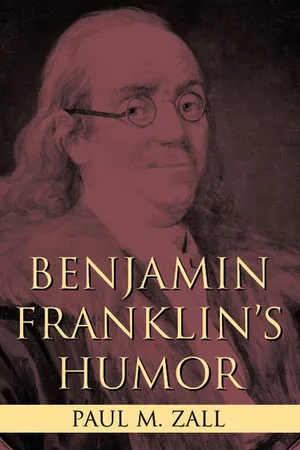
Although he called himself merely a "printer" in his will, Benjamin Franklin could have also called himself a diplomat, a doctor, an electrician, a frontier general, an inventor, a journalist, a legislator, a librarian, a magistrate, a postmaster, a promoter, a publisher—and a humorist. John Adams wrote of Franklin, "He had wit at will. He had humor that when he pleased was pleasant and delightful . . . [and] talents for irony, allegory, and fable, that he could adapt with great skill, to the promotion of moral and political truth." In Benjamin Franklin's Humor, author Paul M. Zall shows how one of America's founding fathers used humor to further both personal and national interests. Early in his career, Franklin impersonated the feisty widow Silence Dogood in a series of comically moralistic essays that helped his brother James outpace competitors in Boston's incipient newspaper market. In the mid-eighteenth century, he displayed his talent for comic impersonation in numerous editions of Poor Richard's Almanac, a series of pocket-sized tomes filled with proverbs and witticisms that were later compiled in Franklin's The Way to Wealth (1758), one of America's all-time bestselling books. Benjamin Franklin was sure to be remembered for his early work as an author, printer, and inventor, but his accomplishments as a statesman later in life firmly secured his lofty stature in American history. Zall shows how Franklin employed humor to achieve desired ends during even the most difficult diplomatic situations: while helping draft the Declaration of Independence, while securing France's support for the American Revolution, while brokering the treaty with England to end the War for Independence, and while mediating disputes at the Constitutional Convention. He supervised and facilitated the birth of a nation with customary wit and aplomb. Zall traces the development of an acute sense of humor throughout the life of a great American. Franklin valued humor not as an end in itself but as a means to gain a competitive edge, disseminate information, or promote a program. Early in life, he wrote about timely topics in an effort to reach a mass reading class, leaving an amusing record of early American culture. Later, Franklin directed his talents toward serving his country. Regardless of its origin, the best of Benjamin Franklin's humor transcends its initial purpose and continues to evoke undying laughter at shared human experiences.
- 200 pages
- English
- ePUB (mobile friendly)
- Available on iOS & Android
eBook - ePub
Benjamin Franklin's Humor
About this book
Information
1
SILENCE DOGOOD
1722–1723
At thirteen, Franklin plunged into print with a timely ballad about lighthouse keeper George Worthylake drowning with two daughters in the heavy November surf of Boston Harbor. A few months later, he followed with another timely ballad on the capture of the notorious pirate Blackbeard off the Carolina coast. Emboldened, he adopted higher models. Having learned to write by imitating Addison and Steele’s popular Spectator essays, Franklin aspired to their role as censor of morals and manners. He would correct deviations from community standards by exposing them to ridicule. At sixteen, he transplanted their style to Boston in James Franklin’s New-England Courant. He left no doubt about his model in his first sketch, using many of the Spectator’s words. No attribution was necessary, because readers would have known Addision and Steele’s style anywhere. Such copying, common in Franklin’s time, would be considered legitimate imitation.1
Franklin, fearing that James never would have published work by a mere boy otherwise, slipped the first “Silence Dogood” essay through the door under cover of darkness and the pseudonym Silence Dogood, a feisty Boston widow lady. The Courant ran fourteen of her essays fortnightly from 2 April through 8 October 1722. Mrs. Dogood’s timely remarks on society and fashion sometimes resonate with Benjamin Franklin’s incipient talents. But the polished writing suggests help from the coterie of writers, the Couranteers, who lounged around brother James’s shop to read London literary periodicals and imitate them in articles for the Courant under names like Timothy Turnstone and Zechariah Hearwell.2 The coterie spent the winter of 1721–1722 mocking Rev. Cotton Mather, who branded them “The Hell-Fire Club” for abusing Boston’s clergy. Not surprisingly, then, young Franklin crafted the sprightly widow’s name from two of Mather’s recent tracts, Silentarius and Essays to Do Good. Why a widow? One-fourth of Boston’s adults were widows.3
Even more subtle for modern readers (though not for Franklin’s contemporaries) is the allusion to Mather’s overwrought scene in the third book of his Magnalia Christi Americana (pt. 2, chap. 2, p. 77). Sailing from Newbury to Marblehead with his family, preacher John Avery “was by a Wave sweeping him off, immediately wafted away to Heaven,” says Mather. Mrs. Dogood indicts a comparably culpable wave for the death of her father.
As he, poor Man, stood upon the Deck rejoycing at my Birth, a merciless Wave entred the Ship, and in one Moment carry’d him beyond Reprieve. This was the first Day which I saw, the last that was seen by my Father; and thus was my disconsolate Mother at once made both a Parent and a Widow. [No. 1]4
Mrs. Dogood’s balance of contrasting terms (first Day and last, Parent and Widow) will become a hallmark of Franklin’s epigrammatic style, as in, “It is not [General Howe] who had taken Philadelphia, but Philadelphia who had taken him.”5 After telling how she owed her writing skill to a country parson who encouraged her love of books, Mrs. Dogood concludes the first chapter with the same sort of front-loaded shot.
I liv’d a chearful Country Life, spending my leisure Time either in some innocent Diversion with the neighbouring females, or in some shady Retirement, with the best of Company, Books. Thus I past away the Time with a Mixture of Profit and Pleasure, having no Affliction but what was imaginary, and created in my own Fancy; as nothing is more common with us Women, than to be grieving for nothing, when we have nothing else to grieve for. [No. 1]
Aside from Addison and Steele’s carefully crafted style, Mrs. Dogood sounds like Daniel Defoe’s spunky, smart, and independent heroines, particularly Moll Flanders, whose popular memoirs appeared in January 1722. In a passage for tonal comparison, Mrs. Flanders offers a capsule account of her first marriage: “Modesty forbids me to reveal the Secrets of the Marriage Bed. . . . My Husband was so Fuddled when he came to Bed, that he could not remember in the Morning, whether he had any Conversation [sex] with me or no. . . . It concerns the Story in hand very little, to enter into the farther particulars . . . [of] the five Years that I liv’d with this Husband; only to observe that I had two Children by him, and that at the end of five Year he died: He had been really a very good Husband to me, and we liv’d very agreeably together.”6 In contrast, Mrs. Dogood’s account of her last marriage relies on schoolyard innuendo (fruitless, topping) for comic effect.
My Reverend Master who had hitherto remained a Batchelor, (after much Meditation on the Eighteenth verse of the Second Chapter of Genesis,) took up a Resolution to marry; and having made several unsuccessful fruitless Attempts on the more topping Sort of our Sex, and being tir’d with making troublesome Journeys and Visits to no Purpose, he began unexpectedly to cast a loving Eye upon Me, whom he had brought up cleverly to his Hand. . . .
We lived happily together in the Heighth of conjugal Love and mutual Endearments, for near Seven Years, in which Time we added Two likely Girls and a Boy to the Family of the Dogoods: But alas! When my Sun was in its meridian Altitude, inexorable unrelenting Death, as if he had envy’d my Happiness and Tranquility, and resolv’d to make me entirely miserable by the Loss of so good an Husband, hastened his Flight to the heavenly World, by a sudden unexpected Departure from this. [No. 2]
To prevent her young son, William, from idleness, her boarder, Clericus, advises sending him to Harvard. This induces her to dream about the Temple of Learning devoted to idleness and dissipation. Her sketch contributed to the ongoing feud between the Couranteers and the local clergy. The competing Boston Gazette (28 May 1722) claimed the dream was nonsense (“Whoever heard of taking a Plow into a Temple!”). The critic himself talked nonsense in charging plagiarism from Richard Allestree’s didactic The Gentleman’s Calling (1670). Obviously Franklin’s model was the allegorical “Vision of Mirza” (1 September 1711), one of the Spectator’s most popular papers.7 Where the “Vision of Mirza” scanned generalized vices and virtues, Mrs. Dogood’s vision had a local habitation and a name.
I reflected in my Mind on the extream Folly of those Parents who, blind to their Childrens Dulness, and insensible of the Solidity of their Skulls, because they think their Purses can afford it, will needs send them to the Temple of Learning, where, for want of a suitable Genius, they learn little more than how to carry themselves handsomely, and enter a Room genteely, (which might as well be acquir’d at a Dancing-School,) and from whence they return, after Abundance of Trouble and Charge, as great Blockheads as ever, only more proud and self-conceited.
While I was in the midst of these unpleasant Reflections, Clericus (who with a Book in his Hand was walking under the Trees) accidentally awak’d me; to him I related my Dream with all its Particulars, and he, without much Study, presently interpreted it, assuring me, That it was a lively Representation of HARVARD COLLEGE, Etcetera. [No. 4]
For her contribution to the Couranteers’ ongoing critique of women’s society and fashion, Mrs. Dogood had—besides the Spectator—many models in the London popular press as, for example, in the weekly British Apollo, Defoe’s Review, or London’s Penny-Post. But her model lay closer to home in the frequent columns by Couranteer Nathaniel Gardner. Franklin adopted his device of chatting with correspondents (himself under assumed names). For example, Mrs. Dogood responds to criticism from “Ephraim Censorious” by publishing his letter. The trick here is to distinguish her style from that of her correspondent, which Franklin reinforces by concluding “Ephraim’s” letter with salacious innuendo.
Let the first Volley of your Resentments be directed against Female Vice; let Female Idleness, Ignorance and Folly, (which are Vices more peculiar to your Sex than to our’s,) be the Subject of your Satyrs, but more especially Female Pride, which I think is intollerable. Here is a large Field that wants Cultivation, and which I believe you are able (if willing) to improve with Advantage; and when you have once reformed the Women, you will find it a much easier Task to reform the Men, because Women are the prime Causes of a great many Male Enormities. [No. 5]
With an eye to print-shop business, Mrs. Dogood’s satire on the vanity of “Hoop-Petticoats” offers comical treatment of a quasi-religious pamphlet published in the same year by James Franklin. The anonymous author of Hoop-Petticoats Arraigned and Condemned by the Light of Nature and Law of God sends a simple message to women of fashion: “Methinks they would do well to consider, that strait is the gate, & narrow the way that leads to Life; and whether their extensive Hoops may not be some hindrance unto them in walking this narrow way” (3). Mrs. Dogood also yokes incongruous images in a solution both comical and sensible, prefiguring the Paris citizen who later proposes daylight savings. She had another model in the Spectator (26 July 1711), which also exaggerated the image of hoopskirts as fortification (“Outworks and Lines of Circumvallation”). In keeping a more exaggerated caricature under control, Franklin at age sixteen displayed a major advance in keeping comic imagery credible.
These monstrous topsy-turvy Mortar-Pieces, are neither fit for the Church, the Hall, or the Kitchen; and if a Number of them were well mounted on Noddles-Island, they would look more like Engines of War for bombarding the Town, than Ornaments of the Fair Sex. An honest Neighbour of mine, happening to be in Town some time since on a publick Day, inform’d me, that he saw four Gentlewomen with their Hoops half mounted in a Balcony, as they withdrew to the Wall, to the great terror of the Militia, who (he thinks) might attribute their irregular Volleys to the formidable Appearance of the Ladies Petticoats.
I assure you, Sir, I have but little Hopes of perswading my Sex, by this Letter, utterly to relinquish the extravagant Foolery, and Indication of Immodesty, in this monstrous Garb of their’s; but I would at least desire them to lessen the Circumference of their Hoops, and leave it with them to consider, Whether they, who pay no Rates or Taxes, ought to take up more Room in the King’s High-Way, than the Men, who yearly contribute to the Support of the Government. [No. 6]
Another exercise in comic technique of a different sort foreshadows Franklin’s deadpan style in mocking the gullibility of competing almanac maker, Titan Leeds, and also previews the theme of the classic “Old Mistresses Apologue.” The present sketch follows directly from Mrs. Dogood’s tenth essay, which chiefly reprinted extracts from Defoe’s Essay on Projects proposing an insurance plan for indigent widows. It differs from a petition by “Chastity Loveworth” in the Spectator (9 February 1712) against women who spoil suitors for other women: the petition from Mrs. Dogood’s correspondent guilelessly reveals a more selfish motive.
1. That your Petitioner being puff’d up in her younger Years with a numerous Train of Humble Servants, had the Vanity to think, that her extraordinary Wit and Beauty would continually recommend her to the Esteem of the Gallants; and therefore as soon as it came to be publickly known that any gentleman address’d her, he was immediately discarded.
2. That several of your Petitioners Humble Servants, who upon their being rejected by her, were, to all Apperance in a dying Condition, have since recover’d their Health, and been several Years married, to the great Surprize and Grief of your Petitioner, who parted with them upon no other Conditions, but that they should die or run distracted for her, as several of them faithfully promis’d to do.
3. That your Petititoner finding her self disappointed in and neglected by her former Adorers, and no new Offers appearing for some Years past, she has been industriously contracting Acquaintance with several Families in Town and Country, where any young Gentlemen or Widowers have resided, and endeavour’d to appear as conversable as possible before them: She has likewise been a strict Observer of the Fashion, and always appear’d well dress’d. And the better to restore her decay’d Beauty, she has consum’d above Fifty Pound’s Worth of the most approved Cosmeticks. But all won’t do.
Your Petitioner therefore most humbly prays, That you would be pleased to form a Project for the Relief of all those penitent Mortals of the fair Sex, that are like to be punish’d with their Virginity until old Age, for the Pride and Insolence of their Youth.
And your Petitioner (as in Duty bound) shall ever pray, &c.
Margaret Aftercast.
Were I endow’d with the Faculty of Matchmaking, it should be improv’d for the Benefit of Mrs. Margaret, and others in her Condition: But since my extream Modesty and Taciturnity, forbids an Attempt of this Nature, I would advise them to relieve themselves in a Method of Friendly Society . . . whereby every single Woman, upon full Proof given of her continuing a Virgin for the Space of Eighteen Years, (dating her Virginity from the Age of Twelve,) should be entituled to 500 Pounds in ready Cash. [No. 11]
A few years earlier, Franklin’s initial plunge into print had been sailors’ ballads on timely topics, such as the capture of Blackbeard and the drowning of the local lighthouse keeper. Now, to show that every doggerel hath its day, Mrs. Dogood comments on a poem by Dr. John Herrick.8 She is up to date in supporting Isaac Watts’s efforts to restore common sense and common language to poetry—“plain Narration and a simple Dress,”9 modeled on the words, if not the music, of Alexander Pope’s popular “Receit to make an Epick Poem.”10 Franklin burlesques the form, parodies the content of a specific poem, and creates a new category for Kitelic verse. If nothing else, the sustained, cool control of Mrs. Dogood’s exaggerated encomium hints at corporate authorship among the Couranteers lounging in James Franklin’s shop.
It has been the Compla...
Table of contents
- Cover
- Half title
- Title
- Copyright
- Dedication
- Contents
- Preface
- Introduction: A Life in Laughter
- 1. Silence Dogood: 1722–1723
- 2. Paragraphs in Philadelphia: 1729–1735
- 3. Philadelphia’s Poor Richard: 1733–1748
- 4. Philadelphia Comic Relief: 1748–1757
- 5. Making Friends Overseas: 1757–1774
- 6. Losing London: 1773–1776
- 7. Seducing Paris: 1776–1782
- 8. Comic Release: 1783–1785
- 9. Revising Past and Future: 1786–1790
- Notes
- Sources
- Index
Trusted by 375,005 students
Access to over 1.5 million titles for a fair monthly price.
Study more efficiently using our study tools.
Frequently asked questions
Yes, you can cancel anytime from the Subscription tab in your account settings on the Perlego website. Your subscription will stay active until the end of your current billing period. Learn how to cancel your subscription
No, books cannot be downloaded as external files, such as PDFs, for use outside of Perlego. However, you can download books within the Perlego app for offline reading on mobile or tablet. Learn how to download books offline
Perlego offers two plans: Essential and Complete
- Essential is ideal for learners and professionals who enjoy exploring a wide range of subjects. Access the Essential Library with 800,000+ trusted titles and best-sellers across business, personal growth, and the humanities. Includes unlimited reading time and Standard Read Aloud voice.
- Complete: Perfect for advanced learners and researchers needing full, unrestricted access. Unlock 1.5M+ books across hundreds of subjects, including academic and specialized titles. The Complete Plan also includes advanced features like Premium Read Aloud and Research Assistant.
We are an online textbook subscription service, where you can get access to an entire online library for less than the price of a single book per month. With over 1.5 million books across 990+ topics, we’ve got you covered! Learn about our mission
Look out for the read-aloud symbol on your next book to see if you can listen to it. The read-aloud tool reads text aloud for you, highlighting the text as it is being read. You can pause it, speed it up and slow it down. Learn more about Read Aloud
Yes! You can use the Perlego app on both iOS and Android devices to read anytime, anywhere — even offline. Perfect for commutes or when you’re on the go.
Please note we cannot support devices running on iOS 13 and Android 7 or earlier. Learn more about using the app
Please note we cannot support devices running on iOS 13 and Android 7 or earlier. Learn more about using the app
Yes, you can access Benjamin Franklin's Humor by Paul M. Zall in PDF and/or ePUB format, as well as other popular books in History & Political Biographies. We have over 1.5 million books available in our catalogue for you to explore.