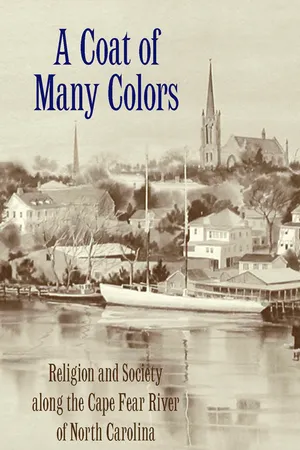
While religious diversity is often considered a recent phenomenon in America, the Cape Fear region of southeastern North Carolina has been a diverse community since the area was first settled. Early on, the region and the port city of Wilmington were more urban than the rest of the state and thus provided people with opportunities seldom found in other parts of North Carolina. This area drew residents from many ethnic backgrounds, and the men and women who settled there became an integral part of the region's culture. Set against the backdrop of national and southern religious experience, A Coat of Many Colors examines issues of religious diversity and regional identity in the Cape Fear area. Author Walter H. Conser Jr. draws on a broad range of sources, including congregational records, sermon texts, liturgy, newspaper accounts, family memoirs, and technological developments to explore the evolution of religious life in this area. Beginning with the story of prehistoric Native Americans and continuing through an examination of life at the end of twentieth century, Conser tracks the development of the various religions, denominations, and ethnic groups that call the Cape Fear region home. From early Native American traditions to the establishment of the first churches, cathedrals, synagogues, mosques, and temples, A Coat of Many Colors offers a comprehensive view of the religious and ethnic diversity that have characterized Cape Fear throughout its history. Through the lens of regional history, Conser explores how this area's rich religious and racial diversity can be seen as a microcosm for the South, and he examines the ways in which religion can affect such diverse aspects of life as architecture and race relations.
eBook - ePub
A Coat of Many Colors
Religion and Society along the Cape Fear River of North Carolina
- 384 pages
- English
- ePUB (mobile friendly)
- Available on iOS & Android
eBook - ePub
A Coat of Many Colors
Religion and Society along the Cape Fear River of North Carolina
About this book
Information
Publisher
The University Press of KentuckyYear
2006Print ISBN
9780813192819
9780813124056
eBook ISBN
9780813138305
1
The Cape Fear and Its Indians
Although sailors make their living with attention to wind and waves, there is nothing more pleasant for transatlantic mariners than the sight of land. Such happy thoughts filled the mind of Giovanni Verrazzano as he beheld the North American coast for the first time in March 1524. Verrazzano was an Italian sailing on behalf of the French monarch Francis I, and it had taken Verrazzano and his armed and well-provisioned crew roughly fifty days to sail across the Atlantic. Though the voyage began with fair winds, within a few weeks the crew encountered a violent storm that nearly sank the ship. Their vessel was a hundred-ton royal caravel, the Dauphine, and Verrazzano attributed their survival to its seaworthiness, in addition to divine assistance. Shortly after setting a new westward course in the wake of the storm, Verrazzano enthusiastically announced their landfall at “a new land which had never been seen before by any man, either ancient or modern.”1
Even if no European eyes had previously seen this land, the captain and crew soon realized that native peoples already populated it. Large bonfires on the shore, for example, were visible from onboard the Dauphine as it rode at anchor, and Verrazzano could see that they had been built by humans and not by the chimerical creatures that legend sometimes placed in new lands. Yet instead of going ashore, Verrazzano continued a little ways south only to turn back and anchor again in the area of his first sighting of land. This time he sent a small boat ashore to reconnoiter the land and its people. There his crewmen encountered more natives, who showed “great delight at seeing us and marveling at our clothes, appearance, and our whiteness; they showed us by various signs where we could most easily secure the boat, and offered us some of their food.” The land also impressed Verrazzano, who called it a place “with many beautiful fields and plains full of great forests, some sparse and some dense; and the trees have so many colors, and are so beautiful and delightful that they defy description.” Despite the amity of the Indians, this encounter with native America did not last long. Verrazzano soon called the landing party back to the ship. Like various other post-Columbian explorers, Verrazzano sought a passage to Asia and its riches. Because no such gateway was immediately apparent at this site, he needed to push on. Nevertheless, Verrazzano was sure of one thing—that his landfall had occurred at 34° north latitude—and he was glad of another—that he had not encountered any Spaniards.2
Over the next 150 years, other explorers would introduce North America, and specifically the Cape Fear region, to Europe. This chapter examines the complex and often conflicting perceptions of the Cape Fear that developed during this period. It also investigates the much longer presence of Native Americans in the Cape Fear region and the dynamic reality, including religious dimensions, that they represented. The Cape Fear was both exotic image and quotidian experience, a capacious land of opportunity and challenge that entices humans in the present and did so in the past.
Although some scholars scoff at Verrazzano’s reckoning, most credit the relative accuracy of his calculations and the placement of his sighting of land at roughly 34° north latitude, that is, at or near the modern Cape Fear region. Yet if Verrazzano gets credit for the first European glimpse of the Cape Fear (if not on his initial landfall, then certainly when he returned from his southern detour), his was not the only sixteenth-century European encounter with what later was named the Cape Fear coast. Indeed, because the French did little to follow up on the information of this portion of Verrazzano’s voyage, awareness of the Cape Fear emerged through Spanish and English explorations as well as French.
In the aftermath of Columbus’s voyages into the Americas, Spanish forces quickly developed their empire in the Caribbean basin. One such venture in 1521 left Hispaniola (later the Dominican Republic) and headed for the Florida coast. Eventually, this group sailed north along the coast to 33°30’ north by their own reckoning. They then proceeded a short distance up a river they named the Jordan. The captain anchored, and the crew explored the immediate vicinity, where they encountered native peoples. Disappointed in their search for gold or other mineral wealth, they decided to leave, but not before they had enticed some seventy Indians on board. Restraining the natives, they raised anchor and set sail for home with their ill-gotten victims.3
Lucas Vasquez de Ayllón, justice of the supreme court in Santo Domingo and a well-connected politician and colonial entrepreneur, had helped with the arrangements for this voyage. Ayllón followed up the 1521 voyage by sending out a small expedition in 1525. Led by Pedro de Quejo, a pilot in Ayllón’s employ, this group first sighted land near the present-day Savannah River and then sailed north. It is possible that they entered the Cape Fear River, but in any case, they soon left and sailed south again. By July 1525 Quejo was back in Santo Domingo with news and prizes for Ayllón.4
Shortly thereafter, in 1526, Ayllón set out himself to establish a Spanish colony in the area of the earlier voyages. His squadron included six ships and five hundred men, women, and children, as well as a number of Dominican friars. Upon reaching the location of the 1521 landing and sailing up the river, Ayllón’s flagship ran aground and lost its cargo. Transferring to the other ships, the expedition ultimately sailed south to another location, where they broke ground for their colony of San Miguel de Gualdape. While the allusion to St. Michael the archangel is well established, the meaning of Gualdape is not known. Misfortune continued to trouble the expedition, for cold weather set in, and because word had spread about the earlier kidnapping, the native people provided no food or assistance. Many Spaniards became ill. Ayllón himself sickened and passed away on October 18, 1526, and he received a Catholic burial. Soon the remaining 150 persons abandoned the colony and returned to Santo Domingo.5
Franco-Spanish rivalry in the Southeast at first deterred English interest in the Carolina coast, but by the seventeenth century, that was no longer the case. Some twentieth-century scholars continue to debate whether the Rio Jordan was the Cape Fear River or whether the colony of San Miguel de Gualdape was located on that river. To late-sixteenth- and early-seventeenth-century English explorers, however, there was no doubt that the Spanish presence, wherever on the southeastern coast it might be located, posed a dangerous and jealous threat. News of the Spanish massacre of the French colonists at Fort Caroline in 1565, for example, had spread quickly to the English. In the sixteenth century Franco-Spanish antagonism was real, and Anglo-Spanish competition, symbolized by the Spanish Catholic monarch Phillip II and the English Protestant queen Elizabeth I, encompassed politics, religion, and trade. Yet with the destruction of the Spanish Armada in 1588 and changes in domestic policy and social perceptions in England, opportunities for exploration of the Carolina coastline were encouraged and slowly became a reality.6
On October 12, 1663, an expedition sailing out of Barbados under the command of William Hilton anchored in the Cape Fear River. Other English outposts in North America, including the settlements at Roanoke, Jamestown, and Massachusetts Bay, had been established decades before. Indeed, a year earlier, in 1662, Hilton had led another party to the same area. This group, backed by the New England Company for the Discovery of Cape Fear, hoped to purchase land from the Indians, gain title in England, and establish a colony. In his report of the 1662 voyage, Hilton described the landscape, noting the variety of trees, the verdant meadows, and the multitude of birds, fish, and deer. He suggested that the land could yield two sets of crops a year and that several towns and many farms could be accommodated in the area. Almost immediately, Hilton’s description enticed a corps of New Englanders to settle on the Cape Fear. However, within months they were gone. Perhaps attacks by Indians, discouragement at the lack of economic and political support for the colony, or dissension within the group forced their departure. In any case, they abandoned the site, leaving their livestock and other supplies and renouncing the whole enterprise.7
Despite the failure of the New Englanders’ venture, Hilton was back in the Cape Fear region in 1663. Unlike the voyage of 1662, this expedition had the support of the Lords Proprietors, the eight friends of Charles II who were given, by royal decree, the tract of land that encompassed North Carolina. Adopting the same promotional stance that he had in his first report, Hilton again wrote glowingly of the natural resources and physical beauty of the Cape Fear region. “Good tracts of land, dry, well wooded, pleasant and delightful as we have seen anywhere in the world,” were matched by an “abundance of Deer and Turkies everywhere” and “a great store of Ducks.” Oak trees, “all bearing Akorns very good,” and especially pine trees, “tall and good for boards and masts,” could be found as well. Hilton and his men traded with the local native population and enjoyed beef and pork from the cattle and hogs left by the previous New England colonists. In the conclusion of his report, Hilton took issue with the disparaging remarks from the Puritans, countering that the region possessed “as good Land, and as well Timbered, as any we have seen in any other part of the world, sufficient to accommodate thousands of our English Nation.” Here in the Cape Fear was the answer to England’s current problems and the bounty for a promising future.8
Thus, from the mid-seventeenth century and into the eighteenth, the Cape Fear entered into European consciousness under the auspices of the English. However, this awareness was an ambivalent one, in no small part due to the legacy of earlier explorations. One aspect of this ambivalence reflected the shoals, bars, and shifting sands found beneath the coastal waters and in the entrance to the river itself. This was the ensemble of grim images that gave the river its lasting name and came to encompass the adjacent region as a whole. The term Promontorium Tremendum (cape fear) dates back to 1526 and the map of the world by Juan Vespucci, nephew of Amerigo. In Vespucci’s depiction of the Carolina coast, which is named the “new lands of Ayllón,” one scholar has identified the Río de Arrecifes (river of reefs) as the historic Cape Fear River. For sixteenth- and seventeenth-century mariners, the whole coast from present-day Cape Fear through Cape Hatteras and up to the Virginia line was treacherous, and the term Promontorium Tremendum was applied inconsistently by mapmakers to refer to a number of different capes on a number of different maps.9
In 1666 a map attributed to Robert Horne was the first to use the designation “Cape Fear” for its present location. In 1672 John Ogilby published a map entitled “A New Description of Carolina by Order of the Lords Proprietors” that received wide circulation. Due to its popularity, its reaffirmation of the location of the Cape Fear as the promontory located at 33°51’ north was important. In 1672 mapmaker Ogilby called the river that ran into the sea at this point the Clarendon. However, within a decade, a map printed by Joel Gascoyne fixed the name “Cape Fear” for the promontory and its river as well. By the late seventeenth century, a stable nomenclature seemed to have been established for this river and its adjacent lands.10
Ambivalence, however, always contains opposing energies. Another representation of the river and its region countered that of the hazardous Promontorium Tremendum. This was the depiction of the New World as Arcadia, an idyllic garden replete with fresh water, fertile soil, and abundant game. In his 1524 voyage Verrazzano drew on this image in the works of Virgil and sixteenth-century Italian writer Jacopo Sannazzaro when he named a portion of the southern coast Arcadia because of the grandeur of the forests.11
While Verrazzano was particularly impressed with the beauty of the trees, Hilton did him one better. Hilton’s reports of 1662 and 1663 were designed to promote colonization of the Cape Fear region, so in his rendering, the psychological barriers and physical threats posed by the shoals and reefs were diminished, if not completely erased. Pastoral images and lists of exotic and familiar flora and fauna replaced hydrographic notations for navigating the coastal hazards. Hilton reported on oyster beds, Indian corn, and mulberry trees. Indeed, he identified more than a dozen different types of trees, including oak, cedar, walnut, and pine, and delightedly described “exceeding good land” that could be plowed without striking stones and rocks. He also surmised that tobacco would grow well here and even anticipated the successful cultivation of oranges, lemons, and pineapples.12
If mention of soil without rocks, board feet of timber, and crops of citrus fruits and pineapples was designed to appeal to potential colonists in New England or the Caribbean, such images were also part of a larger stylized representation of the New World. Pictorial images could match belletristic allegories from literature to form this broad narrative. Nominally a discourse of factual reporting, these representations functioned more powerfully as richly symbolic tropes that depicted a land of easy opportunity and plentiful resources. Maps are of particular interest here, for contemporary cartography not only details the physical exploration of space; it also illuminates the imaginative conceptualization of that space.
The map of the Southeast by Gerard Mercator and Jodocius Hondius in 1606 makes a clear division between the terrors of the ocean and the opportunities available on land. Mighty ships, fully rigged with billowing sails, share conceptual space with prodigious sea monsters. However, the pristine landscape is dotted with turkeys, stags, and woodlands. Native peoples, partially clad, appear at the margins and stand in as markers for primitive life. This allegorical New World lies waiting to be explored and domesticated, with untapped resources and native adversaries already displaced. The Ogilby map of 1672 continues the tradition of fantastic monsters from the deep pitted against the trim sailing vessels, in this case from England. Representations of natives show them wholly or partially naked, festooned with elaborate headdresses, and armed, albeit with primitive spears. Yet this new world of Carolina is already the arena for civilization, as tracts of land have been laid out and named, all under the jurisdiction of the Lords Proprietors. Here, pastoral Arcadia only needs the sturdy hand of the English yeoman farmer to make real this bucolic dream.13
Three other maps demonstrate how individuals sought to overcome the associations of Promontorium Tremendum and, instead, make the Carolina coast attractive. For example, the map and accompanying report attributed to Robert Horne in 1666 detailed the Cape Fear region. Sea monsters are gone, though the sailing ships remain. Particularly striking are the depictions of deer, beavers, and silkworms juxtaposed with the names of land claimants up and down the Charles (Cape Fear) River. The plotting of claims and the possession of land are further secured in another map that illustrates a solidly built fort, complete with crenellated battlements and a swallowtail flag with St. George’s cross on a white field. This anonymous map, dating to the 1660s, reflects information from William Hilton’s 1662 voyage to the Cape Fear. Land claims up the river are attributed to various individuals, many of whom were associated with Hilton’s 1662 voyage.14
Although no churches appear on these maps, by the mid-seventeenth century, religion had once again received official endorsement. The results, however, were no better than before. When the Spanish Catholic Ayllón brought friars on his expedition of 1526, he probably anticipated using their services for purposes other than his own burial. Colonization of the land and Christianization of the indigenous population were already familiar themes in Spanish missionary and exploration literature. Not to be outdone, the English Protestant Lords Proprietors promised land to individuals willing to settle in Carolina. They also stipulated a hundred acres of land to the Anglican Church for each parish that it developed. Little came of these proposals, but they were a portent of future developments and an affirmation of the importance of religion in this phase of exploration and colonization.15
The epitome of the Arcadian vision of the Carolina coast came with the map of James Wimble published in 1738. Wimble was an early land developer and promoter of European immigration and settlement of the area. His map not only included soundings along the coast but also explicitly indicated the safe passage over the bar and up the river. Beyond that, it renamed the cape and its river “the Cape Fair.” William Hilton’s 1663 promoti...
Table of contents
- Cover
- Half title
- Title
- Copyright
- Dedication
- Contents
- List of Illustrations
- Acknowledgments
- Introduction
- 1. The Cape Fear and Its Indians
- 2. Tensions in the Colonial Era
- 3. Religious Liberty and Denominational Expansion
- 4. Bonds of Association
- 5. Mystic Chords of Memory
- 6. Religion and the New South
- 7. Pluralism in the Port City and Beyond
- Conclusion
- Notes
- Selected Bibliography
- Index
Trusted by 375,005 students
Access to over 1.5 million titles for a fair monthly price.
Study more efficiently using our study tools.
Frequently asked questions
Yes, you can cancel anytime from the Subscription tab in your account settings on the Perlego website. Your subscription will stay active until the end of your current billing period. Learn how to cancel your subscription
No, books cannot be downloaded as external files, such as PDFs, for use outside of Perlego. However, you can download books within the Perlego app for offline reading on mobile or tablet. Learn how to download books offline
Perlego offers two plans: Essential and Complete
- Essential is ideal for learners and professionals who enjoy exploring a wide range of subjects. Access the Essential Library with 800,000+ trusted titles and best-sellers across business, personal growth, and the humanities. Includes unlimited reading time and Standard Read Aloud voice.
- Complete: Perfect for advanced learners and researchers needing full, unrestricted access. Unlock 1.5M+ books across hundreds of subjects, including academic and specialized titles. The Complete Plan also includes advanced features like Premium Read Aloud and Research Assistant.
We are an online textbook subscription service, where you can get access to an entire online library for less than the price of a single book per month. With over 1.5 million books across 990+ topics, we’ve got you covered! Learn about our mission
Look out for the read-aloud symbol on your next book to see if you can listen to it. The read-aloud tool reads text aloud for you, highlighting the text as it is being read. You can pause it, speed it up and slow it down. Learn more about Read Aloud
Yes! You can use the Perlego app on both iOS and Android devices to read anytime, anywhere — even offline. Perfect for commutes or when you’re on the go.
Please note we cannot support devices running on iOS 13 and Android 7 or earlier. Learn more about using the app
Please note we cannot support devices running on iOS 13 and Android 7 or earlier. Learn more about using the app
Yes, you can access A Coat of Many Colors by Walter H. ConserJr.,Walter H. Conser Jr. in PDF and/or ePUB format, as well as other popular books in History & North American History. We have over 1.5 million books available in our catalogue for you to explore.