In the postwar era, the lure of controversy sold movie tickets as much as the promise of entertainment did. In Freedom to Offend, Raymond J. Haberski Jr. investigates the movie culture that emerged as official censorship declined and details how the struggle to free the screen has influenced our contemporary understanding of art and taste. These conflicts over film content were fought largely in the theaters and courts of New York City in the decades following World War II. Many of the regulators and religious leaders who sought to ensure that no questionable content invaded the public consciousness were headquartered in New York, as were the critics, exhibitors, and activists who sought to expand the options available to moviegoers. Despite Hollywood's dominance of film production, New York proved to be not only the arena for struggles over film content but also the market where the financial fates of movies were sealed. Advocates for a wider range of cinematic expression eventually prevailed against the forces of censorship, but Freedom to Offend is no simple homily on the triumph of freedom from repression. In his analysis of controversies surrounding films from The Bicycle Thief to Deep Throat, Haberski offers a cautionary tale about the responsible use of the twin privileges of free choice and free expression. In the libertine 1970s, arguments in favor of the public's right to see challenging and artistic films were twisted to provide intellectual cover for movies created solely to lure viewers with outrageous or titillating material. Social critics who stood against this emerging trend were lumped in with the earlier crusaders for censorship, though their criticism was usually rational rather than moralistic in nature. Freedom to Offend calls attention to what was lost as well as what was gained when movie culture freed itself from the restrictions of the early postwar years. Haberski exposes the unquestioning defense of the doctrine of free expression as a form of absolutism that mirrors the censorial impulse found among the postwar era's restrictive moral guardians. Beginning in New York and spreading across America throughout the twentieth century, the battles between these opposing worldviews set the stage for debates on the social effects of the work of artists and filmmakers.
eBook - ePub
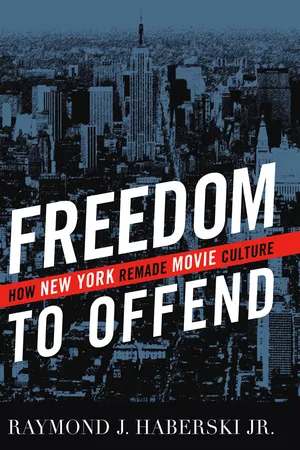
Freedom to Offend
How New York Remade Movie Culture
- 280 pages
- English
- ePUB (mobile friendly)
- Available on iOS & Android
eBook - ePub
About this book
Information
Topic
HistoriaSubtopic
Historia de Norteamérica1
The Web of Control
WHEN THE BICYCLE THIEF premiered in 1949 at Manhattan’s World Theater, it revealed what was wrong and what was right with American movie culture. The story line of the film had little in common with the typical feel-good picture produced in America. Vitorrio de Sica, the film’s director, depicted the pathos of postwar Italian life through the story of a young father’s search for his stolen bicycle. Film historian Gregory Black suggests: “Had Hollywood gotten its hands on the script Antonio [the father] would likely have recovered his bicycle, and the last scene would have shown him riding off to work with his proud wife and son waving from the doorway.” Instead, the film ends with the father broken and crying, walking down a crowded Italian street in shame, holding his little boy’s hand. And yet the picture grossed more at the World in the first five weeks of its run than any foreign film had previously. It was popular because it was so different than the typical Hollywood film, but it was given a chance to be popular because it opened in New York.1
The weekend before the film’s premier, the New York Times Magazine helped create a buzz by running a two-page photo spread profiling the two stars, Enzo Staiola, who played Bruno, the little boy, and Lamberto Maggiorani, his screen father. The Times made special mention that neither had any previous acting experience, which contributed to their performances’ being “remarkable and moving.” Likewise, Commonweal, a Catholic weekly written by laypeople, ran a review the week after the movie’s New York premier, claiming that the plot was as “realistically simple (and complicated) as life.” Reviewers in a number of American publications lauded the perceptive camera work that laid bare the desperation of postwar Italy. Commonweal had particular praise for the “realistic portrayal of emotions.” The reviewer concluded: “ ‘The Bicycle Thief’ is a well-rounded slice of life and as a movie it is a gem of understanding.” John Mason Brown, writing in the popular Saturday Review, expressed his respect for the director’s delicate balance of sorrow and humor. Foreign films, Brown noted, had been doing this with great skill since the end of the war. It seemed to him that because the film’s realism appeared so “unposed and uncontrived,” the understated tone of the picture achieved its “power by making everything exceptional in it appear to be average.” Such vision eluded American filmmakers. “Hollywood, even in its most courageous moments,” Brown argued, approached “our very real, though dissimilar, problems in terms of make-believe. Instead of showing things as they are, it puts on a show.” As America’s “Dream Factory,” the movie industry had made itself wealthy by eschewing reality, yet it was still realistic enough to respond to changes in audience tastes.2
The success of The Bicycle Thief in New York City attracted the attention of Warner Bros., one of Hollywood’s movie conglomerates, which hoped to book the film for its theaters in other cities. That was exactly what Joseph Burstyn, the film’s New York–based distributor, hoped would happen. The film had opened at a small art theater, the type that catered to a particular segment of the mass audience for movies. Burstyn had made a name for himself by importing a string of foreign films—many in the emerging genre of Italian neorealism—that had enjoyed modest commercial but exceptional critical success in the relatively small exhibition market. Like other Italian films, such as Paisan and Open City, The Bicycle Thief fell into a pattern of distribution that Burstyn had honed to a commercial art—a small but devoted New York City audience loved it, and critics writing for the city’s newspapers and journals lauded it. Burstyn had imported a winner, and if he could score big in the nation’s single largest movie market—New York City—he had a shot at a wide national distribution.
Responding to Warner Bros.’ request, Burstyn mailed a print to Hollywood’s in-house review board, the Production Code Administration. On 31 January 1950, the head of the PCA, Joseph Breen, wrote to Burstyn after screening the film. Speaking for the PCA, Breen asked for revisions to the final cut, demanding the excision of two scenes: one that showed the young boy relieving himself against a wall and another of a very brief and quite innocent look inside a brothel. Why require such cuts? As Leonard Leff and Jerold Simmons explain in their history of the PCA, Breen “simply believed . . . that if he ever allowed even the most innocent of toilet gags, unscrupulous producers would flood the screen with them.” Differentiating between crass commercialism and art was not something Breen, or almost any other authority in movie culture, considered part of his job.3
On his end, Burstyn followed his instincts and Vittorio de Sica’s orders and refused to make cuts to the finished film. Appreciating what a little controversy might mean to the success of the movie, Burstyn attempted to get as much mileage out of Breen’s decision as he could. Throughout 1950, while a contest of wills thrust the small Italian film into the spotlight, Burstyn ran ads in New York City papers highlighting the PCA’s attempts to “cut” the film. In one layout advertising the film in theaters all over the five boroughs of New York City, Westchester, Long Island, and northern New Jersey, an oversized cartoon depicted Bruno in his controversial pose: with his back to readers, he declares, “I’m the kid they tried to cut out of Bicycle Thief . . . But couldn’t!” Under the film’s title were the series of awards it had won, including Best Foreign Film of the Year from the New York Film Critics Circle and the National Board of Review’s top prize as the Best Film of the Year. Elsewhere, ads for the World Theater presented Bruno in one of his tragic scenes, seeming to look up at a statement that read “Please don’t let them cut me out of . . . Bicycle Thief” (with the title in full movie announcement type). This was, the World announced, “the prize picture they want to censor!” But people who came to the World would see the “Uncensored Version!” of the movie playing for its “6th Month!” For anyone living in New York City or anywhere close to it, it would have been hard to avoid awareness of de Sica’s relatively small film.4
Compounding the controversy caused by The Bicycle Thief was the fact that both state and city censors had allowed its exhibition. The New York State Board of Censorship licensed the film on 8 December 1949 after the elimination of two lines of dialogue—both referring to the brothel scene. Without such a license, Burstyn would have been in violation of state law if he had attempted to screen the film. Furthermore, the review board of the Catholic Church, the Legion of Decency, based in New York, gave the film a B rating, meaning that it was “objectionable in part” but not bad enough to condemn outright. The Knights of Columbus did, though, picket a few New York City theaters that showed it because the group believed it glorified crime. But, again, Burstyn and the owner of the World were fortunate in that the most effective unofficial censorship body had “passed” the film.5
Even politicians typically hostile to the movies came out in favor of it. Colorado senator Edwin C. Johnson had caused a stir in Hollywood when he introduced a bill in March of 1950 proposing to require a federal licensing process for most people involved in making movies. Johnson argued for a “practical method whereby the mad dogs of the industry may be put on a leash to protect public morals.” Breen might have agreed with the rationale, even if he couldn’t agree to the bill without supporting the elimination of his job. But Johnson’s opinion of The Bicycle Thief was that it was “the most fascinating and engrossing picture I had ever seen.” To Breen’s chagrin, he stood alone as seemingly the only authority figure to reject the picture.6
Burstyn challenged Breen’s ruling by appealing to the Motion Picture Association of America (MPAA)—the parent organization that governed Hollywood from New York, the industry’s financial capital. It was a bold attempt to circumvent the PCA and Hollywood tradition, for if it had proved successful it could have spelled the end of Breen’s reign. Forces on both sides built their cases: Burstyn had defenders such as Bosley Crowther at the New York Times and Elmer Rice, a playwright who wrote to MPAA president Eric Johnston on behalf of the American Civil Liberties Union. Breen appealed directly to the men who had hired him in the first place, the officials of the MPAA. With the bottom line firmly in view, the association sided with their man and declined to make a somber Italian film a test case for new movie morals. The last thing the MPAA wanted was a controversy sparked by a small-time distributor over a film that wasn’t even American, even if audiences in the city around them clearly loved the picture. The MPAA and Hollywood could still resist the cultural influence of New York.
Burstyn and de Sica had run up against a sensibility that had shaped American movie culture almost since the inception of filmmaking. Breen’s response to The Bicycle Thief was not only consistent with that sensibility, it was part of a system of obstructions—a web of control—designed to preserve the nation’s movie culture as clean, traditional, and mostly American entertainment. De Sica’s film grated against such principles by being realistic, modern, and foreign—and, because it was also popular, action by traditional authorities became even more necessary.
Thus, while Breen could take solace in the fact that his adversary had been a relatively minor figure in a city on the other coast, what disturbed him was that the type of movie promoted by Burstyn had hit a chord with audiences and bigger, more traditional distributors. Hollywood’s chief censor sensed a dangerous development brewing in his motion picture world. An associate of Breen reinforced those suspicions: “The Bicycle Thief is a trial balloon rather than a case in its own right,” Fred Niblo believed. “Evidently it has the backing or blessing of some people in the studios who have lent themselves, consciously or stupidly, to the role of boring from within. It may well be that this is only the first round of a bigger fight.”7
The controversy surrounding The Bicycle Thief had begun not within Hollywood but in New York City. Breen and the PCA continued to maintain a check on the assumptions that governed the mainstream film industry. What he and others did not have control over were the forces beginning to emerge in America’s alternative movie capital, New York. Breen’s fight with Burstyn had revealed that Hollywood was changing, but not from within.
Through most of the postwar period, the vast majority of movies released in America had to contend with the rules and regulations of municipal and state censorship boards, the whims of the Production Code Administration, and the dictates of the Catholic Church, not to mention evaluations from critics and the fickle purchasing power of the moviegoing audience. The success of such a system relied on the uncontested authority of formal and informal censorship organizations. This is not to say that as a result of censorship American movies were simply poor substitutes of what they could have been. In fact, film historians widely regard the years when the stiffest control was exerted over movies as the golden age of the American film industry. The productivity and style of Hollywood filmmaking grew to maturity under the influence of studio bosses and the PCA. In a sense, it was because movies emerged out of struggle with competing forces that the system had, as historian Thomas Schatz contends, “a special genius.”8
The position of traditional authorities in the immediate postwar era, despite the “trial balloon” theory applied to The Bicycle Thief, seemed incontestable. The revenue of the big studios had hit an all-time high in 1946 of $1.69 billion in admissions, which accounted for a little less than 82 percent of the total money spent by Americans on amusements—the sixteenth year in a row that Hollywood had accounted for over 80 percent of that budget. The system clearly worked, both financially and culturally, because it was built as much on the assumptions of widespread acceptance by almost every sector of movie culture, from the producers to the audience, as on codes and laws.9
Since the 1920s, America’s motion picture industry had been dominated by five large, mature oligopolies—Warner Bros., Loews Inc. (which owned MGM), Paramount, RKO, and Twentieth Century–Fox. The Big Five, as they were known, produced, distributed, and exhibited most of the big-budget, money-making pictures produced in the United States. Aligned with these companies were the Little Three: Universal, Columbia, and United Artists; with smaller production and distribution capacities, they furnished the larger companies with less expensive pictures and distribution deals. While the total output of these eight companies accounted for an estimated 60 percent of the yearly market, their dominance rested on the control over almost all A-list Hollywood movies made and almost all first-run theaters in which they were seen. Movies made money in their first run, when ticket prices and sales were high. Subsequent runs meant lower prices and fewer tickets sold. First-run theaters in big cities accounted for 70 percent of the ticket revenue in the nation; controlling the production, distribution, and exhibition of pictures that played in those theaters translated into enormous profits.
The Big Five and the Little Three also controlled talent—the army of people from actors to directors to technicians who made the movies. Studio contracts obligated the talent to remain faithful to a studio. The chief way around such an arrangement was to have a studio loan its talent to another, usually on a mutually beneficial basis. Independent producers and distributors were effectively frozen out of this market—they could not tap into the top tier of moviemaking and distribution. Historian Tino Balio explains that “in order to secure financing from banking institutions, independents had to guarantee national distribution and access to better-class theaters. Only then could their pictures stand a chance of making a profit.” Without bank loans, movies did not get made. Therefore, the United States had a very small market for independent films. With eight companies controlling how movies were made, who would be in those movies, when those movies would enter the market, and how long they would stay, Hollywood’s power was pretty much uncontested. Moreover, the PCA seal was directly linked to Hollywood’s control—no seal, no distribution.10
From 1921 to 1966, Hollywood operated under the guidance of an in-house review board, or censors, initially called the Hays office but later known officially as the Production Code Administration. Before the major revisions to the code were enacted in the late 1960s, studios submitted scripts and films to PCA officials for approval. Why did Hollywood adopt such a policy? Industry titans hoped this practice would protect their product from excessive scrutiny outside their control. For the movie moguls, the bottom line was always easy to see: avoid bad publicity because that translated into poor ticket sales.
Such logic allowed two very different views of censorship to coexist: censorship was either essential to the preservation of the film industry because it protected both the industry and ostensibly the public, or it was ultimately disastrous for both filmmakers and moviegoers because it constrained the creative development of a popular art. Either way, though, advocates on both sides had to admit that movies were made to affect those who watched them. The question that demanded to be answered was how such influence should be treated—in other words, were movies like a social disease that the public needed protection from or were they sources for ideas to which the public should have access?
For most of its history, the Production Code of the Motion Picture Producers and Directors of America, Inc. held to three general principles:
1. No picture shall be produced which will lower the moral standards of those who see it. Hence, sympathy of the audience shall never be thrown to the side of crime, wrong-doing, evil or sin.
2. Correct standards of life, subject only to the requirements of drama and entertainment, shall be presented.
3. Law, natural or human, shall not be ridiculed, nor shall sympathy be created for its violation.
The Production Code included twelve separate sections covering topics from “Crimes against the Law” and “Sex” to “Religion” and “Repellent Subjects.” Generally, the PCA ensured that depictions of sex, crime, drugs, and religion were handled in ways that would be inoffensive to audiences operating at a maturity level slightly higher than children. And yet, even though such codes were clearly overprotective, they reflected an understanding that was difficult to dismiss: “The motion pictures, which are the most popular of modern arts for the masses, have their moral quality from the intention of the minds which produce them and from their effects on the moral lives and reactions of their audiences. This,” the fathers of the code declared, “gives them a most important morality.” Fair enough. Most moviegoers agreed that movies had power and that such power needed to be checked in some way. ...
Table of contents
- Cover
- Half title
- Title
- Copyright
- Dedication
- Contents
- Acknowledgments
- Introduction: Cinema Naïveté
- 1. The Web of Control
- 2. The Miracle and Bosley Crowther
- 3. Baby Doll and Commonweal Criticism
- 4. Amos Vogel and Confrontational Cinema
- 5. The “Flaming” Freedom of Jonas Mekas
- 6. The End of New York Movie Culture
- 7. Did Bonnie and Clyde Kill Bosley Crowther?
- 8. The Failure of Porno Chic
- Conclusion: The Irrelevance of Controversial Culture
- Notes
- Bibliography
- Index
Trusted by 375,005 students
Access to over 1.5 million titles for a fair monthly price.
Study more efficiently using our study tools.
Frequently asked questions
Yes, you can cancel anytime from the Subscription tab in your account settings on the Perlego website. Your subscription will stay active until the end of your current billing period. Learn how to cancel your subscription
No, books cannot be downloaded as external files, such as PDFs, for use outside of Perlego. However, you can download books within the Perlego app for offline reading on mobile or tablet. Learn how to download books offline
Perlego offers two plans: Essential and Complete
- Essential is ideal for learners and professionals who enjoy exploring a wide range of subjects. Access the Essential Library with 800,000+ trusted titles and best-sellers across business, personal growth, and the humanities. Includes unlimited reading time and Standard Read Aloud voice.
- Complete: Perfect for advanced learners and researchers needing full, unrestricted access. Unlock 1.5M+ books across hundreds of subjects, including academic and specialized titles. The Complete Plan also includes advanced features like Premium Read Aloud and Research Assistant.
We are an online textbook subscription service, where you can get access to an entire online library for less than the price of a single book per month. With over 1.5 million books across 990+ topics, we’ve got you covered! Learn about our mission
Look out for the read-aloud symbol on your next book to see if you can listen to it. The read-aloud tool reads text aloud for you, highlighting the text as it is being read. You can pause it, speed it up and slow it down. Learn more about Read Aloud
Yes! You can use the Perlego app on both iOS and Android devices to read anytime, anywhere — even offline. Perfect for commutes or when you’re on the go.
Please note we cannot support devices running on iOS 13 and Android 7 or earlier. Learn more about using the app
Please note we cannot support devices running on iOS 13 and Android 7 or earlier. Learn more about using the app
Yes, you can access Freedom to Offend by Raymond J. HaberskiJr.,Raymond J. Haberski Jr. in PDF and/or ePUB format, as well as other popular books in Historia & Historia de Norteamérica. We have over 1.5 million books available in our catalogue for you to explore.