In his seminal article "Freedom Then, Freedom Now," renowned civil rights historian Steven F. Lawson described his vision for the future study of the civil rights movement. Lawson called for a deeper examination of the social, economic, and political factors that influenced the movement's development and growth. He urged his fellow scholars to connect the "local with the national, the political with the social," and to investigate the ideological origins of the civil rights movement, its internal dynamics, the role of women, and the significance of gender and sexuality.
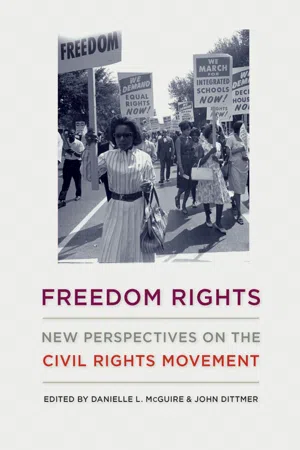
In Freedom Rights: New Perspectives on the Civil Rights Movement, editors Danielle L. McGuire and John Dittmer follow Lawson's example, bringing together the best new scholarship on the modern civil rights movement. The work expands our understanding of the movement by engaging issues of local and national politics, gender and race relations, family, community, and sexuality. The volume addresses cultural, legal, and social developments and also investigates the roots of the movement. Each essay highlights important moments in the history of the struggle, from the impact of the Young Women's Christian Association on integration to the use of the arts as a form of activism. Freedom Rights not only answers Lawson's call for a more dynamic, interactive history of the civil rights movement, but it also helps redefine the field.
eBook - ePub
Freedom Rights
New Perspectives on the Civil Rights Movement
- 402 pages
- English
- ePUB (mobile friendly)
- Available on iOS & Android
eBook - ePub
Freedom Rights
New Perspectives on the Civil Rights Movement
About this book
Information
The Young Women’s Christian Association’s Multiracial Activism in the Immediate Postwar Era
Attempting to explain how race relations were going to differ in the postwar era, the newsletter of the National Board of the 3 million–member Young Women’s Christian Association (the Y) quoted an African American soldier who was overseas at the time: “A different American is coming home.”1 Thousands of voting delegates who had just returned from the Y’s 1946 national convention (held triennially) were already aware of this “different American.” Leadership emphasized that bettering race relations was a top priority, and although most of the Y’s local branches had always been racially segregated, the attendees responded by unanimously voting to desegregate the entire organization.2 To keep up the momentum, members received a newsletter reviewing discussions that had taken place at the convention and outlining new organizational policies and plans. The newsletter made it clear that a heightened racial consciousness was central to the association’s conception of this “different American” and that the wartime experiences of racial minorities contributed to the Y’s newly democratized sensibility.
The Y’s construction of a “different American” was based on three events: wartime changes in the labor market for racial minorities; the service of “colored Americans” in the armed forces, “where they have witnessed both the possibilities and the inconsistencies of the democracy they were fighting to defend”; and the relocation and resettlement of Japanese Americans. Recognizing that race relations had altered considerably during the war to meet “the demands of this crucial hour,” the Y strove to create a more racially inclusive membership to help build a more tolerant American society.3
The “different American” was coming home to a racially changed landscape. Wartime domestic migration had upset existing racial “balances.”4 Most of the 2.5 million African Americans who left the South during the war years sought opportunities for employment or more racially hospitable areas such as Chicago, Detroit, and Los Angeles.5 Also significant was the forced resettlement of more than 100,000 Japanese from the West Coast either to internment camps or to “approved” relocation cities such as Chicago, Minneapolis, and Detroit. Although these demographic shifts tested the Y’s policies, practices, and attitudes, the association’s work on Japanese American resettlement served as the cornerstone of its efforts to better race relations internally and externally in the postwar era.6 In many cases, Japanese Americans served as a buffer between blacks and whites as their resettlement throughout the country prompted dialogues on race in local Y branches. As local chapters opened their doors to Japanese members rather than establishing separate branches, as had been the prewar norm, it seemed logical to begin dismantling other similarly segregated branches. The Y planned to be a proactive surveyor in this racially changed national terrain.
Even before the war ended, the association believed that a harmonious postwar Christian social order was possible.7 As the country’s largest multiracial and interfaith women’s organization, the Y represented women of all races, classes, religions, and regions.8 It was clear to the organization that in order to sit at the table of power in this new postwar society, it needed to expand women’s roles and leadership, regardless of race. A different American was indeed coming home. A different organization was coming home too.
The Effects of Wartime Migration
The multiracial community the Y planned to create was rooted in its wartime work with the Japanese American and African American communities. Although branches were racially segregated, the Y had become more progressive about race relations in the late 1930s. To a greater or lesser degree, all branches segregated blacks and whites. Some had limited social or organizational integration; others had virtually none. Asian Americans, though segregated, were more likely to share facilities with white members when their numbers were small. During war mobilization the Y kept a close eye on opportunities for women, encouraging many industries to look past racially and sexually discriminatory labor practices.9 Once the war began, the Y’s focus, both locally and nationally, quickly moved to aiding its German, Italian, and rather large Japanese American membership.10 With the issuance of Executive Order 9066, which ordered the evacuation and imprisonment of enemy aliens, the Japanese in local branches looked to the national Y for guidance. The Los Angeles and San Francisco Ys, for example, wrote to the National Board, expressing their concerns about the mistreatment of Japanese Americans.11 It established a policy of full support for the Japanese American community during internment, promising, “Wherever you go the YWCA will be there.”12 As a result, the Y established chapters in each of the relocation centers and encouraged staff from local branches near the centers to visit often. National Board staff also visited on a regular basis.13
In addition to its work on behalf of the Japanese community, the Y commissioned an interracial practices study to examine its own internal practices, aimed at black-white relations.14 Throughout the war, local branches received surveys and questionnaires asking about the racial makeup of their members, the attitude of the local communities, and what interracial committees had been formed or work undertaken. The Y was not the only organization to do such a study, but it was one of the first. In his important treatise on race relations in America, Brothers under the Skin, Carey McWilliams examines how the war spurred many community organizations to undertake “self-surveys, ‘social audits,’ and investigations.” Because a “community’s pattern of race relations illuminates nearly every phase of its civic life,” he argues, a “‘social audit’ on race relations, if properly conducted, cannot fail to point up general problems of housing, health, education, employment, and similar issues.”15 Because the Y’s study started prior to the war and continued throughout it, the association could not only gauge its internal practices but also acquire a better grasp of the evolving racial situation brought about by the war and respond more effectively.
Nationally, race relations were irrevocably altered by the massive migrations during this period, triggering sweeping changes throughout the country. More than 12 million people joined the armed forces, going to new locations for training before being shipped overseas. Another 15 million migrated in search of better economic and social conditions.16 These migrations changed the “racial balance” in certain regions and cities, leading to race riots in some places, especially in 1943, but also to interracial community organizing.17 Cities such as Detroit, Los Angeles, Chicago, and Portland, Oregon, grew rapidly, causing shortages in housing, education, and other social services. The Y joined with five other organizations to form the American War-Community Services (AWCS) to help communities ease these strains.18
Although many migrations were voluntary, the U.S. government forcibly resettled Japanese Americans away from the West Coast. The evacuation and internment of Japanese Americans devastated communities and sent ripples throughout the nation. Removing the Japanese from the West Coast also keenly affected the Y branches in the area. One member stated, “We are facing the fact that we soon will lose a number of our most active and valuable club members…. They are girls, who like ourselves, are workers in offices, stores, and banks, civil service, teaching, nursing, household employment, and the service occupations…. They are girls who have worked with us in clubs, council, and conferences; on committees and Boards of Directors. They have helped to build our western coast both economically and culturally.”19
These forced migrations sent Y branches into a tailspin as programming, outreach, and policies had to keep up with the fast-changing populations. Many chapters wrote of these concerns to the National Board. Even with the drastic changes taking place nationally, the Y’s membership increased throughout the war, especially among Japanese women, who remained the third largest group within the association. Faced with an increasingly vocal and visible multiracial membership, the association began to devise a more nationally inclusive view of race, which would become its cornerstone in future race relations work.
The Y was a leader in helping Japanese American women relocate prior to and during internment. The National Board considered this an opportunity to strengthen its overall race relations work, which included the building of “constructive community attitudes regarding the Japanese and other minorities,” emphasizing Japanese community leadership, and maintaining a connection between those still in the camps and those who had been resettled. The Y hoped that the “lessons learned in this project” could be used “as tools to help in problems relating to other minorities.”20
National staff visited branches that were experiencing varying degrees of anti-Japanese tension and reported common issues facing the Japanese: “housing and employment problems … no show of welcome from whites, possible labor trouble(s) … , family relationship problems, great homesickness and feelings of insecurity and discouragement.”21 Staffers also worked with the Japanese community to help ease the transition. The association became a trusted resource for the Japanese community. Esther Briesemeister, a lead staffer in the Japanese Project, noted:
The Y.W.C.A. serves as a thread in the individual’s life. A person may have had contact with the Y.W.C.A. before evacuation. She identifies with the organization in the relocation center and then looks to the Association in the local community as s...
Table of contents
- Cover
- Title Page
- Copyright
- Contents
- Dedications
- Introduction
- Long Origins of the Short Civil Rights Movement, 1954–1968
- Hollywood, the NAACP, and the Cultural Politics of the Early Civil Rights Movement
- The Young Women’s Christian Association’s Multiracial Activism in the Immediate Postwar Era
- James and Esther Cooper Jackson, Communism, and the 1950s Black Freedom Movement
- Till They Come Back Home: Transregional Families and the Politicization of the Till Generation
- The Johns Committee, Sex, and Civil Rights in Florida, 1963–1965
- Joan Little and the Triumph of Testimony
- Gender, Jazz, and Justice in Cold War Freedom Movements
- EEOC Politics and Limits on Reagan’s Civil Rights Legacy
- Race and Partisanship in Criminal Disfranchisement Laws
- “The Community Don’t Know What’s Good for Them”: Local Politics in the Alabama Black Belt during the Post–Civil Rights Era
- “I Want My Country Back, I Want My Dream Back”: Barack Obama and the Appeal of Postracial Fictions
- List of Contributors
- Index
Trusted by 375,005 students
Access to over 1.5 million titles for a fair monthly price.
Study more efficiently using our study tools.
Frequently asked questions
Yes, you can cancel anytime from the Subscription tab in your account settings on the Perlego website. Your subscription will stay active until the end of your current billing period. Learn how to cancel your subscription
No, books cannot be downloaded as external files, such as PDFs, for use outside of Perlego. However, you can download books within the Perlego app for offline reading on mobile or tablet. Learn how to download books offline
Perlego offers two plans: Essential and Complete
- Essential is ideal for learners and professionals who enjoy exploring a wide range of subjects. Access the Essential Library with 800,000+ trusted titles and best-sellers across business, personal growth, and the humanities. Includes unlimited reading time and Standard Read Aloud voice.
- Complete: Perfect for advanced learners and researchers needing full, unrestricted access. Unlock 1.5M+ books across hundreds of subjects, including academic and specialized titles. The Complete Plan also includes advanced features like Premium Read Aloud and Research Assistant.
We are an online textbook subscription service, where you can get access to an entire online library for less than the price of a single book per month. With over 1.5 million books across 990+ topics, we’ve got you covered! Learn about our mission
Look out for the read-aloud symbol on your next book to see if you can listen to it. The read-aloud tool reads text aloud for you, highlighting the text as it is being read. You can pause it, speed it up and slow it down. Learn more about Read Aloud
Yes! You can use the Perlego app on both iOS and Android devices to read anytime, anywhere — even offline. Perfect for commutes or when you’re on the go.
Please note we cannot support devices running on iOS 13 and Android 7 or earlier. Learn more about using the app
Please note we cannot support devices running on iOS 13 and Android 7 or earlier. Learn more about using the app
Yes, you can access Freedom Rights by Danielle L. McGuire, John Dittmer, Danielle L. McGuire,John Dittmer in PDF and/or ePUB format, as well as other popular books in History & African American History. We have over 1.5 million books available in our catalogue for you to explore.