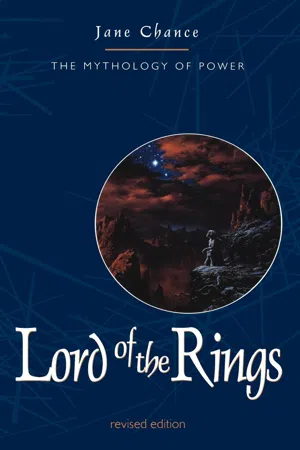
" With New Line Cinema's production of The Lord of the Rings film trilogy, the popularity of the works of J.R.R. Tolkien is unparalleled. Tolkien's books continue to be bestsellers decades after their original publication. An epic in league with those of Spenser and Malory, The Lord of the Rings trilogy, begun during Hitler's rise to power, celebrates the insignificant individual as hero in the modern world. Jane Chance's critical appraisal of Tolkien's heroic masterwork is the first to explore its "mythology of power"–that is, how power, politics, and language interact. Chance looks beyond the fantastic, self-contained world of Middle-earth to the twentieth-century parallels presented in the trilogy.
- 184 pages
- English
- ePUB (mobile friendly)
- Available on iOS & Android
eBook - ePub
About this book
Information
1
INTRODUCTION
A Voice for the Dispossessed
The Lord of the Rings is generally recognized today as a powerful work of creative imagination whose levels of understanding are dependent on the synthesis and assimilation of a variety of medieval and modern materials. The masterpiece offers a twentieth-century understanding of the nature of good and evil, the value of community, the natural order of the universe, and the singularity of the individual. Against the backdrop of the modern age, with which mechanization and the totalitarianism of Big Brother are popularly associated and in which individual freedom may seem to have counted for little, Tolkien wrote his narrative of Middle-earth. That is, he responded to an era in which the individual has appeared to be powerless against fate and the universal horror of evil, whether in Auschwitz and Eastern Europe, South Africa, or southern California. In his fantasy of the empowerment of the individual, Tolkien has most captivated a modern world-audience.
As a masterpiece, LotR was written almost as an afterthought on the part of its author. Tolkien’s power as a storyteller in both England and America had first emerged with the publication of The Hobbit—a story originally intended for children—in 1937. Because of the popularity of that work, Tolkien’s publisher, Allen and Unwin, asked him for “more about Hobbits.” The final result—a 1,200–page, three-volume novel entitled The Lord of the Rings with two books in each volume, and first appearing in print in 1954–55—occasioned widespread popularity for Tolkien, unauthorized paperback publication in the United States, and a cult of millions, especially in the sixties and early seventies. Thereafter, the fantasy was translated, in whole or in part, into more than twenty-two languages, from Dutch to Japanese, Russian, and Chinese, and came to be accepted as a world masterpiece.
The popularity of LotR coincided in the late fifties and sixties with a contemporary need for escape from the political and military tensions wracking the world and for stability in an increasingly unstable environment. A much-copied graffito of the antiestablishment sixties acknowledged that “God is dead,” but the acknowledgment was glossed by its inversion in the equally popular graffito that “Frodo lives.” Frodo, the central Hobbit hero who had retired among the Elves at the end of LotR, like the omnipresent and immortal Arthur of the Welsh legends whose intention to return to power was inscribed in Thomas Malory’s medieval romance, epitomized the popular need for lasting values at the time of the end of the Korean War and the beginnings of the Vietnam War. Accordingly, for college students and others in the sixties, the United States government took on the guise of a Dark Lord demanding universal domination in tiny countries of little interest to most Americans and the submission of Americans’ individual rights and beliefs to the national demand for more combat troops in an alien country.
The attraction of generation after generation of readers to LotR reflects Tolkien’s genius in providing a voice for the dispossessed in the modern world. The genius of the “three-decker novel” (as Tolkien termed it) transcends his creation of a whole fantastic or “secondary” world of “sub-creation” (to use his terminology in his essay “On Fairy-Stories”)1 with fourteen invented languages (including the most complete, Quenya, or the Elven tongue), each obedient to its own internal laws. In some ways a mirror image of the pastoral England that Tolkien and the other “Inklings” (Tolkien’s circle of friends who met to read their manuscripts) idealized in opposition to the rise of late-Victorian urban industrialization, the Shire within Middle-earth seemed to guarantee a near-utopian existence for its childlike Hobbit inhabitants—a group to which a part of us all, regardless of generation, nation, and age, desires to belong. In this fantasy, Tolkien was also constructing a voice for himself, as an alien (born in South Africa) and exile (along with the Tollkühn family, from Saxon Germany), in a secondary world of sub-creation in which he could nevertheless act heroically. As he notes in letter 213, to Deborah Webster, “I am in fact a Hobbit (in all but size).”2
TOLKIEN THE HOBBIT
J.R.R. Tolkien, medieval scholar and storyteller, was at the same time a modern man whose life and writings reflected the stresses and dysfunctions of the twentieth-century world. Born in South Africa in 1892, he was moved at the age of three to a town near Birmingham in England. This traumatic journey existentially shaped much of his early perception of reality: “quite by accident, I have a very vivid child’s view, which was the result of being taken away from one country and put in another hemisphere—the place where I belonged but which was totally novel and strange. After the barren, arid heat a Christmas tree. But no, it was not an unhappy childhood. It was full of tragedies but it didn’t tot up to an unhappy childhood.”3 These “tragedies” refer to his home life. He lost his father the year after the move from South Africa, when he was four; at the age of twelve (1904), he also lost his mother.
It is perhaps no accident that for security Tolkien turned inward and to school and schooling. Taught by his Catholic mother until he won a scholarship to grammar school, he became adept enough at his studies also to win a scholarship to study classics at Oxford (1911). Because of his success in medieval English languages and comparative philology, however, he changed his course of study, which resulted in First Class Honors at graduation. And he remained more or less attached to a university for the rest of his life. After a brief interruption by World War I and a foray into the British army in 1915, when he was wounded, he returned to England and married another orphan, Edith Bratt, three years his senior, in 1916.
Tolkien’s career thereafter reflected two significant influences. The first was language, naming, perceived as a philosophical means of ordering reality, which catalyzed Tolkien’s academic and creative interest in classical and medieval languages. His interest in language led him first to join the staff of The Oxford English Dictionary (1918) and later to become a reader of English language at Leeds University (1920), Rawlinson and Bosworth Professor of Anglo-Saxon at Oxford (1925), and Merton Professor of English Language and Literature at Oxford (1945). Tolkien’s love of language, and thus his love of medieval language, pervades his fictional writing. He delivered his groundbreaking scholarly lecture, “Beowulf: The Monsters and the Critics,” a year before he published The Hobbit (1937), and his understanding of the Anglo-Saxon poem colored his creation of this “children’s story.” His first creative writing of any note, The Silmarillion, a work that remained incomplete at the time of his death, was intended originally as the history of an invented world to represent his created languages.
A second significant influence on Tolkien’s career was the omnipresent physical and spiritual threats to security—within the family, within society, within his nation—whenever war intervened, as World Wars I and II did during Tolkien’s lifetime. These historical events catalyzed and shaped his writing. World War I interrupted his peaceful studies at the university; he joined the army in 1915 and married Edith Bratt in 1916, the same year in which he came down with trench fever during the Battle of the Somme, a malaise that forced him to retire. The year he began writing The Silmarillion (1917), his first son was born. In 1937 he published The Hobbit; he claims to have started The Lord of the Rings during Hitler’s rise to power. The trilogy was actually published in 1954 and 1955 in Great Britain. Tolkien notes in his foreword that
this tale grew in the telling, until it became a history of the Great War of the Ring and included many glimpses of the yet more ancient history that preceded it.… [T]he composition of The Lord of the Rings went on at intervals during the years 1936 to 1949, a period in which I had many duties that I did not neglect, and many other interests as a learner and teacher that often absorbed me. The delay was, of course, also increased by the outbreak of war in 1939, by the end of which year the tale had not yet reached the end of Book I. In spite of the darkness of the next five years, I found that the story could not now be wholly abandoned, and I plodded on, mostly by night, till I stood at Balin’s tomb in Moria. There I halted for a long while. It was almost a year later when I went on and so came to Lothlórien and the Great River late in 1941.…
It was during 1944 that, leaving the loose ends and perplexities of a war which it was my task to conduct, or at least to report, I forced myself to tackle the journey of Frodo to Mordor. These chapters, eventually to become Book IV, were written and sent out as a serial to my son, Christopher, then in South Africa with the R.A.F. Nonetheless it took another five years before the tale was brought to its present end. (1:viii, ix)
Even during the time LotR became popular among college students and young people throughout the world—that is, during the Korean and Vietnam Wars—a war of one kind or another provided a backdrop for the imagination, whether of author or reader.
The long period of Tolkien’s writing and revising LotR took place during the devastation and rebuilding of Europe. Throughout this long span his first audience, his children—for Tolkien had begun telling tales when his children were very young, as both The Hobbit and The Father Christmas Letters testify—continued to provide a “readership” for him. One can imagine Tolkien’s parental concern for Christopher, a member of the Royal Air Force stationed abroad during World War II, as fueling his epistolary serialization of book 4, the second half of Towers. The reader is not only a child but in this case an heir, Tolkien’s future, and like Gandalf to Bilbo, or Bilbo to Frodo, Tolkien wanted to promise a better world for his own progeny. Tolkien indeed noted that “children aren’t a class. They are merely human beings at different stages of maturity. All of them have a human intelligence which even at its lowest is a pretty wonderful thing, and the entire world is in front of them” (Norman, p. 100).
Perhaps because Tolkien recognized the specialness of such marginalized or disempowered groups as Hobbits, children, and college students, LotR was received enthusiastically by the general public. It is no accident that the paperback version sold three million copies between 1965 and 1968: its success coincided with the worldwide student demonstrations of the late sixties that were centered in Paris and Chicago and encompassed university sit-ins to protest the draft, patriarchal control of education that seemed “irrelevant,” and students’ lack of a voice in their own education or lives. At that time students perceived big business as the force dominating political decisions (which meant the Vietnam War and therefore their own lives, if they would be drafted to serve in that war and possibly to die) and viewed the CIA as an underground organization infiltrating and toppling foreign governments: students’ mistrust of government was paramount. John E Kennedy and Lyndon B. Johnson were Democratic American presidents whose victory seemed to guarantee support of and by the people. Hippies and the underground drug cult, powered by a renaissance in rock music intended for drug consumption (chiefly marijuana, hashish, LSD, and magic mushrooms), urged a vision of peace, love, brotherhood, communal life, and hallucinogenic and surreal fantasies otherworldly in nature. It was the right time for a cult work like LotR—indeed, the Harvard Lampoon published a bawdy and psychedelic parody in 1969 entitled Bored of the Rings.
The historical context for Tolkien’s writing of LotR and for its reception thus reveals a world in turmoil and chaos. World War I had shattered the perception of European civilization as an oasis from bloodshed—Tolkien himself lost two of his three dearest boyhood friends in that war.4 The Germans first used chlorine gas at the Battle of Ypres, the Lusitania was sunk, and the Russian war effort collapsed. World War II, for Great Britain, brought home closer still the imminence of invasion because of the devastation brought about by air raids. In 1946 U-boats blockaded Britain. In the decade or so after World War II there began the long cold war, during which tensions between East and West were exacerbated by the creation of the atomic bomb and the threat of nuclear war.5 The Korean War in the fifties in which the United States found itself involved was followed by the Vietnam War of the mid sixties and early seventies. It is no wonder that Tolkien provided a voice for the dispossessed in what was initially viewed by critics only as an eccentric but popular work of fantasy. The importance of Tolkien’s LotR has indeed evolved since its inception.
THE CRITICAL RECEPTION OF THE LORD OF THE RINGS
Although the separate volumes of LotR were published in hardcover in 1954 and 1955, the trilogy did not become a best-seller until 1966, when it was issued as a paperback by Ballantine Books and quickly attained the number one spot. Apparently its unauthorized paperback publication the year before by Ace Books (a science fiction publisher) had in part stimulated two science fiction/fantasy editors at Ballantine Books to publish the trilogy as a Christmas boxed set for $2.85. The initial 50,000 copies sold out, and word about it spread among college students, who made LotR into a cult book. Unfortunately, this same cult celebration delayed Tolkien’s entry into the canon of twentieth-century writers within the academy, which has always mistrusted the appeal of the popular.
In regard to its literary value, the earliest reviews of Fellowship (1954) and Towers (1954, 1955) were decidedly mixed. Reviewers in the small English book reviews praised Fellowship for its serious purpose, imaginative writing, and rich fantasy. It was termed an “extraordinary” book that cannot be classified, one of the “most significant literary achiev...
Table of contents
- Cover
- Title Page
- Copyright
- Contents
- Note on the References and Acknowledgments
- Chronology: J.R.R. Tolkien’s Life and Works
- 1. Introduction: A Voice for the Dispossessed
- 2. “Queer” Hobbits: The Problem of Difference in the Shire
- 3. The Political Hobbit: The Fellowship of the Ring
- 4. Knowledge, Language, and Power: The Two Towers
- 5. Power and the Community: The Return of the King
- 6. Conclusion: Heroic Narrative and the Power of Structure
- Notes
- An Annotated Bibliography: Recommended Works by and about Tolkien
- About the Author
- Index
Trusted by 375,005 students
Access to over 1.5 million titles for a fair monthly price.
Study more efficiently using our study tools.
Frequently asked questions
Yes, you can cancel anytime from the Subscription tab in your account settings on the Perlego website. Your subscription will stay active until the end of your current billing period. Learn how to cancel your subscription
No, books cannot be downloaded as external files, such as PDFs, for use outside of Perlego. However, you can download books within the Perlego app for offline reading on mobile or tablet. Learn how to download books offline
Perlego offers two plans: Essential and Complete
- Essential is ideal for learners and professionals who enjoy exploring a wide range of subjects. Access the Essential Library with 800,000+ trusted titles and best-sellers across business, personal growth, and the humanities. Includes unlimited reading time and Standard Read Aloud voice.
- Complete: Perfect for advanced learners and researchers needing full, unrestricted access. Unlock 1.5M+ books across hundreds of subjects, including academic and specialized titles. The Complete Plan also includes advanced features like Premium Read Aloud and Research Assistant.
We are an online textbook subscription service, where you can get access to an entire online library for less than the price of a single book per month. With over 1.5 million books across 990+ topics, we’ve got you covered! Learn about our mission
Look out for the read-aloud symbol on your next book to see if you can listen to it. The read-aloud tool reads text aloud for you, highlighting the text as it is being read. You can pause it, speed it up and slow it down. Learn more about Read Aloud
Yes! You can use the Perlego app on both iOS and Android devices to read anytime, anywhere — even offline. Perfect for commutes or when you’re on the go.
Please note we cannot support devices running on iOS 13 and Android 7 or earlier. Learn more about using the app
Please note we cannot support devices running on iOS 13 and Android 7 or earlier. Learn more about using the app
Yes, you can access Lord of the Rings by Jane Chance in PDF and/or ePUB format, as well as other popular books in Literature & English Literary Criticism. We have over 1.5 million books available in our catalogue for you to explore.