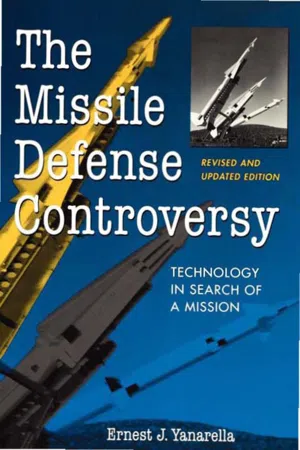
This revised and updated edition identifies the cultural factors and specific administrative agendas that have shaped the way we view ballistic missile technology. Three new sections connect our recent, sudden shifts in foreign policy to ongoing historical patterns. Whether cautioning against the "almost neurotic pursuit of absolute security" or examining the powerful influence of religion on military buildup, Ernest J.Yanarella uncovers the deeply ingrained attitudes that will determine the future of American missile defense.
- 288 pages
- English
- ePUB (mobile friendly)
- Available on iOS & Android
eBook - ePub
About this book
Information
Publisher
The University Press of KentuckyYear
2002Print ISBN
9780813190327
9780813113555
eBook ISBN
9780813138022
1
DEFENSE POLITICS IN THE EISENHOWER YEARS
GOVERNMENTAL decision-making does not occur in a political or institutional vacuum. Besides the constitutional limitations imposed upon public decision-makers, a vast range of constraints operate to circumscribe the latitude of choice available to officials. Among these limiting features are included the force of tradition, the sanctions of bureaucratic rules and procedures, the norms generated by the institutional subculture, as well as the guiding principles and policies of the electoral process. Defense decision-making on military strategy and weapons programs in the United States is no exception.
While the Defense Department has been relatively immune from traditional limits and constitutional restraints, the defense budget and its various programs each year by the central civilian and military policymakers in the executive branch take place within the norms, conventions, traditions, and structural relationships that have developed over time and are capable of periodic alteration. Historically, these changes have found impetus from such things as the prerogatives of central management in the civilian OSD (oftentimes accompanied or assisted by congressional reform or statutory mandate) and the translation of public restiveness into political influence by members of the various formal institutions or informal lobbying organizations linked to the Department of Defense.
During the 1950s, a discernible style of defense decision-making and pattern of defense politics gradually became apparent. An understanding of the first key decision in the history of the ABM controversy in the United States (i.e., Neil McElroy’s decision to resolve tentatively the army-air force squabble over development and operational control of an ABM system) involves an understanding of the basic elements of this style of defense policymaking in the 1950s. The Mc-Elroy decision can then be related to the more general patterns and characteristics of defense politics which evolved over the course of the Eisenhower years and held sway (despite energetic efforts in Congress to promote organizational innovation) until virtually the end of the first year of the Kennedy administration.
A useful guide for comprehending the style and form of the politics of American defense policymaking during the Eisenhower era is the insightful work of Philip Selznick in organizational theory, especially his pioneering work TV A and the Grassroots. In the context of a case study of the early history of the Tennessee Valley Authority, Selznick seeks certain characteristics and tendencies common to the institutionalization and operation of complex organizations.1 Many of the shared patterns and tendencies that he perceives in the operation of the TVA are useful in illuminating the context of defense decision-making during this period, particularly his characterization of the “paradox of delegation.” According to Selznick, any complex organization by its very nature is endangered by inherent entropic tendencies. On the one hand, although it may be created for some specific goal, this strategic objective must be put into operation; and typically this translation from general to specific terms cannot be accomplished in a clear and straightforward manner. Thus, for example, the overall goal for the Defense Department is that of providing military security for the nation. But how this objective of maintaining national security is to be defined precisely in terms of military strategy and supporting programs is never self-evident. Indeed, in recent years even the historical connection between increases in armaments and an increase in national security has been questioned–if not completely refuted–by the unique characteristics of modern weaponry.
Additionally, the implementation of this general goal requires the delegation of specialized tasks to substructures of the organization in order to promote efficiency. In the Defense Department these substructures are the army, air force, navy, and marine corps, whose basic responsibility is to serve as instruments for realizing the goals of the department. These subdivisions over time, according to Selznick, tend to view their functional tasks as ends-in-themselves and perhaps even to reinterpret them so that they come into conflict or compete with the general goals of the larger organization. Reinterpretation occurs generally in the context of the development by each branch of a distinctive tradition, specific goals, and a desire to protect its own interests.2
Rather than providing here a comprehensive examination of the development of the Department of Defense into a complex bureaucracy, I will highlight the specific form that the common characteristics of complex organizations took in the case of the Defense Department in the 1950s.3 This will be done by examining the strategic goal and directing policy, the climate of opinion, the ramifications of delegation, and the specific role played by the civilian managerial agency of the Pentagon.
The goal of the Defense Department–the promotion and maintenance of the common defense–during the 1950s was put into operation through the strategic doctrine of the New Look. The origin of the New Look lay in the Eisenhower administration’s desire to establish some balance and reconciliation between foreign and domestic, military and economic goals, to commit itself to a domestic policy of fiscal responsibility, and to establish a strong economy during the transitional period brought on by the death of Stalin and the ending of the Korean War.4
Shaping the New Look military programs were the belief that the “threat to national security was a dual one, economic and military, and a proper balance between a strong economy and strong military forces was necessary to meet this threat” and the attitude that “once the proper balance between economic and military programs was achieved, it should be maintained.”5 Also fundamental to the New Look was the preponderant American superiority in nuclear weapons and the means of delivering them. The decision to place greater reliance upon nuclear weapons and to make strategic retaliation the keystone of defense had a decisive impact upon the scope and character of defense politics during this decade. Since aircraft were still the primary means of delivering nuclear weapons over great distances, airpower would be given the highest priority. And although the inadequacies of the New Look (particularly in its stress on massive retaliation) would lead to a revision in its basic formulation and although technology would offer missiles as a replacement for the manned aircraft, strategic bombing would remain in its position of top priority throughout the 1950s.
At least five facets of the New Look doctrine had a critical influence on the politics of defense decision-making and on the pace and direction of R&D efforts by the military services at this time: “the emphasis upon strategic retaliation, the faith in novel technology, the ‘long haul’ perspective, the reliance upon nuclear weapons, the depreciation of manpower and conventional capabilities.” Generally, they prompted the services to fund R&D projects relating to air and missile systems and to develop rationales claiming that their programs added something distinctively new and important to the overall goal underlying strategic bombing. Specifically, it promoted programs which were “induced by haste, boldness in technology, and a relative neglect of research and development fields separate from the mainstream of large systems.”6
The defense decision-making and bureaucratic politics in the Pentagon is surrounded generally by a mood of expectation and anticipation, hopes and fears about the international environment in the present and near future. More concretely, this mood includes estimates of the hostility and potential strength of possible adversaries; calculations about the stability of the international arena and the predictability of the potential enemies’ actions in that arena; and judgments about the character of military technology and its impact upon strategic doctrine. Participants in the policy debate take that climate of opinion into account when formulating strategy or vying for operational control of a weapons system.
In the 1950s the assessment of the military environment was characterized within the executive, in Congress, and among the public by a threat to national security from a potential enemy perceived to be both hostile and aggressive in nature and capable of inflicting great damage upon the United States. A second aspect of this climate of opinion was the shared belief in the extreme unpredictability of what that potential adversary might do; and, third, there was the widespread attitude that the feverish tempo and awesome potential of military technology were such that estimates about the continued stability and security of the American posture of strategic deterrence were problematic.
In congressional committees, great deference was given to military expertise on matters of national security. The condition of perceived high risk and uncertainty had endowed the military spokesmen with a distinct power advantage over their civilian superiors in congressional debate concerning the nation’s defense. In this situation, the typical query of congressmen and senators during annual legislative review of defense appropriations was not the critical question “how much is enough?” but rather the solicitous offer “do you need more?” In this situation the OSD allowed duplication of developmental efforts in strategic weapons programs to proceed for long periods before assigning individual responsibility to a single service.
The controversies over weapons and operational control in the Defense Department during the Eisenhower years were generally marked by interservice rivalry, duplicative efforts in weapons development and strategic programs, jurisdictional disputes over roles and missions, diversity of functional interests by each service, a skewed distribution of power and responsibility among the services, and adoption of role of mediator by OSD. Each of these elements will be examined briefly.
As Selznick notes, a feature typical of most complex organizations arising out of the “paradox of delegation” is the emergence of conflict and competition among subdivisions for the coveted prizes of safety, deference, and value. In the Department of Defense this took the form of interservice rivalry. For, as the Defense Department increased its power and financial support during the period of the cold war, it became a battleground in which its three major services entered into unending combat in pursuit of the limited, but highly valued, economic, status, and security rewards of organizational politics.
The impact of interservice competition on civil-military relations in the 1950s was both direct and striking, resulting in the suppression of potential conflict between civilian and military agencies within the Pentagon and its deflection into contention among the military services.7 The civilian OSD, therefore, did not have to confront on any major issue of strategic importance a united military establishment. As a consequence, the civilian agency of the Defense Department could exploit to the maximum degree the flexibility and latitude springing from military disunity by mediating service disputes over jurisdictional issues.
By the middle 1950s strategic consensus among the services and others was evident in agreement concerning the requirements for strategic deterrence and the functional programs necessary to meet these requisites. As a result, interservice haggling moved from dispute over strategic issues to contest over proprietary matters. Thus, basic questions like strategic alternatives (deterrence vs. disarmament vs. preemptive war) and the fundamental existence of the services (functional division vs. unification) were suspended and the lines of struggle were redrawn to include more marginal issues concerning budgetary funding, jurisdiction over roles and missions, and the allocation of responsibility for a single program or activity. Issues like the relative percentage of the overall defense budget, rights to a particular military role, and developmental or operational responsibility for a specific program became the basic fuel igniting interservice competition. Overall, then, mere strategic consensus of fundamentals did not preclude interservice squabbling over priorities and relevancies.
A second notable element of the politics of defense in the Eisenhower administration was the increase in duplicative efforts in R&D on weapons and delivery systems, as well as in functional programs. One factor encouraging duplication was surely the climate of opinion suffusing the decision-making apparatus in defense. The fears of war breaking out at any moment, the perception of a hostile and potentially aggressive enemy capable of inducing heavy loss upon North America, and the belief in the vast potency of a military technology capable of rendering obsolete whole weapons systems–all these attitudes promoted duplication as a lesser evil to the possibility of unpreparedness.
In addition, duplication tended to be rationalized on the grounds that it maximized the learning process in weapons developments. As Michael Armacost observes, “by temporarily deferring choice between competitive projects, time and information may be obtained, and the flexibility to adjust the design for a finished weapons system to changing circumstances and greater technical experience sustained.”8
The shift in the character of the issues at stake in inter-service controversy–from strategic to proprietary issues–was another condition that facilitated the rise of duplication. Since strategic bombing was accorded priority in the doctrine of deterrence, the branch services tended to vie for jurisdictional rights to roles and missions within the functional needs set up by the requirements of the overall strategy. Increases in the status of formerly lower priority activities and programs also tended to foster service competition and duplication. The case of the program of counterinsurgency in the late 1950s and the early 1960s is a classic example of how rising status elicits a proliferation of closely related programs among the services only tenuously related to traditional service missions.
Finally, the characteristic role played by the OSD and, more important, the type of procedural control it typically employed in delimiting the scope of interservice conflict and in resolving issues in dispute by decision were other factors promoting duplicative projects at the developmental stage and beyond.
The broadly based agreement over the doctrine of strategic deterrence, the primacy of strategic airpower, and the general functional requisites of the guiding policy had the effect of constraining political controversy among the services to bargaining over jurisdiction of roles and missions. So, for example, in contrast to the B-36 controversy in 1949 which involved fundamental issues of unification and strategy, the Thor-Jupiter dispute between the army and air force in 1956 concerned the questions: who should construct the missiles, who should operate them, and how much should be spent on the missiles? 9
In theory, the service whose traditional activity was relatively low in the hierarchy established by the strategic policy could pursue two political options: it could attempt to trigger policy debate over the strategy in an effort to alter the ranking of the various activities or it could try to get a piece of the action by claiming part of the priority activity. In practice, this latter alternative tended to be the sole option open to it, given the narrow boundaries imposed by general agreement on fundamentals. The substance of the ABM debate between the army and the air force in the middle 1950s and the arbitrary range restrictions forced upon army rockets–both offensive and defensive–by the secretary of defense at the same time are illustrative of these tendencies.
A fourth element conditioning the bureaucratic politics of the Defense Department during this period was diversification of functional programs within each branch of the armed forces. For example, in the 1950s, besides its traditional interest in the ground combat mission, the army also developed programs in guided missiles, BMD, and limited war capabilities; the navy and air force expanded their interests to include a broad range of functions as a hedge against the future. Thus, no one service too closely identified itself with one functional interest in the strategic programs and activities.
The diversification of function acted as a moderating force on interservice rivalry. If no service depends upon a single strategic purpose, no service need oppose intransigently changes in strategic purposes. Nor does any service have cause to resent losses in major political gambits to secure jurisdiction over an important role or mission within a high status activity (e.g., the army’s loss in the Thor-Jupiter case), since defeat tends to be mitigated by the breadth of one’s functional interests and the prospects of victory in one of the many other interests in the same area being pursued simultaneously. Organizational flexibility and balance thus resulted from the quest for multiple interests. Even the air force continued to seek out new strategic missions to exploit during these years, despite its large share of the budget as a consequence of its natural association with the highest status activity in the strategy of deterrence.
The breadth of functional interests pursued by each branch service and the encouragement of duplicative efforts in weapons and program development built into the strategic and institutional context did not, however, ensure equality of power in the politics of defense decision-making and interservice rivalry. A skewed distribution of political power and military responsibility between 1954 and 1961 was exhibited, as Alain Enthoven and K. Wayne Smith have observed, in the fairly constant proportion of the defense budget allocated to each of the military services–approximately 47 percent to the air force, 29 percent to the navy and marines, and 24 percent to the army.10
Raymond H. Dawson and William Lucas have drawn a useful distinction between status activities and normative activities in complex organizations and applied it to their analysis of the dynamics of the organizational politics of defense in the 1950s and 1960s.11 Status activities, for them, correspond to those functions and programs that are established by the specifying of the overall objective or policy directing the organization. These activities are ranked according to the degree to which they contribute to the larger purpose of the organization. They see normative activities, on the other hand, as springing from the combination of traditions, goals, and subideologies of the substructures of that organization. These traditions, goals, and subideologies coalesce over time into unique outlooks and structure the relative hierarchy of the subdivisions’ normative activities. Differential power and influence within the overall organization comes from a combination of the organiz...
Table of contents
- Cover
- Title Page
- Copyright
- Dedication
- Contents
- Preface
- Introduction
- 1. Defense Politics in the Eisenhower Years
- 2. The Army Gets a Mission
- 3. McNamara’s Twin “Revolution” in Defense Decision-Making
- 4. Zeus Denied
- 5. Exit Zeus, Enter Nike-X
- 6. Interlude: From Nike-X to Sentinel
- 7. The Decision to Deploy
- 8. Safeguard, SALT, and the McNamara Heritage
- 9. Shield of Dreams: The Persistence of Ballistic Missile Defense
- Conclusion
- Notes
- Index
Trusted by 375,005 students
Access to over 1.5 million titles for a fair monthly price.
Study more efficiently using our study tools.
Frequently asked questions
Yes, you can cancel anytime from the Subscription tab in your account settings on the Perlego website. Your subscription will stay active until the end of your current billing period. Learn how to cancel your subscription
No, books cannot be downloaded as external files, such as PDFs, for use outside of Perlego. However, you can download books within the Perlego app for offline reading on mobile or tablet. Learn how to download books offline
Perlego offers two plans: Essential and Complete
- Essential is ideal for learners and professionals who enjoy exploring a wide range of subjects. Access the Essential Library with 800,000+ trusted titles and best-sellers across business, personal growth, and the humanities. Includes unlimited reading time and Standard Read Aloud voice.
- Complete: Perfect for advanced learners and researchers needing full, unrestricted access. Unlock 1.5M+ books across hundreds of subjects, including academic and specialized titles. The Complete Plan also includes advanced features like Premium Read Aloud and Research Assistant.
We are an online textbook subscription service, where you can get access to an entire online library for less than the price of a single book per month. With over 1.5 million books across 990+ topics, we’ve got you covered! Learn about our mission
Look out for the read-aloud symbol on your next book to see if you can listen to it. The read-aloud tool reads text aloud for you, highlighting the text as it is being read. You can pause it, speed it up and slow it down. Learn more about Read Aloud
Yes! You can use the Perlego app on both iOS and Android devices to read anytime, anywhere — even offline. Perfect for commutes or when you’re on the go.
Please note we cannot support devices running on iOS 13 and Android 7 or earlier. Learn more about using the app
Please note we cannot support devices running on iOS 13 and Android 7 or earlier. Learn more about using the app
Yes, you can access The Missile Defense Controversy by Ernest J. Yanarella in PDF and/or ePUB format, as well as other popular books in Politics & International Relations & Political History & Theory. We have over 1.5 million books available in our catalogue for you to explore.