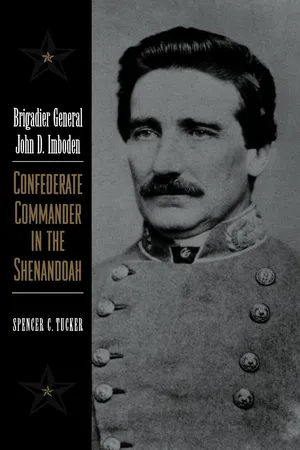
" John D. Imboden is an important but often overlooked figure in Civil War history. With only limited militia training, the Virginia lawyer and politician rose to the rank of brigadier general in the Confederate Army and commanded the Shenandoah Valley District, which had been created for Stonewall Jackson. Imboden organized and led the Staunton Artillery in the capture of the U.S. arsenal at Harper's Ferry. He participated in the First Battle of Bull Run/Manassas and organized a cavalry command that fought alongside Stonewall Jackson in his Shenandoah Valley Campaign. The Jones/Imboden Raid into West Virginia cut the Baltimore & Ohio Railroad and ravaged the Kanawha Valley petroleum fields. Imboden covered the Confederate withdrawal from Gettysburg and later led cavalry accompanying Jubal Early in his operations against Philip Sheridan in Sheridan's Shenandoah Valley Campaign. Imboden completed his war service in command of Confederate prisons in Georgia, Alabama, and Mississippi. Spencer C. Tucker fully examines the life of this Confederate cavalry commander, including analysis of Imboden's own post-war writing, and explores overlooked facets of his life, such as his involvement in the Confederate prison system, his later efforts to restore the economic life of his home state of Virginia by developing its natural resources, and his founding of the city of Damascus, which he hoped to make into a new iron and steel center. Spencer C. Tucker, John Biggs Professor of Military History at the Virginia Military Institute, is the author of Vietnam and the author or editor of several other books on military and naval history. He lives in Lexington, Virginia.
eBook - ePub
Brigadier General John D. Imboden
Confederate Commander in the Shenandoah
- 392 pages
- English
- ePUB (mobile friendly)
- Available on iOS & Android
eBook - ePub
About this book
Information
Chapter 1
Early Life to the Civil War
John Daniel Imboden was born on February 16,1823, at Christians Creek near Fishersville, Virginia, a small community not far from the Augusta County seat of Staunton. Augusta County is situated on the westward slopes of the Blue Ridge Mountains in the central Shenandoah Valley, which takes its name from the Shenandoah River. Named for an Indian word meaning “Daughter of the Stars,” the river is unusual in that it flows north rather than south.1
The first white settlers, predominantly of English stock, crossed the Blue Ridge from the Piedmont area of eastern Virginia and arrived in the Shenandoah Valley in 1716. Early in the nineteenth century another wave of immigrants arrived, largely Scotch-Irish and German in origin and predominantly from the northeastern United States. They established small ethnic farming communities in the Valley. The Germans quickly learned English and assimilated into the mainstream British culture.2
The name Imboden is Germanic in origin and means “of the valley” John Daniel Imboden’s great grandfather, Johannes Imboden (1733–1819), was born in Henau, Switzerland, and arrived in Philadelphia from Rotterdam aboard the ship Two Brothers in 1752. The ships captain apprenticed him to a rich farmer in Lebanon, Pennsylvania, as payment for the voyage. Johannes Imboden later married Eleanor Diller, his employer’s daughter. He fought as a private in the Pennsylvania Militia during the Revolutionary War, and he and Eleanor had eleven children: seven sons and four daughters.
One of these sons, John Henry Imboden (1765–1838), and his wife, Catherine Williams Fernsler, moved to Augusta County, Virginia, in 1795. In May 1796 they bought from Gilbert and Lucy Christian a 195-acre farm on Christians Creek, some five miles east of Staunton. The creek was named after the earliest white setders there, and reportedly the farm was close to the site of the areas oldest fort erected for settlers’ protection against Indian attack. The farm was also situated near the town of Fishersville and the Old Tinkling Spring Presbyterian Church.3
John Henry and Catherine Imboden had eleven children, seven of them sons. Their fifth son was George William Imboden (1793–1875). Although his other brothers moved west, George chose to remain in Augusta County, and in May 1822 he married Isabella Wunderlich, the daughter of close neighbors, whose forefathers had also come to America on the Two Brothers, although on a different voyage.4
On February 16, 1823, Isabella Imboden gave birth to their first child, John Daniel Imboden (1823–1895). George and Isabella Imboden would have eleven children. John Daniels siblings were Susan B. (1824–1832); Polly Jane (1826–1832); Benjamin (1828–1847); Henry (1831–1832); Eliza Catherine, known as “Kate” (1833–1892); George William (1836–1922); David (1838–1851); Francis Marion, “Frank” (1841–1922); James Adam, “Jim’ (1843–1928); and Jacob Peck, “Jake” (1846–1899). Benjamin probably died of typhoid fever at Buena Vista during the 1846–1848 Mexican War; Susan B., Polly Jane, and Henry all succumbed to scarlet fever in 1832.
In 1827, George Imboden purchased the three hundred-acre farm belonging to his father-in-law, also located on Christians Creek some five miles east of Staunton. It remained in the family until 1852, when they sold it to William M. Simms and moved to Lewis County in western Virginia, with three of their younger children: Frank, Jim, and Jake. John, Kate, and George William remained in Augusta County. In 1855 George and Isabella Imboden sold an additional six hundred acres that they had acquired in Augusta Springs. Shortly thereafter, they moved again, this time to Braxton County, which adjoins Lewis County to the southwest. They were brought back to Virginia by their sons during the Civil War.5
The population of Augusta County was overwhelmingly rural. In 1820 the one thousand-square-mile county had a population of only 16,742, less than a tenth of whom lived in Staunton. Life on the farm was financially difficult at times, but the Imboden children seem to have been relatively well off. By all indications the family was close-knit and happy. Money was probably in short supply—much of the trade was by barter and there was no bank in the county until one was established in Staunton in 1847—but the children were never without food or clothing.6
John Daniel grew into a handsome, strong, well-built, tall (standing well over six feet), and intelligent young man. Children on the farm were expected to work from an early age and, as the firstborn son, John Daniel assumed an increasing leadership role in family activities. Reportedly, his father gave him charge of operating a small water-powered sawmill erected by the family on their property. There is a story, perhaps apocryphal, that John Daniel rigged the machinery so that it would operate more slowly in order that he might read at the same time. The story goes that his father, investigating the diminished output, easily discovered the modification and gave John Daniel a sound whipping.7
Certainly farmwork took precedence over education, but all of the Imboden children learned to read and write well. Surviving samples of their writing show commendable handwriting, spelling, and composition. All save Jim received a higher education. Before her marriage, Kate attended the Augusta Female Seminary in Staunton (now Mary Baldwin College). George William went to the Staunton Academy, and Frank and Jake attended the Virginia Military Institute in Lexington.
There was no formal state education system in Virginia until 1869, and John Daniel went to the county school, which probably enrolled children until age fifteen or sixteen. The Staunton Academy was for the children of wealthier families and was probably beyond the means of the Imboden’s when John Daniel was growing up. By the late 1840s, however, the family was apparently doing well enough financially that George William could attend there. While barely in his teens, John Daniel developed an avid interest in reading and self-education, perhaps encouraged by family attendance at the Lutheran Church.8
Even as a young man, John Daniel revealed the desire to elevate himself by means of education. In August 1841, at age eighteen, he enrolled as a student at Washington College (later Washington and Lee University) in Lexington, forty miles south of Staunton. Founded in 1749 by Presbyterian settlers, the school was known by 1776 as Liberty Academy. It survived thanks to a grant of stock in the James River Company, a river barge operator, given by George Washington in 1796. In gratitude for this gift, the school was then renamed Washington College. The Commonwealth of Virginia chartered the institution in 1782, and by the time Imboden enrolled there, Washington College enjoyed a fine academic reputation.
Strict regulations prohibited students from drinking, gambling, using profanity, and dancing. Tuition, room rent, and the matriculation fee came to $42 a year. Board ran $7.50 to $8.00 per month. Laundry, firewood, and candles were additional. In all, costs came to about $142 per year, not counting books and incidental expenses. The school day began with chapel services at 5:00 A.M. and lasted until dusk. Washington College offered both a four-year conventional track leading to a bachelor’s degree and a two-year agricultural course “to qualify young men to become intelligent farmers.”9
Imboden’s farming background and the fact that he attended Washington College only two years and yet graduated in June 1843 suggest that he followed the agricultural curriculum. The first year’s studies centered on mathematics and rhetoric; the second year addressed the physical and natural sciences. University records show that he studied chemistry, natural philosophy (physics), mathematics, ethics, French, rhetoric, and ancient history.10
Imboden stated later in life that he took engineering courses at the Virginia Military Institute. Founded in 1839, it was located adjacent to Washington College. As a condition of VMTs founding, the state legislature had mandated student exchanges between it and Washington College.11
This exchange arrangement was in fact spelled out in Washington College’s catalogue, which noted that because the institutions were so close physically, the boards of the two schools had agreed that “All the classes, lectures and exercises of instruction in the one, are to be open to the students and cadets of the other, on payment of tuition fees not exceeding ten dollars per annum for each class entered.”12
Even if Imboden took some engineering courses at VMI, he was never formally enrolled at the Institute; nor was he required to attend classes there.13 Regardless, Imboden retained a great fondness for VMI throughout his life. In November 1863, when he was a brigadier general, he wrote VMI superintendent Francis H. Smith: “The Institute over which you have so long presided has always been an object of deep interest to me. And I have greatly regretted during the past three years that I had not enjoyed the advantages of a training within its walls. I have sons growing up, who if I live, shall not have the same cause of regret.”14
While in Lexington, Imboden made social contacts with a number of individuals who would be important to him later in life. These included John Howard McCue, called Howard, of Fishersville; John Letcher of Lexington, who would serve as Virginias governor at the beginning of the Civil War; VMI superintendent Smith, an influential educator in the South and lifelong friend; and John Letcher Jr., the editor of the Valley Star from 1839 to 1846 and a practicing lawyer in Lexington. From 1851 to 1859 the second John Letcher represented Virginia in the U.S. House of Representatives. He may also have been influential in getting Imboden to take up the practice of law.15
Imboden had a strong interest in engineering and may thus have met Claudius Crozet, if indeed he studied at VMI; in any case, the two became acquainted when Imboden was a young adult. Born in France and a graduate of the ficole Polytechnique, Crozet had taught at the United States Military Academy, West Point, for a time and in 1823 became chief engineer of the Commonwealth of Virginia. During the next forty years, he was a major influence in education and in the development of transportation in the state.16
Following completion of his studies, Imboden returned to Augusta County. Twenty years old in February 1843, he faced the decision of a profession. Imboden decided he would return to Staunton and settle there. Soon he obtained a teaching position at the Virginia Institute for Education of the Deaf and the Dumb and of the Blind in Staunton. Later he became a member of its governing body.17
Imboden did not teach long, for he decided to pursue a career in law. He loved reading, and he enjoyed improving his mental capabilities, so a career in the law must have seemed natural. There were few law schools in the United States at that time, and none was immediately available to him. In that day the majority of lawyers did not learn their profession in the classroom. Rather they “read law,” usually in the office of an established attorney or at least under his supervision.
There were no law examinations. In mid-nineteenth-century America there were also relatively few legal precedents with which students had to become acquainted, and American courts relied heavily on common law.18
For the better part of a year, Imboden read law in Staunton. Having satisfied his mentor, possibly William Frazier, he then presented himself to the presiding judge of Augusta County and was duly admitted to the bar. In October 1844 Imboden formed a law partnership in Staunton with Frazier. Court records indicate that the firm of Frazier and Imboden was rarely involved in trial activities. The two lawyers spent most of their time in business-related matters, including debt collection, estates, and property law.19
In December 1844 Imboden joined the fraternal order of the Masons. His keen interest in Masonry may be seen by the fact that he was advanced to master mason after only two months, in January 1845. This suggests that Imboden had not joined the order simply as a device to attract clients to his law practice. Imboden was elected worshipful master in 1848 and again in 1849; in the latter year, also, he became district deputy grand master, a high honor in Masonry.20
Imboden also married. His close friendship with Col. Franklin McCue (1795–1874) led to the courtship of McCues daughter Eliza, known as “Dice” to her family and friends. They were married on June 16,1845. Their first child, a daughter named Jane (“Jennie”) Crawford, was born on November 28, 1847.
The Imboden’s purchased a lot in Staunton in December 1847 and there built a home, which they named “Ingleside Cottage.” It was completed before the arrival of another daughter, Isabella (“Bel”), born on December 6, 1849. She died at two and a half on July 27, 1852. Another daughter, Martha Russel (“Russie”), was born on March 29,1852. Their fourth child, a son named Frank Howard, was born on June 21, 1855.21
In May 1846 war began between the United States and Mexico, and President James K. Polk asked for fifty thousand volunteers. Although most of these came from the states closest to Mexico, Virginia contributed a regiment, to which Augusta County furnished a company. Imboden’s personal reaction to the war is unknown, but his younger brother Benjamin enlisted, went to Mexico, and died there, probably of a fever.22
Imboden’s law partnership dissolved, most probably because Frazier became increasingly interested in commercial activities, specifically the development of Rockbridge Alum Springs, a health resort seventeen miles west of Lexington. The Springs was a considerable enterprise. It extended over some two thousand acres, housed up to four hundred guests a day, and was at one point considered the most valuable piece of real estate in the South. Beginning in 1846, however, it was also the subject of a lawsuit over its rightful ownership. Frazier became more involved in the Springs, and in 1852 he and his brother John purchased it.23
Apparently the firm of Frazier and Imboden had done well financially as Frazier had sufficient resources to help purchase the Springs; Imboden, on his part, purchased Staunton real estate and erected houses on both North Market and West Main (today Beverly) Streets.24 It is unclear exactly when the firm of Frazier and Imboden was dissolved, but by October 1854 Imboden was practicing as the junior law partner of John Howard McCue, his acquaintance from Washington College days and first cousin by marriage to Imboden’s wife, Eliza. The partnership continued until 1860, when McCue moved to Nelson County and established his own practice there. The firm of McCue and Imboden specialized in business law, and all indications are that the practice was successful. When the firm was dissolved, Imboden went into practice by himself, building his own law office in downtown Staunton near the courthouse.25
T...
Table of contents
- Cover
- Half title
- Title Page
- Copyright
- Dedication
- Contents
- List of Maps
- Introduction
- 1. Early Life to the Civil War
- 2. Initial Military Service
- 3. First Battle of Manassas
- 4. Forming a Partisan Command
- 5. The 1st Virginia Partisan Rangers (1862–1863)
- 6. The Spring 1863 Jones-Imboden Raid into West Virginia
- 7. The Gettysburg Campaign
- 8. Imboden’s Second West Virginia Raid
- 9. The 1864 Shenandoah Valley Campaign
- 10. Destruction of the Valley
- 11. Final Confederate Service
- 12. Post–Civil War Career
- Conclusion
- Notes
- Bibliography
- Index
Trusted by 375,005 students
Access to over 1.5 million titles for a fair monthly price.
Study more efficiently using our study tools.
Frequently asked questions
Yes, you can cancel anytime from the Subscription tab in your account settings on the Perlego website. Your subscription will stay active until the end of your current billing period. Learn how to cancel your subscription
No, books cannot be downloaded as external files, such as PDFs, for use outside of Perlego. However, you can download books within the Perlego app for offline reading on mobile or tablet. Learn how to download books offline
Perlego offers two plans: Essential and Complete
- Essential is ideal for learners and professionals who enjoy exploring a wide range of subjects. Access the Essential Library with 800,000+ trusted titles and best-sellers across business, personal growth, and the humanities. Includes unlimited reading time and Standard Read Aloud voice.
- Complete: Perfect for advanced learners and researchers needing full, unrestricted access. Unlock 1.5M+ books across hundreds of subjects, including academic and specialized titles. The Complete Plan also includes advanced features like Premium Read Aloud and Research Assistant.
We are an online textbook subscription service, where you can get access to an entire online library for less than the price of a single book per month. With over 1.5 million books across 990+ topics, we’ve got you covered! Learn about our mission
Look out for the read-aloud symbol on your next book to see if you can listen to it. The read-aloud tool reads text aloud for you, highlighting the text as it is being read. You can pause it, speed it up and slow it down. Learn more about Read Aloud
Yes! You can use the Perlego app on both iOS and Android devices to read anytime, anywhere — even offline. Perfect for commutes or when you’re on the go.
Please note we cannot support devices running on iOS 13 and Android 7 or earlier. Learn more about using the app
Please note we cannot support devices running on iOS 13 and Android 7 or earlier. Learn more about using the app
Yes, you can access Brigadier General John D. Imboden by Spencer C. Tucker in PDF and/or ePUB format, as well as other popular books in History & Military Biographies. We have over 1.5 million books available in our catalogue for you to explore.