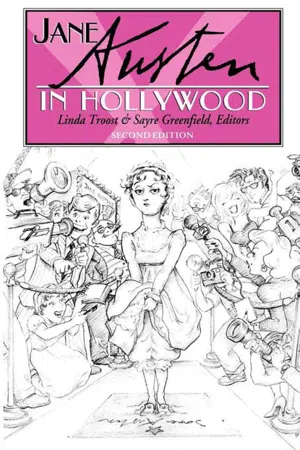
In 1995 and 1996 six film or television adaptations of Jane Austen's novels were produced—an unprecedented number. More amazing, all were critical and/or box office successes. What accounts for this explosion of interest? Much of the appeal of these films lies in our nostalgic desire at the end of the millennium for an age of greater politeness and sexual reticence. Austen's ridicule of deceit and pretentiousness also appeals to our fin de siècle sensibilities. The novels were changed, however, to enhance their appeal to a wide popular audience, and the revisions reveal much about our own culture and its values. These recent productions espouse explicitly twentieth-century feminist notions and reshape the Austenian hero to make him conform to modern expectations. Linda Troost and Sayre Greenfield present fourteen essays examining the phenomenon of Jane Austen as cultural icon, providing thoughtful and sympathetic insights on the films through a variety of critical approaches. The contributors debate whether these productions enhance or undercut the subtle feminism that Austen promoted in her novels. From Persuasion to Pride and Prejudice , from the three Emmas (including Clueless ) to Sense and Sensibility , these films succeed because they flatter our intelligence and education. And they have as much to tell us about ourselves as they do about the world of Jane Austen. This second edition includes a new chapter on the recent film version of Mansfield Park .
- 248 pages
- English
- ePUB (mobile friendly)
- Available on iOS & Android
eBook - ePub
Jane Austen in Hollywood
About this book
Information
Publisher
The University Press of KentuckyYear
2000Print ISBN
9780813190068
9780813120843
eBook ISBN
9780813137766
1
Out of the Drawing Room, Onto the Lawn
Rachel M. Brownstein
What gave Harpo Marx the great idea of adapting Jane Austen for the screen was “a sentimental comedy in three acts” by an Australian named Helen Jerome, a dramatization of Pride and Prejudice that he saw in Philadelphia on October 28, 1935. “Just saw Pride and Prejudice. Stop. Swell show. Stop,” he telegraphed the powerful Hollywood producer Irving Thalberg. “Would be wonderful for Norma. Stop.” The actress Norma Shearer was Thalberg’s wife, who had just been nominated for an Oscar for her portrayal of Elizabeth Barrett Browning in The Barretts of Wimpole Street; another English Elizabeth, another evocation of a literary woman, was a natural for her. But Shearer put the project off, and then Thalberg died, and it was not until 1940 that Pride and Prejudice was made, starring Laurence Olivier, fresh from his brilliant successes in Wuthering Heights and Rebecca. Because MGM was reluctant to cast his real-life lover Vivien Leigh against him, Greer Garson, newly arrived from England, was given the role of Elizabeth. It was to be what Hollywood called a woman’s picture, with Darcy’s beautiful marble face as its focus—also a costume drama, more notable for the fancifulness and the number (over five hundred gowns by Adrian) than the truth-to-history of the clothes. (Voluminous, anachronistic, ship-in-full-sail dresses with five-foot wingspans were deliberately substituted for the “wet-nightgown” empire look of Austen’s day.) But above all it was to be a comedy like the stage play Harpo enjoyed: a romp. Heaps of dirty paper flowers, plausible on the screen in black and white, decorated the sets where the Bennet virgins cavorted: the director’s aim was to keep it light, bright, and pleasant. It was important to keep it British, as well. The first frame announces in print that “It happened in OLD ENGLAND,” and the studio went so far as to hire the famous English novelist Aldous Huxley to collaborate with screenwriter Jane Murfin. While Huxley was somewhat distressed by his task—he acknowledged that “the very fact of transforming the book into a picture must necessarily alter its whole quality in a profound way”—he stuck patriotically, for $1,500 a week, to the “odd, crossword puzzle job,” trying “to do one’s best for Jane Austen.”1
The advertising for the film was pure Hollywood: “Bachelors Beware! Five Gorgeous Beauties are on a Madcap Manhunt!” Appreciative reviewers called it “pert,” “crackling,” and “brittle”; the snappy dialogue and the smart, sassy heroine were stylish, standard in screen comedies of the time. Jane Austen’s plot and characters and her dialogue too were radically revised to condense and simplify (“Jane, I love him; what a fool I’ve been,” says Elizabeth). Lady Catherine de Bourgh (played by the redoubtable Edna May Oliver, who impressed her fellow actors by swimming in the Pacific each morning before filming began) actually makes the match, here, between Darcy and Elizabeth. (“What you need is a woman who will stand up to you,” she tells her nephew. “I think you’ve found her.”)
The film diverges from the novel less predictably at the beginning than the end. The action starts in a village shop (Ford’s, perhaps, borrowed for the occasion from Austen’s Emma?) where Mrs. Bennet is buying muslin and damask to dress her daughters for the Assembly Ball, pink for Jane and blue for boyish Lizzy (this Lizzy, after the ball where Darcy rejects her, will sport a man’s tie.) The business of marketing is neatly connected with that of marrying as the women look out the shop window at the “exquisite young men” who “must have come straight from court,” and a sweaty Lady Lucas rushes in excitedly to announce that “Netherfield Park is let at last.” (This last is pronounced to be the best news “since the battle of Waterloo”—which occurred two years after Austen’s novel was published.) The Bennet ladies collect Kitty and Lydia from a Punch and Judy show in the village, and all bustle down the wooden sidewalks, the girls (count ‘em: five!) like goslings behind their mother. Then comes the race home against Lady Lucas’s carriage to bag the prize young men—a brilliant free translation of the theme of Pride and Prejudice into the language of horse-obsessed Hollywood.
Readers of the novel must balk, however, when Darcy calls Elizabeth “tolerable,” and adds, “I’m in no humour tonight to give consequence to the middle classes at play.” Austen is more egregiously misrepresented when Elizabeth speaks of Darcy’s unwillingness to ally himself to “a family of such low descent.” The novel’s Elizabeth, so proud of being “a gentleman’s daughter,” was not quite what Hollywood wanted—any more than an Elizabeth less beautiful than her sister Jane was. Enjoying Greer Garson’s perfect features and glassy composure, the camera persuades us to forget she is a decade or so older than Elizabeth Bennet’s “not yet twenty.” Similarly, we are meant to consider Elizabeth as a daughter of those middle classes that reliably rose up against the aristocracy in Hollywood’s wartime renderings of nineteenth-century novels (cf. Jane Eyre), which portray OLD ENGLAND as democratic America’s ancestor. Part of the context that shaped this film was the producers’ aim to get the United States into the war as England’s ally: together with the formal constraints of Hollywood comedy, politics was responsible for changing Lady Catherine’s mind about Elizabeth.
Why adapt Pride and Prejudice for the screen? Better to ask, Why not? As Harpo knew, Hollywood was always looking for plots, and certainly for variants on that reliable plot in which a charming young lady and a handsome young man find true love in spite of impediments. Austen’s name recognition would not hurt sales, nor would her famous fondness for the marriage plot (she wrote six variations on it, which shows she was quite as hip as Harpo to what dependably entertains). “[W]hen a young lady is to be a heroine, the perverseness of forty surrounding families cannot prevent her,” she insisted in Northanger Abbey. “Something must and will happen to throw a hero in her way” (16–17). Those surrounding families tend to be underrepresented in the film versions of Austen’s novels, which since 1940 tend to focus closely on the heroines and the love stories, and of course the fun of thwarting the dreariness of real life, where storybook happiness hardly happens.
But the focus shifted a little away from frothy romance in the Austen films of the second half of the twentieth century. The new emphasis was on realism—and respect. The many and various Austen dramatizations that were made for television between 1952 and the late 1980s show earnest, increasing regard for both women’s domestic lives and Great Literature. The women’s movement of the 1970s was an influence; so were the rise of television and the (associated?) decline of reading. As one writer observes about the television serials made in England, “In adapting well-known works of fiction as a means of attracting an audience, filmmakers have in fact been relying on the appeal of a combination of familiarity with slightly mysterious remoteness and high prestige” (Lauritzen 19). Aiming at people who had not read the books but meant to, the often state-supported producers of these TV dramas claimed and maybe really thought their aim was to educate—to expose the people of Britain to their heritage, the best that had been thought and written in a more literary past. Some even meant to make viewers become readers—although the films might of course be seen, and used, as substitutes for reading, even by students required to read Austen for school. The producers relied on viewers’ respect for Great Novels—and for genteel manners and upper-class accents. Audiences in America could be depended upon to respect Britishness tout court.
The twentieth-century notion that the novels of Jane Austen are suitable to be “taught” in school, indeed the very idea that Novels are Classics, would have startled Austen herself, who boldly argued, against established opinion, that novels should be taken seriously. In her time, novels—especially those about, by, and for women—were underrated as serious literature, and even despised. So she might, conceivably, have been heartened by seeing Emma and Sense and Sensibility presented as Classics. But surely she would have been distressed by dramatized episodes of Pride and Prejudice and The Golden Bowl and Brideshead Revisited that look and feel like chapters of a single interminable Classic Serial. A genre was being developed in the literal-minded literary films made for television in the 1970s and 1980s: the particulars and peculiarities of individual novels and novelists were absorbed in its overeager embrace.
Both the high seriousness and the glossy look of the literary film were intensified, and fixed, when Classic Serials met Merchant and Ivory. The complex relationship of England and America, and the almost as vexed one of movies and television, are part of the story: the producer Ismail Merchant recalled that “Jim [Ivory] used to watch BBC Television productions of Henry James and mutter, ‘I can do better than that,’ and ‘Why should the English be doing this sort of thing, and never the Americans?’” (Long 96). (Ivory himself is an American; his partners are Indian Ismail Merchant and Polish-Jewish Ruth Prawer Jhabvala, who is married to an Indian.) The team’s first adaptation of a James novel, The Europeans (1979), is meticulous and intelligent, also informed by respect for genteel fiction. So are their subsequent films based on novels: The Bostonians (1984); the three E.M. Forster movies—A Room with a View (1986), Maurice (1987), and Howards End (1992); Quartet (1981), based on a book by Jean Rhys; Heat and Dust (1983), from the novel by Jhabvala; Mr. and Mrs. Bridge (1990), which dramatizes two novels by Evan S. Connell, and The Remains of the Day (1993), based on the novel by Kazuo Ishiguro. The last, like Howards End, stars a stately home and Emma Thompson, the handsome, clever, rich, Cambridge-educated, gifted English actress who was soon to be identified with Jane Austen.2 The distinctive Merchant-Ivory style—the deliberate savoring of elegant faces and dresses and furnishings and colors and slants of light; the focus on manners and personal relationships and country houses and greenery; the clarity of speech and importance of dialogue—makes the claim that film is Art, representational, nineteenth-century literary Art. Virginia Woolf, in an essay on “The Cinema,” expressed her fear that movies would rip off the plots of novels and vulgarize and diminish them; Merchant-Ivory stakes a claim for Film as Art by making classy films of Classic novels.
Woolf’s fear was justified by the films ground out for television, such as the 1985 BBC Sense and Sensibility. In retrospect, it is notable for, among other things, identifying itself as “By Jane Austen.” Coming back to it from the Ang Lee/Emma Thompson 1995 version (“Adapted from the novel by Jane Austen”), one is equally astonished by its slowness and dullness. Muted colors, pearl grays and ochers, and lots of shadows insist this story is serious and meaningful—after all, above all, a Classic. In order to make the point of its high seriousness, the Dashwood women’s daily life at Norland Park and Barton Cottage is rendered in pointlessly exhaustive and therefore distorting detail: they are shown unpacking their linens and stowing them in chests, as Austen’s characters never have to do. Ten years later, Ang Lee could make domestic life interesting by brilliantly shifting narrative point of view, allowing us to see through Elinor’s eyes and then to see Elinor, as Austen does. In 1985, simple domestic realism, therefore trivia, triumphs; the point of the film seems to be that, despite their gentility, these women are just like us and the heroines of our soap operas. So when Marianne prepares to be visited (in bed!) by Colonel Brandon, after her dangerous illness, she looks into a hand mirror and squeals, “My skin looks terrible!” Our contemporary, she accuses herself of playacting and (although she remains round-faced) of starving herself: one could read in all the papers, in the 1980s, that girls who suffer from anorexia nervosa are mostly middle-class.
Austen scholars today tend to be most interested in how the social and political life of the novelist’s time informs her novels. It is amusing to think about how their own contexts, inevitably, also inform the Austen films: twentieth-century wars and politics and fashions, the technical and corporate changes in the film and television industries. Perhaps it is because context is so much talked about these days that it seems to have thickened, somehow. The Austen films of the mid-1990s are impossible to detach from it. Watching the Thompson/Lee Sense and Sensibility on a videocassette, one sees first of all ads for The Sense and Sensibility Screenplay and Diaries ($23.95) by star/screenwriter Thompson and the CD of Patrick Doyle’s music for the film. (Publishers Weekly reported on 1 January 1996 that “the Thompson book has a first printing of 28,500 and has already gone back to press for another round of 5,000. It is a selection of both QPBC [Quality Paperback Book Club] and The Fireside Theater Book Club.”) Norma Shearer’s having played Elizabeth Barrett Browning made her seem (to Harpo) a likely Elizabeth Bennet; the connection between Emma Thompson and the media idea of Jane Austen is much more than casual or nominal. Thompson’s aura of English literature derives not only from her having written the screenplay and the diaries but also from her prior roles in the Merchant-Ivory films, and as Beatrice in the film version of Much Ado about Nothing directed by her (now former) husband Kenneth Branagh; it is enhanced by Branagh’s career and reputation as a Shakespearean actor and director. Modern, successful Emma’s act of rescuing a female predecessor from obscurity (Austen signed herself as “A Lady”) asks to be viewed as a generous star turn. From the bold beginning—the clip of the action, the clarity and intensity of the color—it is clear that Thompson’s new and revised Sense and Sensibility is full of energy. One easily gets the picture: Jane Austen has come a long way.
Beyond the context of the tie-ins and the talk of profits that adds to the drama and glamour, beyond the context of the stars and the gossip about their private lives (Thompson’s breaking up with Branagh and having a fling with Greg “Willoughby” Wise; Hugh “Edward Ferrars” Grant’s getting arrested for a sex crime in Los Angeles during the filming), there are the wider contexts that we call cultural: the context of films and film buffs, of feminism and postfeminism, of cultural self-consciousness and cultural criticism, even of academic Austen criticism. The force of that last, narrowest context is easiest to illustrate: Roger Michell’s directing in Persuasion (1995) confronts head-on, to begin with, the best-known criticism of Austen, that she failed to notice the Napoleonic Wars. Here at the beginning of the movie are demobilized sailors; over there, therefore, are the Wars themselves, of which Jane Austen, you see, was richly aware. Persuasion goes on to engage—as Diarmuid Lawrence’s direction of Emma (1996) also flashily does—the other standard criticism of Austen, that she ignores the servant class, by showing us the servants looking on enviously at the gentlefolks or conspicuously easing their lives. Austen is being improved for the 1990s, her field of vision and her sympathies widened. She is being armed to defend herself against her critics, and those who know the novels and the critical controversies around them are being signaled, acknowledged, personally addressed, flattered.
It would be laughably grandiose for me to suggest that filmmakers who evoke Austen criticism seek communion with academic critics as they do with savvy film buffs, who can be depended on to observe, for instance, that the archery scene in Douglas McGrath’s Emma (1996) harks back to a similar scene in the 1940 Pride and Prejudice (also not in the novel). My more modest point is that the sense of a subtext, of meanings accessible only to a chosen few, pervades the films of the 1990s. Whether it is because of what you have read about Gwyneth Paltrow (and Brad Pitt), or because of what you remember about Alan Rickman’s portrayal of Valmont in the RSC Les Liaisons Dangereuses, or because you know the essays of Lionel Trilling (actually discussed in Metropolitan [1990], which evokes Mansfield Park), or because you do not need to be told on the screen that Clueless (1995) is based on Austen’s Emma, you are invited and assumed to be in the know by the mid-1990s Austen films.
As the 1940 film reflects the element of romance in Austen’s novels and the 1980s made-for-television dramas reflect her realism, these more recent movies pick up on Austen’s celebrated irony. In Sincerity and Authenticity, Trilling, one of Austen’s best readers, defines irony (with irony) as
one of those words, like love, which are best not talked about if they are to retain any force of meaning—other such words are sincerity and authenticity…. The etymology of the word associates it directly with the idea of the mask, for it derives from the Greek word for a dissembler. It is used in a diversity of meanings, of which the simplest is saying one thing when another is meant, not for the purpose of deceit and not wholly for the purpose of mockery (although this is usually implicit), but, rather, in order to establish a disconnection between the speaker and his interlocutor, or between the speaker and that which is being spoken about, or even between the speaker and himself. [112]
To which I would say Yes, and also No. For it is a connection with an interlocutor that irony also depends on—someone out there who will get the allusion, read between the lines. Jane Austen is ironic when she writes, “No one who had ever seen Catherine Morland in her infancy, would have supposed her born to be an heroine” (1); this first sentence is directed at a reader who understands that Catherine, for this novel’s duration, will be precisely that.
The Austen films of the mid-1990s are, like Austen’s novels, ironic about romantic plots and the realities that (still) constrain women’s lives. Having all come out almost at once, and being aware of that, they direct themselves at audiences equally aware—people who have read about the films and the stars in newspapers and magazines, which also feature articles about what it means that Jane Austen is the heroine of our moment. Was she or wasn’t she a feminist? A snob? Is it not ironic that although we do not have a decent picture of her she is behind all these pix? That she is a celebrity as she never was in life, declared, by People magazine, “one of the most intriguing people of 1995”? Where earlier films ignored or elided the fact, the postmodern films insist on the irony of making a movie (that low form) of a novel by Austen (that avatar of Culture, that cultural commodity). The ads also, of course, insist—as critics have also done—on the irony of a maiden l...
Table of contents
- Cover
- Half title
- Title
- Copyright
- Contents
- Acknowledgments
- Introduction: Watching Ourselves Watching
- 1 Out of the Drawing Room, Onto the Lawn
- 2 Balancing the Courtship Hero: Masculine Emotional Display in Film Adaptations of Austen’s Novels
- 3 Misrepresenting Jane Austen’s Ladies: Revising Texts (and History) to Sell Films
- 4 Austen, Class, and the American Market
- 5 Jane Austen, Film, and the Pitfalls of Postmodern Nostalgia
- 6 “A Correct Taste in Landscape”: Pemberley as Fetish and Commodity
- 7 Mr. Darcy’s Body: Privileging the Female Gaze
- 8 Emma Becomes Clueless
- 9 “As If!”: Translating Austen’s Ironic Narrator to Film
- 10 Emma Thompson’s Sense and Sensibility as Gateway to Austen’s Novel
- 11 “Piracy Is Our Only Option”: Postfeminist Intervention in Sense and Sensibility
- 12 Feminist Implications of the Silver Screen Austen
- 13 Mass Marketing Jane Austen: Men, Women, and Courtship in Two Film Adaptations
- 14 The Mouse that Roared: Patricia Rozema’s Mansfield Park
- Appendix. Austen Adaptations Available on Video
- Selected Reviews, Articles, and Books on the Recent Films, 1995-2000
- Contributors
- Index
Trusted by 375,005 students
Access to over 1.5 million titles for a fair monthly price.
Study more efficiently using our study tools.
Frequently asked questions
Yes, you can cancel anytime from the Subscription tab in your account settings on the Perlego website. Your subscription will stay active until the end of your current billing period. Learn how to cancel your subscription
No, books cannot be downloaded as external files, such as PDFs, for use outside of Perlego. However, you can download books within the Perlego app for offline reading on mobile or tablet. Learn how to download books offline
Perlego offers two plans: Essential and Complete
- Essential is ideal for learners and professionals who enjoy exploring a wide range of subjects. Access the Essential Library with 800,000+ trusted titles and best-sellers across business, personal growth, and the humanities. Includes unlimited reading time and Standard Read Aloud voice.
- Complete: Perfect for advanced learners and researchers needing full, unrestricted access. Unlock 1.5M+ books across hundreds of subjects, including academic and specialized titles. The Complete Plan also includes advanced features like Premium Read Aloud and Research Assistant.
We are an online textbook subscription service, where you can get access to an entire online library for less than the price of a single book per month. With over 1.5 million books across 990+ topics, we’ve got you covered! Learn about our mission
Look out for the read-aloud symbol on your next book to see if you can listen to it. The read-aloud tool reads text aloud for you, highlighting the text as it is being read. You can pause it, speed it up and slow it down. Learn more about Read Aloud
Yes! You can use the Perlego app on both iOS and Android devices to read anytime, anywhere — even offline. Perfect for commutes or when you’re on the go.
Please note we cannot support devices running on iOS 13 and Android 7 or earlier. Learn more about using the app
Please note we cannot support devices running on iOS 13 and Android 7 or earlier. Learn more about using the app
Yes, you can access Jane Austen in Hollywood by Linda Troost, Sayre Greenfield, Linda Troost,Sayre Greenfield in PDF and/or ePUB format, as well as other popular books in Literature & Literary Essays. We have over 1.5 million books available in our catalogue for you to explore.