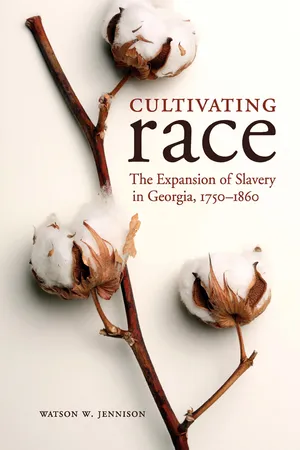
From the eighteenth century to the eve of the Civil War, Georgia's racial order shifted from the somewhat fluid conception of race prevalent in the colonial era to the harsher understanding of racial difference prevalent in the antebellum era. In Cultivating Race: The Expansion of Slavery in Georgia, 1750–1860, Watson W. Jennison explores the centrality of race in the development of Georgia, arguing that long-term structural and demographic changes account for this transformation. Jennison traces the rise of rice cultivation and the plantation complex in low country Georgia in the mid-eighteenth century and charts the spread of slavery into the up country in the decades that followed. Cultivating Race examines the "cultivation" of race on two levels: race as a concept and reality that was created, and race as a distinct social order that emerged because of the specifics of crop cultivation. Using a variety of primary documents including newspapers, diaries, correspondence, and plantation records, Jennison offers an in-depth examination of the evolution of racism and racial ideology in the lower South.
- 440 pages
- English
- ePUB (mobile friendly)
- Available on iOS & Android
eBook - ePub
About this book
Information
Publisher
The University Press of KentuckyYear
2012Print ISBN
9780813161259
9780813134260
eBook ISBN
9780813140216
1
FROM A COMMON MAN’S UTOPIA TO A PLANTER’S PARADISE, 1732–1776
Georgia’s founders established the colony as a haven for the common man, but within a generation their vision had evaporated. The countryside, once filled with inhospitable swamplands, gradually transformed into income-producing rice plantations. The transition to slavery came quickly in Georgia, with far-reaching social, economic, and political consequences for the colony’s development. A mere twenty years elapsed between the repeal of the ban on slavery and the colony’s emergence as a mature plantation society. In that span of time, a new planter elite arose, abandoning the utopian goals of the founders in the pursuit of wealth and political power. Georgia became a hierarchical society stratified by race and class. Planters relied on their slaves to perform all labor, both skilled and unskilled, marginalizing nonelite whites. At the same time, the influence of the Enlightenment as well as respect for slaves’ intelligence prompted some planters to reform the institution. The racial hierarchy that emerged in Georgia, then, did not rigidly conform to a black/white divide.
After more than a year of preparations for the voyage, the Anne set sail on November 17, 1732, from Gravesend bound for North America. Over one hundred migrants, selected by the Georgia Trustees, received free passage and boarded the ship. The group included small tradesmen and artisans from the city but no soldiers or laborers from the countryside. After a quick crossing, the vessel arrived at Charlestown on January 13, where James Edward Oglethorpe, the group’s leader, went ashore to seek counsel from the colonial authorities there and to secure supplies. Upon Oglethorpe’s return, the Anne sailed south to Port Royal. After docking, the migrants disembarked in preparation for the last leg of their journey. Following a two-week respite, they boarded six vessels that carried them to a site selected by Oglethorpe on the banks of the Savannah River. On February 1, having reached their final destination, they climbed the Yamacraw Bluff, where they broke ground on a settlement that would eventually become Savannah. In the months that followed, new migrants arrived, composed of Jews, Scots, and Salzburgers, adding to the colony’s fledgling population. Together this diverse group of settlers formed the nucleus of the Georgia colony, a social experiment unique in the annals of British North America.1
From the outset, Oglethorpe recognized that he had to establish good relations with the neighboring Indians if his utopian society was to have any chance of surviving. Soon after arriving, Oglethorpe initiated negotiations with Tomochichi, the leader of the Yamacraw Indians, the tribe that lived closest to the area where he hoped to build the first settlement. Though dismayed initially at the prospect of an English settlement, Tomochichi quickly came around to the idea. Like other Indian chiefs living nearby, Tomochichi understood that he could benefit from his new connection with the English. He recognized their value as potential allies and as a source of trade goods, particularly weapons and ammunition. In short order, then, Tomochichi and Oglethorpe came up with an agreement that allowed the colonists to establish a settlement. The relationship between the Yamacraws and Oglethorpe succeeded in large part due to the actions of Mary Musgrove, a mestizo woman, who mediated these first interactions and later served as Oglethorpe’s interpreter. Musgrove and her husband, John Musgrove, also a mestizo, operated a trading house close to the Yamacraws. In addition to her keen business acumen, Mary possessed strong ties with nearby Creek towns. Oglethorpe put Mary Musgrove’s diplomatic skills and connections among the Creeks to use when he successfully negotiated with the headmen of the eight most powerful Lower Creek towns that May for their recognition. Later, her efforts also aided Oglethorpe’s push to establish a trading town in the backcountry in 1736. Indeed, Musgrove continued to play an active role in Oglethorpe’s interactions with neighboring Indians in the years to come.2
Georgia’s creation was the product of a convergence of interests. Since the founding of South Carolina in 1670, the English and Spanish had contested the area between the Savannah and Altamaha rivers. The English colonists in South Carolina and the Spanish colonists in Florida and their respective Indian allies fought a series of wars and battles in the decades that followed as each side sought to protect its interests. Gradually, by the turn of the eighteenth century, the English pushed the Spanish back to the St. Johns River, but their claim to the land remained tenuous and their settlements vulnerable to attack. Additionally problematic, the French began to exhibit greater interest in the Southeast. Facing a threat from both the Spanish and the French, the English hoped to secure the region to retain their hold on trade with the Indians in the interior. This impetus grew after the Yamasee War of 1715–1716, which decimated the Carolina frontier. The authorities in South Carolina pushed for the creation of a settlement south of the Savannah River to serve as a military deterrent. The settlers could defend against Spanish attacks. Several proposals were advanced in the years that followed, but it was not until 1730 that a plan with sufficient government and financial support emerged.3
In addition to imperial designs, philanthropy motivated the founding of Georgia. England at the turn of the eighteenth century was a deeply divided society. The economic changes brought about by the nation’s expansion into the Atlantic World created enormous wealth for some but left many subjects behind. Unemployment and debt were rampant among the common folk. Workers found themselves struggling to survive in the new economic reality. Economic duress contributed to the social problems. An epidemic of alcoholism and crime seemed to take hold of the nation. Confronted with these economic and social ills, some members of the English elite looked for ways to ameliorate the conditions of their “inferiors.” Among those who led this crusade was Oglethorpe, who became interested in the topic while serving in Parliament. Oglethorpe’s work on a parliamentary committee that examined the conditions in the country’s jails exposed him to the deprivations faced by England’s poor and brought him into contact with like-minded individuals who shared his concern for the plight of the dispossessed. After securing the support of several wealthy philanthropists, Oglethorpe proposed creating a colony in America that would serve as a refuge for poor English workers, a place for them to begin their lives anew. With the proper supervision and regulation, he believed, the poor could find salvation and virtuous living. Motivated by nationalism as well as paternalism, he hoped to create a model society that would not only siphon off some of England’s superfluous population but would serve as a model for England itself. With the help of the Earl of Egmont, Oglethorpe convinced the Crown to issue a royal charter in 1732 that authorized the Georgia Trustees to govern the area between the Savannah and Altamaha rivers for a period of twenty-one years. Settling Georgia with the worthy poor represented an opportunity to fulfill humanitarian goals while satisfying the Crown’s military and economic interests.4
The trustees envisioned Georgia as a refuge for the common man. They consciously rejected the path toward cash crops and plantation slavery in place in much of British North America and the West Indies. Instead, they planned to base Georgia’s economy around the production and export of silk and wine, two high-value commodities that would promote England’s mercantilist interests but would not require slave labor to be profitable. Unlike sugar, rice, or tobacco, silk and wine production required specific skills that the trustees believed slaves did not possess. Since the trustees felt that free white labor could not compete on an equal footing with slave labor, silk and wine were perfect for the colony. Silk production alone, the trustees estimated, would create 40,000 to 50,000 new jobs for the poor and unemployed and would save England £500,000 per year, the amount spent annually on importing the luxury item, often from their European rivals. The trustees purposefully avoided the introduction of a cash crop in Georgia because they feared it would lead to the emergence of plantation slavery and, inevitably, to the concentration of land and wealth in the hands of a few colonists, thus undermining the entire project. To avoid such an outcome, they enacted a land policy that limited most migrants to fifty acres. Migrants who funded their own journey and brought four indentured servants, however, could receive up to five hundred acres. In addition, the trustees banned slavery in Georgia altogether, making it the only colony in British North America to impose such a prohibition.5
The trustees’ decision to ban slavery was not based on abolitionist sentiment or concern for the fate of enslaved Africans. While governing Georgia, none of them expressed any hostility to the institution or questioned its value to Britain’s colonial endeavors. Indeed, Oglethorpe had held high office in the Royal African Company prior to his involvement in the Georgia Plan. Instead, the trustees’ opposition to the introduction of slavery in Georgia stemmed from their apprehension over the institution’s impact on the colony’s white population. In addition to their economic concerns, the trustees feared that if slavery were permitted Georgia would follow the same path as South Carolina or Barbados, societies where slaves performed all the labor while white settlers led lives of “luxury” and “idleness.” This was exactly what the trustees hoped to prevent in Georgia. Only through hard work and discipline, the trustees believed, would the worthy poor achieve spiritual salvation and lead a virtuous life. In addition to slavery’s potential impact on Georgia’s moral fabric, the trustees believed the introduction of enslaved Africans would endanger the colony’s security. The trustees hoped to avoid the violence that plagued virtually all slave societies in the Americas. To see the potential for problems, they had to look no farther than South Carolina, which experienced several significant slave revolts in the 1720s and early 1730s.6 Moreover, the trustees recognized that the colony’s proximity to Spanish Florida exacerbated the risk since authorities there promised freedom to runaway slaves from the English colonies. In fact, many of the male slaves who found refuge in Florida were incorporated into the colony’s militia and given the opportunity to fight their former owners.7 For the trustees, then, slavery posed a threat to the creation of their utopian society, a place where, under the tutelage and guidance of paternalistic elites, white commoners could find a semblance of equality.
Opposition to the trustees’ vision of a nonslaveholding sanctuary quickly arose. Within months of the colony’s founding, in fact, planters from South Carolina tried to bribe Oglethorpe to repeal the ban on slavery and the restrictions on land ownership. Despite Oglethorpe’s outright rejection of their offer, South Carolinians continued to press for a change in Georgia’s policies, though in a subtler manner. Although the South Carolinians were acting with their own self-interest in mind, they truly believed that slave labor was necessary to achieve any kind of financial success in the lowcountry’s harsh environment. Articulating a sentiment shared by many of his peers, Samuel Eveleigh, a Charlestown merchant, declared that without slaves “Georgia can never be a Colony of any great Consequence.”8 In fact, some doubted whether the experimental colony could survive at all without slavery.
Within two years of the colony’s founding, a proslavery faction formed in Georgia proper. Consisting mostly of Englishmen and Lowland Scots, these malcontents pushed relentlessly for the trustees to end the prohibition on bondage. They were mostly adventurers who paid their own passage to Georgia, where they hoped to make their fortunes. In contrast to Oglethorpe and the trustees, who viewed South Carolina and the British West Indian colonies as corrupt societies that corroded the moral character of their inhabitants, the malcontents aspired to emulate their economic success. Slavery, the malcontents argued, was not an obstacle to virtuous living but a vehicle for achieving prosperity. Patrick Tailfer, a Lowland Scot who arrived in Georgia in 1734, was one of the movement’s earliest leaders. In a letter to the trustees in 1735, Tailfer communicated the malcontents’ position. Their argument rested on a number of claims: whites could not labor in Georgia’s oppressively hot climate without getting sick; white servants were more expensive than slaves and were more likely to flee; and, finally, Africans were accustomed to working in the heat and were more easily identifiable and therefore easier to recapture in the event of escape. The malcontents recognized that unlimited numbers of slaves could not be admitted to the colony without jeopardizing its security, but they felt that with the implementation of certain regulations these problems could be overcome. The malcontents also advocated restricting slaves to unskilled agricultural labor in order to protect white workers in Georgia and to attract more white migrants to the colony. They favored the introduction of a restricted system of slavery that would benefit the common man. Ultimately, the malcontents’ initial efforts failed to persuade the trustees to alter the colony’s laws, but they did lay the groundwork for future, more successful assaults on the trustees’ land and labor policies.9
In the late 1730s and early 1740s, the trustees’ utopian plans began to crumble. Thomas Stephens was the man most responsible for this change. Stephens moved to Georgia in 1737 with his father, William Stephens, who served as the trustees’ secretary in the colony. Dissatisfied with the rule of law in Georgia and the colony’s policies, Stephens attempted to remove Oglethorpe from power. When this failed, he submitted several reports to Parliament that detailed the colony’s many troubles, specifically the land and slavery policies, which he thought doomed Georgia’s success. By doing so, Stephens pulled Parliament into the debate over slavery in Georgia, which upended the dynamic between the trustees and the malcontents. His allegations found a receptive audience among critics of the Georgia Plan in the House of Commons, who used his tracts to assail the enterprise. Patrick Tailfer’s publication of A True and Historical Narrative of the Colony of Georgia, written in 1741 after he abandoned Georgia for South Carolina, bolstered the proslavery cause. Like Stephens, Tailfer denounced Oglethorpe’s leadership and claimed the trustees’ land and labor policies had condemned the colony to failure. Stephens gained some headway before halting his campaign in 1743 for unknown reasons and settling in South Carolina. Although Stephens ended his campaign before realizing his goal, his impact on shaping the debate over slavery is difficult to overstate.10
Not all colonists embraced ending the prohibition against slavery. Two groups in particular voiced support for the ban. The Salzburgers agreed with the trustees’ guiding logic. They viewed slavery’s effect on society as poisonous. Led by Johann Martin Bolzius, they settled north of Savannah at a location named Ebenezer, where they kept largely to themselves. Equally vehement in their opposition to slavery were the Highland Scots who settled near Darien. Slavery, they noted in a 1739 petition to the trustees, “is shocking to human Nature, that any Race of Mankind and their Posterity should be sentenc’d to perpetual Slavery; nor in Justice can we think otherwise of it, than they are thrown amongst us to be our Scourge one Day or other for Sins: And as Freedom must be as dear to them as to us, what a Scene of Horror must bring about! And the longer it is unexecuted, the bloody Scene must be the greater.”11 The Stono Rebellion in September 1739 confirmed slavery’s opponents’ worst suspicions and highlighted the danger posed by holding an enslaved population.12
Despite the trustees’ lofty plans, Georgia struggled to survive. When the silk and wine industries failed to live up to the trustees’ expectations, the economy stagnated, prompting an exodus from the colony. The population plummeted, falling in 1740 to one-sixth of its peak, according to one estimate. And those who remained “were in a starving and despicable condition.”13 Compounding matters, the charitable donations that had helped finance the experiment in Georgia dried up after 1740 as the philanthropic spirit dissipated in England. From that point on, the trustees relied on parliamentary grants to keep the colony afloat, yet even this source of funding became precarious as the complain...
Table of contents
- Cover
- Half title
- Title
- Copyright
- Dedication
- Contents
- Acknowledgments
- Introduction
- 1. From a Common Man’s Utopia to a Planter’s Paradise, 1732–1776
- 2. The Contagion of Liberty, 1776–1804
- 3. The Trans-Oconee Republic, 1794
- 4. The State of Muskogee, 1799–1803
- 5. Borders of Freedom, 1812–1818
- 6. Making Georgia Black and White, 1818–1838
- 7. The Democratization of Slavery, 1820–1860
- 8. Rewriting Georgia’s Racial Past, 1850s
- Notes
- Selected Bibliography
- Index
Trusted by 375,005 students
Access to over 1.5 million titles for a fair monthly price.
Study more efficiently using our study tools.
Frequently asked questions
Yes, you can cancel anytime from the Subscription tab in your account settings on the Perlego website. Your subscription will stay active until the end of your current billing period. Learn how to cancel your subscription
No, books cannot be downloaded as external files, such as PDFs, for use outside of Perlego. However, you can download books within the Perlego app for offline reading on mobile or tablet. Learn how to download books offline
Perlego offers two plans: Essential and Complete
- Essential is ideal for learners and professionals who enjoy exploring a wide range of subjects. Access the Essential Library with 800,000+ trusted titles and best-sellers across business, personal growth, and the humanities. Includes unlimited reading time and Standard Read Aloud voice.
- Complete: Perfect for advanced learners and researchers needing full, unrestricted access. Unlock 1.5M+ books across hundreds of subjects, including academic and specialized titles. The Complete Plan also includes advanced features like Premium Read Aloud and Research Assistant.
We are an online textbook subscription service, where you can get access to an entire online library for less than the price of a single book per month. With over 1.5 million books across 990+ topics, we’ve got you covered! Learn about our mission
Look out for the read-aloud symbol on your next book to see if you can listen to it. The read-aloud tool reads text aloud for you, highlighting the text as it is being read. You can pause it, speed it up and slow it down. Learn more about Read Aloud
Yes! You can use the Perlego app on both iOS and Android devices to read anytime, anywhere — even offline. Perfect for commutes or when you’re on the go.
Please note we cannot support devices running on iOS 13 and Android 7 or earlier. Learn more about using the app
Please note we cannot support devices running on iOS 13 and Android 7 or earlier. Learn more about using the app
Yes, you can access Cultivating Race by Watson W. Jennison in PDF and/or ePUB format, as well as other popular books in History & North American History. We have over 1.5 million books available in our catalogue for you to explore.