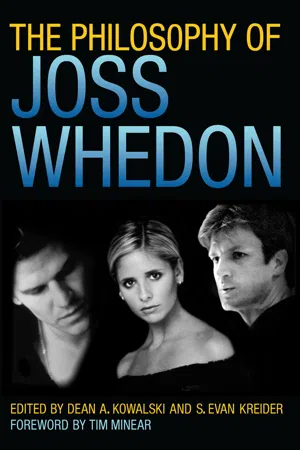
Every generation produces a counterculture icon. Joss Whedon, creator of the long-running television series Buffy the Vampire Slayer, is famed for his subversive wit, rich characters, and extraordinary plotlines. His renown has only grown with subsequent creations, including Angel, Firefly, Dollhouse, and the innovative online series Dr. Horrible's Sing-Along Blog. Through premises as unusual as a supernatural detective agency run by a vampire and a Western set in outer space, Whedon weaves stories about characters forced to make commonplace moral decisions under the most bizarre of circumstances. The Philosophy of Joss Whedon examines Whedon's plots and characterizations to reveal their philosophical takes on the limits of personal freedom, sexual morality, radical evil, and Daoism.
eBook - ePub
The Philosophy of Joss Whedon
- 248 pages
- English
- ePUB (mobile friendly)
- Available on iOS & Android
eBook - ePub
The Philosophy of Joss Whedon
About this book
Information
Topic
PhilosophySubtopic
Film & Video>>Part 1
“You Can’t Take the Sky from Me”: Freedom and Its Limits
>>Firefly and Freedom
Take my love, take my land
Take me where I cannot stand
I don’t care, I’m still free
You can’t take the sky from me
Take me out to the black
Tell them I ain’t comin’ back
Burn the land and boil the sea
You can’t take the sky from me
There’s no place I can be
Since I found Serenity
But you can’t take the sky from me
—“The Battle of Serenity,” theme song of Firefly
Written by Joss Whedon and performed by Sonny Rhodes, the theme song of Firefly alerts readers to the central role of freedom in this short-lived but brilliant series. The sky represents a place of freedom; after the war is lost and the land is taken, the sky remains as the refuge of freedom. The freedom that the sky represents is primarily a social sort of freedom: liberation from the controlling hand of the Alliance. The result of losing the Unification war was that some, like Mal (Nathan Fillion), along with Zoe (Gina Torres), his trusted partner in the war, largely removed themselves from what they considered a corrupt society. Unwilling to cooperate with wrongful authorities or tyrannical powers, they opted out of the mainstream “civilized” society, refusing to give their tacit assent to its systemic injustices and corrupt rule of law. Having lost his faith in God and government, Mal moved to the periphery of the “society,” the outskirts of the solar system—the rim, or >outer, planets. Forging a new community on the spaceship Serenity, cobbling together a living through various activities, some nefarious in the eyes of the law, Mal and his crew try to remain under the radar screen of the Alliance, even while harboring a couple of fugitives from the law.
The show’s mixed genre as a space Western lends itself and adds texture to the premise. Set in the future, the series depicts the characters on Serenity fighting for survival on a brutal new frontier and scraping together a living, profoundly distrustful of authority. Whedon came up with the idea for the show after reading Michael Shaara’s 1975 Pulitzer Prize–winning Killer Angels, a novel about the Battle of Gettysburg. While Whedon wasn’t at all enthralled with the Confederacy’s defense of slavery—though rights of self-determination (a Confederacy mantra) are thematically important in Firefly—it was the idea of the losers in a war that captured his attention.1 There have been efforts at mixing the genres of science fiction and Westerns before, of course: Gene Autry and the Phantom Empire, The Adventures of Brisco County, Jr., Star Trek, The Wild Wild West, Battlestar Galactica, to name a few. Ubiquitous Western vernacular, combinations of fiddles, guitar twangs, and symphonic sounds, various codes of behavior, rugged individualism, revolvers, layers of rustic western dust, muted earth tones, settlers of all kinds, boots and vests and horses, retro Wild West accents, all juxtaposed with holograms and spaceships, give Firefly a distinctively space-Western look and sound.2
This essay focuses most especially on one particular episode of Firefly, probably the most philosophical of them all, “Objects in Space.” By Whedon’s admission, this episode is his attempt to capture key ideas of the existentialist writings of Jean-Paul Sartre (and of Albert Camus’ Myth of Sisyphus). Whedon describes Sartre’s philosophical fictional work Nausea as “the most important book I have ever read.” Nausea is much more about what might be labeled “metaphysical freedom,” freedom internal to each person, than political freedom (from tyranny, for example). The connection between these kinds of freedom isn’t always obvious. Sartre, though a firm believer in the autonomy of the individual will, embraced a socialist view of government; whereas other strong believers in individual freedom insist that laissez-faire or free market economies are the most consistent outworking of a strong prior belief in metaphysical freedom. Whedon himself, a social progressive in many respects, has been argued by some to be committed, in his work, to a libertarian understanding of society.3 This essay won’t try settling which economic or political picture is most consistent with existentialist freedom. It will, however, spend some time looking at Whedon’s portrayal >of Sartre’s account of freedom in Nausea, the extent to which Whedon affirms existentialist views about choice and value, and the overall adequacy of Sartre’s vision.
Nausea
Nausea is a brooding novel written as the journal of Antoine Roquentin, a young historian in the throes of existential angst. Horrified by his own existence and by the vacuity of experiences, he comes to see life as devoid of any inherent significance. He’s profoundly cognizant of the transitory nature of life and the unavoidable, encroaching, impending reality of death. The dilemma of the protagonist is not intended by Sartre as a commentary on or to be a function of Roquentin’s idiosyncratic, antisocial, and misanthropic personality; rather, his dilemma is supposed to represent the human condition per se, the existential reality we all face, whether we realize it or not. Ordinary objects, events, and places lack any intrinsic meaning or import, so there is no meaning to be discovered, a dominant Sartrean theme, making Nausea an almost canonical existentialist text. Sartre considered it his greatest achievement, and it contributed to the body of work for which he was awarded the Nobel Prize for literature in 1964, though he declined the award, declaring it a product of a bourgeois institution.
Encountering the meaninglessness of life and its attendant angst and disorientation, irremediably bored by life, Roquentin feels his freedom threatened: “I am no longer free. I can no longer do what I will.”4 The “sweetish sickness” of nausea colors all he does and afflicts him to the core, depriving him of all his zest and passion for life as he desperately searches for meaning. The darkness pervades every aspect of his life, from his sexual liaisons to his historical research. He comes to see this nausea as the result of a recognition that we are here by sheer accident; that we experience bare existence and imagining anything else is an effort to avoid this fact; that meanings and values are not universal or imposed, but at most invented and freely adopted. Neither the future nor the past exists; only the present. No grand metaphysical theory or cosmic lawgiver exists to make sense of life; what determines reality is our own consciousness and ability to be aware of facts and feelings and sensations. What determines the meanings of our lives is no preexisting pattern or purpose for our being here; rather, we find ourselves existing, need to come to terms with the contingency and reality of that existence, and must forge our own meanings, unconstrained by any larger cosmic guide than our own internal consciousness.
>“Objects in Space”
“Objects in Space” is the Firefly episode largely inspired by Nausea. As Rhonda Wilcox puts it, it is “a story Whedon unquestionably used for spiritual, intellectual, and philosophical exploration—non-Christian existentialism.”5 In the episode, a bounty hunter named Jubal Early (Richard Brooks) comes after River Tam (Summer Glau), a member of Mal’s crew.6 River had been abducted by the Alliance, which then treated her as a means to their corrupt ends, violating her in horrific ways, but in the process making her capture and return to the Alliance a lucrative proposition for an unprincipled bounty hunter like Early. Her experiences also left her disoriented, confused, childlike, dysfunctional, and at times bordering on pathological, with a take on reality unique at best, radically skewed at worst. Her instability and potential danger to the crew, and what to do about it, preoccupy the crew members at the beginning of this episode, but by the end of the episode, River is accepted, at long last, as a full-fledged member of the crew.
Early and River share a distinctive viewpoint: they seem particularly sensitive to and aware of their surroundings. River is privy to the private, unarticulated thoughts of crew members, and both wonder about the meanings and functions of objects. Early considers features of his gun unconnected with its intended function as a weapon, such as its weight and aesthetic features, whereas River exudes a childlike wonder when considering objects. In a crucial scene, a gun appears to her as a harmless object of beauty (a branch, specifically), and she says: “It’s just an object. It doesn’t mean what you think.” She seems aware of its bare existence, unmediated by meanings imposed by considerations of its features or functions. Early, too, has a sense, less innocent though, of the solidity and reality of objects and asks philosophical questions about what imbues objects, events, or places with meaning or significance. And he seems, as Lyle Zynda perspicaciously observes, acutely aware of arbitrariness and incongruities in human life.7 Early, like Roquentin, seems overwhelmed at times with the absurdity of his surroundings in particular and of life in general, yet he presses on with his ignoble mission.
Consider River’s perception of the gun that happens to belong to the character Jayne (Adam Baldwin). Despite that the gun’s designer may have intended it to be a weapon, it need not be used as one. It could make a decoration or doorstop or paperweight. The gun is not intrinsically a weapon; it’s a bare object whose meaning is malleable. River sees it as an innocent object of beauty. In her subjective experience and conscious apprehension of it, that is indeed how it appears and, in some sense, what it is. Although >Early and River take their unique perspectives in different directions, each seems gripped with existential insights that would make Sartre proud.
In Nausea, Roquentin comes to terms with the implications of a godless, meaningless world by feeling empowered. He comes to the existentialist realization that the inherent lack of meaning in the world offers him the chance to create his own meanings by his autonomous expressions of will. Rather than allowing his nausea over the insignificance of life to lead him to undervalue the present, he decides to create what meaning he can by throwing himself into an artistic endeavor and by recognizing that the meanings he constructs and projects are the only meanings he will find. He has to invent them, though, not discover them—a common existentialist refrain.
Mal, too, subsequent to the loss of his faith that the good guys will win or that God will ensure that all will come out well in the end, refuses to quit. He goes on, despite his loss of faith, although he’s in a dark place through much of the series and most of the film Serenity. It’s been suggested that Shepherd Book (Ron Glass), a preacher on board Mal’s ship, represents an aspect of Mal’s past he lost, namely, his faith. When Book asks to pray before a meal, Mal says it’s fine, as long as he doesn’t do it out loud. Mal’s experience in Serenity Valley made him lose faith in a reliable providence. The problem of evil, we could say, was the undoing of his religious convictions.
As a teenager, having lost his own faith, Whedon was given Sartre’s book, which proved so significant because it gave Whedon a way to come to terms with his newfound atheism. Sartre is famous for his atheism, of course, as is Camus (who also influenced Whedon), although not all existentialists have been atheists (Dostoevsky, Kierkegaard, Marcel, and Jaspers, for example).8 In Sartre’s view, it’s the absence of any deity that leads to the basic existential reality of our coming to exist first, our meaning and purpose coming later through our volitional choice. Since we aren’t created in God’s image, according to some prepackaged plan or purpose, there is no meaning to discover for our lives, only meaning to invent through passionate commitment and artistic creation.
Is Whedon an Existentialist?
And this brings us to Whedon himself, although it’s with some trepidation we should broach the subject of Whedon’s own views and convictions. Whedon is a purveyor of some particularly memorable pieces of popular culture, and his philosophical views are neither altogether transparent nor eminently important. By his own admission, he is neither an intellectual nor a philosopher. As William Irwin writes: “Some literature, for example >Nausea, may be philosophy, and it is theoretically possible that some element of popular culture could be philosophy, but to my knowledge, no instance yet exists. Until and unless someone manages to create a piece of popular culture that is also philosophy (or vice versa), we must limit ourselves to interpretations that give the philosophical significance of popular culture.”9 Even if Irwin is right, though—and plenty of philosophers would disagree with him—he concedes that works of popular culture can be philosophical, from the movies of Woody Allen to those of Alfred Hitchcock; in fact, something of a cottage industry has arisen among philosophers arguing about just how philosophical popular movies and television shows can be. Still, Whedon is usually better at asking than answering the big questions his dramatizations raise. Generally, popular culture should be used as a springboard to consider various philosophical questions rather than as a source of great philosophical insight; nonetheless, with that said, let’s go ahead and at least tentatively explore whether Whedon’s the existentialist he thinks he is.
Lyle Zynda’s excellent piece on “Objects in Space” accentuates the existentialist influences on Whedon’s story. A key theme in his analysis is the way objects in this episode are, as described earlier, imbued with meaning rather than possessing meaning on their own. Neither their existence nor their essence is necessary; without value, meaning, or function, there is no reason for a thing to be the way it is. Both Early and River, in very different ways, imbue the objects around them with meanings, either innocent or horrific. The meanings aren’t intrinsic to the objects; rather, they’re given to the objects by people like us, which in a real sense says something special about the kind of creatures we are. There are some limits to the meanings with which we can imbue objects, but within those limits (which Sartre refers to as their facticity), there is always a free choice about how to operate.10 River sees the gun as a harmless branch; in patent contrast with her innocent, wide-eyed wonder at things, Early, like Roquentin, sees objects as alien and alienating, producing the sort of anguish and dread of which existentialists speak. For if value is conferred, then ob...
Table of contents
- Cover
- Half title
- Title
- Copyright
- Contents
- Foreword
- Introduction
- Part 1. “You Can’t Take the Sky from Me”: Freedom and Its Limits
- Part 2. “Live as Though the World Were as It Should Be”: Ethics and Virtue
- Part 3. “I’m All of Them, but None of Them Is Me”: The Human Condition
- Acknowledgments
- Appendix: A History of the Whedonverse
- List of Contributors
- Index
Trusted by 375,005 students
Access to over 1.5 million titles for a fair monthly price.
Study more efficiently using our study tools.
Frequently asked questions
Yes, you can cancel anytime from the Subscription tab in your account settings on the Perlego website. Your subscription will stay active until the end of your current billing period. Learn how to cancel your subscription
No, books cannot be downloaded as external files, such as PDFs, for use outside of Perlego. However, you can download books within the Perlego app for offline reading on mobile or tablet. Learn how to download books offline
Perlego offers two plans: Essential and Complete
- Essential is ideal for learners and professionals who enjoy exploring a wide range of subjects. Access the Essential Library with 800,000+ trusted titles and best-sellers across business, personal growth, and the humanities. Includes unlimited reading time and Standard Read Aloud voice.
- Complete: Perfect for advanced learners and researchers needing full, unrestricted access. Unlock 1.5M+ books across hundreds of subjects, including academic and specialized titles. The Complete Plan also includes advanced features like Premium Read Aloud and Research Assistant.
We are an online textbook subscription service, where you can get access to an entire online library for less than the price of a single book per month. With over 1.5 million books across 990+ topics, we’ve got you covered! Learn about our mission
Look out for the read-aloud symbol on your next book to see if you can listen to it. The read-aloud tool reads text aloud for you, highlighting the text as it is being read. You can pause it, speed it up and slow it down. Learn more about Read Aloud
Yes! You can use the Perlego app on both iOS and Android devices to read anytime, anywhere — even offline. Perfect for commutes or when you’re on the go.
Please note we cannot support devices running on iOS 13 and Android 7 or earlier. Learn more about using the app
Please note we cannot support devices running on iOS 13 and Android 7 or earlier. Learn more about using the app
Yes, you can access The Philosophy of Joss Whedon by Dean A. Kowalski, S. Evan Kreider, Dean A. Kowalski,S. Evan Kreider in PDF and/or ePUB format, as well as other popular books in Philosophy & Film & Video. We have over 1.5 million books available in our catalogue for you to explore.