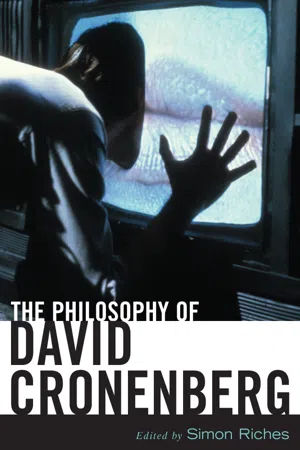
Initially regarded as a cult figure with a strong following amongst sci-fi and horror film fans, Canadian filmmaker David Cronenberg emerged as a major and commercially viable film director with mainstream hits such as A History of Violence (2005) and Eastern Promises (2007). With his unique ability to present imagery that is both disturbing and provocative, Cronenberg creates striking films, noteworthy not just for their cinematic beauty but also for the philosophical questions they raise. The Philosophy of David Cronenberg examines Cronenberg's body of work, from his breakthrough Scanners (1981) through his most recognizable films such as The Fly (1986) and more recent works. Editor Simon Riches and a collaboration of scholars introduce the filmmaker's horrific storylines and psychologically salient themes that reveal his pioneering use of the concept of "body horror," as well as his continued aim to satirize the modern misuse of science and technology. The Philosophy of David Cronenberg also explores the mutation of self, authenticity and the human mind, as well as language and worldviews. While Cronenberg's films have moved from small-market cult classics to mainstream successes, his intriguing visions of humanity and the self endure.
- 232 pages
- English
- ePUB (mobile friendly)
- Available on iOS & Android
eBook - ePub
The Philosophy of David Cronenberg
About this book
Information
Topic
PhilosophySubtopic
Film & VideoPart 1
Body Horror and Bodily Transformation
The Fly and the Human
Ironies of Disgust
The Hermeneutics of the Fly
Different animal species evoke distinctive emotional reactions in human beings. On the positive side, we feel affection, admiration, attraction, and aesthetic pleasure. On the negative side, we feel fear, contempt, revulsion, and aesthetic displeasure. Pandas, elephants, whales, cats, dogs, birds, butterflies, turtles, and kangaroos are examples that tend to fall on the positive side. Sharks, bears, worms, rats, mice, spiders, bacteria, bats, snakes, mosquitoes, and lice are apt to fall on the negative side. With some animals we smile; with others we shudder. Toward a small minority (or is it a majority?) we feel something like envy: this is particularly true of birds, whose aerial abilities we marvel at and covet. Sometimes, perhaps, we envy animals their mindlessness, their freedom from angst, their spontaneity. I don't think we ever hate an animal species, as opposed to fearing it, because to hate something requires that you believe it has wronged you (or another person), and animals, not being moral agents, can't wrong you—though they can obviously harm you.1 (If some primates are to be accorded the status of moral agents, this generalization needs to be restricted; in any case, it is true for the vast majority of animals.) Yet we are capable of extremely strong aversive reactions to certain animal species: they make our flesh creep, they “gross us out,” they inspire dread and fear. What the number one most disliked species may be is debatable: some say the rat, others the tapeworm, yet others the mosquito. In any case, we simply can't stand certain animals; their extinction would not sadden us a bit.
The humble fly ranks high here. Of the order Diptera (two winged), flies proper are distinct from other flying insects, such as dragonflies, fireflies, and butterflies, in possessing only a single pair of wings and in other anatomical respects; and we have notably different attitudes toward these categories of insects. Flies in the narrow sense include mosquitoes, gnats, and midges, as well as the common housefly. They are born as eggs, develop into legless maggots, and finally metamorphose into the buzzing nuisances we know them to be. They are short lived, surviving a matter of days, consume only liquid food, and are adept at the art of clinging to things by using spongy pads on their feet; they are also agile and flummoxed by panes of glass. They breed prodigiously (“like flies”) and are quite hard to kill without employing low-level chemical warfare (a rolled newspaper is a notably blunt weapon). With their zigzag flight, protuberant compound eyes, and tiny bristles—conspicuous under a microscope—they strike us as alien and vaguely reprehensible; not pretty, to be sure. Moreover, they exhibit a kind of driven stubborn determination, taking all manner of risks, not afraid to settle in the most dangerous places. They are surprisingly difficult to get rid of. To make matters worse, they often bite—and some even suck blood. They are invasive of human space—taking up residence in our houses, eating our food, seemingly drawn by our orifices, especially the mouth. They will settle on your face without so much as a by-your-leave, and even lick your lips if they get the chance.
But none of that comes close to their most notorious trait: their penchant for human garbage, rotting flesh, and feces. The things we find most disgusting seem to excite their ravenous little appetites the most. They love places of death, exposed human waste, and garbage dumps. They like to stick their little feet into such revolting material and then suck on it. Our hell is their heaven (pigs have nothing on flies). Thus they strike as supremely dirty, avatars of filth. They are themselves units of dirt, a measure of how mucky a place is. They are saturated with the filth they so relish, we feel. If anything, the maggots are worse: corpses are their dining hall and playground. Squirming, senseless, hideously pale—not many things revolt us as maggots do. The caterpillar we can tolerate, we love the butterfly, but the fly and its maggot progeny excite only nausea and disdain. Note that our reaction is not one of fear: with the exception of disease-carrying mosquitoes, we are not afraid of flies, since they cannot really harm us; rather, they are objects of our disgust. Flies are perceived as contaminating, as agents of defilement, not as dangerous to life and limb (nothing like sharks, say).2 It is their invasiveness combined with their fecal and putrescent proclivities that generate our extreme reaction of disgust: not only are flies in constant contact with the filthy and revolting; they also bring it to us, on us, with their rapid flight and nimble landings on human skin. We can't keep the fecal and putrescent away if flies carry traces of it on their feet and mandibles and then transfer it to us. What is so disturbing (and heartbreaking) about those pictures of African children with dozens of flies buzzing around their face, settling on their eyes, nose, and mouth, is the thought that those very flies have recently been wallowing in feces and filth. Flies represent in concentrated form the invasion of filth on the human domain. They are not just one species among many, going about its own business, oblivious to human beings; they are enmeshed in our human life, surviving on what we reject and then bringing it back to us. They are so much a part of human life, such a dependable nuisance, yet at the same time they are so alien to us; with us but not of us, so present and so shunned.
Flies, then, exist in close proximity to humans. I mean this in the spatial sense, that they take up residence in our houses and buzz around our kitchen tables, but also in the sense that they make contact with substances close to our nature as biological organisms: our food, our excrement, our dead bodies. They want to be near what we are near to, whether we want to be near it or not (death, decay, foul matter). They survive in relation to the most distasteful of biological facts. Indeed, they thrive on what we produce in the way of filth and waste. After all, the feces they so gleefully perch on are often those we humans have only recently released from our own appendage for perching, and the rotting corpses they delight in may be the bodily remnants of a lately deceased conscious human being. They touch us in our most degraded and shameful state. Inevitably, then, they remind us of certain disagreeable facts about ourselves—facts that naturally excite shame and loathing. The fly is an emblem of our mortal organic condition, our connection to the world of biological processes: digestion, dying, the soft and slimy. To be or become food for flies and worms—that is the most base level of human existence.
And there is one other fact about flies and humans that is worth mentioning: the vulnerability that is common to both. Flies live a very short time, yet they thrust and strive like tiny packets of pure will. Their lives seem to us a paradigm of meaninglessness, mere mechanical contrivances for mindless genes to perpetuate themselves: nasty, brutish, short—but also filthy and degraded. They can also, despite their agility, be squashed by the random thwack of a newspaper, or poisoned by a jet of chemicals; the end comes abruptly and unfairly. Flies die easily. That is an uncomfortable mirror of our own mortality: our lives too are short and strenuous, with sudden death always a heartbeat away. We are easily squashed, quickly choked. And then there is the threat of the powerful other—the unbeatable enemy. We may dislike flies, but the sight of one of them caught in a spider's web, trussed up, still breathing, waiting its torturous end—that is a sight to engage our sympathies, our queasy recognition of vulnerability. The fly caught in the spider's web is a symbol of all imprisonment, subjugation, despair, and hopelessness. The fly is vulnerable and so are we; our kinship is as undeniable as our difference. Our emotional relationship to flies is thus a multifaceted and complex one: they touch us at many points, carrying a weight of meaning disproportionate to their size. Sometimes they seem to exist at the opposite pole from us; sometimes they seem our intimates and counterparts, symbols of our own destiny. They disgust us and yet they reflect us. They are a fact of human life that cannot be denied or remedied, as well as being repellent and tragic in themselves. Inescapability, repugnance, queasy sympathy—these are the contours of our human feeling about flies.
Cronenberg's Hymn to the Fly
In his 1986 The Fly, itself a remake of a 1958 film based on a short story by George Langelaan, David Cronenberg made a film with a fly as its star. Seth Brundle (Jeff Goldblum), an eccentric but brilliant scientist, is working on teleportation and making great strides. In one of his experiments he successfully transports himself between two telepods, emerging jubilant, anxious to tell his new girlfriend Veronica (Geena Davis) all about it. After a short while, however, signs that something may have gone wrong emerge: he has abnormal amounts of energy, feels strong and invulnerable, and is sexually potent to an alarming degree. As it turns out, a common housefly had flown into the container with Seth, and the computer then genetically fused the two organisms. As the film progresses, this hybrid status becomes increasingly evident as Seth becomes more physically like a fly. The transformations are grotesque in the extreme: first just bristles on the back, but then loss of fingernails and teeth, blotching of the skin, facial disfigurement, bodily deformation, nasty fluids, twitching of the head, limbs replaced by clawlike structures, and finally a complete metamorphosis into a giant human-fly hybrid, with the fly decidedly in the ascendant. The pathos and horror of this transformation are made vivid to the audience, the emerging creature a disgusting assemblage of sticky, suppurating, deformed tissue, at once soft and bony—biological matter at its most repulsive. In the end Seth is put out of his misery by his former girlfriend, by a gunshot that explodes his fly-like head. Our prior horror of the fly is magnified, refracted, as Seth's body takes on the texture and shape of a fly's body. Many animals could have played this role, but somehow the despised fly seems the most inspired choice: to become a creature we regard with such revulsion, such disdain, strikes us as the most terrible of tragedies, the most horrifying of outcomes. A bee would have been so much more bearable; a butterfly might even have been quite nice. But to turn into a fly—that is utter degradation, and cruel comeuppance for the scientist's hubris.
Two interpretations of this powerful story seem available. The superficial interpretation is that Seth begins as a fine healthy specimen of lovely humanity and then deteriorates into an alien creature existing at the opposite aesthetic pole. The tragedy then is that the beautiful and desirable, the noble and godlike, metamorphoses into the ugly, disgusting, and contemptible: the sublime mutates to the sordid—rather as the fairy-tale prince turns into the frog. The deep interpretation is that the visible transformation we witness is not really a crossing of ontological boundaries at all: the human being was already a loathsome monster, a revolting hybrid, before his DNA and that of the hapless fly were joined accidentally together. The tragedy then is not the end result but the starting point—the tragedy is the tragedy of being human. The transformation into a giant fly serves only to dramatize our given ontological predicament. In effect, we are what Seth becomes. I will explain and defend this interpretation in what follows.
But first let me bring in another famous monster—the one created by another brilliant but incautious young scientist, Victor Frankenstein. (Cronenberg makes the comparison himself, in the commentary to the DVD of The Fly—though he makes the common mistake of supposing that it is the monster that is called Frankenstein not his creator; importantly, the monster has no name.3) Once again, we have an ugly and disgusting creature created by human hubris, whose basic tragedy is to offend the human senses. Does this unfortunate creature stand apart from us, our polar opposite, as a wholly alien form; or is he really the human being writ large and loathsome? As I have argued elsewhere, the latter is the better interpretation: he is made from human materials; he suffers the same physical and social insecurities as humans, especially in their adolescent years; he is stung by the same loneliness and rejection that can afflict us; his idealism turns to bitterness as he ages.4 Thus we identify with the monster, seeing our own reflection in his predicament. It is human perfection that is the myth, not the fact of human monstrosity (just look beneath the skin's surface, as Frankenstein's monster invites us to, with his scars and seams). And it is much the same story with other well-known monsters, such as vampires and werewolves. It is what they tell us about ourselves, physically and psychologically, that commands our attention. It is the gods who are truly alien, not the monsters. The sexual, in particular, is never far away from these canonical monsters—as with Brundlefly, whose sexual powers are radically enhanced by his incipient transformation. Our eating habits, too, in their violence and gore, their biochemical crudity, are put under the magnifying glass. The monster lurks within—not in a place far, far away.
Then there are those traduced human beings on whom an accusation of monstrosity is unfairly pinned. Not merely the deformed and diseased, who make ready targets, but also ethnic and social groups that offend the majority: these are regularly stigmatized by allegations of culpable disgustingness. At different times such treatment has been meted out to Jews, blacks, women, poor people, Gypsies, and homosexuals.5 Such classification is politically motivated, of course, but it also seems to involve a kind of displacement of repressed knowledge: the majority's own self-disgust, which cannot be fully acknowledged, is projected onto others as if they were alien, not continuous with the majority. The human body as such, its evil secretions and excretions, its dark urges and dank recesses, its hairy animal-like surface, its hellish interior, its involuntary smells and sounds—all these are repellent to their possessors. Unable to accept the reality of our organic existence, we project it outward onto groups that are held to exhibit it to a strong (and pungent) degree. But the insistence on otherness that accompanies such projection is just a mask for self-insecurity—for recognition that we are all monstrous, loathsome, and disgusting. We aggressively displace our revoltingness onto others because we cannot bear to accept it in ourselves. The ideal of the perfect male, white, invulnerable body, so prized by the Nazis, but not only by them, is as much a myth as that of the inferior flabby and smelly alien other. In general, wherever you find the strident assertion of alien monstrosity, look to see the cringing normal human thinly disguised.
Now let's return to Brundlefly, twitching and expectorating in his lab. At first no sign of his new Dipteral DNA is present; indeed, the results of his recent teleportation seem all good, at least from Seth's point of view. He feels exhilarated, exuberant, and full of life; nothing can stop him now. His strength has been greatly increased: expert gymnastic moves come easy, he shatters the arm of an arm-wrestling bruiser, he punches through walls. Sexually he is confident and tireless. Even the bristles that appear on his back give him a strange thrill, physical evidence of his transformation—Superman with a hairy back. At this stage he is like a developing adolescent, fired up, more powerful, sprouting hair—not the naive childlike nerd he was at the start of the movie. He likes himself this way, and so does Veronica. Clearly, he represents us here, at least in our dreams. But as time passes, a metamorphosis sets in, and it is not a pleasant one. This is presented as inevitable, a simple working out of the logic of DNA; there is no way back, no cure. As Cronenberg himself has remarked, the story is a metaphor for aging and with it the diseases of aging: the discolored, lumpy skin; the loss of teeth and hair; the reduced mobility and use of crutches. Seth is aging rapidly before our eyes, as he hurtles toward flyhood. We all know what aging is like (eventually, anyway), and disease is a constant anxiety and curse. And these human transformations have their share of the disgusting, which only adds to their tragedy. We identify with Seth as he suffers these indignities and miseries and diminutions. All human life is metamorphosis, from fertilized egg to fetus, from baby to child, then the spurt of adolescence, adulthood, and then the long decline into old age, infirmity, and finally the rapidly decaying corpse. Being equipped with memory and self-consciousness, we are always aware of our own inevitable metamorphoses, of the body's temporal convulsions and rebirths. In the creature Brundlefly we see our own lives speeded up, caricatured, but not falsely represented. As Seth examines his face in the mirror, noting each new bulge and blotch, the dance of the grotesque trampling on his ever-changing face, we see ourselves and our appalled fascination with mirrors—the incredulity, the shock, the revulsion. This is what I have become—and the sure knowledge that things only get a lot worse down the road. The fly's DNA is doing it to Seth; our DNA is doing it to us (with a little help from outside).
And it is significant and resonant that it is a fly that spells Seth's deterioration, because of the proximity of flies to humans. They were always invasive, buzzing around us, landing on us, giving us a friendly nip, entranced by our bodily waste, present even in death; now a fly has penetrated human DNA, invaded the very soul of a human, inserted itself into our essential biologica...
Table of contents
- Cover Page
- Title Page
- Copyright Page
- Contents
- Introduction
- Part 1. Body Horror and Bodily Transformation
- Part 2. Psychology, Skepticism, and the Self
- Part 3. Words and Worldviews
- List of Contributors
- Index
Trusted by 375,005 students
Access to over 1.5 million titles for a fair monthly price.
Study more efficiently using our study tools.
Frequently asked questions
Yes, you can cancel anytime from the Subscription tab in your account settings on the Perlego website. Your subscription will stay active until the end of your current billing period. Learn how to cancel your subscription
No, books cannot be downloaded as external files, such as PDFs, for use outside of Perlego. However, you can download books within the Perlego app for offline reading on mobile or tablet. Learn how to download books offline
Perlego offers two plans: Essential and Complete
- Essential is ideal for learners and professionals who enjoy exploring a wide range of subjects. Access the Essential Library with 800,000+ trusted titles and best-sellers across business, personal growth, and the humanities. Includes unlimited reading time and Standard Read Aloud voice.
- Complete: Perfect for advanced learners and researchers needing full, unrestricted access. Unlock 1.5M+ books across hundreds of subjects, including academic and specialized titles. The Complete Plan also includes advanced features like Premium Read Aloud and Research Assistant.
We are an online textbook subscription service, where you can get access to an entire online library for less than the price of a single book per month. With over 1.5 million books across 990+ topics, we’ve got you covered! Learn about our mission
Look out for the read-aloud symbol on your next book to see if you can listen to it. The read-aloud tool reads text aloud for you, highlighting the text as it is being read. You can pause it, speed it up and slow it down. Learn more about Read Aloud
Yes! You can use the Perlego app on both iOS and Android devices to read anytime, anywhere — even offline. Perfect for commutes or when you’re on the go.
Please note we cannot support devices running on iOS 13 and Android 7 or earlier. Learn more about using the app
Please note we cannot support devices running on iOS 13 and Android 7 or earlier. Learn more about using the app
Yes, you can access The Philosophy of David Cronenberg by Simon Riches in PDF and/or ePUB format, as well as other popular books in Philosophy & Film & Video. We have over 1.5 million books available in our catalogue for you to explore.