Prior to his service in the Civil War, Ulysses S. Grant exhibited few characteristics indicating that he would be an extraordinary leader. His performance as a cadet was mediocre, and he finished in the bottom half of his class at West Point. However, during his early service in the Civil War, most notably at the battles of Shiloh and Vicksburg, Grant proved that he possessed an uncommon drive. When it was most crucial, Grant demonstrated his integrity, determination, and tactical skill by taking control of the Union troops and leading his forces to victory.
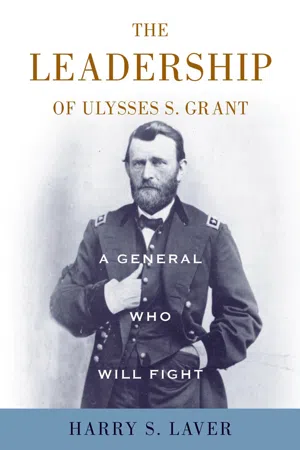
A General Who Will Fight is a detailed study of leadership that explores Grant's rise from undisciplined cadet to commanding general of the United States Army. Some experts have attributed Grant's success to superior manpower and technology, to the help he received from other Union armies, or even to a ruthless willingness to sacrifice his own men. Harry S. Laver, however, refutes these arguments and reveals that the only viable explanation for Grant's success lies in his leadership skill, professional competence, and unshakable resolve. Much more than a book on military strat-egy, this innovative volume examines the decision-making process that enabled Grant both to excel as an unquestioned commander and to win.
- 208 pages
- English
- ePUB (mobile friendly)
- Available on iOS & Android
eBook - ePub
About this book
Information
Topic
Histoire1
First Lessons
I wish I had more officers like Grant.
—Gen. Zachary Taylor
There was little about the young Hiram Ulysses Grant that hinted he would one day command great armies, win improbable battlefield victories, and become president of the United States. Born to Jesse and Hannah Grant in 1822, he joined a family that was comfortable, if not well-to-do. His father was a tanner who dabbled in local politics, a staunch Democrat, and his mother was a reserved, sober Methodist. There was no sign of an innate military genius in young Grant; in fact, there was no indication of any kind of genius. In his memoirs, Grant tells the story of his first venture into horse trading, an experience that reveals more innocent sincerity than native intellect. With the single-mindedness of an eight-year-old boy, he had mercilessly pestered his father for the money to buy a colt from Mr. Ralston, a nearby farmer. When his father finally relented, Ulysses received very specific instructions: first offer $20.00; if he won’t take that, offer $22.50; if he won’t take that, offer $25.00; but under no circumstances agree to pay any more than that. With money in hand and instructions in mind, Ulysses set off for Ralston’s farm and his first experience in dealmaking. Meeting Ralston, he dutifully announced, “Papa says I may offer you twenty dollars for the colt, but if you won’t take that, I am to offer twenty-two and a half, and if you won’t take that, to give you twenty-five.” As Grant went on to observe, “It would not require a Connecticut man to guess the price finally agreed upon.” Years later, General Grant would drive a much harder bargain, to the chagrin of more than one Confederate commander.1
Jesse Grant, perhaps seeing that his son showed little promise as a businessman, explored other possibilities for Ulysses. He settled on trying to secure an appointment for the boy to the U.S. Military Academy at West Point, New York. In an era when the opportunity to attend college and the money to do so were both in short supply, West Point offered an education at the taxpayers’ expense, provided one could obtain an appointment. This the elder Grant was able to pull off by way of his political connections and was pleased when word of admission came from an Ohio senator; the younger Grant, however, did not share his father’s enthusiasm. Ulysses, lacking self- confidence and doubting that he could succeed at the academy, wanted no part of a military life: “When [father] read [the letter] he said to me, ‘Ulysses, I believe you are going to receive the appointment.’ ‘What appointment?’ I inquired. ‘To West Point; I have applied for it.’ ‘But I won’t go,’ I said. He said he thought I would, and I thought so too, if he did.” Cadet Grant enrolled at West Point in the fall of 1839.2
Less than inspired by the path his father had chosen for him, Jesse Grant’s son did find modest success at the academy, although more than once the prospect of a “Lieutenant” Grant was less than certain. A few weeks after his fitting in cadet gray, he learned that Congress was considering a bill to abolish West Point, a measure he saw as “an honorable way to obtain a discharge,” or, put more bluntly, an easy out for a young man who lacked self-motivation and who had little interest in an army career. He later confessed, “A military life had no charms for me, and I had not the faintest idea of staying in the army even if I should be graduated, which I did not expect.” Congress wisely thought better of shuttering the academy, and it remained open, denying Grant an early exit from a life in uniform. In the classroom, he easily conquered math, barely survived two years of French, and voraciously consumed the works of James Fenimore Cooper, Sir Walter Scott, and Washington Irving, among others. Excelling at horsemanship, he held the academy high jump record for more than a quarter century. During his third year, Grant suffered demotion from cadet sergeant to private when he failed to embrace the responsibilities of rank, further confirming the reputation he had established for mediocrity. “The promotion was too much for me,” Grant later recalled. Nevertheless, he graduated, placing twenty-first out of thirty-nine cadets in 1843, having shown little of the ability, dash, and military bearing of the Lees, Beauregards, and Johnstons who had recently preceded him. Assigned to the U.S. Army’s Fourth Infantry Regiment, itself an indicator of his undistinguished record as the top graduates became engineering or artillery officers, the newly commissioned brevet second lieutenant set out on what should have been an extraordinarily unremarkable military career.3
Musket fire north of the Rio Grande River in late April 1846 began the United States’ first foreign war. The Mexican-American War sent thousands of Americans off to battle, commanded by the nation’s first generation of professionally trained officers. On sun-scorched fields with exotic names like Palo Alto, Chapultepec, and Molino del Rey, Lt. U. S. Grant served under Zachary Taylor and Winfield Scott, learning through experience and observation the practical lessons of leadership. At the same time, the young officer also began to reveal that there might be something more to Jesse and Hannah Grant’s son than a good horseman.
One afternoon on the beaches of Corpus Christi, just as General Taylor was setting out on his campaign into northern Mexico, Grant gave a glimpse of the no-nonsense approach to life and leadership that would eventually characterize his command style. Unhappy with his men’s efforts to clear underwater obstacles, he dismounted his horse, waded into the surf, and by example demonstrated exactly how he wanted the job done. His waist-deep enthusiasm for what was considered enlisted men’s work drew smirks from a few “dandy officers” who poked fun at the lieutenant, but Grant ignored the taunts. Taylor, whose craggy face, straightforward command style, and “Old Rough and Ready” persona suggested he knew something about the hard and dirty work of successful leadership, witnessed the episode. The general recognized what it said about this junior officer: “I wish I had more officers like Grant, who would stand ready to set a personal example when needed.”4
Similarly, there was much about Taylor that Grant came to admire and even emulate. Taylor, born in Virginia but raised on the frontier, had seen a lifetime’s worth of fighting even before the war with Mexico had begun. He seemed to have a nose for battle, first fighting under William Henry Harrison on the Tippecanoe campaign (1811), then joining in the Black Hawk War (1832) and the Second Seminole War (1837). As a commander, Taylor was unmistakably clear in his correspondence and orders. He wanted to see things for himself and cared little for the fineries of military dress; moreover, he was a commander who made the best of a situation and did what he could with what he had. With admiration, Grant recalled that Taylor “was not an officer to trouble the administration much with his demands, but was inclined to do the best he could with the means given him.” Years later, President Abraham Lincoln would attribute the same resourcefulness to Grant, but at this moment, as the American army geared up for the push into the prairie and chaparral of northern Mexico, Lieutenant Grant still had those lessons to learn.5
Even before President Polk had sent his war message to Congress, Taylor charged his men into battle at Palo Alto on May 8, 1846. Glistening bayonets caught Grant’s eye as the Americans deployed in shoulder-high grass, their flintlocks loaded with buck and ball, just out of Mexican artillery range. On order, the infantry surged forward, gaps opening, then closing, as men sidestepped bounding solid shot. Brandishing the bayonet, but relying on the superiority of their artillery, Taylor and his Yankee troops drove the Mexicans off the field at Palo Alto, then south through Resaca de la Palma the following day, and, finally, across the Rio Grande. Despite being outnumbered, the Americans had won two quick victories, but, watching the army’s commander as the fighting got under way, Grant came to the realization that, even under favorable circumstances, being in command carried with it tremendous responsibility. “As I looked down that long line of about three thousand armed men, advancing towards a large force also armed,” he later recalled, “I thought what a fearful responsibility General Taylor must feel, commanding such a host and so far away from friends.” But Taylor, sitting with one leg thrown over his saddle’s pommel and squinting from the shade of his broad-brimmed straw hat, never flinched, dead calm amid the chorus of battle. Old Zack did not scare easily, and neither would Grant in his own time.6
Taylor pressed both his advantage and the campaign after this initial success, driving farther into the Mexican interior. Grant followed, through Monterrey to Buena Vista, and then, like most of the regulars, joined the second American invasion force under the conspicuous—some might say ostentatious—Gen. Winfield Scott. Scott’s leadership style was a study in contrasts compared to that of Taylor. Like Taylor, Scott had fought in the War of 1812, but as a general officer, and the Black Hawk and Second Seminole Wars, after which in 1841 he was named commanding general of the army. Unlike Taylor, he delighted in the trappings of command—the most garnished, if not garish, of uniforms, with a flock of well-accoutred staff officers fluttering in his wake.7
From the war’s earliest days, Scott had argued that a negotiated settlement of the kind the Polk administration anticipated would require a campaign from the Gulf Coast at Veracruz to the capture of Mexico City itself. Only with the occupation of its capital would the Mexican government accede to American demands, and, while Taylor’s northern campaign had been a military success, it had been a political disappointment, failing to gain satisfaction for Polk’s demands, proving Scott right. Therefore, on March 9, 1847, Scott set out with ten thousand regulars and volunteers on a march of more than 150 miles into the Mexican heartland, beginning what would become one of history’s great military campaigns. Enduring brutal weather, harsh terrain, supply shortages, and the loss of three thousand volunteers whose enlistments expired en route—not to mention Santa Anna and his thirty-thousand-strong Mexican army—Scott and his men lived off the land and fought their way to the gates of the city by early September. Two additional weeks and a series of hard-fought battles won Scott the prize on September 14, concluding an astounding campaign. The Duke of Wellington had been following the war news in Europe and had predicted that Santa Anna and the Mexican terrain would doom the American offensive, but, when word of the victory came, he reversed course and pronounced Scott “the greatest living soldier.”8
Serving with Scott on this campaign as he had with Taylor, Grant learned additional lessons about command. The march to Mexico City demonstrated the value of reconnaissance, the advantages of enveloping attacks, and the fact that an army could be fed while advancing through a hostile countryside. Of greater significance, Grant saw that Scott’s unwavering commitment to press on, despite crippling setbacks, was what in the end decided victory. Scott might have withdrawn to Veracruz more than once, and justifiably so, but, in each instance, after analyzing the obstacles and available options he chose to advance rather than retreat, decisions confirmed by the campaign’s successful conclusion. Later assessing the leadership of Taylor and Scott, Grant observed that, “with their opposite characteristics both were great and successful soldiers[,] both were true, patriotic and upright in all their dealings”—and, we might add, good role models for a discerning subordinate. Despite their differences in style, they shared the same determination to succeed. In contrast to the American commanders, Grant also could not help but notice, “The Mexicans fight well for a while, but they do not hold out. They fight and simply quit.”9
Soon after returning home from the war, Grant obtained leave and traveled to St. Louis, where in August 1848 he married Julia Dent, the sister of a West Point classmate. While he pledged himself to Julia for life, he still belonged to the army. For four years, the couple trooped to postings in Michigan and New York until his regiment received orders for the Pacific Coast, a journey Grant would make on his own, leaving Julia with family in Illinois. In July 1852, the Fourth Infantry sailed from Governor’s Island in New York Harbor with Lieutenant Grant serving as regimental quartermaster. After arriving on the Panamanian coast, the regiment made its way across the isthmus by steamboat up the Chagres River to Gorgona, where the men disembarked for the twenty-five-mile march to Panama City and the Pacific. Staying behind to oversee the transport of equipment, Grant discovered that the requisite mules were not available for mustering into the U.S. Army, thanks to an incompetent, if not corrupt, American contractor. Relying on much-improved ingenuity and negotiating skills, Grant parleyed with the locals, bent a few regulations, and eventually recruited sufficient mules to reunite equipment and regiment on the coast. Before he and the goods had departed, however, a wave of cholera struck, afflicting and eventually killing one-third of the soldiers under his command. Sending the healthy on to the coast, Grant stayed behind, carrying on with his normal duties while doing his best to comfort the sick, earning their admiration as a “man of iron” and “the coolest man I ever saw.”10 Grant’s steady leadership in Panama demonstrated a maturing confidence and grit; moreover, his resourcefulness and adaptability in handling the mule predicament hinted at a fuller measure of determination than previously shown. These personal victories were unfortunately short-lived as Grant was about to enter his time in purgatory, arguably the most difficult period of his life. In fact, the next seven years would suggest to the undiscriminating eye a distinct lack of determination as he struggled to overcome boredom, isolation, and a litany of setbacks that might well have drawn sympathy from Job.
From Panama, Grant continued his journey to the Pacific Northwest, passing through San Francisco, where “at all hours of the day and night . . . the eye was regaled” with dram shops, gambling houses, real estate swindlers, and the waterfront’s forest of towering ship masts. His orders took him farther north, first to Fort Vancouver on the Columbia River, and later to Fort Humboldt in northern California. The remoteness of these postings, loneliness and heartache for Julia and their two children, and the hollow solace of drink conspired to leave Grant in a deep melancholy. “He drank far less than other officers,” a contractor at Fort Vancouver recalled, but “he had a poor brain for drinking.” Life had handed Grant more than he could handle. While the exact circumstances of Grant’s departure from the army remain unclear—likely he either was forced out or decided he could not continue such a disheartening existence—the young captain resigned his commission in 1854 and made his way east to a reunion with his family and the hope of a new beginning in the civilian world.11
Once back in Illinois, Grant was heartened by Julia and their children, but, beyond the comforts of family, his bad luck gave way to worse. Rather than finding prosperity and peace of mind, he struggled to make ends meet. Financial investments that soured, business ventures that lost money, and a farm that produced mostly heartbreak all pushed Grant toward financial ruin, if not desperation: “If nothing else could be done I would load a cord of wood on a wagon and take it to the city for sale.” In 1858, he was struck with “fever and ague,” convincing him to give up the plow and try his luck in the real estate market, an experiment that only lengthened his string of failures. Yet, in spite of the relentless beating life was giving him, Grant’s spirit and sense of self remained unbroken, revealed in a chance meeting on the streets of St. Louis with an old friend from West Point. Army major and future Confederate general James Longstreet recalled,
Grant had been unfortunate, and he was really in needy circumstances. . . . The next day . . . I found myself face to face with Grant who, placing in the palm of my hand a five dollar gold piece, insisted that I should take it in payment of a debt of honor over fifteen years old. I peremptorily declined to take it, alleging that he was out of the service and more in need of it than I. “You must take it,” said he. . . . Seeing the determination in the man’s face, and in order to save him mortification, I took the money, and shaking hands we parted.
Grant’s finances may have been in ruin and his prospects for the future bleak, but his integrity and sense of honor remained intact. In fact, the preceding years of failure and frustration revealed in Grant a persistent optimism that life would get better, that his luck would change, that he could be a success, if only the right opportunity came along.12
In May 1860, as a divided and apprehensive nation looked ahead to the fall presidential election, Grant’s finances remained dismal, putting him at wit’s end. With few options and even less money, he reluctantly agreed to clerk in his father’s leather goods store in Galena, Illinois.13 For Grant, having to accept that position wa...
Table of contents
- Cover
- Half title
- Title
- Copyright
- Contents
- List of Maps
- Introduction: A Great Force of Will
- 1. First Lessons
- 2. First Battles
- 3. Shiloh
- 4. The Vicksburg Campaign
- 5. Chattanooga
- 6. The Overland Campaign
- 7. Richmond, Petersburg, and Peace
- 8. A Faith in Success
- Acknowledgments
- Notes
- Bibliography
- Index
Trusted by 375,005 students
Access to over 1.5 million titles for a fair monthly price.
Study more efficiently using our study tools.
Frequently asked questions
Yes, you can cancel anytime from the Subscription tab in your account settings on the Perlego website. Your subscription will stay active until the end of your current billing period. Learn how to cancel your subscription
No, books cannot be downloaded as external files, such as PDFs, for use outside of Perlego. However, you can download books within the Perlego app for offline reading on mobile or tablet. Learn how to download books offline
Perlego offers two plans: Essential and Complete
- Essential is ideal for learners and professionals who enjoy exploring a wide range of subjects. Access the Essential Library with 800,000+ trusted titles and best-sellers across business, personal growth, and the humanities. Includes unlimited reading time and Standard Read Aloud voice.
- Complete: Perfect for advanced learners and researchers needing full, unrestricted access. Unlock 1.5M+ books across hundreds of subjects, including academic and specialized titles. The Complete Plan also includes advanced features like Premium Read Aloud and Research Assistant.
We are an online textbook subscription service, where you can get access to an entire online library for less than the price of a single book per month. With over 1.5 million books across 990+ topics, we’ve got you covered! Learn about our mission
Look out for the read-aloud symbol on your next book to see if you can listen to it. The read-aloud tool reads text aloud for you, highlighting the text as it is being read. You can pause it, speed it up and slow it down. Learn more about Read Aloud
Yes! You can use the Perlego app on both iOS and Android devices to read anytime, anywhere — even offline. Perfect for commutes or when you’re on the go.
Please note we cannot support devices running on iOS 13 and Android 7 or earlier. Learn more about using the app
Please note we cannot support devices running on iOS 13 and Android 7 or earlier. Learn more about using the app
Yes, you can access A General Who Will Fight by Harry S. Laver in PDF and/or ePUB format, as well as other popular books in Histoire & Histoire de la guerre de Sécession. We have over 1.5 million books available in our catalogue for you to explore.